Italian Family Traditions
How to Roast Chestnuts the Italian Way: The Complete Caldarroste Guide
Every fall, my grandfather served roasted chestnuts after dinner — they replaced dessert, and the smell was life-changing. This is how to roast them properly, whatever your method, and the story of why caldarroste meant home to Italian families who carried the tradition across the ocean.
To roast chestnuts: score an X or a slit through the shell on the flat side, then roast in a 425°F (220°C) oven for about 20–30 minutes, until the shells curl back and the flesh is tender. Peel them while still hot. That is the short version — but the right time depends on your method and the size of the nuts, so use the calculator below to get yours, then read on for every method, the fixes for what goes wrong, and the Italian tradition behind it all.
Get the Timing Right
Chestnut Roasting Calculator
Roasting time depends on your method and the size of the nuts. Answer three quick questions for your estimate — and a timer.
How are you roasting them?
Chestnut size
Did you soak them first? (15–30 min in warm water)
- the shell curls back and opens along the cut
- the flesh is tender when pierced with a knife
- they smell sweet, nutty, and toasted
These are guideline ranges drawn from common roasting practice — chestnuts vary, so trust your eyes and nose over the clock. Always score them first, and check early.
Free Printable
The whole Italian year, on one printable calendar.
Chestnut season, the feast days, the traditions our grandparents kept — in one free printable calendar. Join the list and we'll send it to you.
How to choose good chestnuts
Good roasting starts before the oven. Choose chestnuts that are firm, heavy for their size, and glossy, with taut shells and no cracks, holes, or soft spots. A chestnut that feels light or rattles has dried out inside; one with a pinhole may have a worm. Buy them fresh in autumn and use them within a week or two — they are a seasonal nut and they do not keep like almonds or walnuts. Store them in the fridge if you are not roasting right away.
How to score chestnuts before roasting
You must cut every chestnut before roasting. As they heat, steam builds inside the shell — and a chestnut with no way to vent will burst, sometimes violently. Scoring also gives you a place to start peeling, which is half the battle. Cut through the hard outer shell and the papery brown skin underneath, on the flat side of the nut, but try not to cut deep into the flesh. Both an X and a long slit work, as the diagram below shows.
Before You Roast
How to Score a Chestnut
Cutting the shell lets steam escape so they don't explode — and makes them far easier to peel. Here's what right and wrong look like.
✓ Do this
✗ Avoid this
Cut through the shell and the papery skin underneath, on the flat side, but not deep into the flesh. An X or a long slit both work — the X vents a little more, the slit can peel a little easier. Either way, cut with a small serrated knife and mind your fingers.
X-cut or slit — which is better? Honestly, both work, and Italian cooks are split on it. The X vents a little more steam and is the most traditional; a single long slit across the width is faster to cut and, many find, a touch easier to peel because you can get a thumb under the flap. Use whichever you find easier to cut safely. A small serrated knife grips the shell best — and mind your fingers, because chestnuts are round and like to roll.
How to roast chestnuts in the oven
The oven is the most reliable method and the best place to start. Here is the full sequence:
- Heat the oven to 425°F (220°C).
- Score each chestnut on the flat side (see above).
- Soak (optional) the scored nuts in warm water for 15–30 minutes — this adds steam and helps keep them moist and easier to peel.
- Arrange cut-side up in a single layer on a baking sheet.
- Roast for about 20–30 minutes (use the calculator for your size), until the shells peel back at the cut and the flesh is tender.
- Rest and peel — wrap them in a clean towel for a few minutes, then peel while still hot.
How long to roast chestnuts — and how to tell when they're done
Most chestnuts roast in about 20 to 30 minutes in a hot oven, but the honest answer is that it varies — which is exactly why the recipes you find never quite agree. Size is the biggest factor (large nuts can take 35 minutes; small ones as little as 18), followed by your method and whether you soaked them. Rather than trust a single number, watch for the three signs: the shell curls back and opens along your cut, the flesh is tender when pierced with a knife, and they smell sweet and toasted. When all three are true, they are done — whatever the clock says.
How to peel chestnuts easily
The single most important rule: peel them while they are hot. As chestnuts cool, the inner skin clings to the flesh and becomes almost impossible to remove cleanly. Wrap the roasted nuts in a clean kitchen towel and let them steam for a few minutes, then peel a few at a time, keeping the rest wrapped and warm. Both the hard shell and the bitter papery skin must come off. If a batch has cooled and gone stubborn, a quick reheat loosens them again.
Other ways to roast chestnuts
In an air fryer
Score and (optionally) soak, then air-fry at around 390°F (200°C) for roughly 12–18 minutes, shaking the basket halfway. The air fryer is fast and even, and works well for small batches — check early, as it runs quicker than the oven.
On the stovetop (chestnut pan or skillet)
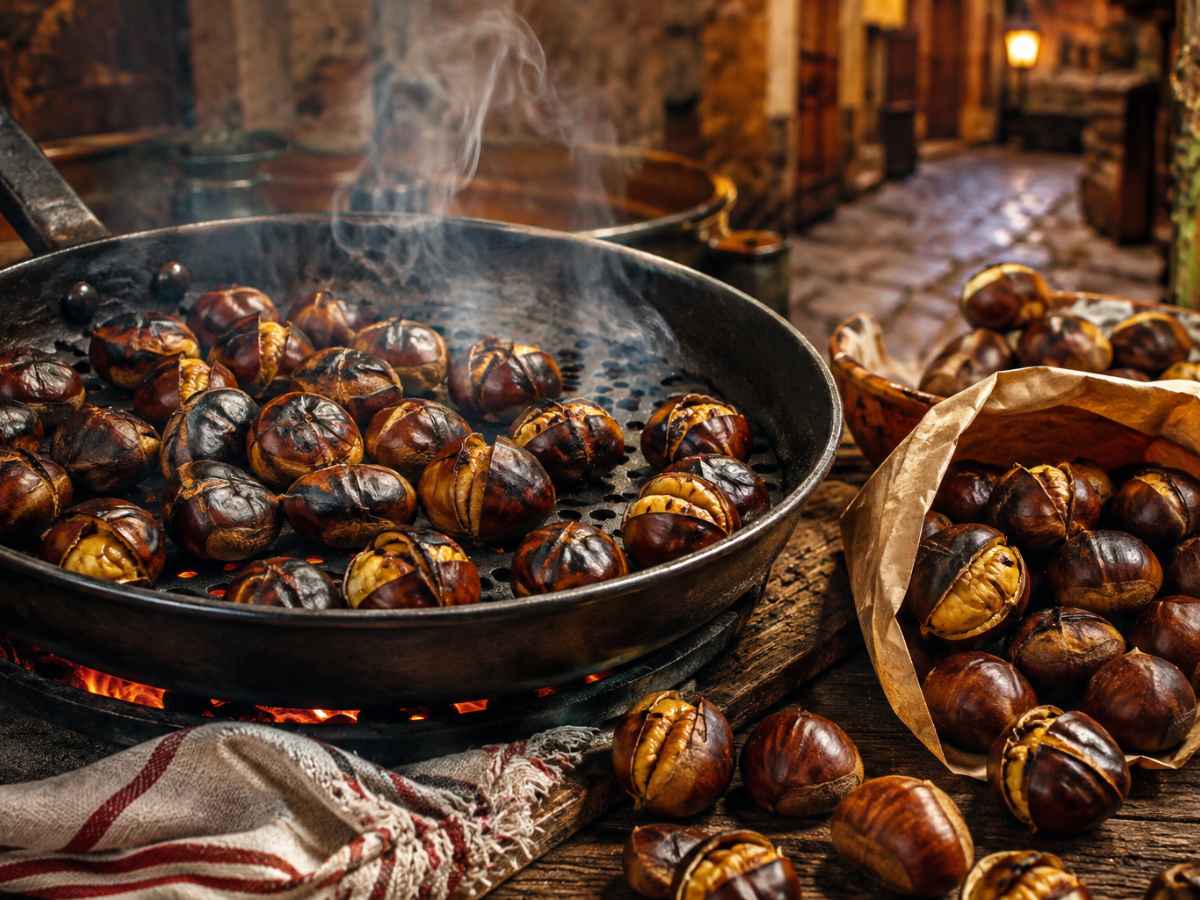
The traditional Italian way uses a padella per caldarroste — a long-handled pan with holes in the bottom — but a heavy cast-iron skillet works too. Score, then cook over medium heat, shaking often, for about 15–25 minutes until the shells char slightly and the flesh is tender. This is the method that fills the kitchen with that unmistakable smell.
Over an open fire
The oldest way, and the one the song is about. Score the nuts, place them in a perforated roasting pan or a fireplace basket, and hold them over hot embers (not open flame), shaking frequently, for about 10–15 minutes. They cook fast and unevenly over fire, so shake often and pull them as the shells blacken and split. Few things taste more like an Italian autumn.
Chestnut roasting problems, solved
Even with practice, chestnuts can misbehave. Here is a quick troubleshooter for the most common problems — tap what happened to find the likely cause and the fix.
Something Went Wrong?
Chestnut Troubleshooter
Roasting doesn't always go to plan. Tap what happened and find out why — and how to fix it next time.
Tap a problem above to see the likely cause.
The Foods That Meant Home
The chestnuts after dinner, the wine in the cantina, the smell that meant autumn — the food traditions our grandparents carried across the ocean fade when no one writes them down. The Italian Family Heritage Kit gives you the prompts to record your family's food, rituals, and memories before they're lost.
Explore the Italian Family Heritage Kit →What are caldarroste?
Caldarroste are roasted chestnuts — the word comes from calde (hot) and arrostite (roasted), and in Italy it means specifically the chestnuts roasted over fire or in a perforated pan and eaten hot, often bought in a paper cone from a street vendor on a cold day. The smell of caldarroste is one of the defining smells of the Italian autumn and winter, drifting through piazzas from October onward. They are humble food, and that is exactly the point: a caldarrosta is warmth you can hold in your hand.
Why chestnuts mattered so much in Italy
To understand why chestnuts carry such feeling for Italian families, you have to know that for centuries they were not a treat — they were survival. In the mountainous regions of Italy, where wheat would not easily grow, the chestnut tree was called l'albero del pane, "the bread tree." Its nuts were dried, ground into flour, made into bread, polenta, and cakes, and roasted whole through the cold months. Whole communities lived through winter on chestnuts. That history gave the humble roasted chestnut a weight far beyond its size: it is the taste of endurance, of poor mountain villages, of getting through the winter — and, later, of nostalgia for exactly those places.
In the mountains they called the chestnut tree l'albero del pane — the bread tree. For centuries, roasted chestnuts were not a treat. They were how you got through the winter.
From Italy to Montreal: the tradition that crossed the ocean
When Italians emigrated, they could not bring the chestnut woods or the village castagnata with them. What they brought was the roasting — the ritual, the smell, the taste. In a Montreal kitchen far from the mountains of the old country, an immigrant family could still score a bag of chestnuts, fill the house with that smell, and taste something that connected them instantly to home. The harvest stayed in Italy. The roasting became the tradition. That is the honest shape of how so many Italian food traditions survived immigration: not the whole thing, but the essential, portable heart of it.
Chestnuts in our family
In my family, chestnuts were my grandfather's. Every fall — and it ran a long season, from mid-autumn all the way to late winter — he would roast chestnuts and serve them after dinner. They did not come with dessert; they replaced it. And the smell, when they were roasting, was genuinely life-changing: warm and sweet and nutty, the smell that told you the season had turned and the house was where you wanted to be.
We loved the heat of them in our hands. Peeling a chestnut fresh from the pan was almost too hot to bear — it genuinely hurt — but we knew it was worth it, and that small ache was part of the whole experience. The taste was pure comfort: it meant home, it meant coziness, it meant being together in the warm while it was cold outside. And at Christmas, honestly, the chestnuts were almost bigger than opening the gifts. That is not an exaggeration. The bowl of hot roasted chestnuts, passed around after the meal, was the centre of gravity of the whole evening.
The heat of them in your hands was almost too much to bear — it hurt — but it was worth it, and that was part of it. At Christmas, the chestnuts were almost bigger than opening the gifts.
How to keep the chestnut tradition alive
You do not need a fireplace or a village festival to carry this one forward. Buy good chestnuts in the fall, score them, roast them by any method above, and serve them hot after dinner — ideally to people you love, on a cold night. That is the whole tradition. If there is an older relative who roasted them, ask how they did it, what pan they used, what it meant to them, and write it down — because the method and the memory disappear together. For more on recovering these traditions, read about the Italian cantina where the autumn harvest was kept, the homemade wine that shared the season, and how to record your family's food memories before they fade.
Every fall, my grandfather served roasted chestnuts after dinner, and the smell was life-changing. Now you know how to roast them properly — scored, timed to your method, peeled while hot — and where the tradition comes from: the bread tree of the Italian mountains, carried across the ocean as a smell and a ritual and a taste of home. Roast a batch this autumn. Serve them hot, to people you love, while it's cold outside. That is the whole of it.
Record the Food Memories
The chestnuts, the wine, the smell of the season.
Who roasted the chestnuts? What did autumn smell like in your family? The Italian Family Heritage Kit includes 133 guided pages and more than 120 prompts to preserve your family's food, traditions, names, recipes, and stories.
Explore the Heritage Kit — $19.99Instant digital download. Print it and complete it with your family.
FAQ
How long do you roast chestnuts?
Most chestnuts take about 20 to 30 minutes in a 425°F (220°C) oven, but the time varies with size and method. Small nuts may take as little as 18 minutes; large ones up to 35. Air fryers run faster (about 12–18 minutes) and open fire faster still (about 10–15). Rather than rely on the clock, roast until the shells curl open at the cut and the flesh is tender. Use the calculator above for an estimate based on your method and chestnut size.
Do you have to cut chestnuts before roasting?
Yes, always. Scoring each chestnut through the shell lets steam escape — without it, they can burst in the oven. Cutting also makes them much easier to peel. Use an X or a long slit on the flat side, cutting through the shell and the papery skin but not deep into the flesh.
Should you soak chestnuts before roasting?
Soaking is optional but helpful. Soaking scored chestnuts in warm water for 15 to 30 minutes adds moisture and steam, which helps keep the flesh from drying out and can make peeling easier. It is especially worth doing if your chestnuts are not perfectly fresh.
Why won't my chestnuts peel?
Almost always because they cooled down. Chestnuts peel easily only while hot — once cool, the inner skin grips the flesh. Peel them straight from the pan, keeping the rest wrapped in a towel to stay warm. A too-shallow score or undercooking can also make peeling hard. If a batch has gone stubborn, reheat it briefly.
What are caldarroste?
Caldarroste are Italian roasted chestnuts — from calde (hot) and arrostite (roasted). The word refers to chestnuts roasted over fire or in a perforated pan and eaten hot, often sold in paper cones by street vendors in autumn and winter. They are one of the defining tastes and smells of the Italian cold season.
Can you roast chestnuts in an air fryer?
Yes. Score the chestnuts, then air-fry at about 390°F (200°C) for roughly 12 to 18 minutes, shaking the basket halfway through. The air fryer is fast and even and works well for small batches — just check early, since it cooks quicker than the oven.
When are chestnuts in season?
Fresh chestnuts are an autumn nut, in season from about October through December in the Northern Hemisphere, which is why they are so tied to fall and the Christmas season. Buy them fresh during these months, choose firm and glossy nuts, and use them within a week or two, as they do not store well.

Marco Ricci is an Italian-Canadian writer and the grandson of Calabrian immigrants. He created Italian Family Traditions to document the customs, feast days, and family rituals Italian families carried from Italy to North America — and to understand what they actually meant. He is based in Montreal.