Italian Family Traditions
What Is a Santino? The Italian Holy Card Tradition
Tucked in missals, carried in wallets, passed hand to hand at funerals and First Communions — the santino was a small paper saint that Italian families kept close for a lifetime.
Open an old Italian family Bible and something almost always falls out: a small, worn card with a saint on the front and a prayer on the back. This is a santino — an Italian holy card — and for generations it was one of the most quietly cherished objects in the Italian home. Small enough to slip into a missal, a wallet, or a coat pocket, the santino carried a saint’s image, name, and prayer wherever you went. It was devotion you could hold in your hand.
If you grew up in an Italian family, you have almost certainly seen them: the card handed out at a funeral with a photograph and dates, the faded image of the Madonna kept behind the crucifix, the little stack tucked into nonna’s prayer book. This is what a santino is, where the tradition comes from, and why these small paper saints meant so much.
What is a santino?
A santino (plural santini) is a small devotional card — an Italian holy card — bearing the image of a saint, the Madonna, or Christ on one side, usually with a prayer or invocation on the other. The word comes from santo (saint), with the affectionate diminutive -ino: literally a “little saint.” That name says everything about how they were regarded — not as disposable pictures, but as small, personal presences of the saint themselves.
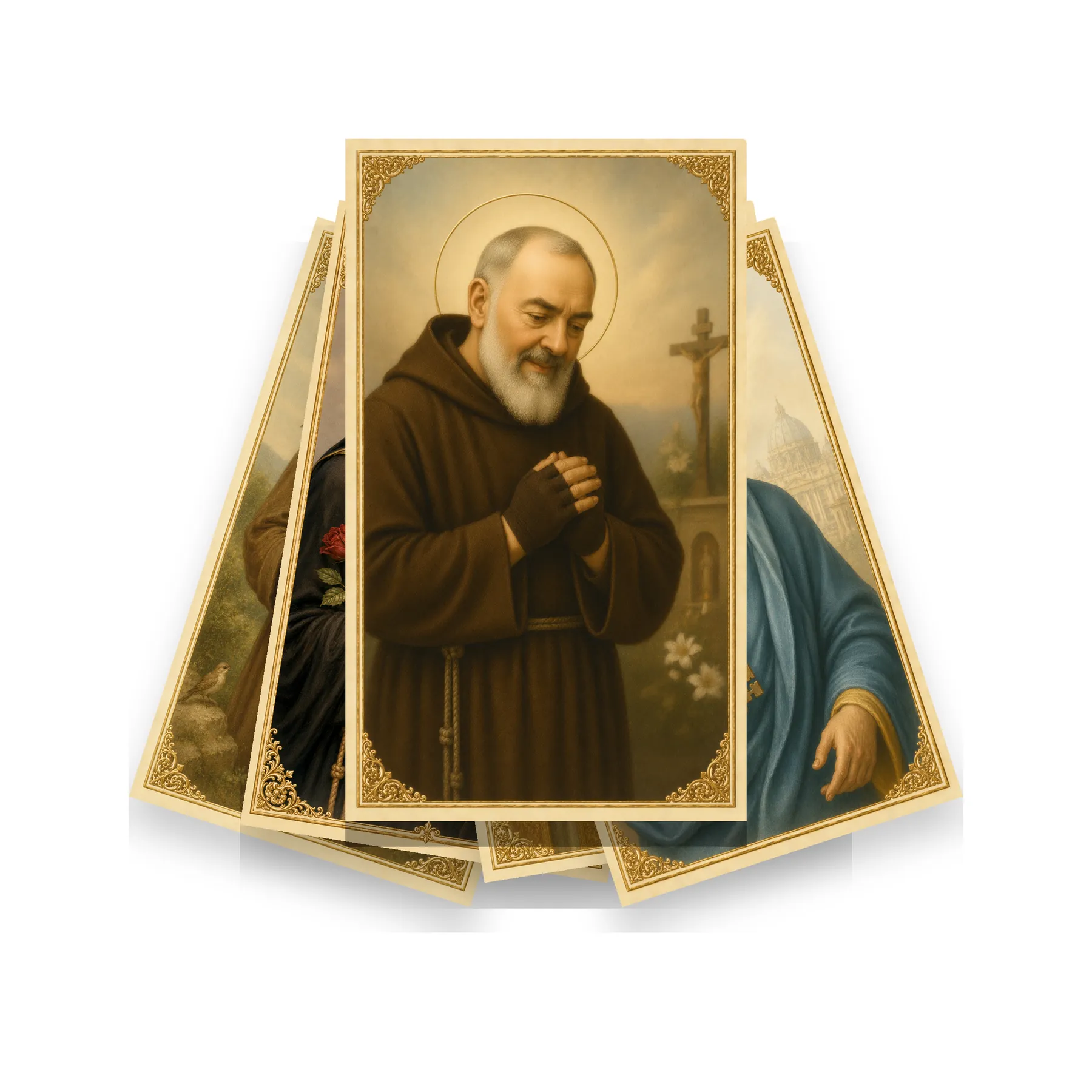
They were typically the size of a playing card or smaller, printed on card stock, and often edged with a decorative, gilt, or lace-like border. Here is what you would find on a traditional santino:
The Italian Holy Card
Anatomy of a Santino
Small enough to tuck in a missal or a wallet, a santino carried a saint, a prayer, and a memory — all on a single card.
The saint’s image
A painting or print of the saint — often with a golden halo and the symbols they’re known by.
The name
The saint named in Italian — Sant’Antonio, San Giuseppe, Santa Rita — so you knew exactly whose help you were asking.
The feast day
Their date on the calendar — the day of their festa and, for many, a family name day.
The prayer
On the back or below the image — the prayer or invocation to say, the reason the card was kept close.
The gilt border
The decorative, often gold-edged frame — made to be treasured, not thrown away.
Kept in missals, wallets, and Bibles, passed hand to hand at funerals and First Communions — the santino was a small, portable act of devotion.
How Italian families used santini
The santino was not decoration — it was used. It lived in the places where devotion and daily life met:
- In the missal and the Bible. Santini marked pages, held favorite prayers, and turned a prayer book into a personal archive of the saints a family loved.
- In wallets and pockets. A St. Christopher for travel, a St. Anthony for protection — carried on the body, close at hand, all day long.
- At funerals. The santino funebre (memorial card) — with the name, dates, photograph, and a prayer for the departed — was handed to every mourner and kept for years afterward. For many families, this is the santino they know best.
- At sacraments. Given as keepsakes at a Baptism, First Communion, or Confirmation, often with the child’s name and the date.
- Behind glass and on walls. Tucked into the frame of a mirror, pinned near the bed, or set behind the crucifix — a saint watching over the room.
It was not a disposable picture. It was a small, personal presence of the saint — devotion you could hold in your hand.
The Santino, For Today
Italian Saint Prayer Cards
A printable set of classic Italian holy cards — the best-loved saints and their prayers, beautifully designed in the santino tradition. Print them for your missal, your wallet, or to give as a keepsake.
Get the Prayer Cards — $9.49 →Instant digital download — print at home.
Where the santino tradition comes from
Holy cards have a long history. Their ancestors were hand-painted and woodcut devotional images from the late Middle Ages, but the santino as Italian families knew it flourished with the rise of cheap color printing in the nineteenth century. Suddenly a beautiful image of a saint was something an ordinary family could own, carry, and give away — and they did, in enormous numbers. Religious orders, shrines, and parishes printed them by the thousands; pilgrims brought them home from holy sites; and every significant moment of family life came to be marked with one.
In Italy and across the diaspora, collecting santini became a devotion in itself. Families kept boxes and albums of them, some inherited across generations. To hold a great-grandmother’s santino — soft-cornered, faded, her saint still gazing out — is to hold a small piece of her faith. Read more about the Italian saints every family prayed to, and use our patron saint finder to discover the saint for any need.
The santino funebre: holy cards for the dead
For many families today, the most familiar santino is the memorial card given at a funeral. The santino funebre carries the name of the person who has died, their birth and death dates, often a photograph, and a prayer — commonly to the Madonna, the Sacred Heart, or a favored saint. Mourners take one home, and it joins the missal or the drawer of remembrance, so that the person is prayed for long after the funeral is over. It is one of the most tender expressions of Italian devotion, binding the memory of the dead to the daily prayers of the living. Read more about Italian funeral traditions and Italian prayers for the dead.
Free Printable
The saints, the feast days, the whole Italian year.
Join the list for a free printable Italian family calendar — every patron saint and feast day, mapped across the year.
Keeping the santino tradition alive
The santino is one of those small traditions that can quietly disappear — not through any decision, but simply because no one prints them, keeps them, or hands them on anymore. Yet they remain one of the most beautiful ways to keep faith close and pass it to children: a saint for a First Communion, a card for a grandparent’s wallet, a small set kept in the family Bible. Given at a baptism or on St. Joseph’s Day, a santino carries meaning that a store-bought card never could.
A santino was never just paper. It was a saint you could carry, a prayer you could keep, a memory you could hold — small enough for a wallet, lasting enough to pass down. Keep the tradition alive: choose the saints your family loves, keep them close, and hand them on to the next generation.
Keep Them Close
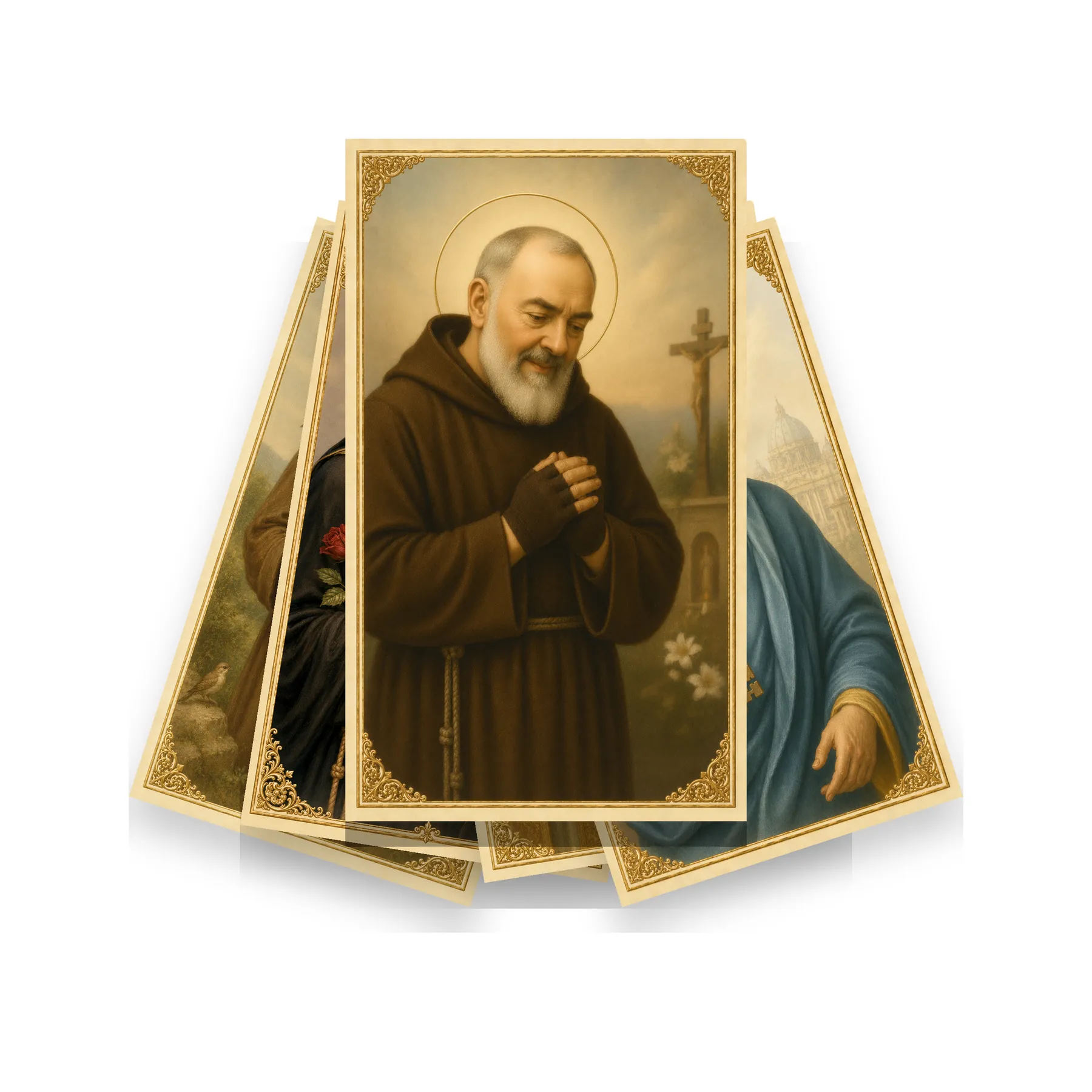
Italian Saint Prayer Cards — the santino, for today.
A beautifully designed, printable set of Italian holy cards in the santino tradition — the best-loved saints and their prayers. Print them for your home, your wallet, or as a keepsake gift that carries real meaning.
Get the Prayer Cards — $9.49 →Instant digital download. Print at home.
More on the saints and devotions behind the cards: the patron saint finder, the Italian saints every family prayed to, Italian prayers for the dead, and the Italian feast day calendar.
FAQ
What is a santino?
A santino is a small Italian holy card bearing the image of a saint, the Madonna, or Christ, usually with a prayer on the back. The word means “little saint” (from santo + the diminutive -ino). Italian families kept them in missals, wallets, and Bibles, and gave them at funerals, baptisms, and First Communions.
What is the difference between a santino and a holy card?
There is no real difference — santino is simply the Italian word for a holy card (also called a prayer card or devotional card). “Santino” specifically evokes the Italian tradition of these cards and how Italian families used and cherished them.
What is a santino funebre?
A santino funebre is a memorial or funeral holy card, given to mourners at an Italian funeral. It carries the name of the person who has died, their birth and death dates, often a photograph, and a prayer. Families keep them for years and continue to pray for the departed.
What do you do with holy cards?
Traditionally, holy cards are kept close as an aid to prayer — tucked in a missal or Bible, carried in a wallet, placed near the bed or behind a crucifix, and given as keepsakes at sacraments and funerals. Each card is a reminder to pray to that particular saint.
Where can I get Italian holy cards?
You can find printable Italian holy cards in the santino tradition, featuring the best-loved saints and their prayers, in our Italian Saint Prayer Cards set — an instant digital download you can print at home for your family or to give as a gift.

Marco Ricci is an Italian-Canadian writer and the grandson of Calabrian immigrants. He created Italian Family Traditions to document the customs, feast days, and family rituals Italian families carried from Italy to North America — and to understand what they actually meant. He is based in Montreal.