Italian Family Traditions
La Vigilia: Why Christmas Eve Was the Most Important Night of the Year
It was never just the night before Christmas. It was the kitchen running all day, the table set differently, the presepe finally lit, the mood in the house that said something sacred is arriving — and we are going to wait for it properly.
The baccalà had been soaking since Tuesday. That is the detail that always comes back to me first — not the table, not the candles, not even the gathering of relatives that eventually filled every chair and most of the available floor space. The baccalà soaking in its bowl of cold water on the kitchen counter, changed twice a day, de-salting slowly toward Friday. The preparation began days before the night itself. That was the point. That was always the point.
La Vigilia was not a meal you made on December 24. It was something you began building toward at the beginning of the week, in the specific way that Italian families have always built toward things that matter — with intention, with time, with the steady accumulation of small acts that turned an ordinary December night into the threshold of Christmas.
Christmas Eve in Italian family life had a quality that Christmas Day did not quite have. Christmas Day was joyful and abundant and full of the kind of noise that comes from people who have been eating and talking for hours. La Vigilia was something else. Quieter in its underlying register even when the house was loud. More anticipatory. More weighted with the specific feeling of being close to something significant that had not yet arrived. The Italian word for this is vigilia — the vigil — and the word itself carries everything: the watching, the waiting, the preparation, the night that belongs to what is coming rather than what is already here.
Christmas Eve sounds like a calendar label. La Vigilia sounds like an atmosphere. That difference is the whole tradition.
This is the full story of La Vigilia — what it was, why it mattered, where the fish came from, what was actually on the table, how the presepe fit into the night, and what it became in Italian-Canadian and Italian-American families far from the country that created it.
What La Vigilia actually means
The word vigilia does not only mean Christmas Eve. It means, in its broadest sense, the night or day before a religious solemnity — the time of watching, waiting, and preparing before the feast. Treccani defines it as the day, originally the night, before a religious solemnity, intended for ritual and spiritual preparation and for keeping watch. The Catholic tradition of the vigil is ancient: you did not simply arrive at a great feast day without preparation. You moved toward it through a period of heightened awareness, prayer, and restraint that gave the celebration its meaning when it finally arrived.
So La Vigilia di Natale — the vigil of Christmas — is the whole night of preparation before Christmas Day. Not just a meal. A posture. A mode of being that was different from ordinary days and different even from Christmas Day itself. Vatican News notes that Christmas is the only liturgical celebration with four Masses — the Vigil Mass, the Mass during the Night, the Mass at Dawn, and the Mass during the Day — which tells you something about how seriously the Church has always treated the slow, staged movement into Christmas. You did not leap into Christmas. You arrived at it in stages.
In my family in Montreal, La Vigilia began at whatever hour the last person arrived and ended when the last person could no longer stay awake, which was usually well past midnight. The house filled gradually across the evening — relatives arriving in stages, coats piling up in the bedroom, the kitchen permanently occupied by at least three people who disagreed about the right way to do everything and were doing it together anyway. Midnight Mass at the Italian parish was the axis around which the whole night turned. Before it, the fish courses and the waiting. After it, the desserts and the coffee and the opening of some presents if the children had survived. The structure was not rigid. It was understood. Nobody wrote it down. It simply happened, year after year, with the specific self-replicating logic of a tradition that has been repeated often enough to become instinct.
Advent — the season that made La Vigilia feel like a culmination
La Vigilia did not exist in isolation. It was the peak of a whole season of preparation — Advent — that Italian families observed in specific ways that gave Christmas Eve its particular emotional charge.
The novena of Christmas — the novena di Natale — began on December 16, nine days before Christmas. In many Italian homes, this meant prayers said each evening in front of the presepe, candles lit in progression as Christmas approached, and a deliberate building of anticipation that made the arrival of La Vigilia feel earned rather than simply scheduled. The novena was the liturgical calendar made domestic — brought into the house, observed around the Nativity scene, felt in the specific way that repeated evening prayers create a rhythm of expectation.
By the time December 24 arrived, the whole household had been leaning toward it for more than a week. The baccalà had been soaking since Tuesday. The presepe had been assembled with the central figures still absent. The shopping had been done. The family had been notified. La Vigilia was not a surprise. It was the destination of a journey that had been traveling toward this specific night for four weeks.
That is why the night felt different from any other night of the year. You had been waiting for it — not passively but actively, in the Italian way, through preparation, through accumulation, through the steady work of getting ready for something that deserved to be gotten ready for properly.
The rhythm of La Vigilia — how the night unfolded
| When | What | Why it mattered |
|---|---|---|
| All week before | Baccalà soaking, shopping, preparation | The vigil began days before the night. The preparation was part of the tradition, not preliminary to it |
| All day Dec 24 | Continuous cooking — fish in stages, the kitchen running from morning | The smell built all day. By evening the house already knew it was La Vigilia |
| Evening | Family gathering, table filling, candles lit, presepe final figures placed | The domestic and the devotional happening simultaneously in the same house |
| The cenone | Multiple fish courses, no meat, bread, wine, the long meal | The vigil expressed through the table — restraint before the feast |
| Midnight Mass | Messa di Mezzanotte at the Italian parish | The moment the vigil became Christmas. The community assembling after their separate family evenings |
| After Mass | Return home, panettone, coffee, some presents, Christ child placed in presepe | Christmas had arrived. The waiting was over. The feast could begin |
This rhythm was the structure of La Vigilia in its fullest form. Not every family observed every stage — the rhythm varied by family, by region of origin, by how devout the household was, and by how much energy the cooks had. What was consistent was the underlying shape: Christmas Eve was not an ordinary evening, the table was different, and the night moved toward something rather than simply ending.
Why fish — and which fish, specifically
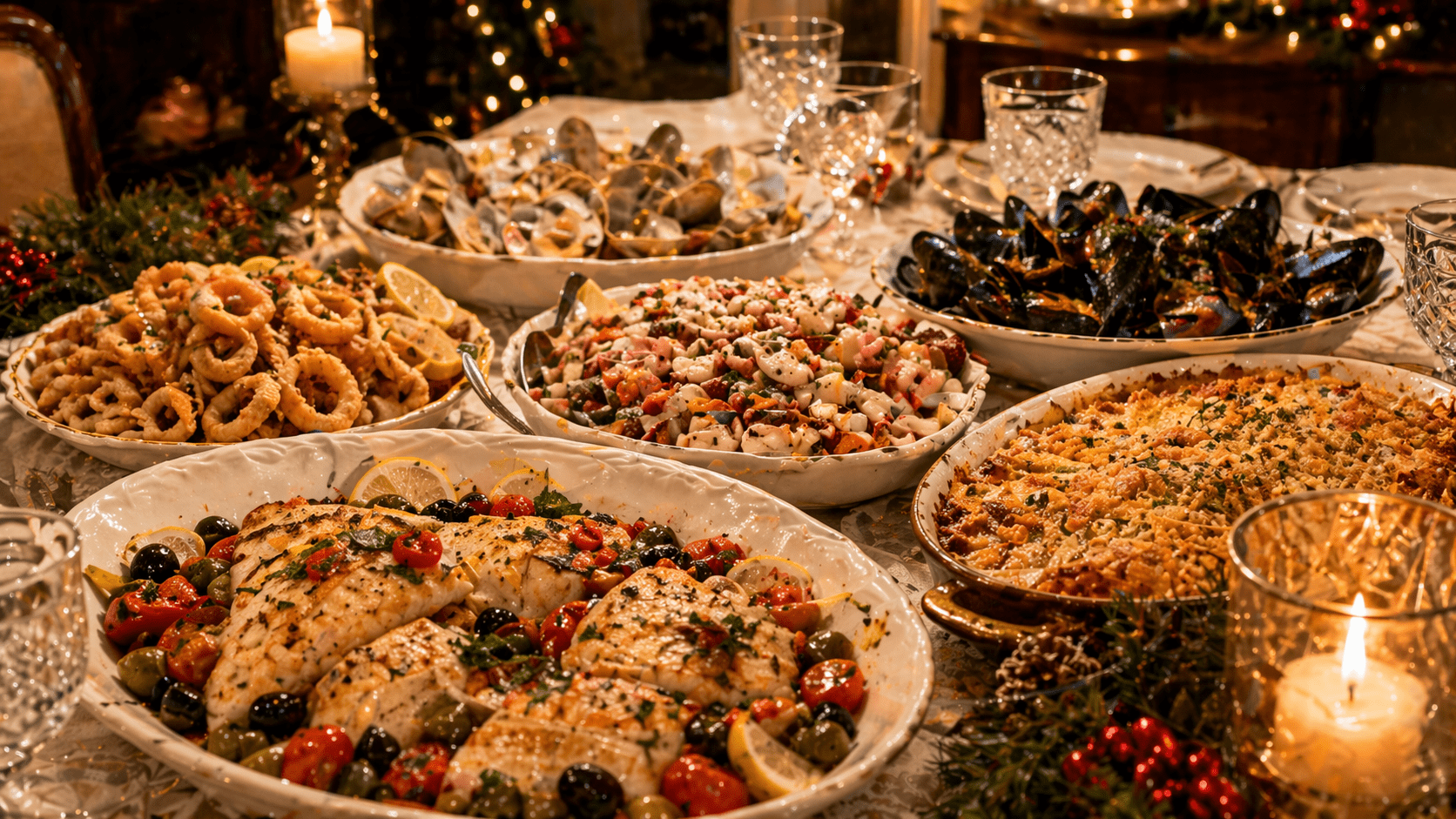
The fish on Christmas Eve was not random and it was not primarily about seafood preference. It was the direct expression of an old Catholic practice: abstinence from meat on days of fasting before great feast days. Britannica says that before Christmas Catholics traditionally fasted and abstained from meat on December 24, and that in southern Italy, where seafood was abundant and relatively affordable, families came to mark the vigil night with a large fish meal. The fish was the vigil expressing itself through the meal. The food reflected the night, and the night reflected something much older than any particular dish.
But which fish, specifically? This is where La Vigilia becomes most regional — and most recognizable to descendants who remember specific dishes rather than the tradition in the abstract.
| Fish or seafood | Regional association | How it was prepared |
|---|---|---|
| Baccalà (salt cod) | Universal across southern Italy and the diaspora | Multiple preparations — fried, baked with tomatoes, in broth, in salad. The one that required Tuesday to begin |
| Capitone (large eel) | Specifically Neapolitan and Campanian | Usually fried or braised. If your family had eel on Christmas Eve, they were almost certainly from Campania |
| Calamari (squid) | Throughout southern Italy and the diaspora | Fried, stuffed, in tomato sauce. Often the first course. The one children were most willing to eat |
| Smelts | Common in Italian-Canadian households — a Canadian adaptation | Fried whole. Arrived by the platterful. Disappeared immediately. The children’s fish |
| Clams | Throughout coastal southern Italy | In white wine sauce over linguine, or simply steamed. The broth soaked into the bread |
| Anchovies | Throughout Italy, especially in pasta | In pasta with breadcrumbs, dissolved into sauces. The invisible fish that flavored everything else |
| Shrimp | Throughout coastal southern Italy and the diaspora | Sautéed in garlic and oil, fried, in pasta. One of the more festive-feeling dishes |
| Octopus | Sicilian and Neapolitan traditions | In salad with lemon and olive oil, or slow-braised. Required the most time, produced the most remarkable result |
The baccalà was always the centerpiece in my grandmother’s version — not because it was the most impressive dish but because it was the most deliberately made. It required Tuesday. It required the bowl changed twice a day. It required patience in a way that other dishes did not. By the time Christmas Eve arrived and it appeared on the table, transformed from the stiff salt-white board it had been at the start of the week into something soft and rich and completely different, it carried with it the whole week of preparation. You tasted the process when you ate it. That is what made it feel like vigilia food rather than ordinary food. It asked something of you before it gave you anything back.
For the full story of the Seven Fishes tradition and how Italian-American families developed their specific Christmas Eve feast, read the Feast of the Seven Fishes: meaning, history, and how Italian-American families celebrate it.
What else was on the table — beyond the fish
The fish was the center but the vigilia table was never only fish. Understanding what surrounded the main dishes gives a fuller picture of what Christmas Eve actually looked like in Italian homes.
Before the fish came the antipasti: marinated vegetables, olives, cured fish like anchovies on bread, perhaps a small soup or broth to begin. In some families this was its own elaborate course. In others it was simply a way of keeping people fed while the fish courses were finishing.
Alongside the fish came bread — always bread, and often specific Christmas bread in regional traditions. And vegetables: roasted, braised, or marinated. The vigilia table was never only protein, even when the protein was the point.
After the fish courses came the desserts. Struffoli in Neapolitan tradition — small fried dough balls in honey, piled high and decorated with colored sprinkles. Cartellate in Puglia. Cuccidati in Sicily. In Italian-Canadian homes, a version of these alongside panettone or pandoro from the Italian bakery on Saint-Laurent. Then coffee, then the digestivo, then the very Italian second wind that kept everyone at the table long past the hour when they had intended to leave for Mass.
The children in my family were not all committed seafood enthusiasts. This is the honest truth about La Vigilia that food writers sometimes forget. The baccalà was not universally beloved by everyone under twelve. The eel, in the years we had it, was regarded with a suspicion that no amount of ancestral tradition could entirely dissolve. What the children ate — happily, immediately, without philosophical reservation — were the smelts, fried whole and arriving by the platterful and disappearing in minutes. And the bread. And the struffoli after, which required no convincing at all. The vigilia table fed everyone, even the ones who were not yet ready for the whole of it.
The presepe — when the Nativity scene came alive
La Vigilia was also the night the presepe — the Nativity scene — came fully alive. In Italian homes, the presepe was not a Christmas Day decoration. It was assembled during Advent, piece by piece, building toward completion. The stable, the animals, the shepherds, the wise men — all placed in position during the weeks before Christmas. But the central figures were held back: Mary, Joseph, and above all the Christ child, whose place in the manger remained empty through Advent as a visible reminder of what was still coming.
On La Vigilia — at midnight, or after returning from Midnight Mass — the Christ child was placed in the manger. In many families, this was a child’s privilege: the youngest child present was the one who completed the presepe. The gesture was simple and entirely serious. The small figure placed in the small bed of straw marked the moment when waiting became arrival, when the vigil became Christmas, when La Vigilia completed itself.
My grandfather built the presepe himself every year. Not a simple one — a full landscape, with papier-mâché hills and a working waterfall and lights that lit the stable from inside. He started in late November and worked on it evenings through Advent. By December 23 it was complete except for the central figures. The manger was there, and the straw was there, and the place was ready, and it would stay ready and empty until La Vigilia. When we came back from Mass after midnight, still cold from the walk from the church, he would take the Christ child figure — small, ceramic, painted decades ago — and give it to the youngest grandchild present, and that child would place it in the manger while everyone else was quiet for a moment. Then the lights on the presepe were lit fully for the first time. Then Christmas had arrived.
The presepe tradition in Italy is ancient — Saint Francis of Assisi is credited with creating the first living Nativity scene in 1223 — and the specific Neapolitan presepe tradition, which includes elaborate scenes of village life surrounding the central Nativity, is one of the great artistic traditions of southern Italian culture. In Italian-Canadian and Italian-American homes, the presepe often simplified but retained its essential function: a visible countdown to Christmas, a domestic devotional space, and the object that made La Vigilia’s completion visible and tangible when the Christ child was finally placed.
La Vigilia versus the Feast of the Seven Fishes
Many people encounter the Italian Christmas Eve tradition through the Feast of the Seven Fishes — the Italian-American name for the Christmas Eve seafood meal. It is real, beloved, and worth celebrating. But La Vigilia is the bigger, older idea. Britannica says that in Italy Christmas Eve is known as La Vigilia di Natale and the dinner is called cena della Vigilia or cenone della Vigilia. It also notes that the phrase Feast of the Seven Fishes is believed to be an exclusively Italian-American name — the seven fish count is not a standard Italian designation but an American elaboration that developed within the immigrant community.
- La Vigilia is the Christmas Eve vigil tradition — the night of preparation, restraint, gathering, and waiting before Christmas, expressed through a meatless meal and often through Mass
- The Feast of the Seven Fishes is one specific and specifically Italian-American expression of that tradition — elaborate, fish-centered, often counted, carrying its own distinct identity
- The number was never the point. The vigil was the point. The fish were how the vigil showed up at the table
- This helps descendants understand why their family may have had fish without literally counting to seven, or why one family had three fish dishes and another had fifteen
Regional variations — how La Vigilia changed by place of origin
La Vigilia was never a single uniform tradition across Italy. It varied significantly by region, which is why Italian families with different regional backgrounds can have Christmas Eve memories that seem like completely different traditions even though they share the same underlying structure.
Naples and Campania — the most elaborate Christmas Eve tradition. The capitone eel was the Neapolitan centerpiece: large eels bought live from market vendors who set up specifically for Christmas Eve, killed and prepared at home, then fried or braised. Struffoli — small fried dough balls in honey — were the classic Neapolitan Christmas Eve dessert. The presepe tradition is most elaborately developed in Naples, where artisan craftspeople have made elaborate Nativity figures and scenes for centuries.
Sicily — baccalà prepared with tomatoes, olives, and capers. Octopus in salads. Cuccidati — fig-filled Christmas cookies — were the Sicilian Christmas sweet that appeared on La Vigilia and through the Christmas season.
Calabria — baccalà in multiple preparations, along with other preserved fish. The Christmas Eve meal was substantial but shaped by the specific traditions of a mountainous region.
Northern Italy — the Christmas Eve fish tradition was generally more modest in the north, and some landlocked northern families had little or no Christmas Eve fish tradition. The panettone, by contrast, is specifically Milanese in origin and became the universal Italian Christmas sweet across all regions and the diaspora.
Italian-Canadian adaptation in Montreal — Calabrian, Sicilian, and Neapolitan traditions blended over generations in Little Italy. Canadian ingredients entered the tradition through availability — the smelts that became such a fixture of Montreal Italian Christmas Eve tables were a Canadian adaptation absorbed completely into the local version of the feast. The result was a Montreal Italian La Vigilia that was descended from multiple southern Italian regional traditions and identical to none of them. That is not a lesser version. It is the diaspora version — genuine, specific, and its own real thing.
The Midnight Mass — when the vigil became Christmas
For families that observed it, Midnight Mass was the fulcrum of the whole night — the moment when La Vigilia became Christmas, when the waiting ended and the feast began. Vatican News notes that Christmas uniquely has a Vigil Mass before the Mass during the Night, and it is the Messa di Mezzanotte that carried the particular emotional charge of the transition from vigil to nativity.
Walking to the Italian parish at midnight in a Montreal December was its own experience. The cold was significant. The streets were quiet in the specific way that city streets are quiet when almost everyone has gone inside. The church was full and warm. The music had a quality that ordinary Sunday Mass music did not have because it was midnight, because it was Christmas, because the liturgy was explicitly marking the arrival of something that the whole previous night had been preparing for.
My grandfather always cried at Midnight Mass. Not dramatically — he was not a demonstrative man. A specific expression, a particular stillness in him during certain moments of the liturgy, and occasionally when we came out of the church and the cold air hit and someone started singing something in the street, a very brief visible emotion that he immediately controlled. He was not a person who spoke about what the night meant to him. But whatever it meant, it was present in him in a way that was unmistakable if you were paying attention. La Vigilia was, for him, simultaneously a family occasion and a personal one. The two things happened in the same space at the same time and he held them both. The Italian feast and the Italian faith and the Italian man who contained both without needing to explain himself to anyone.
La Vigilia in Montreal’s Italian community
In Montreal’s Italian community — centered first in Little Italy around Saint-Laurent and Dante, then spreading outward to Saint-Michel and Rivières-des-Prairies — La Vigilia had its own specific character shaped by the mix of southern Italian regional origins that the community represented and the specific context of a Quebec December.
The Italian parishes were full on Christmas Eve. The Madonna della Difesa church and the parish on Dante Street served as gathering points for the community’s Christmas Eve observance — families who had spent the evening at different tables coming together at midnight in the same church, the community assembling itself around the liturgy the way it assembled around funerals, baptisms, and feast days throughout the year.
As families moved outward from Little Italy to Saint-Michel and Rivières-des-Prairies, the communal dimension thinned but the family dimension held. La Vigilia traveled with the family. It did not require a specific address to continue.
How to keep La Vigilia alive today
- Start the baccalà on Tuesday — the preparation that begins before the day itself is part of what gives the night its weight
- Keep the meatless meal in some form — it does not need to be fifteen fish dishes. It needs to be the acknowledgment that this night has its own character distinct from Christmas Day
- Build or maintain a presepe — hold the central figures back through Advent and place the Christ child at midnight on La Vigilia. That one gesture does more devotional and family work than almost anything else connected to the night
- Go to Midnight Mass or Christmas Eve Mass — the Vigil Mass connects the family meal to something older and larger than the family itself
- Make the table the event — not a stop on the way to something else, but the destination itself, where the family gathers and stays long enough for the night to happen properly. The same instinct that makes Sunday dinner important makes La Vigilia important
- Tell the children what La Vigilia means — the vigil, the waiting, the preparation, the specific Italian understanding that Christmas is something you move toward rather than something that simply arrives
The baccalà soaked since Tuesday. The presepe waited with its empty manger. The kitchen ran all day. The family filled the house in stages. The fish came out in courses. The bells rang at midnight and something changed in the air and the smallest child placed the Christ child in the straw and the lights on the presepe came on fully for the first time and Christmas had arrived.
That was La Vigilia. Not the night before Christmas. The threshold of it. Italian families have always understood that a threshold deserves to be crossed with intention — and that the crossing begins, if you are doing it properly, on Tuesday, with a bowl of cold water and a board of salt cod that is already becoming something else.
For the full story of the Italian-American fish feast that grew from La Vigilia, read the Feast of the Seven Fishes: meaning, history, and how Italian-American families celebrate it. For how Italian Sunday dinner traditions share the same table logic as La Vigilia. And for the broader story of how Italian Christmas and holiday traditions survived immigration, read Italian-American traditions: what changed and what stayed.
FAQ
What does La Vigilia mean in Italy?
La Vigilia means “the vigil” — more specifically, La Vigilia di Natale means the vigil of Christmas, the night of preparation and waiting before Christmas Day. Treccani defines vigilia as the day, originally the night, before a religious solemnity, intended for ritual and spiritual preparation. It implies a quality of watching, waiting, and being prepared that “Christmas Eve” as a calendar label does not carry. The tradition is not only a meal. It is a posture toward what is coming.
Is La Vigilia the same as the Feast of the Seven Fishes?
Not exactly. La Vigilia is the broader Italian Christmas Eve vigil tradition — the night of preparation, the meatless meal, the gathering, the presepe completion, and often Midnight Mass. The Feast of the Seven Fishes is a specific Italian-American expression of the Christmas Eve fish dinner. Britannica says the “Seven Fishes” name is believed to be exclusively Italian-American. The number was never the point. The vigil was the point. The fish were how the vigil showed up at the table.
Why do Italians eat fish on Christmas Eve?
Because Christmas Eve was traditionally a day of fasting and abstinence from meat before the Christmas feast. Britannica notes that Catholics traditionally fasted and abstained from meat on December 24, and that in southern Italy, where seafood was abundant and relatively affordable, the vigil meal became a large fish dinner. The fish was not a celebration of seafood — it was the traditional expression of the vigil’s restraint before the feast. The meat comes on Christmas Day. The vigil table is a different kind of table.
What fish are traditionally eaten on La Vigilia?
The specific fish varied significantly by region. Baccalà — salt cod soaked for days before Christmas Eve — was the most universal. Capitone (large eel) was specifically Neapolitan and Campanian — if your family had eel on Christmas Eve, they were almost certainly from Campania. Calamari, shrimp, clams, anchovies, octopus, and fresh white fish appeared in various regional versions. In Italian-Canadian homes, smelts fried whole became a fixture — a Canadian adaptation absorbed into the tradition. The specific dishes on your family’s La Vigilia table are a map of where the family came from.
What is the presepe and why does it belong to La Vigilia?
The presepe is the Italian Nativity scene — assembled during Advent but left incomplete until La Vigilia, when the Christ child figure is placed in the manger at midnight or after Midnight Mass, usually by the youngest child present. This gesture marks the moment when the vigil becomes Christmas. The Neapolitan presepe tradition, which includes elaborate village scenes surrounding the central Nativity, is one of the great artistic traditions of southern Italian culture. Saint Francis of Assisi is credited with creating the first living Nativity scene in 1223. In Italian-Canadian and Italian-American homes, the presepe often simplified but retained its essential function as a devotional countdown to Christmas.
Do Italians still have to fast on Christmas Eve?
No longer as an obligation. Treccani notes that the older fasting and abstinence requirements tied to vigils were abolished liturgically. But many families keep the fish dinner tradition regardless — because the tradition has moved from religious requirement to family identity, which in some ways makes it more durable than when it was obligatory. The obligation fades. The feeling stays. The baccalà still soaks since Tuesday.
What is Midnight Mass and why does it belong to La Vigilia?
Midnight Mass — Messa di Mezzanotte — is the Mass celebrated at midnight on Christmas Eve, marking the transition from the vigil to the nativity of Christ. Vatican News notes that Christmas has a Vigil Mass followed by the Mass during the Night, and it is this nighttime Mass that has always been the emotional and liturgical center of La Vigilia for families that observed it. For Italian families, attending Midnight Mass at the Italian parish was the moment when the private family vigil became a community vigil — everyone gathering in the same church after their separate evenings at the table.
Is La Vigilia still celebrated in Italy today?
Yes — La Vigilia di Natale remains one of the most important dates in the Italian calendar, both liturgically and culturally. Midnight Mass attendance, the cenone della Vigilia, the presepe tradition, and the various regional fish traditions are all still observed across Italy. The specific practices vary by region and household, but the sense that Christmas Eve is a special night requiring its own specific observance remains deeply embedded in Italian family life.
When does La Vigilia start?
Technically La Vigilia is December 24 — Christmas Eve. But in practice, for Italian families who kept the tradition fully, it began earlier: the baccalà soaking on Tuesday or Wednesday, the shopping and preparation through the week, the novena prayers of Advent building toward it. On the day itself, the cooking began in the morning and the gathering began in the evening, with Midnight Mass as the culminating moment. The vigil started when the preparation started — which was never the day itself.

Marco Ricci is an Italian-Canadian writer and the grandson of Calabrian immigrants. He created Italian Family Traditions to document the customs, feast days, and family rituals Italian families carried from Italy to North America — and to understand what they actually meant. He is based in Montreal.