Italian Family Traditions
How to Use Old Photos to Preserve Your Italian Family History
The photograph is not the story. It is the door to the story. But only if someone opens it before the person who knows what is behind it is no longer here to say.
There is a photograph in my family that has been unidentified for forty years. It shows a woman standing in front of a stone building — somewhere in southern Italy, probably Calabria, probably sometime in the 1920s based on the clothing. She is looking directly at the camera with an expression that suggests she has done this before and finds it only slightly interesting. She is wearing a dark dress and what appears to be a gold chain. She looks like someone’s grandmother. She looks, in fact, like someone’s grandmother who could be anyone’s grandmother, and that is the whole problem.
Nobody alive can name her with certainty. My grandmother thought she recognized a resemblance to a relative on her mother’s side. My great-aunt thought she had seen her in another photograph with a different family entirely. Nobody wrote anything on the back. Nobody thought they needed to, because at the time there were people who knew who she was, and the idea that those people would one day be gone and the knowledge would go with them was not the kind of thing anyone thought about when they put the photograph in the envelope.
A photo without a name, a date, and one sentence of context can go from a family treasure to a beautiful mystery in a single generation. The information does not disappear slowly. It disappears the day the last person who held it does.
This article is the practical guide for making sure that does not happen in your family. Old photos are one of the most powerful tools available for preserving Italian family history — not just by scanning them, but by capturing the stories attached to them before those stories are gone. Old photos also become much richer when combined with recorded family conversations: for how to capture those conversations, read how to record family stories before they’re lost.
Why old photos matter more than people realize
Old family photographs are not just nice keepsakes. They are some of the best tools available for preserving names, places, stories, and the feeling of your Italian family history before those details disappear. The Library of Congress says photographs should be treated as records of ancestors’ lives and used alongside other genealogical documents, not stored away as decoration alone.
A lot of families keep old photographs in drawers, boxes, albums, or random envelopes and assume that is enough. It is not. A photograph without names, dates, or context can become a mystery very fast. The greater and more common risk is not physical damage — it is context loss. A beautiful wedding photograph means much less when nobody knows who got married. A portrait from Italy means much less when nobody knows the town. A group photograph at a holiday table — the kind that should be the most evocative record a family has of how it once gathered — becomes almost useless when nobody can identify the people in it.
My cousin found a photograph tucked inside a prayer book that had belonged to her grandmother. The photograph showed four young women standing in front of what appeared to be a church. My cousin did not know who any of them were. She brought the photograph to the last family reunion while there were still relatives old enough to remember. One of her great-aunts, ninety-one years old at the time, looked at the photograph for a long moment and named all four women. One of them was her own mother. Another was a cousin who had died in Italy before anyone currently alive was born. My cousin recorded the conversation on her phone and wrote the names on a slip of paper tucked into the prayer book. She very nearly missed the window. The great-aunt died eight months later.
What old Italian family photos can tell you
Old photographs preserve things that official records cannot. A birth certificate tells you a birth date. A photograph can tell you who stood closest to whom, who wore black, who looked proud, what the kitchen looked like, what kind of table the family gathered around, whether people looked settled or struggling or fiercely dignified. The Library of Congress guide on local and family-history photographs treats photos as evidence that can help place people, places, and events in context.
For Italian family history specifically, one photograph can reveal:
- The names and faces of relatives who predate living memory
- Migration clues — whether a photograph was taken in Italy or in the new country, based on clothing, backgrounds, and photographic styles specific to certain periods and regions
- Religious customs — saint’s cards on walls, baptism gowns, confirmation photographs, funeral gatherings, the specific way the family observed holy days
- The physical context of family life — the garden, the cantina, the Christmas Eve table, the kind of house the family lived in after arriving
- Family relationships not recorded anywhere else — who stood with whom, who was absent at significant moments, who was the center of the gathering
- Regional identity — clothing styles, church architecture, and landscape details can sometimes narrow down the region of origin in Italy when no other record survives
Photographs hold both facts and atmosphere. For Italian-Canadian and Italian-American descendants, atmosphere is often what is missing most — the felt sense of what family life actually looked like in specific decades and places, which no document provides and only images preserve.
How to use photos to unlock family stories
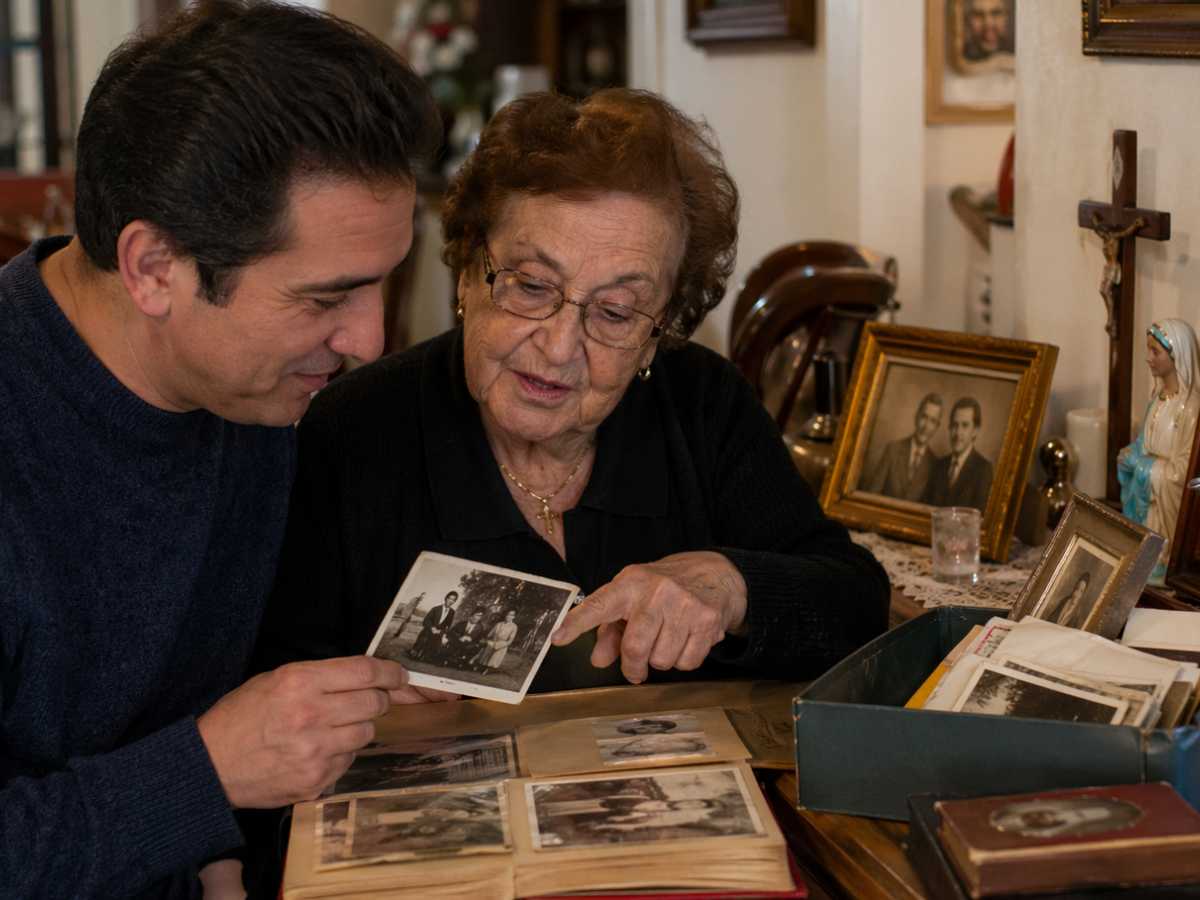
This is where old photographs become genuinely powerful rather than simply poignant. The photograph is not only an image to be preserved — it is a key to be used. The Smithsonian recommends using photographs and visual prompts during oral-history interviews because they stimulate memory in ways that direct questions often cannot. A parent or grandparent who cannot answer “tell me about your childhood” may answer at length when shown a specific photograph and asked a concrete question about what is in it.
Rather than starting with a broad question, bring a physical photograph to the conversation and ask specific questions about the specific image. This connects directly to the approach recommended for any family history conversation — for a full guide to getting the most from those conversations, read what to ask your grandparents about your Italian family history.
When you sit down with a photograph, ask:
- Who is in this photograph — can you name each person?
- Where was this taken — do you know the town, the street, the house?
- Was this in Italy or here?
- What was happening that day — is this a celebration, a visit, an ordinary afternoon?
- What happened to these people later?
- Do you know approximately when this was taken?
- Is there anything about this photograph that you want to make sure I know?
That last question is the one most people skip. It is often the one that produces the most important answer.
I once sat with my grandmother and a stack of old photographs for an afternoon. For the first hour she named people efficiently and moved on. Then she paused at a photograph of a man standing alone in front of a car. She did not name him immediately. She looked at him for a while. Then she said, “This is the one nobody talks about,” and what followed was a story about a branch of the family I had never known existed — people who had made different choices, who had lost contact, who were gone in ways the family had never fully discussed. The photograph unlocked something no direct question would have reached. That is what photographs do when you sit with them properly. They open doors that were not visibly marked as doors.
Write the story down before it drifts away
When someone identifies a photograph and tells you what they know about it, write that information down immediately. This sounds obvious. It is not universally practiced, which is why so many family photographs end up unidentified in shoeboxes. The conversation happens, the information surfaces, and then life continues and nobody writes anything down, and six months later the specific details are already softening.
The Library of Congress specifically advises keeping metadata and descriptions with both physical and digital photographs, labeling photo backs with soft lead pencil rather than ink, and naming digital files clearly. At minimum, when someone identifies a photograph, capture:
- Every name visible in the image — full names where possible, nicknames where full names are not known
- The approximate date or decade
- The location — city, town, address if known, country at minimum
- The occasion or context — what was happening that day
- How the people are related to each other and to the family
- One or two specific story details — anything that makes the image more than a face on paper
If your mother says “That was your bisnonna’s sister at the house in Termini Imerese, just before they left for Canada,” that sentence is simultaneously a name, a family relationship, a town, an immigration clue, and a story. Write it down in the moment. Do not trust your memory to hold it.
A simple photo caption formula that works
You do not need to write paragraphs for every photograph. A simple, consistent formula is enough to make an enormous difference.
Who + Where + When + Why it matters
For example: Maria and Giovanni Ricci outside their home in Rivières-des-Prairies, around 1968, after Sunday lunch. This was the house where the family hosted Christmas Eve for many years. Giovanni died in 1974. Maria moved to Saint-Michel the following year.
That caption is already doing real preservation work. It keeps the image connected to family memory instead of leaving it as a floating face. The Library of Congress recommends understandable file names and descriptions for digital photographs, and notes that tagging and captioning help family members organize and later rediscover their collections. A caption written in soft pencil on the back of a print, or a caption card kept alongside a framed photograph, is worth more than a hundred unwritten intentions.
For photographs that cannot yet be identified, write what you do know: Unknown woman, possibly Calabria, probably 1920s. Resemblance noted to relatives on maternal side. Needs identification. Partial information is always better than no information, and a note that the photograph needs identification is more useful than silence.
How to scan and organize old photos properly
Once you have identified a photograph and written down what you know, digitize it. Smithsonian digitization guidance supports digitizing family photo albums and books, and NARA’s technical guidance stresses that metadata and file management are part of a proper digital workflow — not an afterthought.
For most families, the practical approach is straightforward: scan or carefully photograph the image in good light, save a full-size master file, name the file in a way a family member twenty years from now will understand without additional context, and keep the description with the file.
A useful file name: 1958_Maria_Ricci_First_Communion_Montreal.jpg
Not: IMG_4827.jpg
The difference between those two file names is the difference between a photograph that remains findable and useful and a photograph that gets lost in a folder of thousands of undifferentiated images. The Library of Congress explicitly recommends understandable file names and keeping metadata with the file. Back digital files up in at least two places — cloud storage and a physical drive. One backup is not a backup.
Involve the whole family — do not assume one person has every answer
One of the most effective approaches to old photograph identification is also the simplest: share the photographs with multiple family members and combine their knowledge. Library of Congress reporting on one family archive project describes relatives helping identify names and places in photographs and contributing captions and tags from different locations — a form of family crowdsourcing that dramatically improved the collection’s usefulness.
In practice this means taking a batch of unidentified photographs to a family gathering, or sharing digital scans with siblings, cousins, aunts, and uncles and asking what each person recognizes. One person may know the town. Another may know the surname of the family the photograph came from. Another may know what event was being commemorated. Another may know which relative had already emigrated by that point, which can narrow a date considerably.
My family shared a collection of unidentified photographs at an Ognissanti gathering a few years ago — twenty or thirty prints found in various drawers and boxes after my great-aunt died. We laid them on the dining room table and let whoever was there look at them. Within an hour we had identified most of them. Different people knew different things. My mother recognized a face. My uncle recognized a building. An older cousin remembered a story connected to one of the events photographed. A younger cousin who had been researching family history recognized a name from documents she had found. The photographs on the table were the same photographs that had been unidentified in a shoebox for thirty years. The knowledge to identify them had been in the family the whole time. It just needed a table and a gathering to surface.
How to store original photographs safely
Digitizing is essential, but the original photographs still matter and still require proper care. NARA says photographs should be stored in cool, dry areas and kept out of hot attics, damp basements, and garages — heat and moisture speed deterioration, encourage mold, and can make photographs curl, fade, or stick together. NEDCC recommends a cool, dry, stable environment with good air circulation and limited light exposure.
The quick rule: cool, dry, dark, clean, and labeled. That alone will improve most family photograph situations.
When handling original photographs, NARA recommends clean, lotion-free hands rather than gloves for paper items — gloves can make delicate photographs harder to handle and increase the risk of damage. Handle photographs by their edges. Keep food and drink away from the work surface. For additional protection, store photographs in materials specifically described as acid-free and lignin-free rather than trusting vague “archival” marketing claims.
The photo preservation checklist — before you put them away again
- Sit with a parent or grandparent and go through the photographs together while there is still time — with a recording device running and something to write with nearby
- Write names, dates, locations, and one sentence of context for every photograph that gets identified
- Label physical photo backs with soft lead pencil — never ballpoint pen or marker ink
- Note which photographs remain unidentified and specifically who might still be able to identify them
- Scan or photograph each image clearly and save a full-size master file
- Name digital files descriptively — person, date, location — not camera-assigned numbers
- Back up digital files in at least two places — cloud storage and a physical drive
- Share unidentified photographs with other family members and record what each person recognizes
- Record the conversations the photographs unlock — audio is ideal, written notes are also valuable
- Store originals in a cool, dry, dark location — not the attic, not the garage, not the basement box
The woman in the photograph in front of the stone building in Calabria is still unidentified. We are still looking. Use the photograph to unlock the story, then preserve both — because the goal is not only saving pictures. It is saving the people inside them, before the last person who knows who they are is no longer here to say.
Old photos become even more valuable when paired with recorded family conversations. For how to capture those conversations, read how to record family stories before they’re lost. For the questions worth asking while there is still time, read what to ask your grandparents about your Italian family history. And for how to make those preserved memories visible in everyday family life, read how to create an Italian family memory corner at home.
FAQ
How can old photos help preserve Italian family history?
Old family photographs preserve things that official records cannot: the faces of relatives who predate living memory, the physical context of family life, migration clues, religious customs, family relationships, and the felt atmosphere of specific decades and places. The Library of Congress treats photographs as real genealogical evidence — records of ancestors’ lives that should be used alongside documents. For Italian-Canadian and Italian-American families in particular, photographs are often the only visual record of how grandparents and great-grandparents actually lived.
What should I write on the back of old family photos?
At minimum: who is in the photograph, the approximate date or decade, the location, and what was happening. The Library of Congress recommends labeling photo backs with soft lead pencil rather than ballpoint pen or marker, which can damage the image over time. Write “unknown — possibly Calabria 1930s” on unidentified photographs rather than leaving them completely blank. Partial information is always better than no information, and a note that the photograph needs identification is more useful than silence.
How do I use old photos to unlock family stories?
Bring a physical photograph to a conversation with a parent or grandparent rather than asking a broad question about the past. The Smithsonian recommends photographs as memory prompts because they stimulate specific recollection in ways that general questions cannot. Ask concrete questions about what is in the image: who is each person, where was this taken, what was happening that day, what happened to these people later. The question “is there anything about this photograph you want to make sure I know?” often produces the most important answer.
What is the best way to digitize old family photos?
Scan or carefully photograph each image in good light and save a full-size master file. Name the file descriptively — person, date, location — not with the camera’s default numbering. Back up the files in at least two places. NARA stresses that clear file naming and metadata management are part of a proper digital workflow. A file named “1958_Maria_Ricci_First_Communion_Montreal.jpg” will be findable in twenty years. A file named “IMG_4827.jpg” probably will not be.
How should I store original family photographs?
In a cool, dry, dark, clean environment — not in the attic, not in the basement box, not in the garage. NARA and NEDCC both identify heat and moisture as the primary enemies of photographic materials: they accelerate deterioration, encourage mold, and cause photographs to curl, fade, and stick together. Store photographs in materials described as acid-free and lignin-free. Handle them with clean, dry hands by their edges, and keep food and drink away from the work surface.
Should I involve other family members in identifying old photos?
Yes — actively and as soon as possible. No single family member holds the complete archive. Library of Congress reporting describes families using a crowdsourcing approach — sharing photographs with multiple relatives and combining their different areas of knowledge — to identify collections that had been mysterious for years. One person may know the town. Another may recognize a face. Another may know what event was being commemorated. The complete identification of a photograph collection usually requires combining what different generations and branches of the family remember.
Why is labeling old photos so important?
Because unlabeled photographs lose meaning very quickly — often within a single generation. The Library of Congress specifically warns that photos and digital files without descriptions lose value to future family members. A photograph is not a permanent record of its own content. It is only as permanent as the information attached to it. The faces in the image will always be there. The names will only be there if someone writes them down.
What is the most important thing to do with old family photos right now?
Sit down with a parent or grandparent and go through the photographs together — with a recording device running and something to write with nearby. The photographs are not the endangered resource. The knowledge of what is in them is the endangered resource, and it exists only in the people who are still alive to identify them. Every photograph identified before that window closes becomes something a future family member can actually use. Every photograph that remains unidentified after that window closes becomes a beautiful mystery. Like the woman in front of the stone building. We are still looking.

Marco Ricci is an Italian-Canadian writer and the grandson of Calabrian immigrants. He created Italian Family Traditions to document the customs, feast days, and family rituals Italian families carried from Italy to North America — and to understand what they actually meant. He is based in Montreal.