Italian Family Traditions
How to Get Your Kids Interested in Their Italian Heritage
Not through a lecture. Not through guilt. Through the things that actually work: a story told at the right moment, a ritual done often enough to feel inevitable, a smell from the kitchen that gets filed away and retrieved twenty years later as the smell of being Italian.
My daughter was seven when she first asked why we always had lentils on January 1. She did not ask because I had explained the Capodanno tradition to her. She asked because the lentils appeared every year at the same meal at the same table with the same explanation from her grandfather — something about coins and luck and the new year — and the repetition had finally produced curiosity. She wanted to know the story behind the thing she already knew happened. That is the sequence. Not explanation producing interest. Habit producing questions.
You do not get children interested in their Italian heritage by presenting it to them as something important. Important, to a seven-year-old, is not a compelling category. You get them interested by making heritage part of the texture of ordinary family life — the meals, the phrases, the stories that get repeated, the small rituals that happen often enough that they start to feel like “this is what our family does.” Then one day, usually when you are not expecting it, the questions start. And you realize the habit has been working all along.
Children rarely inherit culture by lecture. They inherit it by repetition, by smell, by the specific sound of a grandmother saying something in a language that is almost lost, by knowing that your bisnonno made sausage in the cold room and took it very seriously.
Understanding what is most worth passing on starts with knowing what Italian-American traditions changed after immigration and what stayed the same.
Why kids connect to heritage when it feels lived
Children usually do not fall in love with heritage because someone gives them a history talk. They connect when heritage feels like part of real life — when the family does certain things on purpose, when a story gets repeated, when a food belongs to a specific day, when a grandparent says something in Italian, when a ritual happens often enough that it starts to feel inevitable.
Research consistently supports this. The APA says family routines and rituals are an important part of healthy development. Emory researchers found that learning family stories creates shared history, strengthens emotional bonds, and helps children make sense of themselves and where they come from. UNESCO’s work on transmission of living heritage emphasizes that traditions last when they are practiced and passed on in everyday community and family life — not when they are explained in the abstract.
The explanation is not the transmission. The practice is the transmission. The explanation is just what you give when someone asks why. Simple family rituals like Italian Sunday dinner traditions and the small habits around Italian table manners can make heritage feel lived instead of abstract.
I did not know what malocchio was because someone sat me down and explained the evil eye. I knew what it was because my grandmother touched my face a certain way when she thought I had been looked at wrong, and said a word in dialect, and the gesture had a specific quality that communicated “this is serious and I know what I am doing.” I learned the word, the gesture, the belief, and the relationship between them all at once — through experience, not explanation. That is how the deepest parts of cultural heritage transmit. Not lecture to student. Adult to child, in the middle of real life, through things that are done rather than things that are said about doing.
Start with feelings, not facts
This is the most important advice in the whole article, and the most counterintuitive for parents who care deeply about their heritage and want to transmit it properly.
Do not begin with “You should care about your roots.” That line lands flat almost every time — not because children are ungrateful but because obligation frames produce resistance rather than curiosity. Begin instead with things that feel good. A cozy Sunday meal. A funny family saying. A saint’s day pastry from the bakery. A story about the nonno’s old neighborhood with a surprising ending. A little phrase they can say that makes adults laugh or light up.
Children attach to warmth first. Meaning comes later. The child who feels good at the Sunday table will, eventually, be curious about why the Sunday table exists and what it means. The child who is told they must appreciate the Sunday table will find reasons to resist.
My son did not care about St. Joseph’s Day until the year we let him help fry the zeppole. He was nine. He was not interested in the tradition, the saint, the history, or any of the meaning I had been gently depositing near him for years. He was interested in frying things, because he was nine. He dropped the dough in the oil. He watched it puff. He ate four of them before anyone else had finished their first one. And then — unprompted, genuinely — he asked why we made these specifically on this day. The frying produced the question. The question produced the conversation. The conversation produced the memory. He is older now and still asks when we are making zeppole for San Giuseppe. That is heritage transmission. It went through the oil.
Tell family stories before you explain family history
Family stories are one of the best entry points into heritage because they make it personal in a way that historical information cannot. Children may not care right away about immigration waves, regional distinctions, or the economic conditions of southern Italy in 1905. But they often care very much about specific people doing specific things in specific circumstances.
Who was funny. Who came over on the boat and why. Who made wine in the basement and whether it was actually good. Who had a nickname and where it came from. Who got in trouble and with whom. Who never wasted bread. Who said the same thing every Christmas for forty years. Who everyone was a little afraid of and why. Who everyone loved most and what they did to earn it.
That is where heritage becomes real — not in the general category of “Italian-Canadian family” but in the specific person with the specific habit who is now gone but was once so present that everyone still talks about them. Emory researchers say family stories help children build a shared history and stronger emotional ties. Tell the funny ones, not only the serious ones. Tell them in a way that makes relatives sound human, not saintlike.
The story that made my children most interested in their great-great-grandparents was not the immigration story, which is genuinely dramatic and worth telling. It was the story about the argument over the wine — a dispute between two brothers in the first years after they arrived in Montreal, involving a batch of homemade wine that one of them claimed was better than the other’s, that lasted so long and became so elaborated over the years that by the time it reached my children it had taken on the dimensions of a minor family epic. Neither brother was alive. The wine was gone. But the argument lived, because my grandmother told it with so much specificity and so much amusement that you could practically taste the wine and hear the argument. My children asked to hear it again. Heritage does not need to be solemn. It needs to be alive.
Make heritage something they do, not just hear about
If heritage stays abstract — only ever discussed, explained, pointed at from a distance — children tune out. If heritage becomes something they actually do, it sticks in a completely different way.
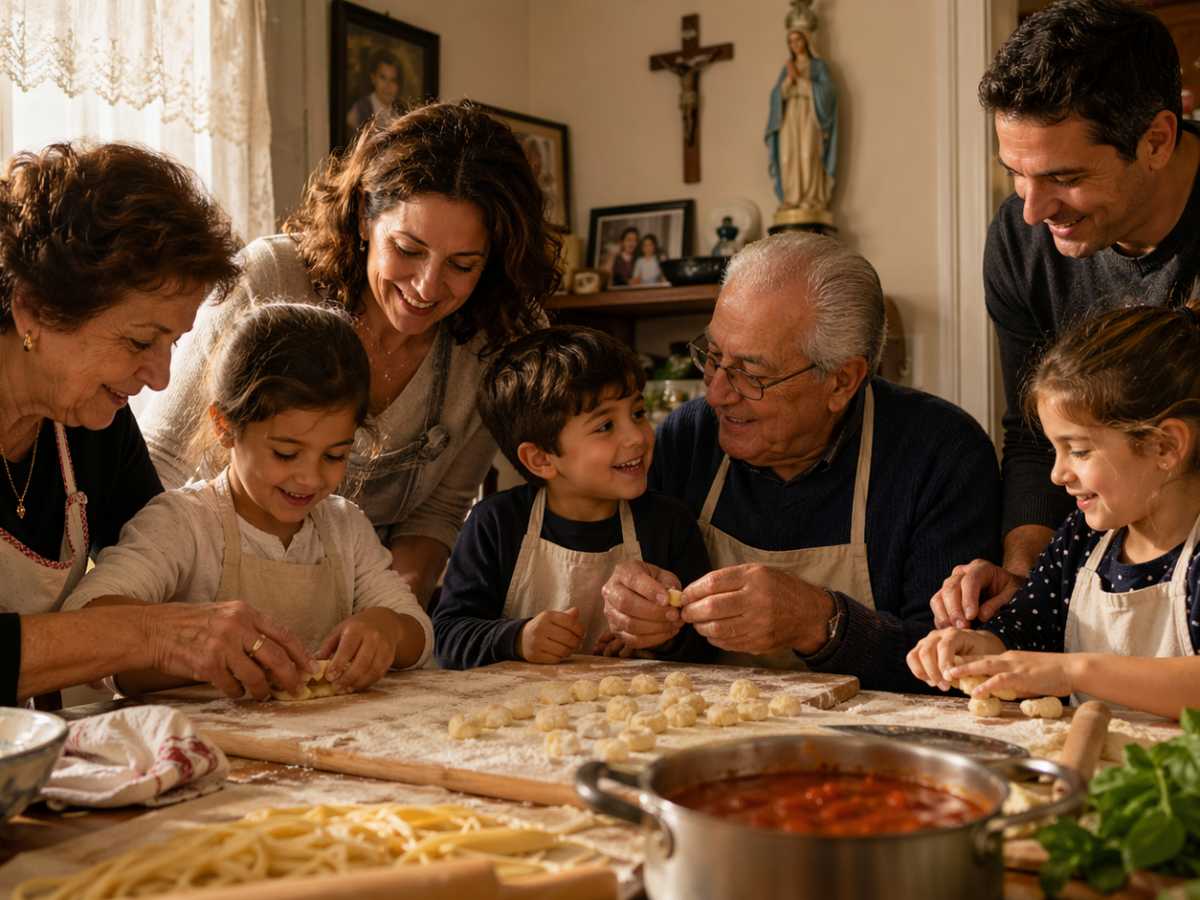
This does not require grand gestures. It requires specific, repeatable participation in things that have meaning attached to them: helping make a holiday dessert and being told why that dessert belongs to that holiday, learning one short Italian phrase and being given its context, visiting a grandparent to ask one specific question and then sitting with the answer, helping set the Christmas Eve table in the specific way it has always been set, going to the cemetery in early November because that is when Italian families go.
UNESCO’s transmission work consistently points to active participation as a key part of preserving living heritage — not passive observation, not academic knowledge, but the doing of things alongside people who have done them before. That is the chain. That is how it passes.
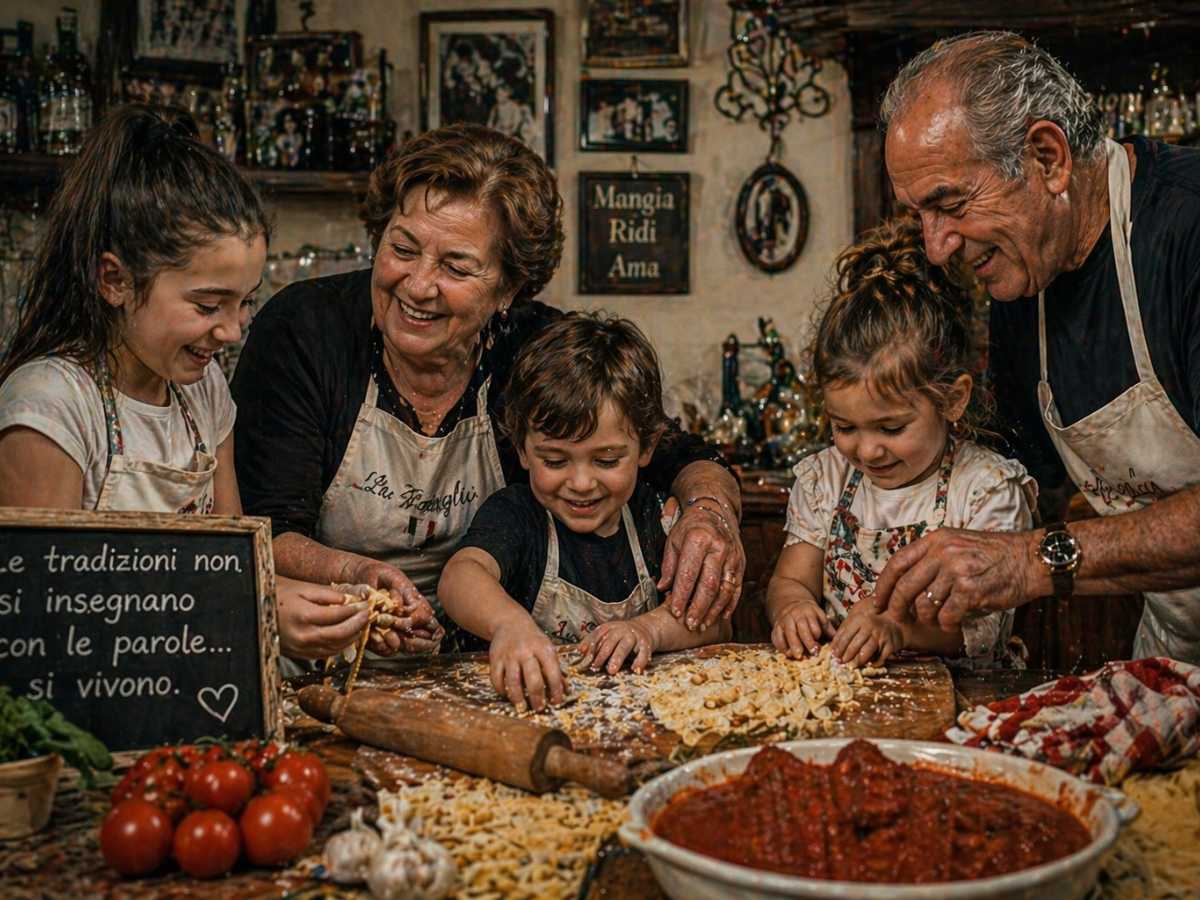
My daughter helped with the passata for the first time when she was eleven. She did not want to. It was a Saturday in August and she had other preferences for that Saturday. She was recruited through mild insistence and the frank acknowledgment that we needed help and she was available. She spent four hours at the table with her grandmother and her aunt, putting tomatoes through the mill, sterilizing jars, labeling in my grandmother’s specific handwriting style that she was shown and attempted to replicate. She complained for the first hour. By the second hour she was in the conversation that runs parallel to all serious Italian domestic work — the one that covers everyone’s business and goes places formal conversation never reaches. By the end of the day she was asking questions about where the tomato tradition came from and whether we had always done it this way. We have passata from that day in the basement right now. She knows which jars she filled.
Use food, language, and little rituals the right way
Food is almost always the easiest doorway into Italian heritage. It is sensory, repeatable, specific to days and seasons, and tends to feel like pleasure rather than instruction. But food works best when you attach the meaning to it — not in a heavy lecture way, but in the casual way that adults talk about things that matter while doing other things.
Do not only make zeppole. Say why they belong to St. Joseph’s Day. Do not only serve lentils on January 1. Say why Capodanno made them lucky. Do not only make Sunday sauce. Say what Sunday meant in the family — why the table was the center, why everyone came, why it mattered that you stayed for the whole meal. That is how food becomes heritage instead of just dinner. The food is the vehicle. The story is what it carries.
Language works the same way. You do not need to create a perfect bilingual household. You need a few words that get repeated enough to feel familiar. A greeting. A blessing before a meal. A nickname everyone uses. A saying that gets quoted when a specific situation arises. A phrase your grandparents really used that carries more emotion than its English equivalent. For the sayings most worth preserving, read Italian grandparent sayings and what they really meant.
Involve the grandparents while you still can
This is the section that is hardest to write and most important to read.
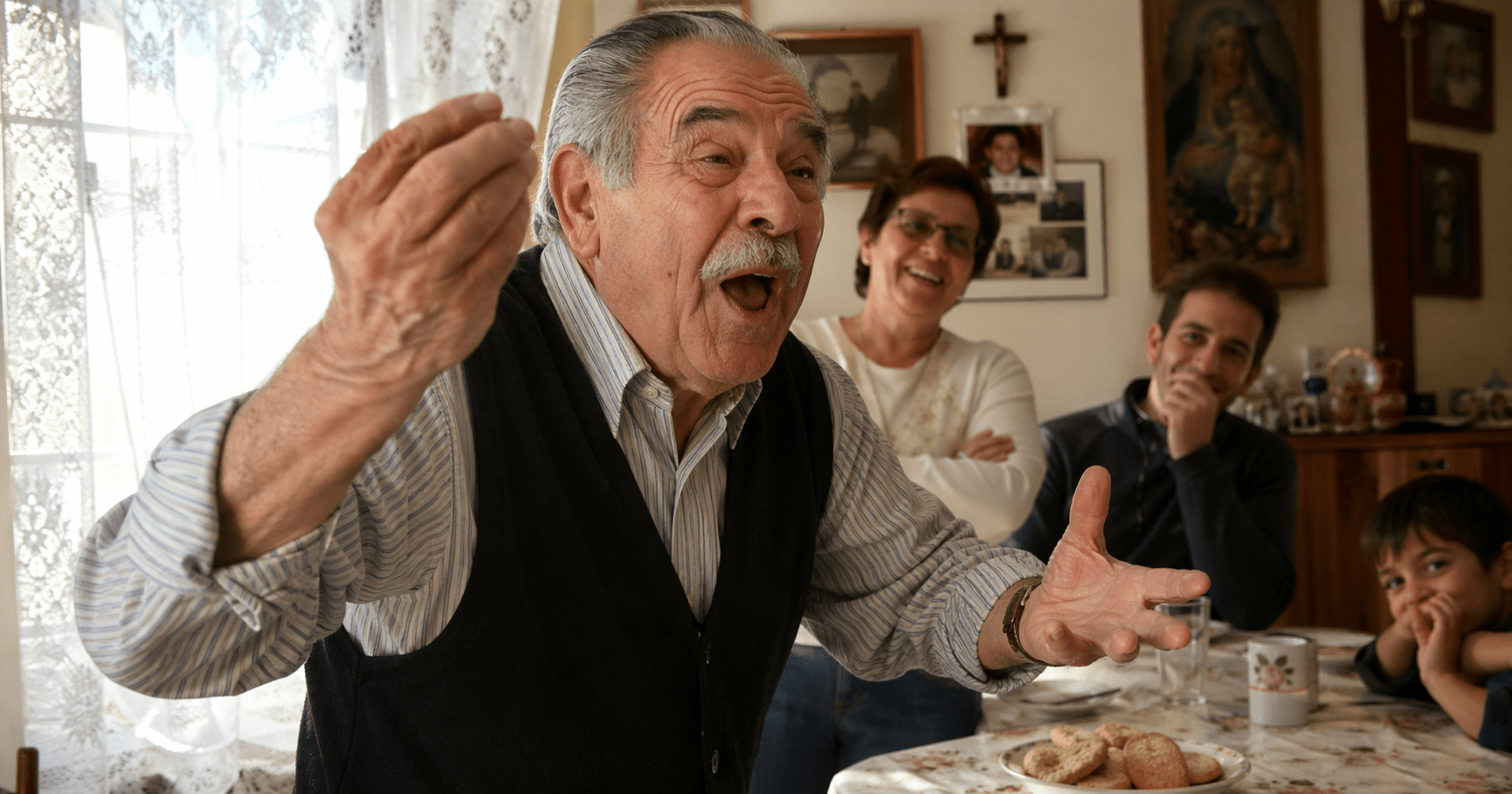
Grandparents are not a heritage resource in the organizational sense. They are the heritage — the living version of everything you are trying to transmit, carrying in their memory and habits and specific way of doing things the information that will not exist anywhere once they are gone. The recipe that lives in their hands rather than on paper. The story about the village that they mention in passing and then move on from. The gesture that means something specific that they would recognize if you named it but have never named themselves because it is simply what they do.
Every conversation your children have with their grandparents is a heritage transmission event, whether or not anyone frames it that way. Every meal cooked together. Every question asked and answered. Every story told and heard. These are not supplementary to the heritage project — they are the heritage project, in its most direct and most irreplaceable form.
My children spent a summer afternoon with my mother going through old photographs, asking who people were. My mother had not looked at those photographs in years. The children had never seen them. For two hours they looked at faces and my mother named them and told what she knew, which was sometimes a great deal and sometimes only “I think this was a cousin of your great-grandmother but I am not certain.” The children were fully engaged the entire time — not because they had been told to be engaged, but because the photographs were genuinely interesting and my mother’s knowledge of them was genuinely fascinating. I recorded the session on my phone with her permission. Those recordings are among the most valuable things our family owns.
For a guide to the questions worth asking while there is still time, read what to ask your grandparents about your Italian family history. And for how to preserve those conversations, read how to record family stories before they’re lost.
Let kids help, choose, and ask questions
One of the fastest ways to make heritage feel like a burden is to make it feel imposed. Children who are presented with heritage as something they must appreciate tend to find reasons not to appreciate it. Children who are invited into heritage as something they have some ownership over tend to find reasons to engage.
- Let them choose which family recipe to make this weekend rather than being told what is being made
- Let them ask a grandparent one question at dinner rather than being asked to sit and listen
- Let them pick an old photo and ask who is in it — the difference between choosing a photo and being shown one is enormous for engagement
- Let them decide which Italian phrase the family will try to use this week
- Let them put the Christ child in the presepe at midnight on La Vigilia
- Let them be the one who brings the pastries on onomastico day
Heritage-language research keeps finding that children’s own agency matters in whether a cultural practice continues. Participation produces ownership. Ownership produces interest. Interest produces continuation.
Match the method to the child
Not every child connects to heritage the same way, and trying to force a single approach on every personality in the family is one of the more reliable ways to produce resistance.
A child who loves stories will connect through the family narratives. A child who loves cooking will connect through the kitchen — the zeppole, the passata, the Christmas Eve baccalà that soaks since Tuesday. A child who loves competition will connect through the games — tombola at Capodanno, briscola on Sunday afternoons. A child who loves mystery will connect through the protective traditions — malocchio, the cornicello, the specific gestures that meant something and still do.
Use what the child already enjoys as the door. Heritage has many rooms. You do not need to enter through the same one every time, and you do not need to visit all of them at once. Find the one that is already slightly open and push it gently. The others become accessible once the child is inside and looking around.
What to avoid if you want it to stick
- Turning heritage into guilt — “You should know this already” or “Your great-grandmother would be sad” produce shame, which produces avoidance
- Dumping too much at once — one story, one tradition, one phrase at a time. Heritage absorbed slowly over years sticks far better than a heritage intensive that exhausts everyone
- Making every moment into a lesson — if every family dinner becomes a heritage education session, children will start dreading family dinners. The ratio should be mostly warmth and enjoyment with meaning woven in naturally
- Acting like they are failing if they don’t care right away — children often don’t care right away. They care later. The job is to keep the thread available for when they are ready to pick it up
- Making it feel like school — school is where you go to learn things that are required. Heritage is where you go to belong to something. The moment those feel the same, heritage loses
The simple formula that actually works
If you want one practical structure, use this:
Story + Ritual + Participation
- Tell one story about a specific person — a grandparent, a great-grandparent, anyone who makes heritage feel like it belongs to real humans rather than abstract categories
- Repeat one ritual connected to that story — the dish that person always made, the feast day they observed, the thing they said every year at the same moment
- Give the child one small role in the ritual — stir the pot, set the specific dish, say the phrase, place the figure in the presepe, carry the pastry box from the car
That is enough. Not a massive cultural master plan. One story, one ritual, one role — repeated consistently enough that it starts to feel like “this is what our family does.” That is the beginning of heritage transmission, and it is also, if you keep doing it, the middle and the end. It fits exactly what Emory’s research on family stories, the APA’s guidance on family rituals, and UNESCO’s work on living heritage all point toward: identity is strengthened by repeated family practices, meaningful participation, and emotional connection — not by information transfer.
The goal is not to raise little historians or perfect Italian speakers or flawless observers of every feast day. It is to raise children who feel that their roots are part of home — and who, one day, will be the ones making the lentils and explaining why.
My daughter asked about the lentils when she was seven. She reminded me we had forgotten to put them on last January 1 before I had thought of it myself. That is the goal. Right there. The habit that passed through repetition into something she now owns and will one day pass on herself, in the same way, to someone who will one day ask why.
For the Italian traditions most worth passing on, explore Italian-American traditions: what changed and what stayed. For how to preserve the family stories before they are lost, read how to record family stories before they’re lost. For the questions to ask grandparents while there is still time, read what to ask your grandparents about your Italian family history. And for the sayings worth preserving and passing on, read Italian grandparent sayings and what they really meant.
FAQ
How can I get my kids interested in their Italian heritage?
The most reliable approach is to make heritage part of the texture of normal family life rather than presenting it as something important that must be appreciated. Stories, repeated rituals, food connected to meaning, small Italian phrases, and active child participation all build heritage interest more effectively than explanation or obligation. Children attach to warmth first — meaning comes later, often when you are not expecting it.
Do family stories really help children connect to heritage?
Yes — strongly. Emory researchers found that family stories create shared history, strengthen emotional bonds, and help children make sense of themselves and where they come from. The most effective stories are specific and human rather than general and historical: not “our family came from Italy” but “your great-grandfather came on a specific boat for a specific reason and did a specific thing when he arrived.” Specificity is what makes heritage feel real rather than abstract.
Is language important for connecting kids to Italian heritage?
Yes, even in small amounts. Heritage-language research shows that heritage languages play an important role in cultural preservation, ethnic identity attachment, and intergenerational continuity. You do not need to create a bilingual household — a greeting, a blessing, a nickname, a saying, a phrase your grandparents really used can be enough to create a meaningful language connection that children carry forward.
What if my kids are not interested right away?
That is completely normal and not a sign that the effort is failing. Children often connect to heritage later — sometimes much later — when the habits and stories that were present in childhood become suddenly important in adulthood. The job in the early years is not to produce visible enthusiasm. It is to make the thread available and keep it present so that when the child is ready to pick it up, it is there. Pressure tends to push children away. Warmth and repetition tend to bring them back.
What is the easiest way to start passing on Italian heritage?
Start with the formula: one story about a specific person, one ritual connected to that story, one small role for the child in the ritual. Do this with one tradition — Sunday dinner, a feast day, a food custom, a name day — and do it consistently enough that it starts to feel like “this is what our family does.” That is both the beginning of heritage transmission and, if you keep doing it, the whole of it.
Should I force my kids to participate in heritage traditions?
Pressure almost always produces worse outcomes than invitation. Children who are required to appreciate heritage tend to find reasons not to. Children who are invited into heritage — given a real role, a choice, a reason that makes sense to them — tend to find reasons to engage. The research on family rituals and heritage transmission consistently points toward emotional warmth, participation, and agency as the effective ingredients, not obligation.
How do grandparents fit into passing on Italian heritage?
Grandparents are not a supplementary resource in heritage transmission — they are the primary one. They carry in their memory, habits, and specific way of doing things the information that will not exist anywhere once they are gone. Every conversation your children have with their grandparents, every meal cooked together, every story told and heard, is a heritage transmission event. The time to involve grandparents is now, while they are present and while their memory is clear. Conversations recorded, stories written down, afternoons spent looking at old photographs together — these are among the most valuable heritage investments a family can make.

Marco Ricci is an Italian-Canadian writer and the grandson of Calabrian immigrants. He created Italian Family Traditions to document the customs, feast days, and family rituals Italian families carried from Italy to North America — and to understand what they actually meant. He is based in Montreal.