Italian Family Traditions
Italian Christmas Traditions: The Complete Guide
From the Immacolata on December 8 to La Befana on January 6 — the feast days, the fish, the sweets, the games, and the family rituals that make an Italian Christmas, and how families carried every one of them across the ocean.
In Italian families, Italian Christmas traditions were never about a single day. Christmas was a season — a long, deliberate stretch that began on December 8 and did not end until the Befana swept through on the morning of January 6. Every part of it had a meaning: the tree and the presepe going up on the Immacolata, the nine evenings of the novena, the fish on Christmas Eve, the long table on Christmas Day, the games after dinner, the lentils at New Year. Nobody explained any of it. You simply grew up inside it, and it became the shape of the year’s most important weeks.
This is a guide to the whole of it — the feast days, the foods, the folk figures, the regional differences, and the family rituals that make up an Italian Christmas, and how families who left Italy for Montreal, Toronto, New York, and Boston carried them across the ocean. Wherever a tradition has its own story, you will find a link to the full telling. Think of this page as the map; the individual stories are the territory.
An Italian Christmas is not a day you arrive at. It is a season you walk through — and the walking is the point.
A Season, Not a Day
The Italian Christmas Season, Day by Day
From the Immaculate Conception to the Epiphany, the Italian Christmas unfolds over nearly a month.
Explore each tradition
Tap any part of the season to read its full story.
In Italian families, Christmas was never a single day. It was a season — and every part of it carried a meaning no one ever had to explain.
December 8: L’Immacolata, the day the season begins
The Italian Christmas season traditionally opens on December 8, the Feast of the Immaculate Conception — l’Immacolata. It is a holy day of obligation and a national holiday in Italy, and in a great many Italian homes it is the day the tree goes up and, more importantly, the day the presepe comes out of its boxes. From December 8 to January 6 the season runs for nearly a month, and the length is the point: it is a season of preparation and anticipation, not a single holiday you arrive at all at once.
In my family nobody announced it. On December 8 the presepe and the tree simply went up. We just knew — there was a gut feeling that it had to be that day and no other. Up and down the street, some of the neighbours brought out statues of the Madonna and set them proudly on their front lawns, and in the evening the whole family went to Mass together, a short one, before coming home to a house that suddenly felt like Christmas. You can read the full story of the day, its novena, and its regional customs in the Feast of the Immaculate Conception and why Italian families decorate on December 8.
We never discussed when the tree would go up. On December 8 it went up, the presepe came out, and that was the start of Christmas. Nobody had to say it. We just knew.
An Italian Christmas Gift
Something to keep long after the panettone
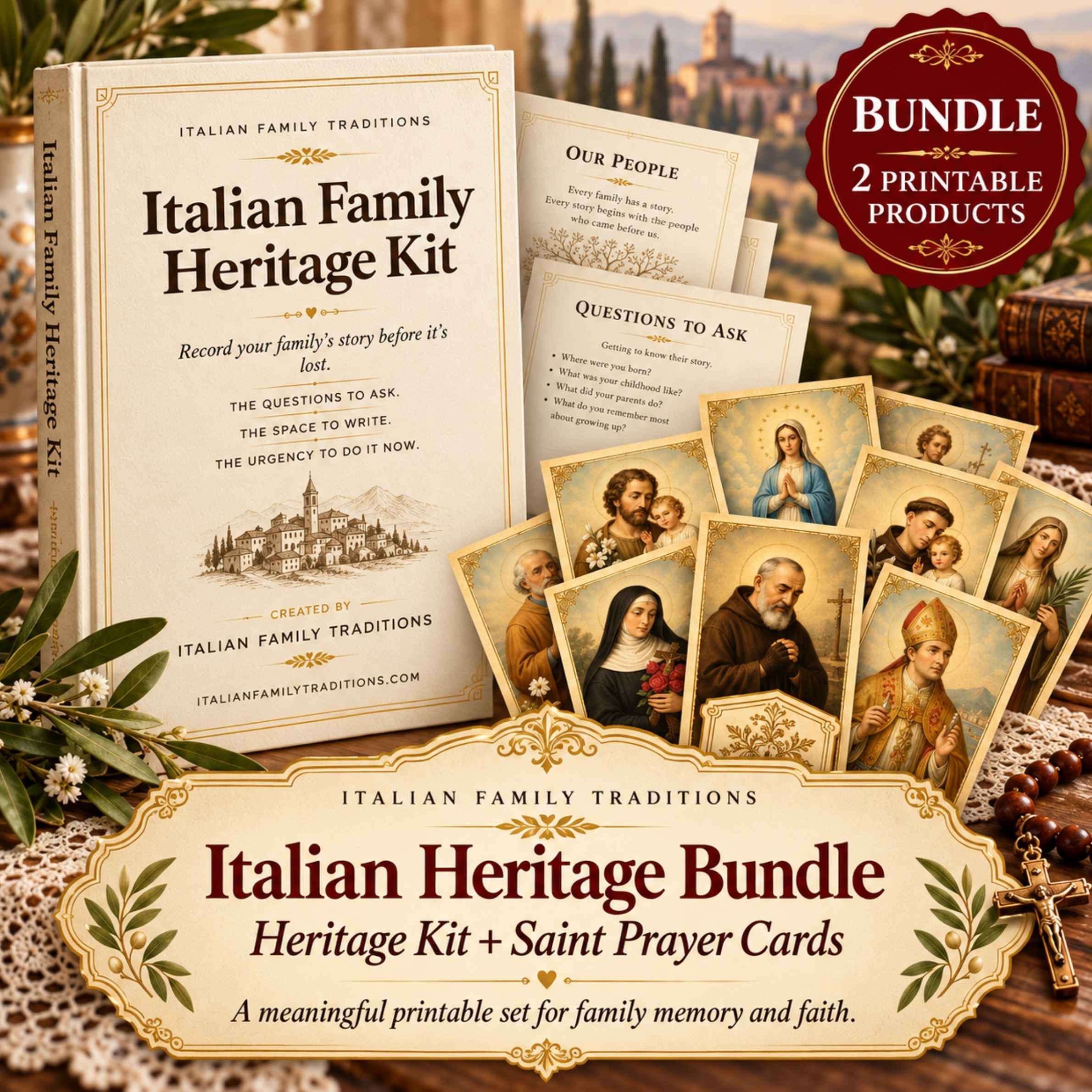
The Italian Family Heritage Kit (133 guided pages to record the family’s stories, recipes and names) together with the Italian Saint Prayer Cards (eleven printable santini with prayers in Italian and English). One gift for the family’s memory, one for its faith.
$24.99 $29.48
Both downloads together · save $4.49
Get the Heritage Bundle →December 13: Santa Lucia and the saint of light
Before Christmas itself comes Santa Lucia on December 13 — the feast of the saint of light, falling in what was once counted as the darkest stretch of the year. In parts of northern Italy, especially around Bergamo, Brescia, and Verona, it is Santa Lucia and not Babbo Natale who brings the children their gifts, arriving in the night on a donkey; children leave out hay for the donkey and something for the saint. In Sicily, and above all in Siracusa where she was born, her feast is marked with cuccìa, a dish of boiled wheat berries eaten in memory of the grain ships that, by tradition, ended a famine on her day. Read the full story of the Feast of Santa Lucia in Italy.
December is crowded with saints in this way. San Nicola, the bishop of Bari whose secret gifts became the legend of Santa Claus, comes on December 6, and in parts of Puglia he is still the gift-bringer. Barbara, Nicola, Concetta, Lucia, Stefano — every one of those names has its day in December, so the season of Christmas is also a season of name days, with pastries and phone calls folded into the preparations.
The presepe: the heart of the Italian Christmas
For many Italian families, the presepe — the nativity scene — matters as much as the tree, and in older households it mattered more. Built up over the days of Advent, often with figures collected and passed down across generations, the presepe is a small world assembled by hand: the stable or grotto, the shepherds, the animals, the villagers going about their work, the Three Kings still far off on their journey, and finally the Christ child, who is traditionally placed in the manger only at midnight on Christmas Eve. The empty manger through Advent is part of the meaning. You wait for him.
In Naples, presepe-making is a celebrated art form, centred on the historic workshops of Via San Gregorio Armeno, where artisans still carve and dress figures by hand — including, every year, caricatures of the famous faces of the moment slipped in among the shepherds. Across Italy, towns stage the presepe vivente, a living nativity with whole villages in costume. It is the tradition that most captures the Italian Christmas as something you build, slowly and with care. Read more about the Italian presepe, its figures, and how to build one.
December 16 to 24: the Christmas Novena and the zampognari
Nine days before Christmas, on the evening of December 16, the Novena di Natale begins — nine evenings of prayer and song leading up to Christmas Eve. In parish churches across southern Italy the novena was, and in many places still is, sung in the early morning or the evening, with the old Advent hymns and the antiphons that count down the days. At home, families who could not get to church said it around the presepe, often with the children placing a small figure or lighting a candle each night.
The sound of the novena in much of the south was the zampogna. The zampognari — shepherd musicians from the mountains of the central and southern Apennines, dressed in sheepskin vests and leather sandals — came down into the towns and cities during the novena to play their bagpipes and reed pipes before the shrines of the Madonna and in front of the presepi in people’s homes. Many Italians still say Christmas does not start for them until they hear it. Our guide to the Christmas Novena has the prayers, the O Antiphons, and a day-by-day tracker so you can keep the nine evenings with your own family.
If the novena is part of your December, a set of printable Italian Saint Prayer Cards — eleven santini with prayers in Italian and English, including Santa Lucia and the Immacolata — makes a quiet companion for the nine evenings, and a small gift for anyone in the family who still keeps them.
Christmas Eve: La Vigilia and the Feast of the Seven Fishes
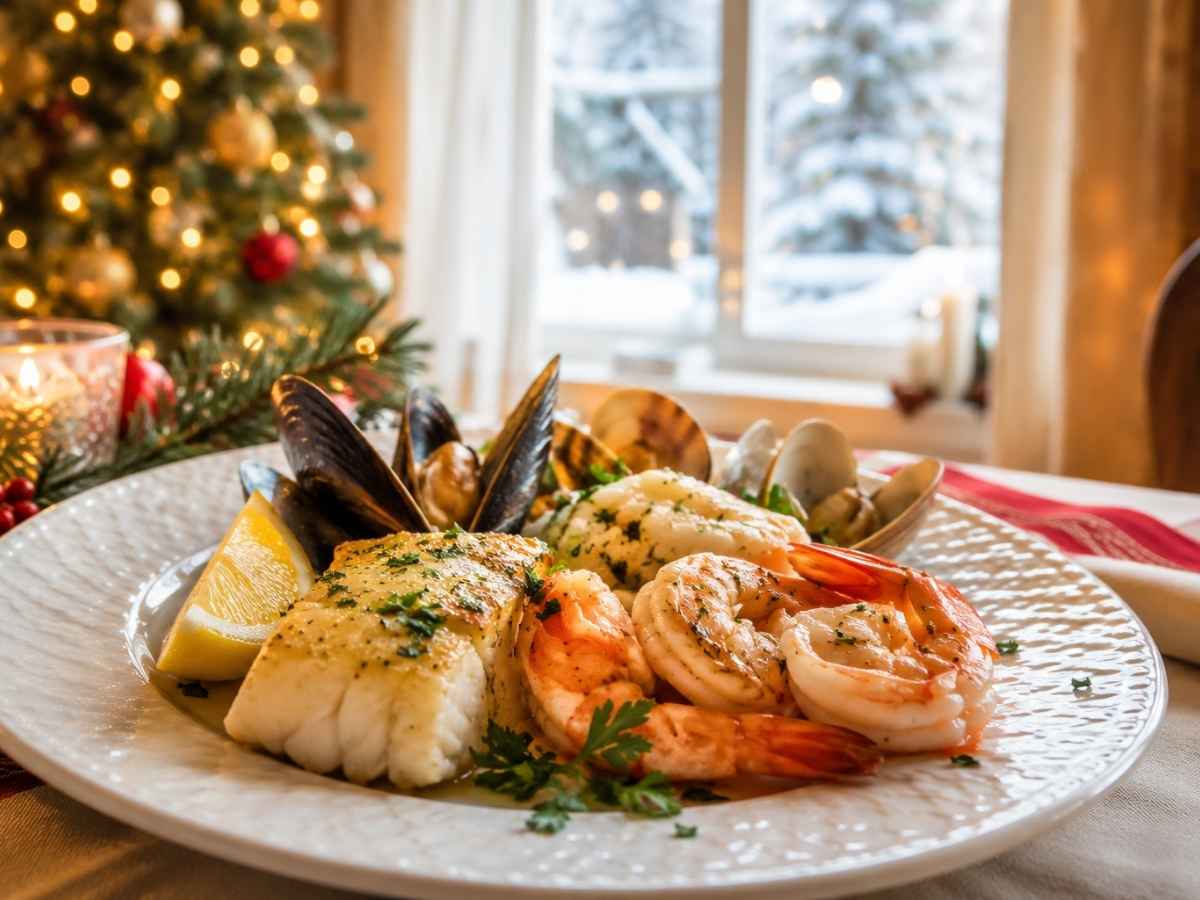
Christmas Eve — La Vigilia — is the most important night of the Italian Christmas for a great many families, and especially for southern Italian and Italian-North American ones. Traditionally a day of abstinence from meat, it became instead a celebration of the sea: the long meal Italian-Americans call the Feast of the Seven Fishes, eaten before Midnight Mass. In Italy the dinner is simply il cenone della Vigilia, the great Christmas Eve supper, and the number of fish varies from house to house; in the diaspora, seven became the number to defend.
In my family the Vigilia meant fish, always. Baccalà, calamari, shrimp, clams, smelts — and my nonna, who came from Calabria, at the stove from the morning onward, orchestrating the whole thing. My grandfather insisted on exactly seven fishes. A great-uncle maintained it should be nine. Neither ever conceded the point, and the table somehow accommodated both of them. For the children who would not eat fish there was a plate of plain spaghetti with butter, which nobody considered a betrayal of the tradition so much as part of it. And on the last Christmas Eve before she could no longer host, my nonna directed the cooking from her chair.
My grandfather said seven. My great-uncle said nine. My nonna cooked for both of them, and the kids who would not touch the fish got spaghetti with butter. That was the Vigilia — an argument, a stove, and a table that made room for everyone.
Read the full traditions of La Vigilia, the Italian Christmas Eve and the meaning behind the Feast of the Seven Fishes. And if you are the one cooking this year, our Seven Fishes menu builder will plan a menu for your guest count, scale the shopping list, build a cooking timeline for the day, and give you simple recipes for the classics.
After dinner came Midnight Mass — the Messa di mezzanotte — and in many homes, the moment everyone had waited for through Advent: the Christ child placed in the manger of the presepe, often by the youngest child in the house. In some families gifts were opened after Mass, in the small hours of Christmas morning; in others they waited for the day itself, or for the Befana.
The whole Italian year, on one free calendar
Get the free printable 2027 Italian Family Traditions calendar — every feast day from the Befana to the Immacolata, the saints’ days, and the seasonal customs, marked out the way a nonna would keep them. Enter your email and I’ll send it to you.
Christmas Day: the long table and the sweets
If Christmas Eve belongs to the sea, Christmas Day belongs to the table. The pranzo di Natale is a midday meal that can run well into the evening, and it is regional to its core. In Emilia-Romagna it begins with tortellini or cappelletti in brodo; in much of the south, with a baked pasta or lasagna; in the north, a roasted or boiled capon often follows. Dish after dish comes out over hours, in the same spirit as the Italian Sunday dinner raised to its highest form, and nobody leaves the table early.
And then there are the sweets. The great Italian Christmas breads — panettone, the tall Milanese sweet bread studded with candied fruit and raisins, and pandoro, the golden star-shaped cake from Verona — appear on almost every table, alongside regional treats: torrone, struffoli soaked in honey in Naples, cartellate in Puglia, panforte and ricciarelli in Siena, and countless family cookies. The two great cakes have their own rivalry — see our full guide to panettone vs. pandoro — and if you are planning a tray, here are the Italian Christmas cookies every family made, with a planner and free recipe cards. On cold evenings through the season there were roasted chestnuts too; here is how to roast chestnuts the Italian way.
Italian Christmas food, region by region
Italy is a country of regions before it is a country, and nowhere is that clearer than at Christmas. These are some of the dishes and sweets most strongly tied to the season in different parts of the country — a starting point, not a complete list, because every town and every family had its own.
| Region | On the table at Christmas | Signature Christmas sweets |
|---|---|---|
| Campania (Naples) | Capitone (fried eel) and baccalà on Christmas Eve; insalata di rinforzo | Struffoli, roccocò, mostaccioli, susamielli |
| Calabria | Baccalà and fried fish on the Vigilia; pasta with anchovies and toasted breadcrumbs | Turdilli, crispelle, pitta ‘mpigliata |
| Sicily | Baccalà and fish on Christmas Eve; sfincione in Palermo | Buccellato, cassata, cannoli |
| Puglia | Eel, baccalà, and fried pettole on Christmas Eve | Cartellate soaked in vincotto or honey |
| Lazio (Rome) | Fried baccalà and fish on the Vigilia; cappelletti in brodo on Christmas Day | Pangiallo, panpepato |
| Tuscany | Crostini di fegatini; pasta in brodo and roasts on Christmas Day | Panforte, ricciarelli, cavallucci |
| Emilia-Romagna | Tortellini or cappelletti in brodo on Christmas Day | Certosino (panspeziale) |
| Lombardy and Veneto | Capon, risotto, and rich broths on Christmas Day | Panettone (Milan), pandoro (Verona) |
| Abruzzo and Molise | Fish and fried vegetables on Christmas Eve | Calcionetti (caggionetti), torrone |
After dinner: Tombola and the family games
Once the meal winds down, the Italian Christmas becomes a family affair of a different kind. Tombola, the Neapolitan cousin of bingo, is played with the whole family gathered around the table, dried beans or orange peel marking the cards, and someone calling the numbers from a basket. Every number from 1 to 90 has its traditional meaning from la smorfia napoletana, which is why a good caller never just reads out “forty-seven” — he says ‘o muorto, the dead man, and waits for the room to react. At Christmas, 25 is ‘o Natale, and 32 is ‘o capitone, the eel still being digested from the night before. Learn how to play Tombola and what the numbers mean.
In my family the games after the fish were mostly simple ones, played with whatever was on the table. Rolling hazelnuts off a serving spoon to try to touch another nut. Guessing how many nuts were hidden in someone’s closed hand. And tombola, if we were lucky enough to own a set that year. Nobody needed anything more elaborate. The point was that nobody left the table, and that the youngest and the oldest were playing the same game.
A spoon, a handful of hazelnuts, and a closed fist. That was the entertainment after the fish — and if we were lucky that year, a tombola set. Nobody left the table.
December 26 to January 6: Santo Stefano, Capodanno, and La Befana
The Italian Christmas does not end on December 25. December 26 is Santo Stefano, the feast of the first martyr and a public holiday across Italy — a day for visiting the relatives you did not see on Christmas, eating the leftovers, and, in many towns, touring the presepi set up in churches. Then comes Capodanno, New Year’s Eve, with its own cenone: lentils for prosperity, cotechino or zampone alongside them, red underwear for luck, and in some places old things thrown out to make way for the new. Read about Capodanno, the Italian New Year.
And then, finally, the season closes on January 6, the Epiphany, with La Befana — the kindly old woman who flies from house to house on her broom on the night of January 5, filling children’s stockings with sweets if they were good and “coal” — usually black sugar candy — if they were not. The Three Kings arrive at the presepe that same day, completing the scene that began on December 8. For many Italian children the Befana rivals Christmas morning itself, and the old saying sums up the whole season: l’Epifania tutte le feste porta via — the Epiphany carries all the holidays away. Read the full story of La Befana and the Italian Epiphany.
How to say Merry Christmas in Italian — and the words of the season
A few words carry the whole Italian Christmas. These are the ones you will hear most often at the table, on the phone, and on the cards that arrive in December.
| Italian | English | When you hear it |
|---|---|---|
| Buon Natale | Merry Christmas | The standard greeting from December onward |
| Auguri! / Tanti auguri | Best wishes | Said all season, often on its own, by everyone |
| Buone feste | Happy holidays | Covers the whole stretch from Christmas to the Epiphany |
| Buon anno / Felice anno nuovo | Happy New Year | From Capodanno onward |
| La Vigilia | Christmas Eve | The night of the fish |
| Il presepe | The nativity scene | The heart of the Italian Christmas home |
| Babbo Natale | Father Christmas, Santa Claus | The gift-bringer in many modern Italian homes |
| Gesù Bambino | The Christ child | Placed in the presepe at midnight; in some families, the gift-bringer |
| La Befana | The Epiphany gift-bringer | January 5–6 |
Italian Christmas gifts: what families gave
Gift-giving in the older Italian Christmas was spread across the season and across several bringers — Santa Lucia, San Nicola, Gesù Bambino, Babbo Natale, and the Befana, depending on the region and the family. The gifts themselves were often modest and edible: a panettone carried to every house you visited, a tray of cookies, a bottle of homemade wine from the cantina, torrone for the children. What mattered was that you arrived with something.
That instinct still holds. If you are looking for gifts that carry the same weight — something rooted in the family rather than bought in a hurry — see our guides to meaningful Italian Christmas gifts and gifts for Italian grandparents, the people most likely to remember how Christmas used to be done. The Italian Heritage Bundle above, the Heritage Kit and the Saint Prayer Cards together, was made for exactly this kind of gift: one for the family’s memory, one for its faith.
What changed across the ocean — and what refused to
When Italian families emigrated to North America, the Christmas season came with them, but it adapted. The Feast of the Seven Fishes, in many ways, became more central in the diaspora than it had been in Italy — a fixed anchor of identity, defended by grandfathers who insisted on the exact number. Panettone crossed over intact and became the gift every Italian household gave and received. The presepe shared space with the tree. Some feast days faded, especially those tied to a single town’s saint; others, like the Befana, survived in families who kept the old calendar.
In cities like Montreal, Toronto, New York, and Boston, the Italian parishes kept the novena and the Midnight Mass, the Italian bakeries kept the struffoli and the cartellate, and the fish markets learned what to stock on December 23. What endured, above all, was the shape of it: a season and not a day, a long stretch of feast and family that held the year together. Many of these Italian Christmas traditions survived the crossing precisely because families refused to let them go. Understanding what stayed and what changed is part of the larger story of Italian-American traditions, and the rest of the year’s feasts are laid out in the complete Italian feast day calendar.
An Italian Christmas is a season, not a day — a month-long arc that begins with a tree and a presepe going up on December 8 and ends with the Befana’s broom on January 6, with the fish, the sweets, the saints, and the games in between. Keep the parts your family kept, learn the ones you never knew, and pass the whole shape of it on before it slips away.
Somewhere there is a table where a grandfather is still arguing for seven fishes and a great-uncle for nine. Make sure your children get to sit at it.
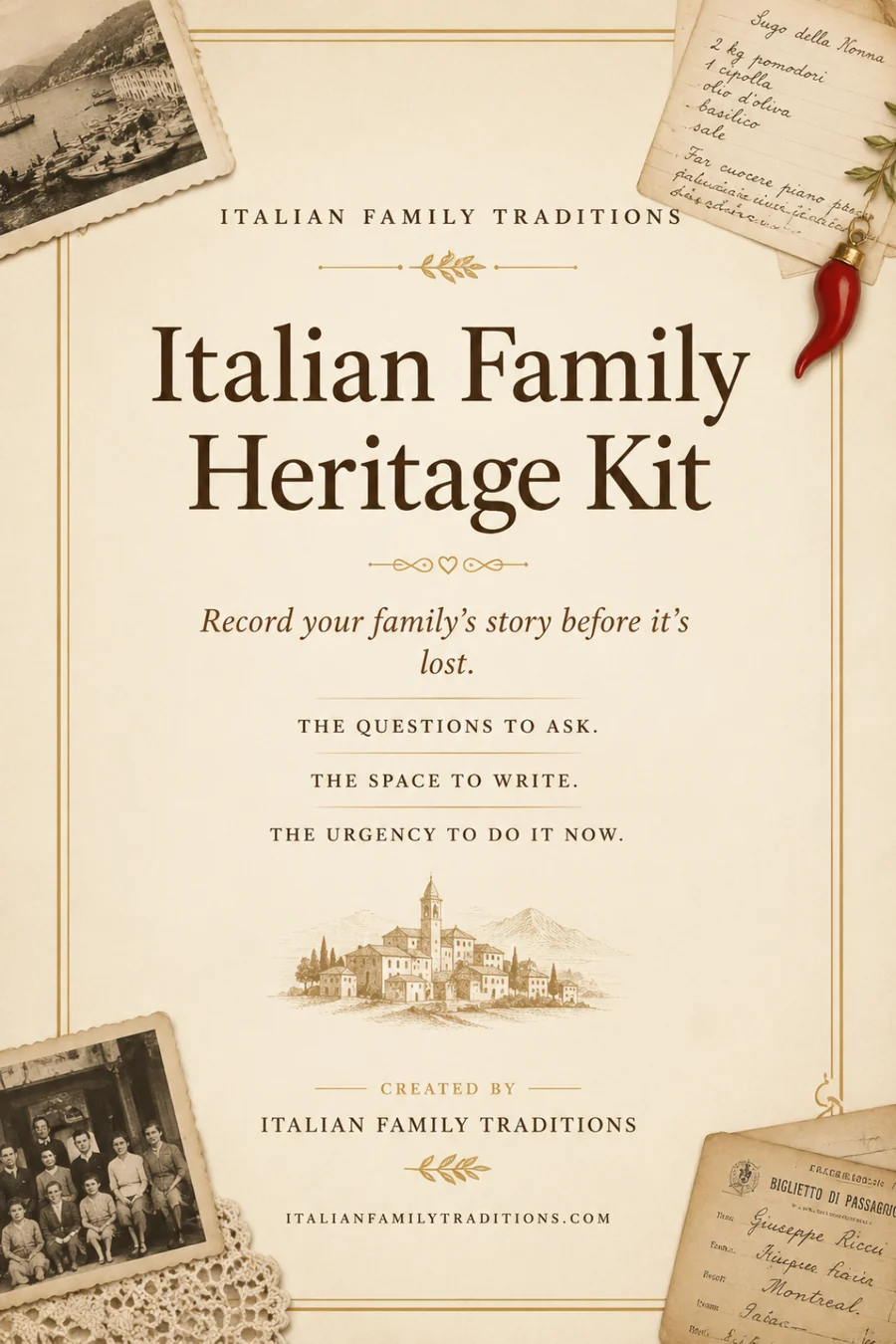
Preserve Your Christmas
Write down your family’s Christmas before it fades.
The recipes, the feast-day customs, the Vigilia menu only your family made. The Italian Family Heritage Kit gives you 133 guided pages to record it all — a keepsake for the next generation.
Explore the Heritage Kit — $19.99Instant digital download. Print it and complete it with your family.
FAQ
When does the Italian Christmas season start and end?
Traditionally it begins on December 8, the Feast of the Immaculate Conception (l’Immacolata), when many families put up the tree and begin the presepe, and it ends on January 6, the Epiphany, with La Befana. That makes the Italian Christmas a season of nearly a month rather than a single day, with Santa Lucia (December 13), the Christmas Novena (December 16–24), Christmas Eve, Christmas Day, Santo Stefano (December 26), and New Year in between.
What are the most important Italian Christmas traditions?
The essentials are the presepe (nativity scene), built from December 8 with the Christ child placed at midnight on Christmas Eve; the Christmas Novena; La Vigilia, the Christmas Eve fish dinner known in North America as the Feast of the Seven Fishes; Midnight Mass; the long Christmas Day meal; panettone and pandoro; tombola after dinner; lentils at New Year; and La Befana on January 6.
What is the Feast of the Seven Fishes?
It is the traditional Italian, and especially Italian-American, Christmas Eve meal — a long dinner of seven or more seafood dishes eaten on La Vigilia, historically a day of abstinence from meat. Common dishes include baccalà (salt cod), calamari, shrimp, clams, smelts, and eel. Every family has its own lineup, and many argue about the number.
Do Italians have Santa Claus?
Yes — Babbo Natale, Father Christmas, brings gifts in many modern Italian homes. But Italy has several gift-bringers depending on region and family: San Nicola on December 6 in parts of Puglia, Santa Lucia on December 13 in parts of the north and in Sicily, Gesù Bambino (the Christ child) on Christmas, and La Befana on the night of January 5.
When do Italians open their Christmas presents?
It depends on the family and the region. Some open gifts after Midnight Mass on Christmas Eve, many on Christmas morning, and in families that keep the older customs, children receive gifts from Santa Lucia on December 13 or from the Befana on January 6. Many families do a little of each.
What do Italians eat on Christmas Day?
Christmas Day centres on a long midday meal — often tortellini or cappelletti in brodo in the north and centre, a baked pasta or lasagna in the south, followed by roasts or capon and many courses over several hours. The signature sweets are panettone and pandoro, along with regional specialities like struffoli, torrone, cartellate, and panforte.
What is Santo Stefano in Italy?
Santo Stefano, December 26, is the feast of Saint Stephen, the first Christian martyr, and a public holiday in Italy. It is the second day of Christmas — a day for visiting relatives, eating leftovers, and in many towns visiting the presepi displayed in churches.
How do you say Merry Christmas in Italian?
Buon Natale. You will also hear Auguri or Tanti auguri (best wishes) all season, Buone feste (happy holidays), and from New Year’s Eve onward, Buon anno.
Who is La Befana?
La Befana is a kindly old woman who, on the night before the Epiphany (January 6), flies from house to house on her broom filling children’s stockings with sweets if they were good, or “coal” — usually black sugar candy — if they were not. She closes the Italian Christmas season.
How did Italian Christmas traditions change in North America?
Many carried over intact — the Feast of the Seven Fishes actually became more central in the diaspora as an anchor of identity, and panettone crossed over unchanged. Some feast days faded while others, like La Befana, survived in families who kept the old calendar. The core shape endured: Christmas as a season of feast and family, not a single day.

Marco Ricci is an Italian-Canadian writer and the grandson of Calabrian immigrants. He created Italian Family Traditions to document the customs, feast days, and family rituals Italian families carried from Italy to North America — and to understand what they actually meant. He is based in Montreal.