Italian Family Traditions
Italian Baby Naming Traditions: Why the Firstborn Carries His Grandfather’s Name
For centuries, an Italian child’s name wasn’t chosen — it was inherited, according to a rule so firm nobody had to say it out loud. I know, because I’m the one in my family who broke it. Here’s how Italian baby naming traditions actually worked, and what it means to carry a name that belonged to someone else first.
My name is Marco. It is mine alone — it wasn’t handed to me by a grandfather, it doesn’t repeat back through the family, it isn’t a version of anyone who came before. And in an Italian family, that makes me the strange one.
Because almost everyone around me was named by the rule. My cousins carry the old names, passed down exactly as tradition demanded — the juniors, the ones built around a grandfather’s name, the ones ending in the familiar way that tells you immediately whose line they belong to. My grandfather was Giovanni, and Giovanni echoes through my relatives in its worn-down forms — the Gian- names, the Gianni, the pieces of Giovanni fused onto whatever came next. Look closely at an Italian family and you don’t see a list of individuals. You see the same handful of names cycling through generation after generation, each new child slotting into a name that was waiting for them before they were born.
I didn’t do that. Neither did my parents, entirely, in naming me — and I chose, deliberately, to give my own children names that don’t come from anyone before them. Names that are theirs. I made that choice on purpose, and I don’t regret it. But the older I get, the more I understand the weight of what I stepped outside of — and the more I want to explain it properly, because it’s one of the most beautiful and least understood things Italian families ever did.
In an Italian family, a name was not a personal expression to be invented. It was an inheritance to be honored and continued — a way of keeping the dead in the room, generation after generation.
This is how the tradition worked, why it produced so many people with the same name, how it survived and mutated when families crossed the ocean, and what it means to carry — or not carry — a name that belonged to someone else first.
The rule: how Italian baby naming traditions actually worked
The core of it was a fixed sequence — so widely followed that most families observed it without ever discussing it. Panoram Italia lays out the traditional order plainly, and it’s the same one my own family lived by:
- The firstborn son was named after the paternal grandfather
- The firstborn daughter was named after the paternal grandmother
- The second son was named after the maternal grandfather
- The second daughter was named after the maternal grandmother
- Children after that took the names of great-grandparents, aunts, uncles, godparents, or the saint whose feast day fell near the birth
The order carried meaning. The paternal side came first — the firstborn son and daughter honored the father’s parents — which reflected a family hierarchy that was rarely spelled out but universally understood. This wasn’t the American habit of tacking “Junior” onto a father’s name; it was something older and more structured, a way of ensuring that the grandparents, not the parents, were the ones memorialized in the next generation. The Italian phrase for it is nome del nonno — the grandfather’s name — and the whole system was built to weave the presence of ancestors into every new child.
The tradition is far from dead. It’s still widely practiced across southern Italy and Sicily — which is exactly why, as more than one source dryly notes, you can walk into a family gathering in Calabria and find three or four Giuseppes answering to the same call. My family, with its roots in the province of Cosenza, was no exception. The names didn’t belong to people. They belonged to the line.
Free Printable
Who were you named after? The whole Italian year, on one calendar.
Every feast day and name day — the onomastico of the saint you may be named for — in one free printable calendar of the Italian year. Join the list and we’ll send it to you.
Why so many Italians share the same name
Once you understand the rule, the famous over-abundance of Giuseppes and Marias stops being a coincidence and becomes a mathematical certainty. If every firstborn son is named for his paternal grandfather, and that grandfather was himself a firstborn son named for his paternal grandfather, then the same name marches down the direct male line indefinitely. Meanwhile, every one of that man’s sons names their firstborn after him too — so cousins end up sharing the name as well. One popular grandfather could seed an entire generation of cousins who all answer to the same name.
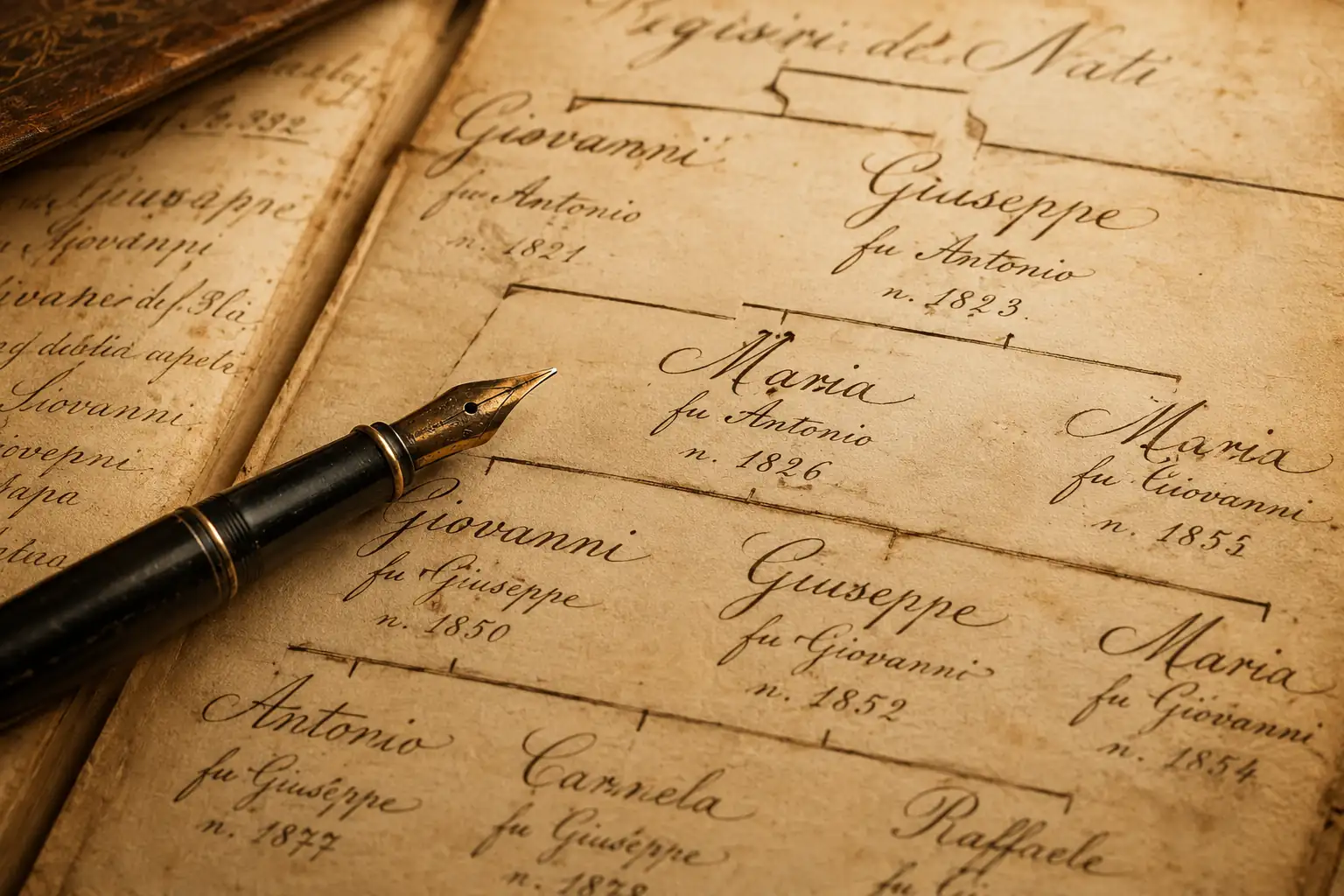
This is also why Italian genealogy researchers treat repeating names as evidence. As genealogists note, alternating names across generations — a Giovanni, then an Antonio, then a Giovanni again — often confirm that a family was following the naming pattern, which helps reconstruct a lineage even when written records are patchy. The name becomes an informal record of descent. If you want to trace your own line, recognizing these cycles is one of the first tools you’ll use — something I get into in how to find your Italian town of origin.
Also, these same names often changed once families emigrated — see what your Italian name becomes in English (and in Quebec French).
Look closely at an Italian family and you don’t see a list of individuals. You see the same handful of names cycling through, each child slotting into a name that was waiting before they were born.
There was even a rule for tragedy. Italian genealogy records show that if a child who carried a grandparent’s name died young, the next baby born was frequently given the same name again — so that the ancestor’s name would not be lost. In the records this produces the haunting pattern of two siblings with the same name, years apart. The name mattered more than any single child who briefly carried it. It had to survive.
When the firstborn was a girl: the female version of a grandfather’s name
The system had elegant workarounds. If a couple’s firstborn was a daughter but the family wanted to honor the paternal grandfather — for respect, and, some said, for luck — they would give the girl a feminine version of his name. Getting to Know Italy gives the pattern: Paolo becomes Paola, Francesco becomes Francesca, Carlo becomes Carla. A grandfather named Antonio could live on in a granddaughter named Antonia. The name bent by a single letter, and the honor was preserved.
This is also where the great tradition of compound names came from — and where my own family’s Giovannis went. Gian- is a shortened form of Giovanni used to build blended names, and it’s everywhere in Italian families carrying that name forward. Behind the Name lists a long parade of them: Giancarlo (Giovanni + Carlo, literally “John Charles”), Gianluca, Gianfranco, Gianpiero — and Gianmarco, which is simply Giovanni fused to Marco, the English “John Mark.” A family could satisfy the rule and add a second name in one stroke: the child carried the grandfather’s Giovanni and a name of their own, welded together. My relatives did exactly this, which is how one Giovanni became a whole cluster of Gian- names down the generations.
The hidden Marias: the names that vanished in plain sight
Here is one of the quietest and most poignant threads in the whole tradition, and it took me years to notice it in my own family.
For generations, an enormous number of Italian girls were given Maria as the first element of a compound name — Maria Roberta, Maria Concetta, Maria Grazia, Maria Teresa — a near-universal devotional gesture toward the Madonna. But in daily life, the Maria was very often dropped. The girl went by the second name for her entire life. The Maria sat there on the baptismal certificate, honored and invisible, spoken by no one.
My nonna went by Roberta her whole life. It was only much later that I learned her name was really Maria Roberta — and that almost no one, across decades, had ever known the Maria was there at all.
That detail undid me a little when I understood it. A whole first name — a devotion, a tribute to the Madonna, chosen with care at her baptism — carried silently for a lifetime, known to no one, spoken by nobody. It is the perfect emblem of how these names worked: they were never really about being called. They were about being carried. The Maria did its job simply by existing on the record, an inheritance the woman bore whether or not a single person ever said it aloud. If you have an older female relative who goes by one name, ask her whether there’s a hidden Maria in front of it. There very often is, and it’s one of the questions worth asking your grandparents before the answer is lost.
Names and the onomastico: why your name came with a saint
The naming tradition didn’t stand alone. It was bound tightly to the Catholic calendar, because so many of the inherited names were also saints’ names — and that meant every child inherited not just an ancestor but a day. When you were named Giovanni, you received the feast of San Giovanni. When you were named for a grandmother named Anna, you received Sant’Anna’s day. That annual celebration is the onomastico, the name day, and in traditional Italian life it was celebrated with nearly the weight of a birthday.
What makes this beautiful is how it stacks the meaning. A child named after a grandfather named Giuseppe carried, all at once: the grandfather, the name, and San Giuseppe’s feast on March 19. The name day became a single annual moment that honored the saint and the ancestor in the same breath. To be named, in an Italian family, was to be given a patron in heaven and an ancestor on earth, folded into one word. That’s why some families also named children directly after the saint whose feast fell near the birth — the name reached in both directions at once, toward the family and toward the divine.
Who Were You Named For?
The name, the grandparent behind it, the hidden Maria, the saint’s day it carried — these are exactly the details that vanish when no one writes them down. The Italian Family Heritage Kit gives you the questions to ask, and the space to record the answers, while there’s still someone to ask.
Explore the Italian Family Heritage Kit →What immigration did to the names
When Italian families came to Canada and the United States, the naming rule came with them — but it collided with a new language that couldn’t quite hold the old names. What followed is a pattern every Italian-Canadian family knows in its bones: the Italian name survived, but it grew an English shadow.
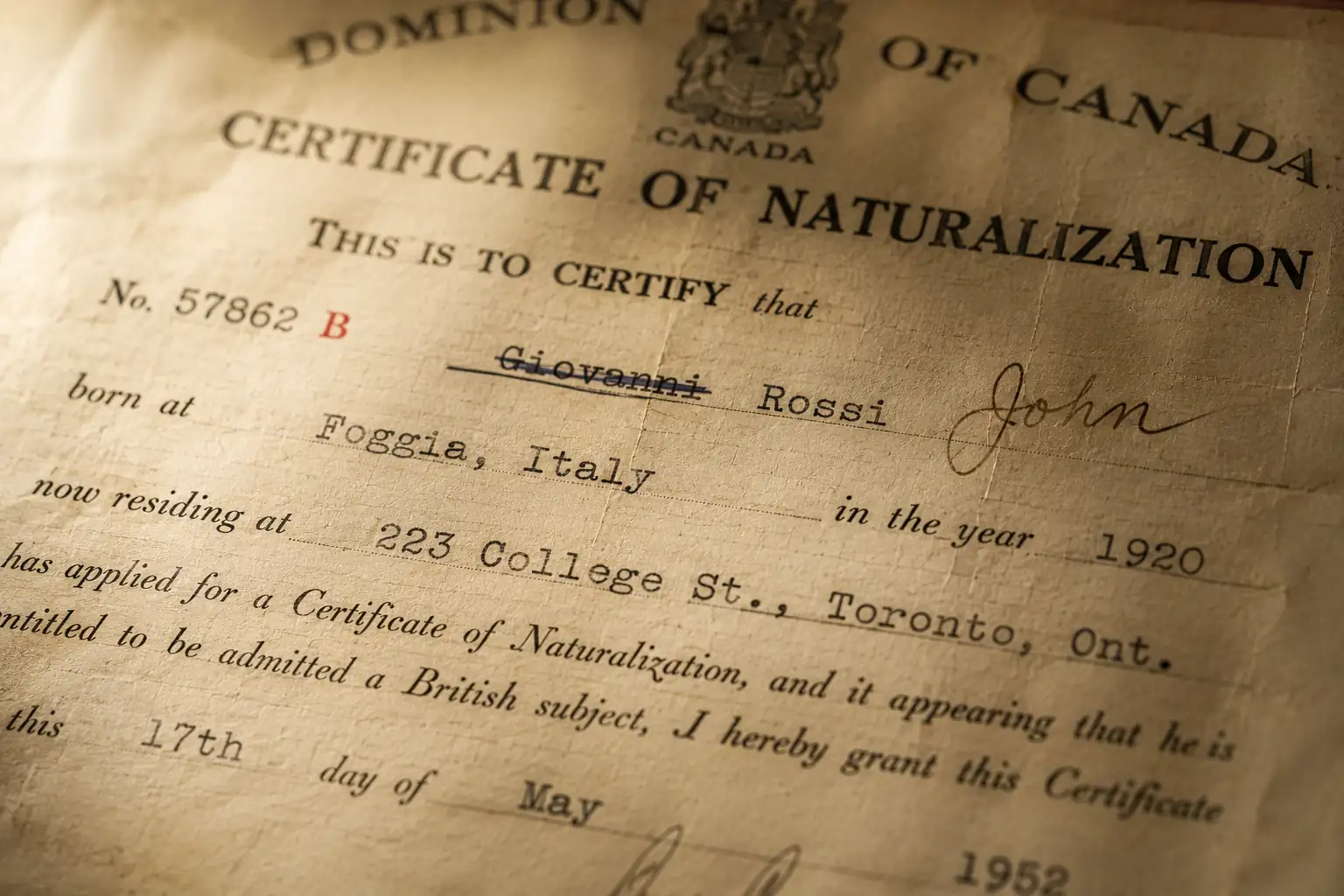
Giovanni became John. Giuseppe became Joe. And in my own family the anglicizations are everywhere. My uncle Alfredo became, to everyone outside the house, Alfie. My cousin was named Antonio after his grandfather — honoring the tradition perfectly — and then spent his whole life as Anthony, the Italian original preserved on the certificate and quietly translated in daily use. The name obeyed the rule and adapted to the country in the same stroke. This is the same softening I’ve written about in the wine and the greetings and the sound of a surname — the tradition survives, but the country files down its edges. It’s all part of the larger story of what Italian families kept and what changed after immigration.
Often the compromise was the middle name. The English first name went on the outside — the one for teachers, employers, forms — while the Italian ancestral name was tucked into the middle, still honoring the grandfather, still keeping the chain unbroken, just out of the new country’s earshot. A boy could be John Giovanni on paper: John for Canada, Giovanni for the family. The rule bent so it wouldn’t break.
| The Italian name | What it became in Canada | What was really happening |
|---|---|---|
| Giovanni | John, or Gianni → “Johnny” | The grandfather’s name, softened for a new language |
| Giuseppe | Joe, Joseph | Saint and ancestor, shortened at the door of daily life |
| Antonio | Anthony, Tony | The tradition honored, then quietly translated |
| Alfredo | Alfie, Fred | The name kept; the sound made friendly |
| Maria Roberta | “Roberta” (the Maria dropped) | The devotion carried in silence, the everyday name in front |
Breaking the pattern — and what I gave up
Which brings me back to my own name, and my children’s.
I gave my kids names that are theirs alone — chosen, not inherited. Names that don’t march back up the family line, that no grandfather wore first, that carry no obligation. I did it deliberately, because I wanted them to be individuals before they were a continuation, and I still believe that was the right choice for our family. I’m not writing this to recant it.
But I understand now what the old way was actually doing, and it’s worth being honest about the trade. When you name a child after a grandfather, you are not just being sentimental. You are performing a small act of resurrection every generation — keeping the dead present, giving a family a spine of continuity that runs straight back through the centuries, making sure that no ancestor is ever fully gone as long as someone still answers to their name. My cousins, the ones who followed the rule, carry that. When their grandfather’s name is called, something older than them answers. My children have their own names, free and clear — and they will not carry anyone forward the way my cousins do. That’s not a mistake. But it is a loss, and I’ve made my peace with naming it as one.
Maybe that’s why I do this — why I write any of it down. If my children won’t carry the old names, then at least they’ll have the record: who Giovanni was, why Roberta was really Maria Roberta, how the whole system worked, and what it meant to be a link in a chain rather than a name unto yourself. The tradition I broke, I can at least preserve. That’s what the recording of these things is for — so that even the traditions we choose not to continue are not lost, only set down.
My name is Marco, and it’s mine alone. My children’s names are theirs. In a family where a name was always a grandfather’s before it was yours, that makes us the ones who stepped outside the line. I don’t regret it — but I know now what the old names carried: the dead kept present, the chain unbroken, an ancestor answering every time the name was called. If your family still carries those names, you’re holding something centuries deep. And if, like me, you broke the pattern, then the least we can do is write down what the names meant — so the tradition survives even in the families that chose not to continue it.
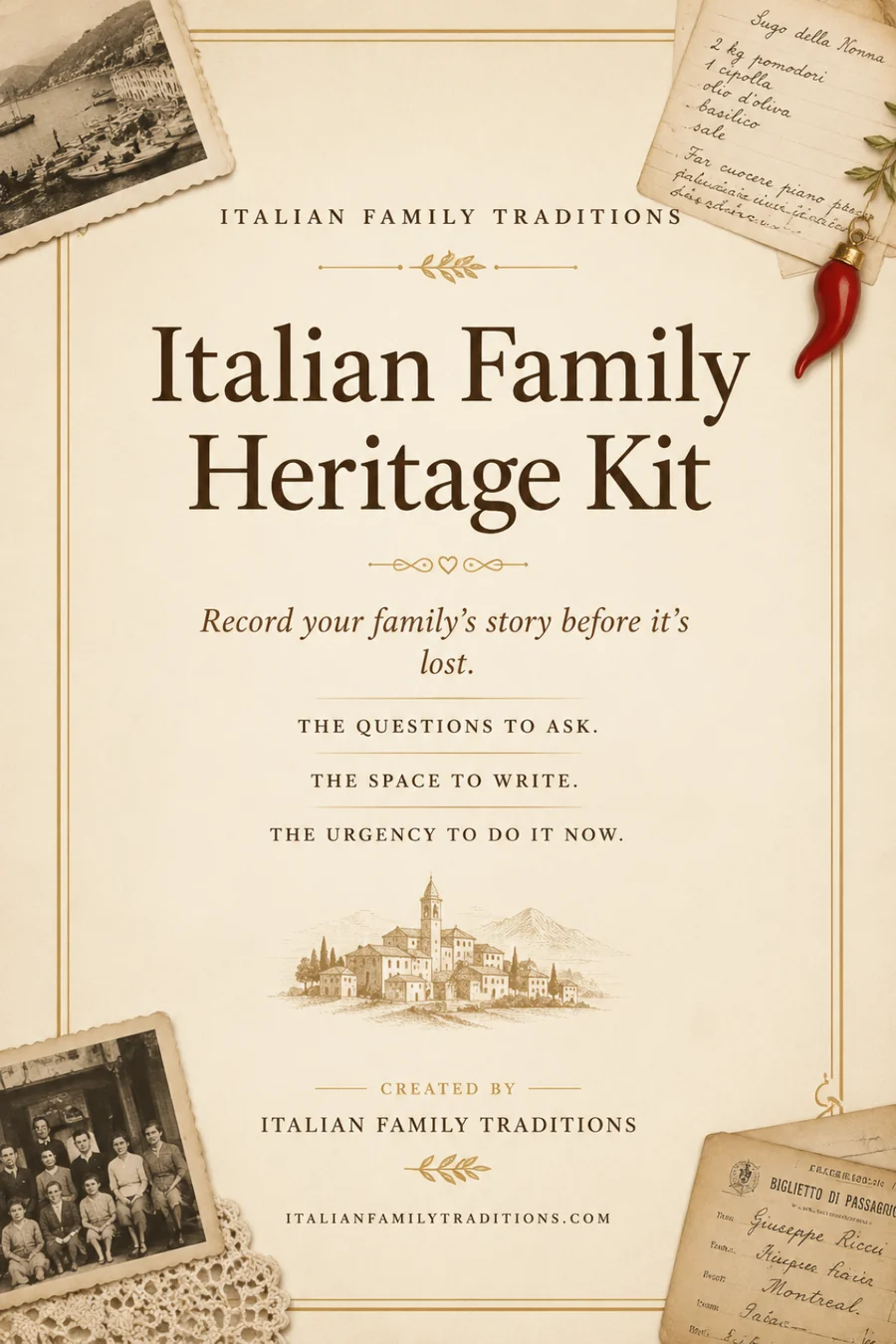
Every Name in Your Family Has a Story
Record who each name came from — before no one remembers.
Who was named for whom? What was the hidden Maria? Which saint’s day did each name carry? The Italian Family Heritage Kit includes 133 guided pages and more than 120 prompts to preserve your family’s people, names, traditions, recipes, sayings, photographs, and memories.
Explore the Heritage Kit — $19.99Instant digital download. Print it and complete it with your family.
The naming tradition connects to almost everything else Italian families carried. Read about the onomastico, the name day every name came with, and about Italian baptism traditions, where the name was first spoken over the child in church. To trace the ancestors these names honored, start with finding your Italian town of origin, and to preserve it all, read how to record your family’s stories before they’re lost.
FAQ
What is the traditional Italian naming pattern?
Traditional Italian baby naming follows a fixed order: the firstborn son is named after the paternal grandfather, the firstborn daughter after the paternal grandmother, the second son after the maternal grandfather, and the second daughter after the maternal grandmother. Later children are typically named after great-grandparents, aunts, uncles, godparents, or the saint whose feast day falls near the birth. The pattern was so widely followed that most families observed it without ever discussing it, and it remains common in southern Italy and Sicily today.
Why do so many Italians have the same name?
Because of the naming pattern. When every firstborn son is named after his paternal grandfather — who was himself named after his own paternal grandfather — the same name travels straight down the male line for generations. At the same time, all of a grandfather’s sons name their own firstborns after him, so cousins share the name too. The result is families with multiple Giuseppes, Giovannis, or Antonios in the same generation. Genealogists actually use these repeating names as evidence of lineage when written records are incomplete.
What happened if the firstborn was a girl but the family wanted to honor the grandfather?
Families would use a feminine version of the grandfather’s name. Paolo became Paola, Francesco became Francesca, Carlo became Carla, Antonio became Antonia. This let the family honor the paternal grandfather even when the firstborn was a daughter. The same instinct fed the tradition of compound names built with Gian- (a short form of Giovanni), such as Giancarlo, Gianluca, and Gianmarco — allowing a child to carry a grandfather’s Giovanni fused with a second name of their own.
Why were so many Italian women named Maria?
Maria was given as a devotional first name honoring the Madonna, extremely commonly as the first element of a compound name — Maria Roberta, Maria Concetta, Maria Grazia, Maria Teresa. In everyday life the Maria was frequently dropped, and the woman went by her second name for her entire life, so that many people never realized the Maria was there at all. It was carried on the baptismal record as an act of devotion whether or not anyone ever spoke it aloud. If an older female relative goes by a single name, there is often a hidden Maria in front of it worth asking about.
How did Italian names change after immigration to Canada and the US?
The names usually survived on paper but grew English equivalents in daily use: Giovanni became John, Giuseppe became Joe, Antonio became Anthony or Tony, Alfredo became Alfie. Often the Italian ancestral name was preserved as a middle name while an English first name went on the outside for school and work — so the naming tradition was honored while adapting to a new language. This meant a family could keep the chain of grandfather-names unbroken even as the everyday, spoken version of each name shifted toward English.
Is the Italian naming tradition still followed today?
Partly. It remains common in southern Italy and Sicily, where you’ll still find children named for their grandparents in the traditional order. In the diaspora and among younger generations, it has weakened — many modern Italian and Italian-Canadian parents now choose names freely, sometimes keeping the ancestral name only as a middle name, or setting the pattern aside entirely in favor of a unique name. Even where the tradition is no longer followed, understanding it reveals a great deal about a family’s history and the ancestors its names once honored.
Marco Ricci is an Italian-Canadian writer and the grandson of Calabrian immigrants. He created Italian Family Traditions to document the customs, feast days, and family rituals Italian families carried from Italy to North America — and to understand what they actually meant. He is based in Montreal.