Italian Family Traditions
Italian Kiss on Both Cheeks: Which First, How Many Kisses & When
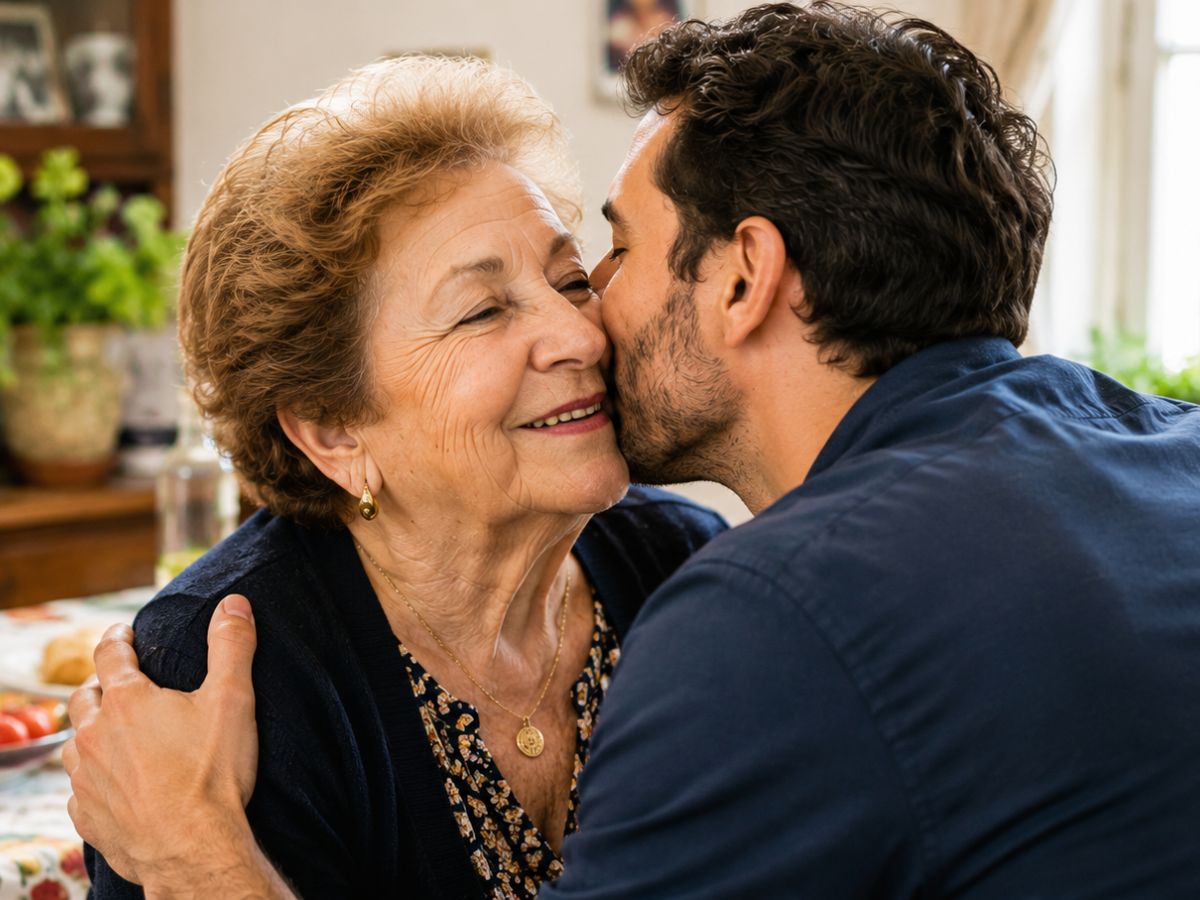
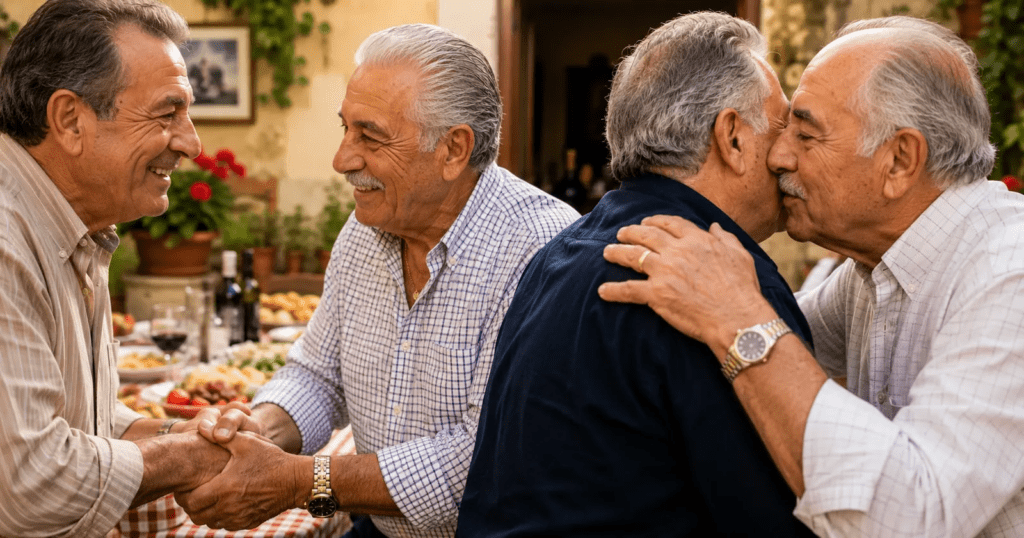
In my Calabrian grandfather’s house, the double kiss – or kiss on both cheeks – was simply how you greeted anyone — adults kissed adults, kids kissed elders, grown men kissed grown men, no questions asked, no hesitation. Then I met my other grandfather, from Tuscany, who shook hands with men and considered the kiss something else entirely. Same country. Same language, more or less. Two completely different answers to the same simple question of how you say hello.
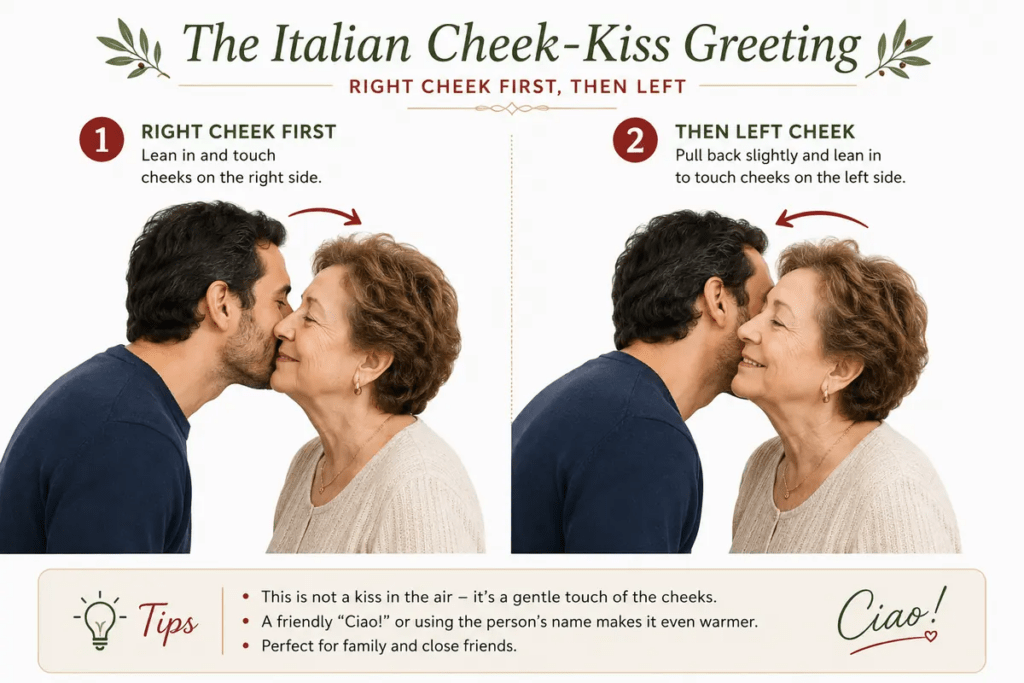
The quick answer: in most of Italy you give two kisses, and the direction matters — you move to your left first so your right cheek meets the other person’s right cheek, then switch sides. In other words, you start on the other person’s right cheek. Cheeks touch with a light kiss sound; lips usually don’t actually land on the skin. Among relatives and close friends it’s automatic — in many southern families, men kiss men too. With business contacts or someone you’ve just met in a neutral setting, a handshake is safer. But the honest truth is that it shifts by region, generation, and family, so use the guide below for your exact situation.
Should you cheek-kiss them? An interactive guide
Tell it where you are, who you’re greeting, and the occasion, and it’ll give you a sensible read — plus which cheek, how many, and whether lips touch. It’s a guide, not a law; when in doubt, follow the other person’s lead.
Italian Greeting Etiquette
Should You Cheek-Kiss Them?
The Italian cheek kiss has unwritten rules that shift by place, relationship, and setting. Answer three questions for a guide — not a law.
Where are you?
Who are you greeting?
What’s the occasion?
Your guidance appears here.
This is a friendly guide, not a rulebook — Italian greeting customs vary by region, generation, and family. When unsure, follow the other person’s lead: let them start, and mirror what they do.
How Did Your Family Say Hello?
Did everyone kiss both cheeks — or did some relatives shake hands?
The greetings your family took for granted often reveal exactly where they came from. Record the regional customs, sayings, traditions, and stories your family carried with them.
Preserve Your Family’s Story →133 guided pages · Instant digital download · $19.99
Two grandfathers, two greetings
I grew up assuming the double kiss (otherwise known as the kiss on both cheeks) was simply what Italians did. It took meeting my other grandfather to learn that “Italian” covers a lot more ground than that.
On my Calabrian side, the kiss on both cheeks was automatic and universal. You arrived at a gathering and kissed your way around the room — right cheek, left cheek, on to the next person — and it made no difference whether you were greeting your grandmother, your uncle, or a grown cousin you hadn’t seen in months. Men kissed men. Nobody hesitated. Nobody thought twice. It was simply the sound a greeting was supposed to make.
A few specifics from my own Calabrian side, because this is where the real texture lives. We lead by moving to our left — right cheek to right cheek first — that’s just how ours goes. The men kiss each other without a second thought; if someone’s feeling especially warm, you might even get a cheek squeeze along with it. Nonna doesn’t necessarily kiss the relatives she sees every single day — the everyday ones get a nod — but a relative she hasn’t seen in a while gets the full greeting, no question. At weddings, everyone’s in the kissing line; at the airport, an arrival means kisses followed by hugs and every other warm gesture the family can pile on. Southerners, honestly, are pretty nonchalant about the whole thing — it’s not a careful ritual you overthink, it’s just how you say hello.
Then there was my other grandfather, from Tuscany, for whom the rule was entirely different. Men shook hands. The kiss, in his world, belonged to a different category of relationship — not necessarily romantic, but more reserved, more selective, not something extended automatically to every man in the room simply because you were related to him. It was not coldness. It was a completely different, equally valid Italian custom, shaped by a different region with a different history of expressing affection between men.
I did not understand, as a kid, that I was watching two real and distinct regional cultures collide at the same family table. I just thought one grandfather was a hugger and the other wasn’t. It turns out the truth was bigger than personality. It was geography.
Free Printable
The small customs that marked your family’s region.
Get new stories about Italian customs, folk beliefs, and family traditions — plus the free printable calendar of the Italian year. Join the list and we’ll send it to you.
Where the cheek kiss actually comes from
The Italian habit of greeting with a kiss on both cheeks is old — old enough that crediting any single era with inventing it would be inaccurate.
The Local Italy credits the Ancient Romans with spreading the cheek kiss throughout Europe and North Africa, while noting they almost certainly did not invent the custom themselves — kissing as greeting predates them. Martina Minieri’s research on Italian greeting customs traces a continuous religious thread through the Christian tradition as well, where the kiss functioned as a sign of peace during Mass and a broader gesture of brotherhood and respect between believers — a meaning that persisted well beyond any specific liturgical use.
The custom kept evolving through the centuries. The same research describes kissing as a social gesture being common among people of high rank during the Middle Ages and Renaissance as a sign of courtesy and respect, before gradually becoming democratized and adopted by working-class Italians as well. The modern, casual, everyday version of the cheek kiss as we know it today only really accelerated in the 20th century, spreading especially through southern Italy and urban areas where cultural exchange and close-quarters cohabitation were more frequent — and the custom spread further still through the influence of cinema, television, and broader media in the late 20th and early 21st centuries.
Did you know? France takes the cheek kiss even further than Italy. L’Italo-Americano notes that while Italians generally exchange two kisses, the French often prefer four kisses in the North-West, and in parts of Corsica the count climbs to five.
The etiquette — which cheek, and when
There is an actual sequence to the Italian kiss on both cheeks, and getting it backwards is the single most common way newcomers end up somewhere they didn’t intend to.
L’Italo-Americano lays out the standard rule clearly: in most of Italy, you give two kisses, starting on the other person’s right cheek and moving to the left — meaning you move to your own left first so your right cheek meets theirs. Starting on the correct side is not a minor detail — get the order backwards and you risk meeting the other person’s lips instead of their cheek, an outcome nobody intends and everybody remembers.
Consistency matters just as much as direction. The Local Italy notes that if you have kissed someone once — at a previous meeting, or earlier the same day — you should kiss them again the next time you greet or say goodbye, since failing to follow through can leave the other person wondering, even briefly, what they might have done to offend you. The gesture, once established between two people, becomes the expected baseline going forward.
And while two kisses is the standard across most of Italy, it is not universal. Martina Minieri’s research notes that three kisses, while less common overall, do appear in specific regions and social contexts — particularly in parts of Sicily and Campania, especially during festive occasions or family gatherings, where the extra kiss signals a particularly deep level of affection rather than a fixed regional rule.
Why the north and south are so different about the kiss on both cheeks
The single biggest variable in whether a cheek kiss is appropriate between two men has almost nothing to do with personality and almost everything to do with which part of Italy you’re standing in.
This is exactly the divide my two grandfathers represented, and it is well documented rather than a quirk specific to my family. It is the same north-south split that shapes why southern Italians gesture far more than northern Italians, and even how the southern nonna differs from her northern counterpart. A detailed Quora answer on the custom’s origin notes that in southern Italy specifically, men generally reserve the kiss for family members and prefer a pat on the back to show affection in more general greetings. The Local Italy confirms the broader pattern: the double cheek kiss (kiss on both cheeks) is most commonly used between two women, or between a woman and a man, while men typically shake hands with each other — except in certain areas, mostly in the southern part of the country, where man-on-man cheek kissing is genuinely the norm rather than the exception.
Tuscan Traveler confirms this is precisely the pattern — usually the cheek-kissing routine runs between women and women, and men and women, but there are regions in Italy, mostly in the south, where men greet one another with kisses on either cheek as a matter of course. This is exactly the contrast that played out at my own family table: a Calabrian grandfather for whom this was simply normal, and a Tuscan grandfather for whom it was not the custom at all.
| Region | Typical greeting between men |
|---|---|
| Southern Italy (Calabria, Sicily, Campania, Puglia) | Cheek kiss between men is common and often automatic between family and close acquaintances |
| Northern and Central Italy | Handshake is the default between men; cheek kiss reserved more selectively |
| Women greeting women, or men greeting women | Cheek kiss is the near-universal default across most of Italy, north and south |
| First meeting or formal/business context | Handshake regardless of region — the kiss is reserved for informal, personal relationships |
When it’s a handshake instead
Even in families and regions where the kiss is the norm, it isn’t unconditional — context still decides which greeting is correct.
Tuscan Traveler offers the clearest practical guidance: consider how well you know the person, whether the occasion is business or social, and follow the lead of the people around you. When in doubt, the safest route is a handshake, particularly for a man meeting another man for the first time, in any region. Civilisable’s etiquette guide reinforces this directly — if you’re meeting someone for the first time or greeting in a formal context, starting with a handshake and following their cues is considered the more respectful choice, even in regions where the kiss is the everyday default among family.
This is the nuance that gets lost when the custom is reduced to a single rule. It was never really “Italians kiss” or “Italians shake hands.” It was always closer to: family and close relationships get the kiss, new and formal relationships get the handshake, and which version of “close” applies to a given man depends heavily on which region shaped his particular sense of where that line sits.
The kiss on both cheeks in Italian-Canadian families
The custom traveled to Montreal exactly as regionally specific as it left Italy — meaning two Italian-Canadian families could have completely different defaults, and both would be correctly carrying on their own authentic tradition.
Because the vast majority of Italian immigration to Canada in the mid-20th century came disproportionately from southern Italy and Sicily, the automatic kiss on both cheeks — the version my Calabrian grandfather practiced without hesitation — became the dominant version inherited by most Italian-Canadian families. It is the version most commonly recognized today as simply “the Italian greeting,” even though, as the regional divide makes clear, it was never the single national standard to begin with.
Families with roots in Tuscany and other parts of northern Italy, like my other grandfather’s, carried a quieter, more selective version of physical greeting across the same ocean — equally authentic, equally Italian, simply shaped by a different regional history. Neither version is more correct than the other. They are both real inheritances, carried faithfully from two different parts of the same country, and the contrast between them says more about Italy’s genuine regional diversity than any single generalization about “how Italians greet each other” ever could.
This same kind of quiet regional variation — different families carrying authentically different versions of “Italian” depending on exactly where their ancestors came from — runs through the broader story explored in Italian-American traditions: what changed and what stayed.
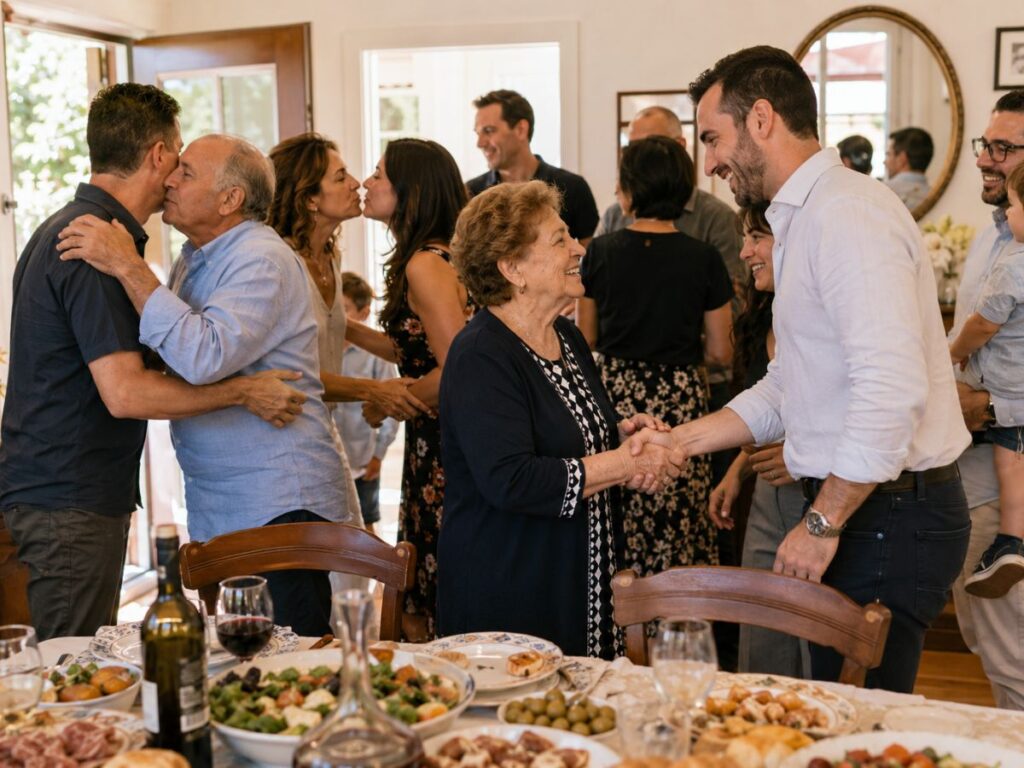
Two grandfathers. Two completely different ways of saying hello. One kissed everyone in the room without a second thought. The other shook hands with the men and meant every bit as much warmth by it. Both of them were right. Both of them were entirely, authentically Italian. The country was always bigger, and more regionally specific, than any single greeting could capture.
How Did Your Family Say Hello?
Record the greetings, regional customs, and family stories behind them.
Did everyone kiss both cheeks? Did the men shake hands? Did different sides of the family greet one another differently? The Italian Family Heritage Kit includes 133 guided pages and more than 120 prompts to preserve your family’s people, names, traditions, recipes, sayings, photographs, and memories.
Explore the Heritage Kit — $19.99Instant digital download. Print it and complete it with your family.
Regional variation like this runs through nearly every Italian custom explored on this site — the way cheese on seafood pasta traces back to a geographic divide between coastal and inland regions, or the way fare bella figura plays out differently depending on where in Italy a family is from. You’ll find the same regional thread in the figure who held it all together — the Italian nonna — and across the whole Italian feast day calendar. For the broader story of how these regional differences shaped Italian immigrant communities, read Italian-American traditions: what changed and what stayed.
FAQ
Why do Italians kiss on both cheeks as a greeting?
The custom has deep historical roots, with the Ancient Romans credited with spreading the cheek kiss as greeting throughout Europe and North Africa, though they likely did not originate it themselves. The Christian tradition reinforced the gesture through the “kiss of peace” used during Mass, symbolizing brotherhood and respect among believers. Over the following centuries the gesture evolved from a sign of courtesy among high-ranking individuals in the Middle Ages and Renaissance into a broadly democratized everyday greeting, accelerating especially through the 20th century in southern Italy and urban areas.
Which cheek do you kiss first in Italy?
The standard convention across most of Italy is to start on the other person’s right cheek and then move to the left. That means you move your head to your own left first, so your right cheek meets their right cheek. Getting this order backwards is one of the most common ways newcomers accidentally end up closer to a lip kiss than intended, since the two participants’ movements are coordinated around the expected right-then-left sequence. Following the other person’s lead, rather than initiating confidently if you’re unsure, is generally the safer approach.
Do Italian men kiss each other on the cheek?
It depends heavily on region. In much of southern Italy and Sicily, cheek kissing between men, particularly family members and close acquaintances, is common and unremarkable. In northern and central Italy, the more typical greeting between men is a handshake, with the cheek kiss reserved more selectively. This regional divide is well documented and reflects genuine cultural differences across Italy rather than a single uniform national custom.
Is it always two kisses, or does it vary?
Two kisses, one on each cheek, is the standard across most of Italy. However, three kisses do appear in certain regions and contexts, particularly in parts of Sicily and Campania during festive occasions or family gatherings, where the extra kiss typically signals especially deep affection rather than indicating a fixed regional rule everyone follows. The exact number can also depend on personal or family preference beyond strict regional patterns.
What is the Italian “double kiss”?
The “double kiss” is simply the common English name for the standard Italian greeting: one kiss on each cheek, starting on the other person’s right cheek and then the left. It is sometimes typed online as “double check kiss,” a garbled version of “double cheek kiss,” but all three refer to the same gesture — two light kisses, often just a brush of cheeks with a kissing sound rather than lips on skin, exchanged as hello or goodbye. It is the default greeting between women, and between a man and a woman, across most of Italy, and between men as well in much of the south.
What is the difference between an Italian kiss and a French kiss?
As a greeting, an “Italian kiss” means the cheek-kiss greeting — two kisses, one on each cheek, exchanged socially to say hello or goodbye, with no romantic meaning at all. The greeting sometimes called the “French kiss” in this same sense refers to the French bise, where the number of cheek kisses varies by region: commonly two, but four in parts of north-western France and up to five in parts of Corsica. The Italian version is a cheek-touch rather than a lip kiss, which is exactly why starting on the correct side — the other person’s right cheek — matters, since getting the order backwards is how people accidentally meet in the middle. (“French kiss” is of course also used for a romantic, open-mouth kiss, but that is a separate meaning entirely and not a greeting.)
When should you shake hands instead of cheek-kissing in Italy?
A handshake is the appropriate and safer choice when meeting someone for the first time, in business or formal settings, or any time you are uncertain about the relationship or the other person’s regional customs. The cheek kiss is generally reserved for informal, personal relationships — family, friends, and established acquaintances — rather than extended automatically to strangers or new professional contacts, regardless of which region’s customs are in play.
Why is the kiss on both cheeks more common in southern Italy than northern Italy?
While the exact historical reasons aren’t fully settled, the pattern is consistently documented: southern Italian and Sicilian culture has historically tended toward warmer, more physically expressive social customs, while northern Italian culture, often shaped by different historical influences and closer proximity to more reserved Central European norms, tends toward more measured physical greetings between men specifically. The divide is consistent enough that it shows up reliably across etiquette guides, regional accounts, and the lived experience of families with roots in both regions.
Did the Italian cheek kiss survive immigration to Canada and the United States?
Yes, largely intact, particularly among families with southern Italian and Sicilian roots, since the majority of Italian immigration to North America in the mid-20th century came disproportionately from those regions. As a result, the automatic, universal double-kiss greeting became the version most commonly recognized today as the default “Italian greeting” within Italian-Canadian and Italian-American communities, even though families with northern Italian roots carried an equally authentic, more reserved version of the same broader tradition.
Marco Ricci is an Italian-Canadian writer and the grandson of Calabrian immigrants. He created Italian Family Traditions to document the customs, feast days, and family rituals Italian families carried from Italy to North America — and to understand what they actually meant. He is based in Montreal.