Italian Family Traditions
What Is San Martino? Italy’s November Tradition Explained
A saint’s cloak divided in the cold. One last patch of autumn sun. Chestnuts roasting. The new wine finally ready. And an Italian grandfather standing at the window saying something about the weather that sounds like a proverb because it is a proverb.
My grandfather watched the weather on November 11 the way other men watch sports — with personal investment, strong opinions, and a complete willingness to hold the weather accountable if it failed to perform. San Martino was supposed to bring a few mild days, a last patch of autumn warmth before winter settled in properly. This was not a hope. It was, in his view, an arrangement. If the sun came out around November 11, he accepted it with the satisfied nod of a man whose understanding of the calendar had been confirmed. If it did not, he regarded the cold with a particular expression that communicated that November had fallen short of its obligations.
He was from Calabria, where San Martino was felt as much as observed — in the air, in the wine, in the quality of November light, in the sudden appearance of chestnuts roasting on the stove. He did not celebrate the feast in any formal way. He marked it the way Italian families have always marked the quieter traditions: by noticing the date, saying the right things about it, and treating it as a checkpoint in the year that the rest of the world had apparently failed to notice was important.
San Martino is one of those dates that older Italian generations treated like a seasonal contract — a point where the year officially changed hands, the wine was ready, and everyone, big and small, needed to start dressing warmly.
What San Martino is
San Martino is the Italian celebration of Saint Martin of Tours on November 11. As Encyclopaedia Britannica explains, Martin was a 4th-century bishop of Tours whose Western feast day falls on November 11. As Treccani notes, that date in Italy became tied to proverbs, rural customs, wine, weather observations, and even moving day in some regions.
San Martino falls in the heart of the season for both roasting chestnuts and tasting the new wine — and if you pressed your own grapes, this is how much wine they made.
In family life, San Martino is more than a saint’s name on the church calendar. It is one of those dates older generations used as a seasonal checkpoint — a pause in the year when the harvest had ended, the weather was shifting, the wine was changing, and winter was close enough to be felt without having fully arrived. That combination gave the day its specific atmosphere. Not religious solemnity exactly. Not festive noise. Something more like a warm, slightly elegiac awareness that the year had turned a corner and that there were things — the chestnut, the new wine, the last soft days of light — worth noticing before they were gone.
Who Saint Martin was — and why the cloak story matters
Saint Martin of Tours was born around 316 and died in 397. Britannica describes him as the father of monasticism in Gaul and one of the most significant early leaders of Western Christianity. His feast day is November 11 in the Western Church.
The part of his story that everyone remembers is the cloak. Martin, while still serving in the Roman military, met a freezing beggar outside the gates of Amiens in winter. He had no money to give. He drew his sword and cut his military cloak in half, giving one half to the beggar. That night, according to the tradition Britannica records, he had a vision of Jesus wearing the half-cloak he had given away.
That story matters because it explains why San Martino never became only a weather tradition or only a wine tradition. At its heart it is a story about generosity — the specific kind of mercy that does not wait for a convenient moment, that uses what is at hand, that gives what it can rather than what it intended to. A cold day. A person in need. A sword. Half a cloak. A vision that said the giving was received. Once a story like that attaches to a date, it stays attached. The chestnut and the wine and the mild weather gathered around November 11 because the story was already there, making the day feel worth marking.
My grandfather told the cloak story every year on San Martino, but he told it in a specific way: briefly, without embellishment, as though it were simply a fact about November 11 that anyone paying attention would already know. He did not make it dramatic. He stated it. Martin was in the army. He met a beggar in the cold. He cut his cloak. He gave half. That night, the vision. And then my grandfather would say nothing more about it and pick up his glass, and that was the sermon. I understood much later that the brevity was the whole point. Some stories do not need to be amplified. They only need to be repeated, once, at the right time of year, so that the children in the room absorb them without knowing they are being given something.
The proverbs — what Italians said about November 11
No Italian tradition worth keeping arrives without proverbs, and San Martino has some of the most specific and satisfying in the autumn calendar. They are not grand or philosophical. They are practical, sensory, and delivered with the particular Italian satisfaction of a saying that compresses an entire seasonal observation into a single line.
A San Martino ogni mosto è vino. — By Saint Martin’s Day, every must has become wine.
L’estate di San Martino dura tre giorni e un pochino. — The summer of Saint Martin lasts three days and a little bit.
A San Martino si veste il grande e il piccino. — At Saint Martin, everyone — big and small — dresses warmly now.
Per San Martino, castagne e vino. — For Saint Martin, chestnuts and wine.
Each of those lines does something specific. The wine proverb marks the completion of the harvest cycle — the moment when the agricultural year’s primary product had reached its finished state. The estate proverb names that specific quality of November warmth that Italians have always known. The clothing proverb makes the seasonal turning practical and communal. And the chestnuts-and-wine proverb names the specific sensory experience of the day: the smell, the taste, the particular autumn comfort of those two things together.
Treccani records several of these proverbs, connecting them to the agricultural and seasonal meanings of the feast. These were not decorative folk sayings. They were the functional vocabulary of people who used the calendar to manage their lives — to know when to bottle the wine, when to bring out the winter clothes, when to stop expecting warmth and start preparing for the cold.
The estate di San Martino — Italy’s brief November summer
The estate di San Martino deserves its own section because it is one of the most beautiful ideas in the Italian seasonal calendar: the brief mild-weather spell around November 11 that gives autumn one last soft, luminous stretch before winter makes its final claim on the year.
It corresponds roughly to what English speakers call an Indian summer — that unexpected warm interlude in late autumn when the light takes on a particular quality, the air is still rather than cutting, and the sense of seasonal reprieve is almost unbearably pleasant precisely because everyone knows it is temporary. The Italian version names this for a saint, which gives it an additional layer: the mild days are Martin’s days, his gift to November before the cold he once shared his cloak against returns in full.
Whether the estate di San Martino reliably appears on schedule is a matter of meteorological inconsistency rather than folk failure. The tradition is that it lasts three days and a little bit — and some years it does and some years it does not, and in either case older Italians have an opinion about what that means for the winter ahead. That interpretive flexibility — the weather as a sign that rewards attention — is the same instinct that produced i giorni della merla and every other Italian tradition of reading the natural world for meaning.
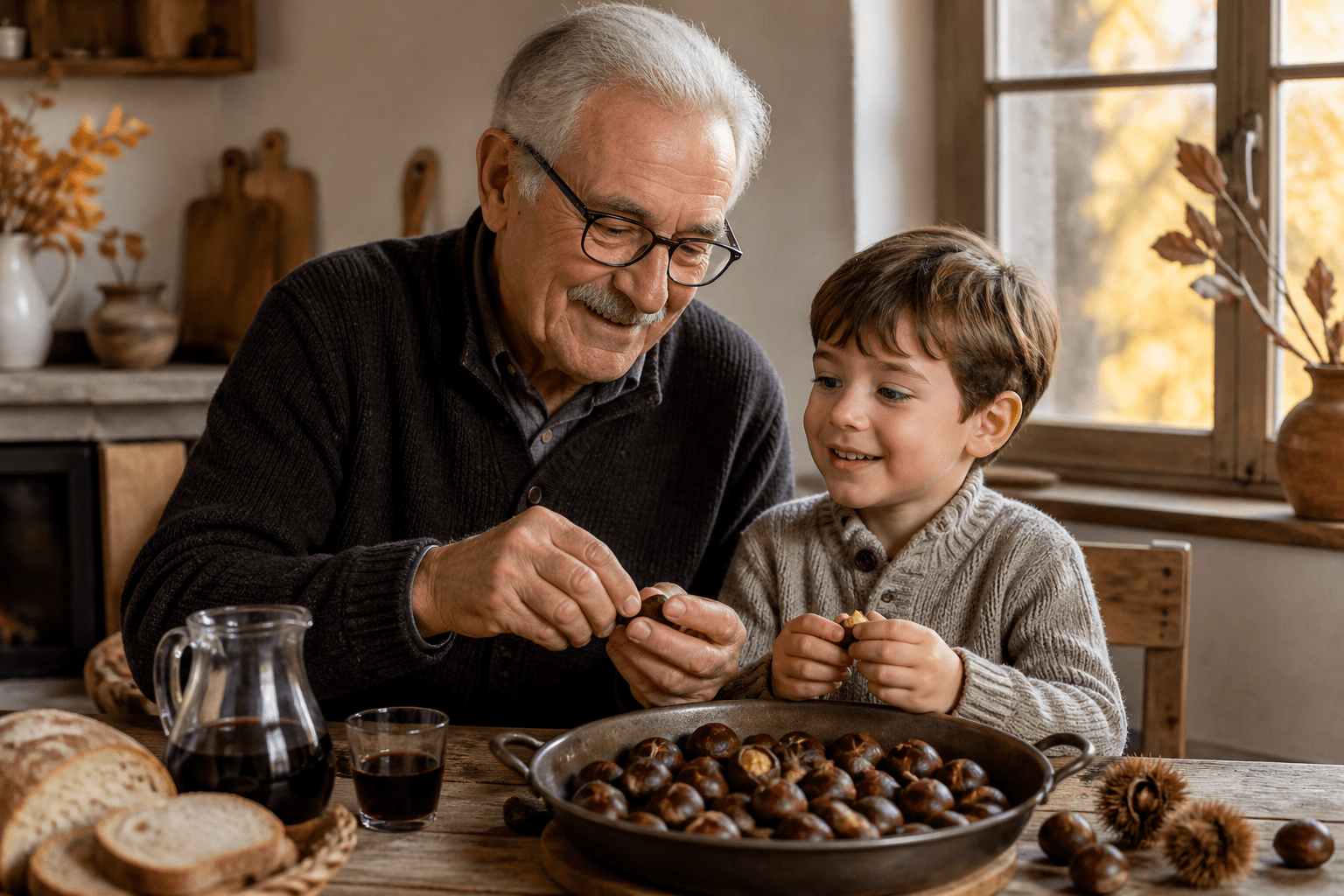
The San Martino I remember most clearly was the year the estate came through on schedule and my grandfather, who had been watching the sky all week, felt personally vindicated. The mild days arrived. He opened the new wine. He roasted chestnuts on the stove — not a fireplace in a Montreal house but the same pan, the same smell, the same specific deliberateness. He sat at the kitchen table and looked out at the November light in a way that communicated contentment without saying it. “San Martino,” he said, to nobody in particular. The wine was good. The chestnuts were good. The light was doing what it was supposed to do. November had kept its side of the arrangement.
Fare San Martino — when the feast meant moving house
One of the most fascinating and most overlooked aspects of San Martino is the phrase fare San Martino — to do Saint Martin, meaning to move house. Treccani documents this directly: in northern Italy, November 11 was traditionally a deadline for rental and agricultural contracts, which made it a common day for tenants to pack up and transition to new arrangements. The phrase became so embedded in daily language that fare San Martino came to mean moving house in general, even in cities where the agricultural contract logic no longer applied.
That detail is one of the most humanizing aspects of the whole tradition. San Martino was not only poetry and proverbs and mild weather. For many Italian families, it was a day of real change — packing things up, leaving a farm or a home, arriving somewhere new. The feast of a saint known for generosity became associated with the specific vulnerability of moving, of transition, of starting again with what you could carry.
For Italian families in the diaspora, fare San Martino carries an additional resonance: immigration itself was, in some sense, the ultimate San Martino — a leaving in autumn, a cloak divided, an arrival somewhere new with whatever could be carried. The connection is not one the tradition explicitly makes. It is one that families who observe the feast and know their own history can make for themselves.
How San Martino is celebrated across Italy
Like most Italian traditions, San Martino was never one uniform national observance. It expressed itself differently by region, by climate, and by whether the family in question was connected more to the agricultural calendar or to the urban customs that grew up around it.
| Region / context | How San Martino was observed |
|---|---|
| Rural Italy broadly | Agricultural checkpoint: the moment when contracts turned over, provisions were assessed, the wine was declared ready, and the year’s work was essentially complete. Chestnuts roasted. New wine opened. Proverbs about weather, warmth, and winter spoken at the table. |
| Venice and the Veneto | Child-centered tradition: children go through the city in paper crowns and capes, banging small pots, asking for sweets or coins. Bakeries sell the glazed dolce di San Martino — a shortcrust biscuit shaped like the saint on horseback, decorated with sugar and chocolate. |
| Northern Italy (Lombardy, etc.) | San Martino as moving day — fare San Martino as the expression for household transitions, contract endings, new beginnings. The feast as a hinge point in the domestic year rather than only a seasonal one. |
| Southern Italy | The feast observed more devotionally, with the saint’s story and the cloak at the center, the estate di San Martino watched with particular attention, and the proverbs about winter dressing and seasonal change repeated in the kitchen. |
That range — child’s noisy biscuit celebration in Venice, agricultural contract deadline in Lombardy, devotional seasonal marker in the south — is why Italian diaspora families sometimes have very different memories of what San Martino meant. They are all right. They are remembering different parts of the same tradition.
The Venetian dolce di San Martino — a feast for children
Venice deserves a moment of its own here because the Venetian San Martino tradition is one of the most charming in the Italian autumn calendar. Visit Venezia describes how children go through the neighborhoods of Venice on November 11 banging pots and asking for sweets or coins — a custom rooted in the spirit of Martin’s own generosity, transposed into a children’s ritual of asking and receiving.
The bakeries of Venice sell the dolce di San Martino for this occasion: a shortcrust biscuit shaped like the saint on horseback, glazed and decorated with sugar, chocolate, and colored sweets. It is the kind of pastry that is simultaneously a religious image and a child’s treat, which is the most Venetian possible resolution of those two things. The saint’s story — the divided cloak, the beggar in the cold — is embedded in the shape of the biscuit and available to whoever tells it.
Visit Venezia also notes that the Venetian feast was once treated almost like a peasant New Year — a moment of eating and drinking before the abstinence that would eventually lead to Christmas, a celebration of the year’s completed work before the long interior season of Advent began. Italia.it confirms the same tradition, noting that today children go through the city wearing paper crowns and capes. That framing — San Martino as the last feast before the quiet — gives the Venetian tradition its particular warmth and slightly elegiac quality.
San Martino in Italian-Canadian and Italian-American families
San Martino crossed the ocean the way the quieter Italian traditions often did: not as a formal ceremony but as a sensibility. A date noticed. A proverb repeated. A quality of attention given to November 11 that the surrounding culture did not share.
In Montreal’s Italian community — in the houses of Little Italy and later in Saint-Michel and Rivières-des-Prairies — San Martino was not an elaborate public observance. But it was present in the way that family-carried traditions are present: in what someone said at the table, in whether the wine was opened on that specific night, in the roasted chestnuts appearing with a specific purposefulness, in the grandfather who watched the sky for the estate and took it personally when the weather did not comply.
Families from the south brought the devotional and atmospheric version — the saint’s story, the weather attention, the seasonal acknowledgment. Families from the north brought the wine-and-contract associations. What survived most consistently was the proverb and the feeling — the specific Italian sense that November 11 was a date worth naming, that the year’s turning deserved acknowledgment, and that wine and chestnuts and one last mild day were not incidental pleasures but the right way to mark the hinge of autumn. That survival is part of the broader story of Italian-American and Italian-Canadian traditions after immigration.
How to keep San Martino meaningful today
This is one of the easier Italian traditions to maintain, because it does not ask much and it fits modern life with surprisingly little adjustment.
Open a bottle of wine on November 11 — ideally something new, something from this year’s harvest, but any good bottle will do the work. Say the proverb while you open it: a San Martino ogni mosto è vino. Tell the cloak story — briefly, the way my grandfather told it, as a fact about the date that anyone paying attention would already know. Roast chestnuts if you have them. Watch for the estate di San Martino and notice it when it arrives.
If you have children, the Venetian tradition translates beautifully: make or buy a biscuit, tell them who the saint on horseback is and why he is remembered, and let them understand that the feast is about generosity — about giving what you have to give to someone who needs it, with the specific unsentimental directness that Saint Martin demonstrated in the cold outside Amiens.
Ask older relatives what November 11 meant in their house — the proverbs they used, whether the mild days came that year, whether fare San Martino meant anything specific to the family. For how to recover those conversations while there is still time, read what to ask your grandparents about your Italian family history. For how to record and preserve those conversations, read how to record family stories before they’re lost.
The wine was good. The chestnuts were good. The November light was doing what it was supposed to do. “San Martino,” he said, to nobody in particular. A saint’s cloak divided. One last mild day. The wine finally ready. That is San Martino — not a loud tradition, but a warm one, and one that still fits November perfectly.
Open the wine. Roast the chestnuts. Tell the story of the cloak. Watch for the estate. November 11 has always deserved more attention than it gets.
San Martino belongs to the same Italian seasonal calendar as i giorni della merla and the Ognissanti feast of all souls. For the December traditions that follow it, read about the Feast of Santa Lucia and the presepe and Italian nativity tradition. For how to preserve the family memories these seasonal traditions carry, read what to ask your grandparents about your Italian family history. And for the broader story of how Italian traditions survived immigration, read Italian-American traditions: what changed and what stayed.
FAQ
What is San Martino in Italy?
San Martino is the Italian celebration of Saint Martin of Tours on November 11. In family life it is also a seasonal checkpoint — the date when the harvest was considered complete, the new wine was ready, the mild estate di San Martino weather was watched for, and the year was understood to have officially turned toward winter. Treccani documents the proverbs and rural customs, Britannica identifies the saint and his feast day, and regional traditions from Venice to rural Calabria each give the date its own specific character. For Italian families in the diaspora, the tradition often survived as a sensibility — a proverb at the table, a bottle opened on the right night, an attention given to November 11 that the surrounding culture did not share.
What is the story of Saint Martin and the cloak?
Martin, while serving in the Roman military, met a freezing beggar outside the gates of Amiens in winter. He had no money. He drew his sword, cut his military cloak in half, and gave one half to the beggar. That night, according to the tradition Britannica records, he had a vision of Jesus wearing the half-cloak he had given away. It is a story about generosity that does not wait for the right conditions — that uses what is at hand and gives what it can. That story attached to November 11 and stayed, which is why San Martino has always carried a moral weight that its autumn pleasures of wine and chestnuts do not fully account for on their own.
What is the estate di San Martino?
The estate di San Martino is the brief mild-weather spell around November 11 — Italy’s version of the Indian summer, a last patch of autumn warmth and soft light before winter settles in. Treccani records the proverb that it lasts “three days and a little bit.” Whether it reliably arrives on schedule is a matter of meteorological inconsistency rather than folk failure. The tradition is that it comes, that it is worth watching for, and that older Italians have opinions about what the winter ahead holds depending on whether it appears. The estate is named for the saint because the mild days are understood as his gift to November before the cold he once shared his cloak against returns in full.
What does fare San Martino mean?
Fare San Martino means to move house. In northern Italy, November 11 was traditionally a deadline for rental and agricultural contracts, which made it a common day for tenants to pack up and transition to new arrangements. The phrase became so embedded in daily language that fare San Martino came to mean moving house in general — in cities as well as in the countryside — long after the original agricultural contract logic had faded. Treccani documents this directly. It gives San Martino an additional emotional dimension: not only the seasonal warmth of wine and chestnuts but the specific vulnerability of moving, of transition, of starting again with what you could carry.
Why is San Martino linked to wine?
Because November 11 marked the point in the agricultural year when the must — the freshly pressed grape juice — had completed its fermentation and become wine. Treccani records the proverb “a San Martino ogni mosto è vino” — by Saint Martin’s Day, every must has become wine. The feast coincided with the completion of the wine-making cycle, which made it a natural occasion for opening a new bottle and celebrating the year’s harvest. In family life this meant San Martino was associated with the first tasting of the new vintage — one of the most sensory and most anticipated events of the autumn calendar.
How is San Martino celebrated in Venice?
In Venice, children traditionally go through the neighborhoods on November 11 banging small pots and asking for sweets or coins — a custom rooted in the spirit of Martin’s own generosity, transposed into a children’s ritual of asking and receiving. Bakeries sell the dolce di San Martino: a glazed shortcrust biscuit shaped like the saint on horseback, decorated with sugar and chocolate. Visit Venezia describes the feast as once treated almost like a peasant New Year — a celebration of completed work before the abstinence of Advent began. The combination of noisy children, a saint-shaped biscuit, and the underlying story of the divided cloak makes the Venetian tradition one of the most complete expressions of what San Martino actually is: generous, earthy, festive, and grounded in a story worth telling.
How can I keep San Martino meaningful today?
Open a bottle of wine on November 11 and say the proverb while you open it: a San Martino ogni mosto è vino. Tell the story of the cloak — briefly, as a fact about the date, not as a sermon. Roast chestnuts. Watch for the estate di San Martino and notice when it arrives. If you have children, make or find a San Martino biscuit and explain who the saint on horseback is and why he is remembered. Ask older relatives what November 11 meant in their house — the proverbs they used, whether the mild days came that year, whether fare San Martino meant anything specific to the family. Write down what they say. The specific details of how a tradition was observed are more valuable than the general knowledge that it existed.

Marco Ricci is an Italian-Canadian writer and the grandson of Calabrian immigrants. He created Italian Family Traditions to document the customs, feast days, and family rituals Italian families carried from Italy to North America — and to understand what they actually meant. He is based in Montreal.