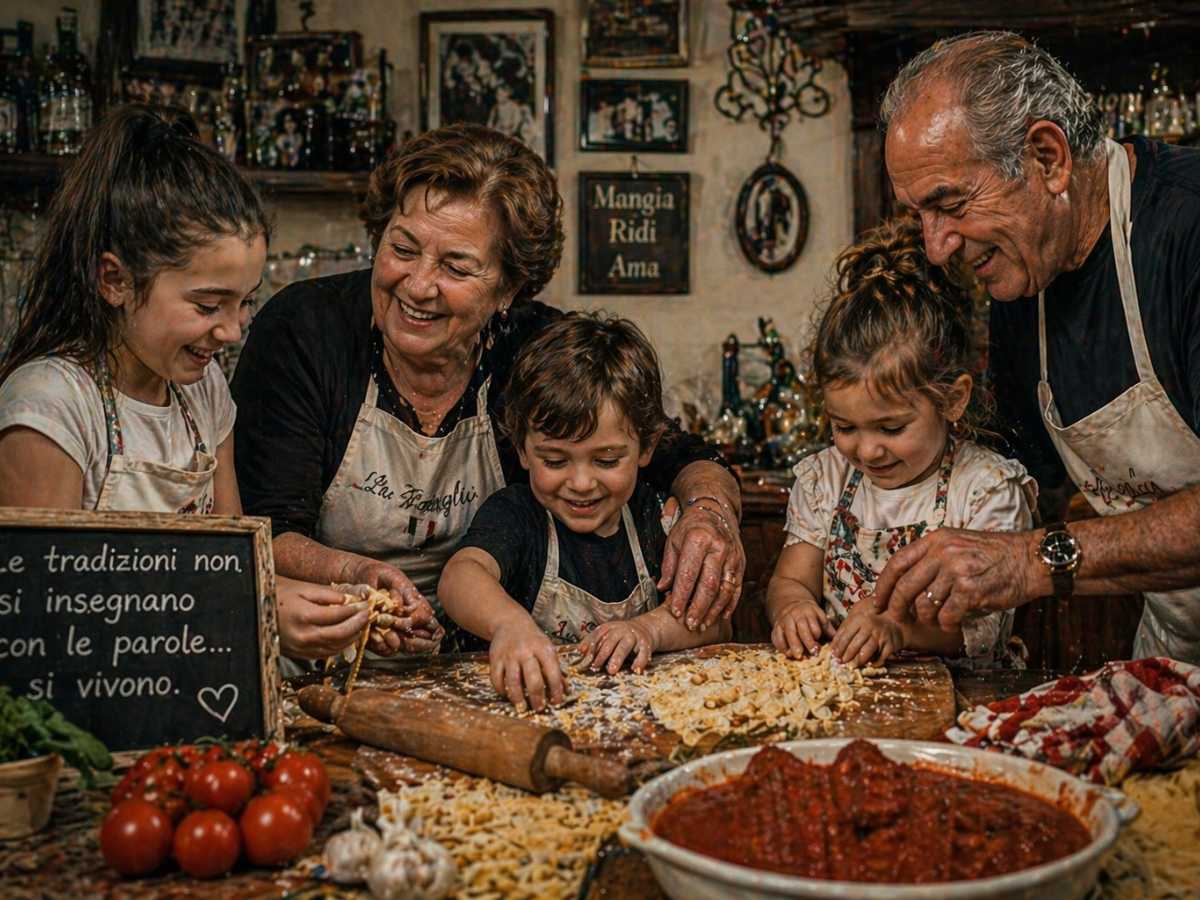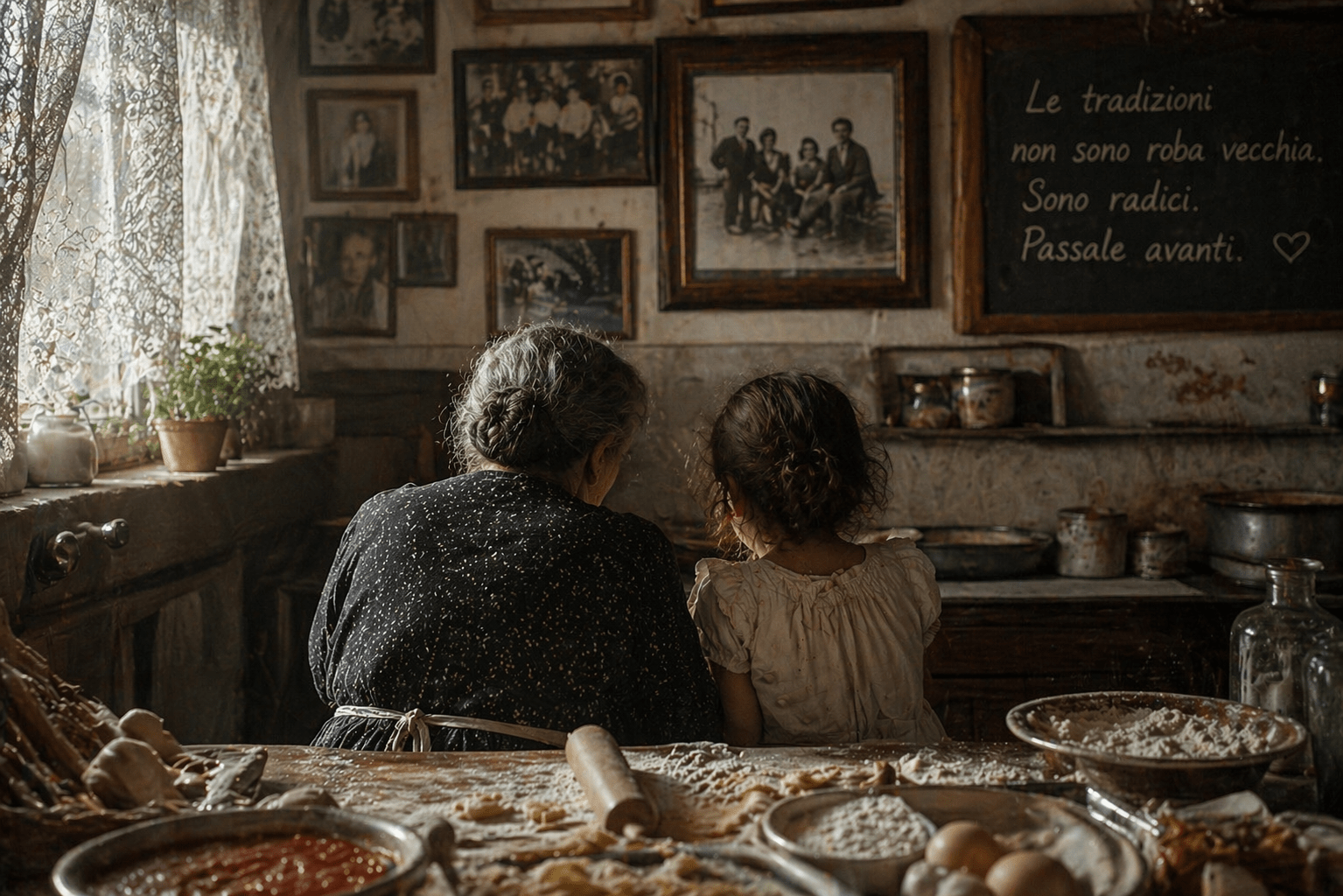
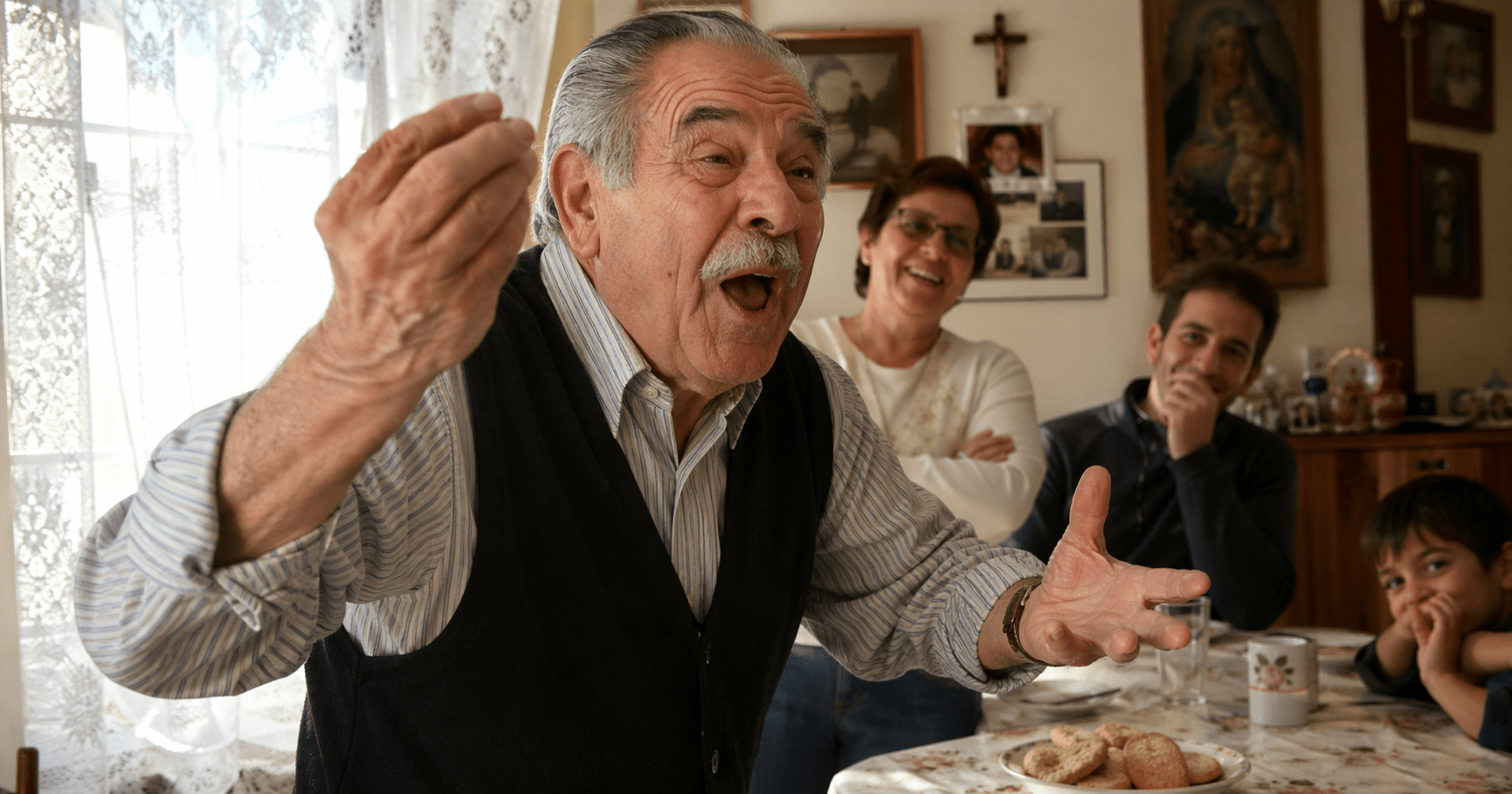
Italian Family Traditions
Italian Sayings Your Grandparents Used (And What They Were Really Telling You)
They did not give speeches. They gave you one line, one look — and somehow that was always enough. Here are the sayings, the translations, and the stories behind why they still live in your head decades later.
My grandmother did not waste words. This was a woman who had raised four children in a two-bedroom apartment, fed entire extended families on what most people would consider not enough, and navigated sixty years of life in a country whose language was not her first. She had a well-developed sense of when a situation required a full explanation and when it required exactly one sentence and a look.
It was almost always the one sentence and the look.
And the sentence was almost always a proverb. Something compact and old and already loaded with meaning before it left her mouth — so that by the time it reached you it arrived fully formed, like a verdict rather than a conversation opener. You did not argue with it. You did not ask follow-up questions. You sat with it, and eventually — sometimes years later — you understood exactly why she said it at that exact moment.
If you grew up around Italian grandparents, you know what I mean.
Italian grandparents did not lecture. They delivered. One line, one look, and the entire lesson was already inside you.
This article is for everyone who grew up hearing these phrases and always meant to look them up. It is also for everyone who half-remembers something their nonna said and wants to know if they have the words right. And it is for anyone who wants to understand what these sayings reveal about the values Italian families actually lived by — because taken together, they form a portrait of a complete worldview.
Why Italian grandparents spoke in sayings
Older Italian family culture leaned heavily on oral wisdom. Not because people could not explain things at length — Italian grandparents were perfectly capable of extraordinary length when the occasion demanded — but because a proverb could do something a speech could not. It arrived pre-loaded with centuries of collective judgment. It could correct you without turning into a confrontation. It could teach without sounding like a lesson. And it could do all of this in five words, leaving your dignity more or less intact while making the point unmistakably clear.
My grandfather used to say things I initially thought were his own inventions — little compressed wisdoms that felt personal and original. I was in my twenties before I recognized them as proverbs with roots going back centuries. He delivered them with such complete ownership that I genuinely believed he had just thought of them. That, I now understand, is the highest compliment you can pay a proverb: you make it so yours that people think you invented it.
The exact wording varied by region, dialect, and family habit. One family’s version might sound slightly different from another’s. That is not corruption — that is how oral wisdom travels. It absorbs the people who carry it. So if your nonna’s version sounds different from what you read here, that does not make it less real. It probably makes it more real. More hers. More yours.
The sayings, the translations, and the stories
01 — A buon intenditor, poche parole
Literal: Few words to the good listener.
Real meaning: A word to the wise is enough. I am not repeating myself.
This is peak grandparent energy. It is what got said when you were being told something once, and only once. Not twice. Not with a demonstration. Not followed by a check-in to make sure you understood. Once.
The beauty of it is the implication built into the phrase itself: if you are the kind of person who needs more than a few words, that is a reflection on you, not on the speaker. The good listener gets it immediately. The rest of you can work it out.
A nonna might deploy this after a warning look across the Sunday table. A nonno might say it at the end of a conversation that was supposed to be the only conversation necessary on the subject. Either way, it had the finality of a door closing quietly — much more effective than slamming it.
My grandmother said this to me exactly once, when I was about thirteen and pushing back on something she had decided. She said it softly, went back to what she was doing, and did not look at me again. I still do not know whether she knew how devastating that was. I suspect she did.
02 — Chi dorme non piglia pesci
Literal: Whoever sleeps does not catch fish.
Real meaning: The early bird catches the worm. Life rewards the person who gets up and does something.
This one was for lazy mornings, wasted time, missed opportunities, and slow starts. If you overslept, procrastinated, or watched the day slide past while doing nothing, this was waiting.
There is something specifically Italian about the fishing image — concrete, practical, connected to physical labor and the real world. Not “you will miss your chance” in the abstract. You will miss the fish. And the fish are the point. You cannot eat ambition. You need to have actually gotten up and gone fishing.
03 — Chi va piano va sano e va lontano
Literal: Whoever goes slowly goes safely, and whoever goes safely goes far.
Real meaning: Slow and steady wins the race. Calm down. You will get there.
This is one of the gentler sayings — patient, not sharp. It came out when someone was rushing, panicking, making mistakes because they were moving faster than was wise. A grandfather teaching something practical. A grandmother watching you make a mess of the kitchen because you were in too much of a hurry.
It is not criticism exactly. It is a reminder that steadiness outperforms speed over any meaningful distance — and that most Italian grandparents had a lifetime of evidence to prove it.
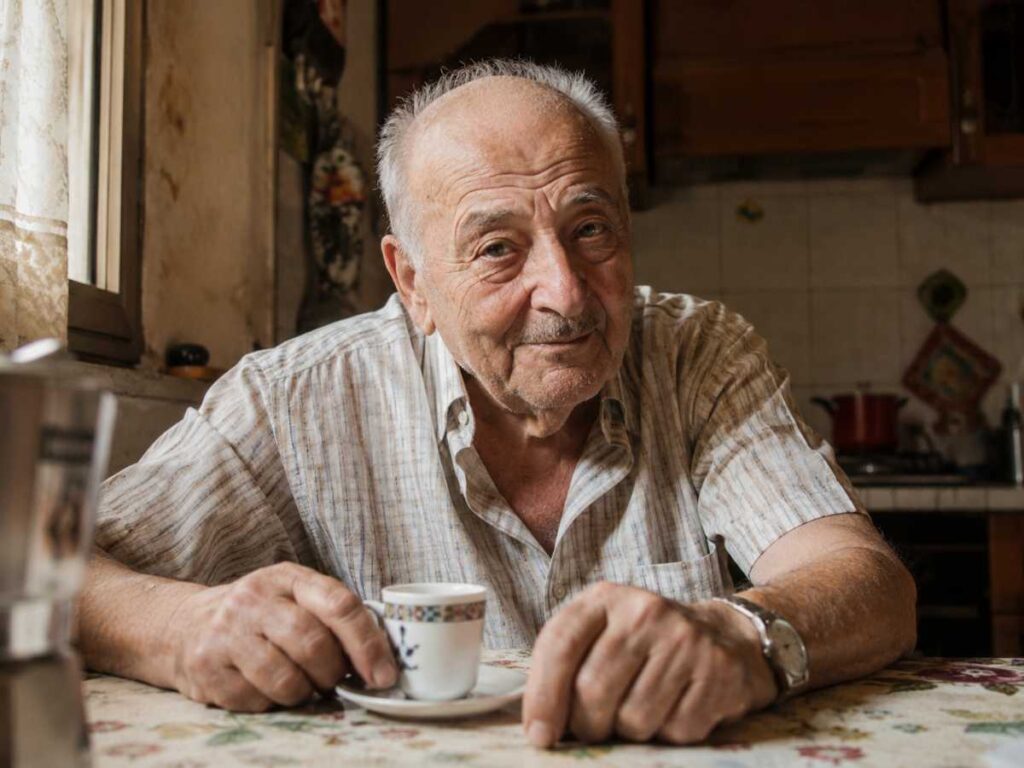
My grandfather said this constantly — about cooking, about building things, about life decisions, about the way I was rushing through something he was trying to teach me. He had an absolutely unhurried quality that I found maddening as a child and have spent my entire adult life trying to acquire. He was right every single time.
04 — Tra il dire e il fare c’è di mezzo il mare
Literal: Between saying and doing, there is the sea.
Real meaning: Easier said than done. Talk is cheap. Now let’s see.
This one is for big talkers, bold promises, and confident announcements that have not yet met the friction of reality.
There is something magnificent about using the sea — the actual sea, the vast Mediterranean — as the unit of measure for the gap between intention and execution. Not a river. Not a road. The sea. A grandparent might say it after someone made a plan that sounded impressive in the living room. They were not mocking. They were calibrating. The Italian version of “yes, yes, nice words — now let’s see.”
05 — A caval donato non si guarda in bocca
Literal: Do not look a gift horse in the mouth.
Real meaning: Be grateful for what you are given. Right now.
This appeared when someone complained about a gift, found fault with a favor, or received generosity and responded by evaluating it instead of being grateful for it.
You can practically hear the voice already. Dry. Controlled. Not angry — something more effective than angry. Disappointed in a very precise and specific way. The kind that tells you exactly where the line was and that you crossed it.
I said the wrong thing about a birthday present when I was seven. I have never made that mistake again. I did not need a second lesson. A buon intenditor poche parole, as it were.
06 — Chi fa da sé, fa per tre
Literal: Whoever does it themselves does the work of three people.
Real meaning: If you want something done right, do it yourself.
This one tells you everything about the immigrant-generation mentality. Not in a boastful way — in a practical one. You cannot always wait for help. You cannot always trust that help will be as capable as you. You have hands and a head and the job in front of you. This is sufficient.
A grandparent using this was usually already halfway through fixing, building, or repairing whatever was under discussion. The saying arrived as commentary on what they were already doing. They had already made the decision. They just wanted you to understand the logic.
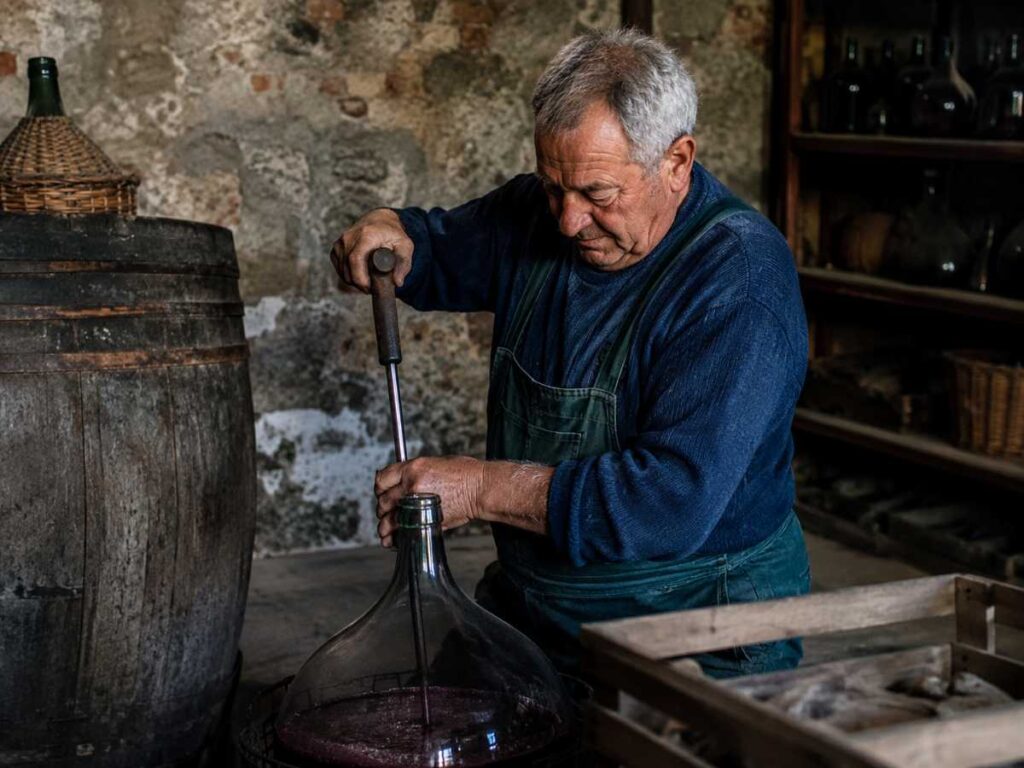
07 — A chi dai il dito si prende anche il braccio
Literal: Give someone a finger and they take the whole arm.
Real meaning: Give them an inch and they take a mile. Know your limits.
Italian grandparents were generous people. They were also clear-eyed people. These are not contradictions. They understood that generosity without discernment is not virtue — it is naivety, and naivety costs you.
This saying usually came out when someone was being taken advantage of, or when a situation had drifted past reasonable into something else. Not anger. A lesson. Be good. Be generous. But know the difference between a person who deserves your kindness and a person cataloguing how much they can extract from it.
08 — Al bisogno si conosce l’amico
Literal: In need, you know the friend.
Real meaning: A friend in need is a friend indeed. Hard times reveal who is real.
This is one of the warmer sayings and one of the most honest. It came after difficulty — after someone showed up for the family in a crisis, or failed to when it mattered. It is not bitter. It is observational. Life teaches you who your people are by testing the relationship under pressure.
An Italian grandparent saying this was not expressing surprise. They were filing information. Someone showed up or did not show up, and that fact has been properly noted and categorized in the family’s permanent understanding of the world.
My grandmother had a very precise internal ledger of who had been there when it mattered. She never said it out loud. She never had to. But you could tell from the way she treated certain people — the welcome that was just slightly more complete — that she knew. She always knew.
09 — Mannaggia!
What it means: Darn. Oh come on. For heaven’s sake. (Nonna-approved.)
Not a proverb — something more useful in everyday life: a perfectly calibrated mild outburst. Italy Magazine describes it as one of the tamest Italian expressions of frustration, suitable even around children.
You dropped a glass. The sauce overflowed. The bakery was closed. Someone said something slightly ridiculous. “Mannaggia.” Not a crisis. Just enough seasoning to let the air know something had happened that was not ideal, and that you had noticed, and that you were now moving on.
My grandmother said mannaggia the way other people say “oh well.” The verbal equivalent of a small shrug — acknowledgment without drama, irritation without catastrophe. I have used it my entire adult life and it has never once failed me.
10 — Ti voglio bene
Literal: I want you well.
Real meaning: I love you — in the family way. The deepest, quietest kind.
Not all grandparent sayings were corrections. Some were love.
Ti voglio bene is what Italians use for family love — warmer than a greeting, less dramatic than a declaration, more honest than most things. Not the love of romance and urgency. The love of wanting someone to be well. To be okay. To have enough. To be safe.
A grandparent might say it at the end of a phone call, at the door after a visit, quietly before bed, or at the end of a conversation that did not need much more. It is the phrase that gets said when no other phrase is quite right and this one always is.
What these sayings reveal when you line them up
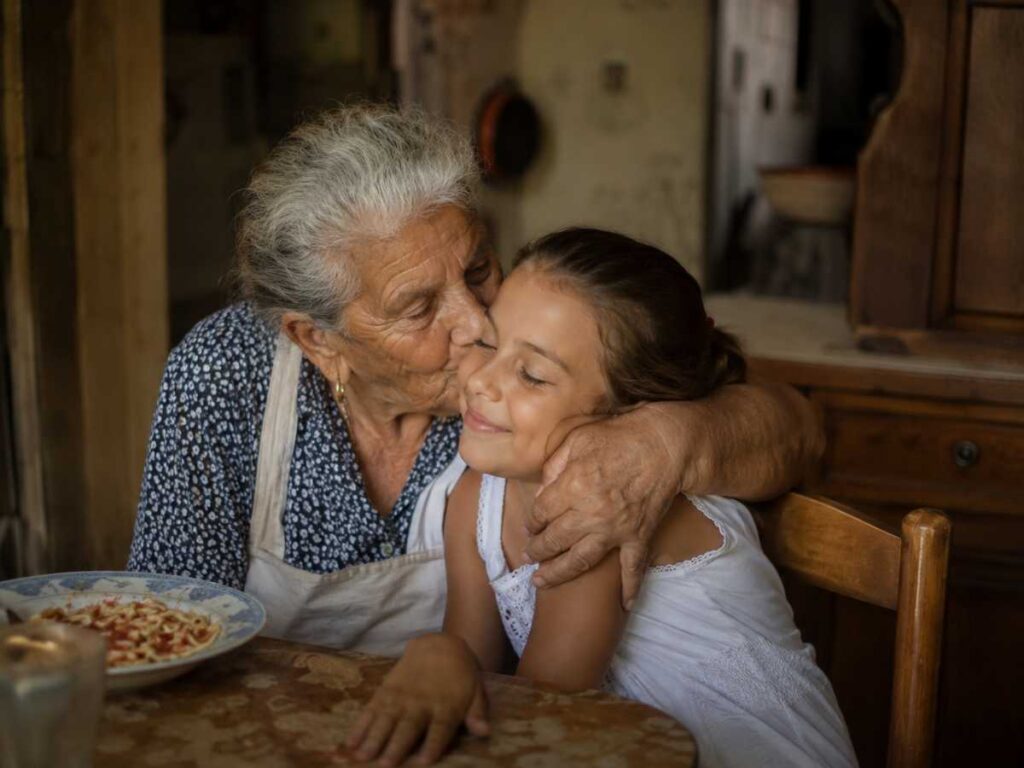
Look at them together and the pattern is obvious. Every one of these phrases orbits the same constellation of values: work hard and get up early, move carefully not frantically, mean what you say and back it up with action, be grateful, be self-reliant, protect your limits, know who your real people are, express frustration without theater, love the people in front of you.
That is not a random collection of opinions. That is a complete worldview, compressed into phrases that could be delivered across a dinner table without anyone needing to take notes.
A proverb is not a sentence. It is a worldview that has been folded very small so it fits in a pocket and can be deployed at exactly the right moment.
This is why descendants remember these sayings even when they cannot always reconstruct the exact Italian wording. The phrases were attached to moments, to faces, to the tone of a specific voice in a specific kitchen. They arrived with weight already inside them. And weight is harder to forget than words.
What happened to these sayings after immigration
Honest truth: these phrases changed form when they crossed the ocean. Sometimes the full Italian survived intact. Sometimes only the first half did. Sometimes it was translated into English and lost the music while keeping the meaning. Sometimes the exact words faded entirely, but the habit of speaking in sayings survived — the rhythm of compression, the instinct to sum up a situation in one line rather than three paragraphs.
My grandmother’s version of certain proverbs was distinctly Calabrian — words I could not find in any dictionary, sounds that belonged to a specific valley in southern Italy and nowhere else. By the time the phrase reached my parents it was half-translated. By the time it reached me it was in English with an Italian word still embedded in the middle, like a fossil in rock. The exact form had changed beyond recognition. I still use it. I still know exactly what it means and when to say it. That is how tradition actually survives — not perfectly, but really.
So if your family’s version sounds different from what you read here, that is not a mistake. It is the natural life of oral wisdom in a family that moved through time and across continents. The saying adapted. The value it was carrying did not.
How to keep them alive — without turning them into wall art
The worst thing you can do with a family saying is frame it and never use it again. These phrases were built for deployment in real situations, real kitchens, real tables. That is the only context in which they fully work.
- Use one or two on purpose — in the right moment, with the right delivery, and watch what happens
- Write down the exact words your grandparents used, in whatever mix of languages they used them — do not clean them up
- Ask the older relatives who still remember: what did Nonna say when someone was being lazy? What did Nonno say when someone broke a promise?
- Keep the half-translated versions — they are often the most specific to your family and therefore the most valuable
- Give your children the deployment instructions, not just the words — tell them when to say it and why
- Let them be funny when they are funny — grandparent wisdom was rarely solemn. It was wry, dry, and often a little theatrical
They did not lecture. They did not explain at length. They gave you one line — and the line was already full. Teaching, correcting, protecting, and loving, all in five words or less. That is the tradition.
If one of Nonna’s lines still pops into your head years later, that is not random. That is tradition doing exactly what it was built to do.
If your grandparents also passed down little warnings, charms, and beliefs, you may like what malocchio is and the meaning of the cornicello.
FAQ
What are some common Italian sayings grandparents used?
The most widely recognized include A buon intenditor poche parole (a word to the wise is enough), Chi dorme non piglia pesci (the early bird catches the worm), Chi va piano va sano e va lontano (slow and steady goes far), Tra il dire e il fare c’è di mezzo il mare (easier said than done), and Chi fa da sé fa per tre (do it yourself and it is worth three people doing it). Each one is a complete lesson compressed into a single line.
What does “a buon intenditor poche parole” mean?
Literally “few words to the good listener” — the English equivalent is “a word to the wise is enough.” It was used when a grandparent was making a point they did not intend to repeat. The implication was clear: if you are a smart person, you already understand. If you need more explanation, that says something about you, not about the person who spoke.
What does “tra il dire e il fare c’è di mezzo il mare” mean?
Literally “between saying and doing there is the sea.” The English equivalent is “easier said than done” — but the Italian version is more vivid. It uses the actual sea as a measure of the gap between intention and execution. It was said when someone made a plan or promise that sounded better in the telling than it would look in the doing.
What does mannaggia mean?
A mild Italian exclamation — roughly equivalent to “darn,” “oh come on,” or “for heaven’s sake.” It expresses mild irritation or exasperated sympathy without crossing any line. It was the grandparent-approved response to small frustrations: something spilled, something went wrong, something was slightly ridiculous. Not a crisis. Just enough acknowledgment to let the air know.
What is the difference between “ti voglio bene” and “ti amo”?
Ti amo is romantic love — passionate, urgent, the language of lovers. Ti voglio bene is family love — warm, steady, meaning literally “I want you well.” It is what grandparents said to grandchildren, parents to children, close friends to each other. Softer than a declaration, deeper than a greeting. The kind of love that does not need drama because it has already been proved over time.
Did Italian sayings change after immigration?
Yes, frequently. Some survived intact in Italian. Others were translated into English, shifted into dialect, or became a mix of both. Proverbs are oral traditions, and oral traditions absorb the people and languages that carry them. The form changed. The value inside the form did not. If your family’s version sounds different from the standard Italian, it is probably more specific to your family — and therefore more valuable, not less.
Are Italian sayings the same as idioms?
Not exactly. Proverbs are short expressions of shared wisdom or warning — complete lessons in a line. Idioms are fixed figurative expressions whose meaning cannot always be understood word by word. In real family life, grandparents used both freely, along with their own family-specific phrases that were neither quite one nor the other. The distinction matters less than the effect: all of them taught something, and all of them stuck.

Marco Ricci is an Italian-Canadian writer and the grandson of Calabrian immigrants. He created Italian Family Traditions to document the customs, feast days, and family rituals Italian families carried from Italy to North America — and to understand what they actually meant. He is based in Montreal.