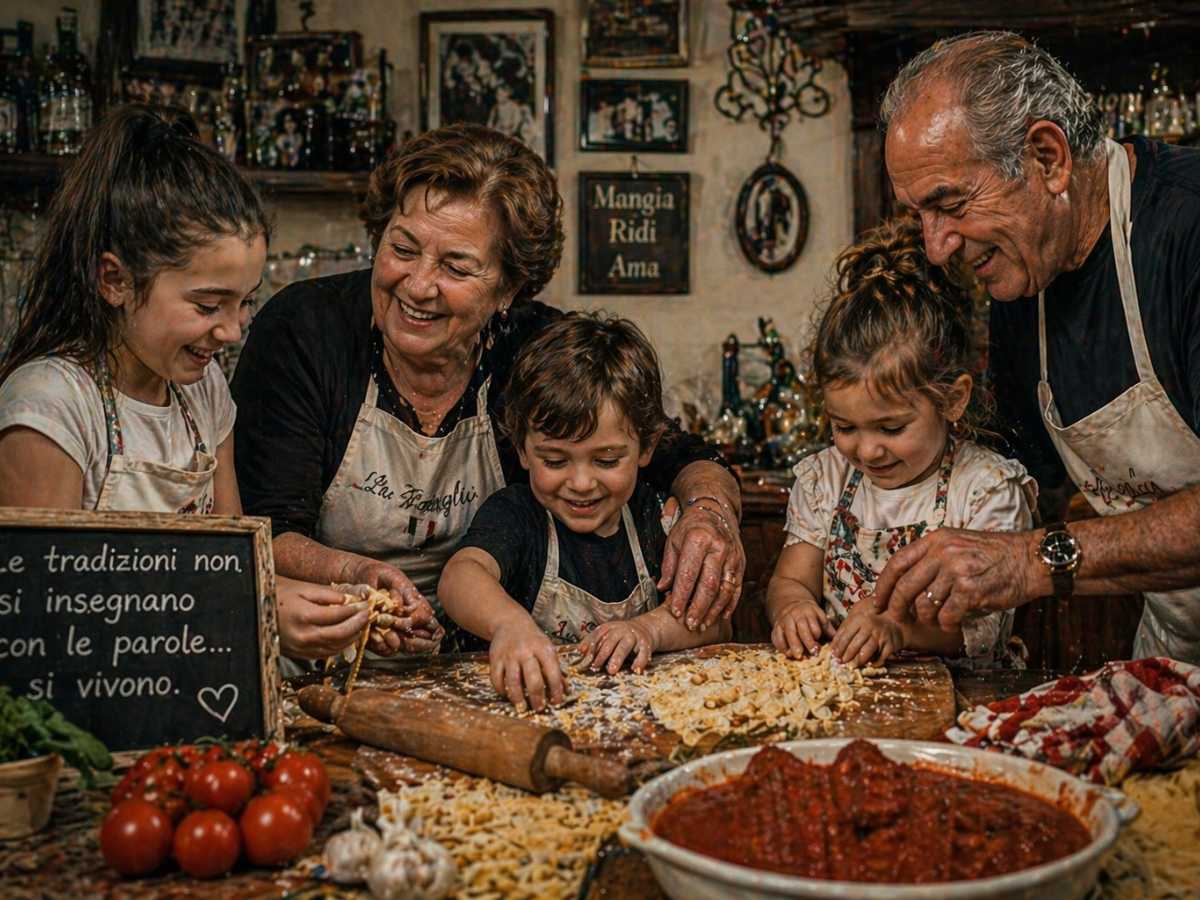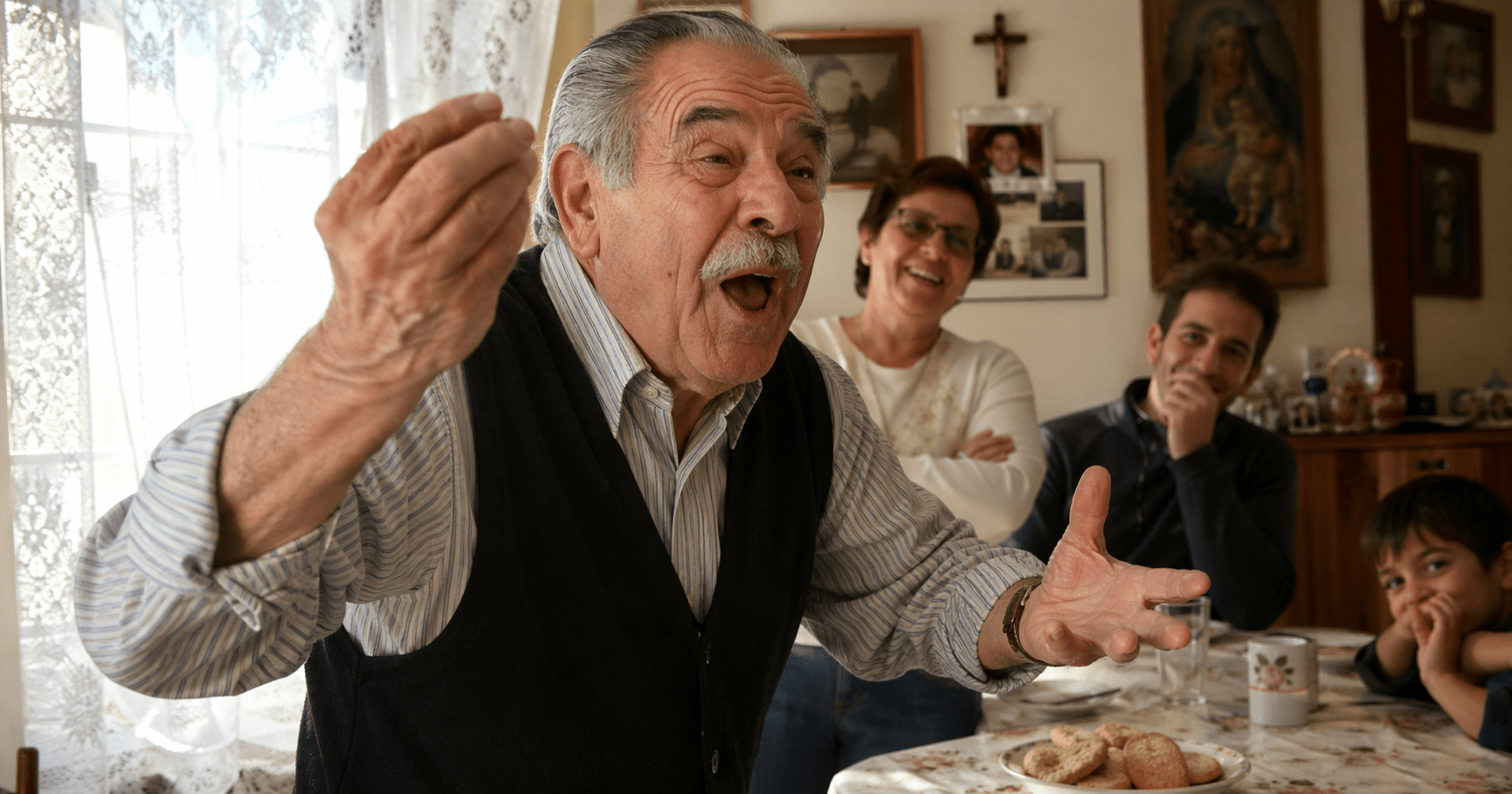
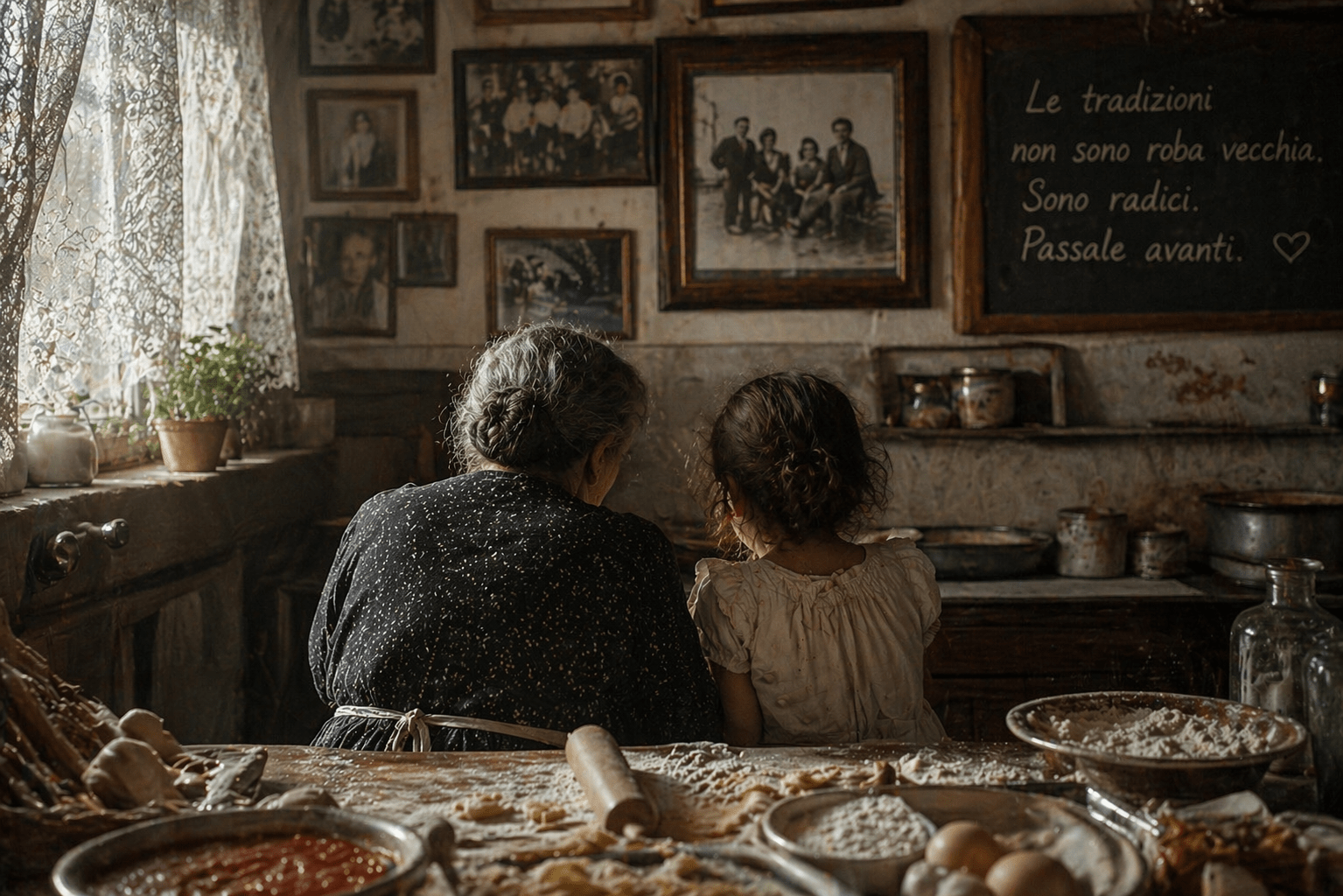
Italian Family Traditions
What to Ask Your Grandparents About Your Italian Family History — Before the Answers Are Gone
The best questions are not “Where are we from?” The best questions are the ones that make your grandmother stop mid-sentence and say something she has never been asked before — and then say it anyway, for the first time in her life, to you.
My grandmother told me the name of her village once. We were not having a formal conversation about family history. We were sitting in her kitchen in Rivières-des-Prairies on a Tuesday afternoon in, I think, 1994, and she was making something and talking at the same time — the way she always talked, in the specific half-distracted way of someone whose hands were occupied but whose mind was fully running — and she mentioned the name of the village she had left as a young woman, the village in Calabria where her family had been for generations, the village that was the entire beginning of everything that eventually became us. She said the name once. I did not write it down. I did not ask her to repeat it. I assumed I would remember it or that there would be other times.
There were not other times. Not like that one. I have tried to find the village through other means — through documents, through relatives, through the approximate geography of what I half-remember her saying about where it was in relation to other places. I have gotten close. I have not gotten there definitively. The name she said in her kitchen in 1994 is the missing piece, and the missing piece is missing because I did not ask the right question at the right moment, and the right moment passed while I was not paying the right kind of attention.
Grandparents rarely give family history in a neat timeline. They give it sideways. A wedding story leads to a town. A memory about Easter leads to a grandmother’s maiden name. A complaint about a relative leads to a whole missing branch of the family. A story about arriving “with nothing” leads to a ship, a city, and a job nobody knew about.
This article is the one I needed in 1994. Not because I needed a script or a methodology or a formal oral history protocol. Because I needed to understand that the conversation I was already having was the archive — that the kitchen on a Tuesday afternoon with someone making something while talking was exactly the right conditions for preserving the things that matter, if I had known what to ask and how to ask it and, most importantly, how to write it down.
Why this is urgent — and why most people wait too long
The information in your grandparents’ heads exists nowhere else. No passenger manifest tells you why they left. No naturalization paper tells you what they missed. No census record tells you the village nickname everyone used, the name the family pronounced differently after the crossing, or the tradition kept in private for fifty years because no one had ever thought to ask about it. That information lives in one place: the person sitting across from you, who is not going to live forever and who, unlike a document, cannot be found in an archive after they are gone.
Most people understand this in the abstract and do not act on it until it is too late. Not because they are careless — because the conversation seems like it can always happen next visit, next holiday, next time things slow down. And then it cannot happen, because the person is gone or the memory has gone or the specific quality of recall that was present last year is not present this year. The window is open. It is not open indefinitely. The best time to have this conversation is before you think you need to. The second-best time is right now.
The Smithsonian’s oral history guidance is clear on this: firsthand interviews preserve direct experience that documents cannot capture, and open-ended questions bring out the richest material. The Library of Congress describes oral history as preserving what people experienced directly — which is precisely the category of information that disappears when the person does.
Before you ask — how to make the conversation work
Pick the right moment. Not a busy holiday when everyone is distracted and loud. A quiet afternoon, one-on-one or nearly so, with coffee available and no particular place to be. The Smithsonian recommends a calm setting — this is not incidental advice. Memory opens differently in calm than in noise.
Bring something physical. An old photo, a prayer card, a recipe notebook, a wedding picture, a cornicello or religious medal from a drawer. Physical objects unlock memory in ways that direct questions sometimes cannot. Put it on the table and ask about it. Then listen to where the answer goes.
Record it if they are comfortable. The Library of Congress notes that recording preserves voice, phrasing, and pronunciation — the specific sound of the person telling the story, which is part of what is lost when only the facts are written down. A phone placed on the kitchen table is sufficient. Ask permission first and then let them forget it is there.
Start easy and let it grow. Begin with something simple — a name, a memory, a photo — and let one answer lead to the next question. The Smithsonian specifically recommends starting with easy questions and letting the interviewee talk in their own way. The best family history conversations look like conversations, not interviews. And do not try to cover everything in one sitting — the Smithsonian notes that interviews can become tiring after 90 minutes to two hours.
The conversation I remember most clearly with my grandfather was not the one I planned. I had come with specific questions about immigration dates and had written them down. He answered two of them briefly and then said, unprompted, “Do you know why we really left?” and began talking about something I had never known — not poverty exactly, not the standard reasons, something more specific and more complicated and more human than the narrative the family had been using. He talked for forty minutes. I had not asked the right question. I had asked the first question, and the first question had opened the right door. That is what oral history actually looks like. You are not gathering facts. You are standing at a door and asking someone to walk you through it.
Names and identity — where to start
Start here. Names are one of the richest entry points into Italian family history because they carry so much — saints, ancestors, immigration changes, and the specific adaptation of identity to a new country. In traditional Italian naming, the firstborn son was named for the paternal grandfather and the firstborn daughter for the maternal grandmother, which means names are often a direct key to earlier generations. Ask about the name and you are often asking about the person the name came from. Read more about this in the Italian onomastico and naming traditions.
- What is your full name — first, middle, and family name?
- Did you ever go by another version of your name — a different spelling, a shortened form, a dialect version?
- Were there family nicknames? What did people call each other at home?
- How did your parents choose your name? Were you named after a grandparent, a saint, an aunt or uncle?
- Did our family ever change the spelling or pronunciation of our surname after coming here?
- Did anyone in the family use an Italian name at home and a different English name outside?
- What is the meaning of our family name, if you know it?
My grandfather’s legal name in Canada was one thing and the name everyone who had known him in Italy called him was something slightly different — a dialect version that had been quietly retired at some point during the immigration process without anyone formally deciding to retire it. He answered to both without seeming to notice the distinction. I only realized this when I heard an older relative use the Italian version and watched my grandfather’s expression change in a specific way — a recognition that was also a kind of homecoming. Ask about the name. Then ask if there was another name underneath it.
The exact place in Italy — the single most important question
This may be the single most important category in this entire article. FamilySearch’s Italy research guidance is emphatic: identifying the ancestral town is essential for Italian genealogy because Italian records are local rather than national. A birth certificate, marriage record, or death record in Italy is in the archive of the specific municipality — not in a central national database. Without the town, you cannot find the records. With the town, everything opens.
A lot of people stop at “southern Italy” or “Sicily” or “Calabria” and consider that sufficient. It is not sufficient. You want the town. You want, ideally, the village. You want the name your grandmother said in the kitchen in 1994 that you did not write down. Ask for that name. Write it down immediately. Ask her to spell it. Ask again next time to confirm.
- What town or village in Italy did our family come from — the exact name, not just the region?
- Do you know the province? Was it near a larger city?
- Did the family say “we’re from Calabria” or “we’re from [specific village]”?
- Do you remember any landmarks, churches, or nearby towns that were mentioned?
- Did anyone ever talk about the old house, the street, the piazza, the church?
- Was the family proud of being from a certain place — or did they not talk about it?
- Did they speak a dialect? Do you remember any words from it?
- Are there relatives still in Italy? Do you have any contact with them?
Immigration — the crossing-over story
This is where you get the emotional truth — not only where they came from but why they came, what they planned when they came, and what happened to that plan. The gap between why someone left and what they actually found is often the whole immigration story. Understanding it also helps explain everything about what Italian-American and Italian-Canadian traditions changed after immigration and what stayed the same.
- Who was the first person in our family to come to North America?
- Why did they leave Italy? What was actually happening at the time?
- Did they come alone or with relatives?
- Did they plan to stay permanently, or did they think they might go back?
- Did anyone go back? Did anyone want to and could not?
- Around what year did they come? Do you know which ship?
- Where did they land — what city, what port?
- Where did they live first? Who did they know when they arrived?
- What kind of work did they do here?
- Did they settle near other Italians from the same town?
- Were there family members who never left Italy?
- What did they miss most? What did they never stop talking about?
My grandfather said once that his father had not meant to stay. He had come for work. He had sent money back. He had planned — genuinely, specifically planned — to return when enough had been saved. Then one thing and another happened, and the children were born here, and the plan got revised and then quietly abandoned and then eventually forgotten by everyone except the original person who had made it. He was thinking about going home for the rest of his life. He died in Montreal having never gone back. I had not known that. It changed something in how I understood the whole story of the family in Canada. Ask why they came. Then ask what they planned when they came. The gap between those two answers is often the whole immigration story.
The older generation — parents, grandparents, relatives
This is where family history becomes family life. The people before your grandparents — their parents, their grandparents, the relatives who shaped the household — are often the most vivid and most fragile part of the family archive. These are the people for whom no living memory will exist after the current generation is gone.
- What were your parents like — as people, not just as parents?
- What do you remember about your grandparents?
- Who was the strict one? Who was the funny one? Who told the best stories?
- Who in the family cooked the best — and what did they make?
- Who was the one everyone respected, and why?
- Who had the hardest life?
- Were there relatives everybody admired?
- Were there relatives nobody talked about — and do you know why?
- What family stories got repeated again and again?
- What did you know about your grandparents that you wish you had asked more about?
Pay special attention to the repeated stories. If a family tells the same story about the same person across decades and generations, that story is carrying something — an identity, a value, a wound, a pride. Ask about the repeated stories. Then ask why people kept telling them.
Language and sayings — the most Italian part of the archive
Language questions preserve the most human dimension of family culture. The specific words older family members used — the dialect expressions, the Italian proverbs, the things they said when they switched languages mid-sentence — are often the last things that survive and the first things that are lost when those people are gone. A remembered saying in dialect is irreplaceable. Write down exactly what it sounded like, phonetically if necessary. Ask what it meant. Ask who said it most often. For the sayings your grandparents may have repeated, read Italian grandparent sayings and what they really meant.
- Did the family speak Italian, a dialect, English, French, or a mix?
- Which Italian or dialect words did older family members always use?
- Were there sayings or proverbs the family repeated? Can you remember any of them?
- Did people switch to Italian when they were angry, emotional, or talking about something private?
- Were there words for food, relatives, or household things in Italian that younger people stopped using?
- Did anyone pronounce the family name the original Italian way?
- Are there expressions you still remember hearing in childhood that you have not heard since?
Traditions and daily family life
This is usually where grandparents start smiling. Facts are useful. Traditions are where the feeling lives. These questions connect directly to everything this site explores — the Italian Sunday dinner, the La Vigilia Christmas Eve, the Ognissanti remembrance, the feast days the family observed. Ask about what they did and you start to understand why they did it.
- What did Sunday look like when you were young?
- Which traditions felt most Italian in the house?
- What holidays mattered most — and how were they observed?
- What did the family always do at Christmas, Easter, St. Joseph’s Day, or other feast days?
- Were there traditions that changed after coming here?
- What foods were everyday foods, and what foods were saved for feast days?
- Did the family keep name days — onomastici?
- Was there a garden, a cantina, a wine-making, sausage-making, or passata tradition?
- What traditions disappeared and why?
- What do you wish the family had kept?
- Is there anything you did that you never told us about?
The last question on that list — is there anything you did that you never told us about — produced the single most surprising answer I ever received in a family history conversation. My grandmother paused for a long time. Then she described a specific protective ritual she had observed every year on a specific date, something connected to a local saint’s tradition from her village, something she had continued in Canada without ever explaining it to anyone because she had assumed no one would understand. She had been doing it for fifty years in private. She told me because I asked. That is why you ask questions that leave room for answers you did not expect.
Hard times, work, and sacrifice — the questions that reveal the most
Ask gently here. But do ask. Sometimes these are the answers people most want preserved — the ones that validate the difficulty, that acknowledge what was carried without recognition, that finally give voice to the part of the story that never got told properly at the dinner table.
- What were the hardest years for the family?
- What kind of work did the older generation do?
- What sacrifices did your parents make that you did not fully understand until later?
- Was money ever very tight? How did the family manage?
- Did anyone serve in a war?
- Did anyone have to leave school early to work?
- Who carried the most responsibility in the family, often without recognition?
- What was never talked about openly, but everybody knew?
- What do younger people not understand about what the older generation actually went through?
- What are you proud of that you have never been asked about?
That last question — what are you proud of that you have never been asked about — is one of the most powerful questions available in any family history conversation. Most people spend their lives being proud of things nobody ever thought to ask them about. The question gives them permission to say it. What emerges is often the most essential thing about that person — the thing they most wanted acknowledged, the contribution they most wanted recognized, the part of their life that mattered most to them and that risked going unnoticed entirely.
The genealogy questions — the practical ones that unlock research
If you want to research the tree in Italian archives later, ask these clearly and write down the answers carefully. FamilySearch’s Italy genealogy guidance is specific: the ancestral town is the key that opens church and civil records. Everything else follows from that one answer.
- What were the full names of your parents — including your mother’s maiden name?
- And their parents — your grandparents’ full names, including maiden names?
- Do you know approximate birth years for any of them?
- Do you know the exact town in Italy for each branch of the family?
- What church did the family attend here — the name and location?
- Are there baptism, marriage, or funeral records — holy cards, certificates — anywhere in the house?
- Is there a family Bible, old address book, passport, or naturalization paper?
- Are there old photos with writing on the back?
- Does anyone still have documents written in Italian?
- Which relative knows the most family history — and should I talk to them next?
Ask who else you should talk to. The person across from you is rarely the only archive. They will often know who holds the oldest memories and the most complete knowledge — and that person may not have much time left either.
Using photos and objects to unlock what direct questions cannot
Some of the best family history information emerges not from questions but from objects. Bring something physical to the conversation — an old photo album, a prayer card, a saint’s medal, a wedding picture, a kitchen object, a recipe notebook, a cornicello from a drawer — and place it on the table. Then ask about it.
- Who is in this photo?
- Where was this taken? When?
- What was happening that day?
- What happened to these people later?
- Is this object from Italy or from here?
- Why did the family keep this?
- Is there anything in this house that younger people might throw away without realizing it matters?
- What would you want us to keep?
The most productive family history conversation I ever had began with a photograph I found in a shoebox. I brought it to my grandmother and asked who the woman in it was. She looked at it for a long time without answering. Then she said a name I had never heard — a great-aunt who had died young in Italy before the family immigrated, who had been, it emerged over the next two hours, one of the people her mother had most missed for the rest of her life and had never spoken about directly because the grief was too specific and too old and too untranslatable into the new country’s language. The photograph opened the door to a person I had never known existed and a loss that had shaped the family’s emotional landscape for sixty years. The shoebox had been in that house for decades. Nobody had asked about the photo. One question changed that.
What to do immediately after the conversation
The conversation is not the end of the work. It is the beginning. What you do in the hours immediately after determines how much of it survives.
- Save the recording in at least two places — your phone and a cloud backup, at minimum — right now, before anything else
- Label the recording file with names, location, and date immediately — “Grandma Rosa kitchen Montreal Oct 2025” not “Voice memo 47”
- Write down every town name, every spelling, every church name while the pronunciation is still in your ear
- Note every name that came up — full names where possible, relationships, approximate dates
- Photograph any documents, photos with writing on the back, or objects that were discussed
- Write down the questions that were not answered — the ones to come back to next time
- Note which relatives were mentioned as knowing more — and contact them this week, not eventually
- Send a warm follow-up and one specific question within the week while the conversation is still fresh for both of you
The Library of Congress frames oral history as preserving firsthand memory for the future — which means the preservation step is not separate from the process but essential to it. The conversation without the preservation is a window opened and closed. The conversation with careful preservation is a document that will exist in a hundred years.
The best material is often not only the answer. It is the pause before the answer. The correction from across the room. The laugh after a name. The little village detail nobody thought mattered until suddenly it does. That is the real archive. It is still breathing. Ask before it is not.
The name she said in her kitchen in Rivières-des-Prairies in 1994 — I am still looking for it. I have gotten close. The search has taken me through documents and relatives and the approximate geography of what I half-remember. I have not gotten there definitively. Ask your question. Write down the answer. Do not assume there will be other times, because sometimes there will not be, and the name said once on a Tuesday afternoon is the one that matters most, and it is the one most likely to be the one nobody wrote down.
Once you know what to ask, read about how to preserve Italian family traditions with kids today. For the traditions your grandparents may have observed, explore Italian-American traditions: what changed and what stayed. For the sayings they may have repeated, read Italian grandparent sayings and what they really meant. And for the protective traditions and objects that may have been kept quietly in the house, read about malocchio and the cornicello.
FAQ
What are the best questions to ask grandparents about Italian family history?
The best questions are open-ended ones that invite stories rather than yes-or-no answers. Strong starting points include full names and how they were chosen, the exact ancestral town in Italy, who came first and why they left, what the older generation was like as people, which traditions the family kept, and what was never openly discussed but everyone knew. The most productive conversations follow the answer rather than the list — one good question can open two hours of material if you listen to where it leads and ask what comes next.
What is the single most important question for Italian genealogy?
Ask for the exact town or village in Italy — not just the region. FamilySearch’s Italy research guidance is clear that Italian records are local rather than national, which means you cannot research the family in Italian archives without knowing the specific municipality. “Southern Italy” is not enough. “Calabria” is not enough. You need the town name, spelled correctly, confirmed if possible. That one answer unlocks everything that comes after it in genealogical research.
Should I record the conversation with my grandparents?
Yes, if they are comfortable with it. The Library of Congress notes that recording preserves voice, phrasing, pronunciation, and the specific quality of the person telling the story — not just the facts. A phone placed on the kitchen table and forgotten is sufficient. Ask permission first. Then label the recording immediately with names, location, and date, and save it in at least two places. The recording without proper preservation is almost as lost as no recording at all.
How long should a family history conversation be?
The Smithsonian notes that oral history interviews can become tiring after 90 minutes to two hours. A focused 60 to 90-minute conversation on one or two topic areas is usually more productive than an exhausting session that tries to cover everything at once. Plan for multiple conversations over time rather than one comprehensive interview. End while there is still energy and momentum — that makes it easier and more natural to return.
What if my grandparents say they do not remember much?
Try physical memory triggers first. Bring an old photo, a prayer card, a religious medal, a kitchen object, or a recipe notebook and ask about it specifically. The Smithsonian recommends visual prompts to stimulate memory during oral history interviews. People who claim not to remember much often have vivid specific memories attached to objects and photographs that direct questions do not unlock. Start with something concrete and let the memory open from there.
What if they are reluctant to talk about the past?
Start with the pleasant things — food, celebrations, the people they loved, the stories that always made everyone laugh. Build warmth and trust before moving toward anything difficult or sensitive. Let them set the pace. If a topic produces reluctance, acknowledge it and move to something else — you can return in a future conversation. Some things are offered in their own time. The NMAAHC oral history guide recommends starting easy and respecting what people choose not to share. Not every story is ready to be told. Some become ready later, if you come back.
What should I do with the information after the conversation?
Do it immediately rather than later: save the recording in two places, label the file with names and date, write down every town name and spelling while the pronunciation is still in your ear, note every name that came up and their relationship to the family. Then photograph any documents or objects discussed, make a list of follow-up questions for next time, and identify which other relatives were mentioned as knowing more. Contact them this week. The preservation step is part of the process, not an afterthought, and doing it within hours of the conversation rather than days later dramatically increases how much survives.
What is the most powerful question you can ask a grandparent?
“What are you proud of that you have never been asked about?” Most people spend their lives proud of things nobody ever thought to ask about. The question gives permission to say it. What emerges is often the most essential thing about the person — the contribution they most wanted recognized, the part of their life that mattered most to them, the thing that risked going unnoticed entirely. It is the question that surprises people most and produces the answers that are remembered longest.

Marco Ricci is an Italian-Canadian writer and the grandson of Calabrian immigrants. He created Italian Family Traditions to document the customs, feast days, and family rituals Italian families carried from Italy to North America — and to understand what they actually meant. He is based in Montreal.