
Italian Family Traditions
Italian Pregnancy Superstitions — The Rules Nobody Argued With
Don’t buy anything. Don’t tell anyone. Don’t let people too close. And whatever you do, don’t ignore a craving — because the baby will wear it. Italian pregnancy superstitions were rules that modern medicine never wrote, and the family enforced every single one.
8 minute read
My grandmother always knew before anyone told her.
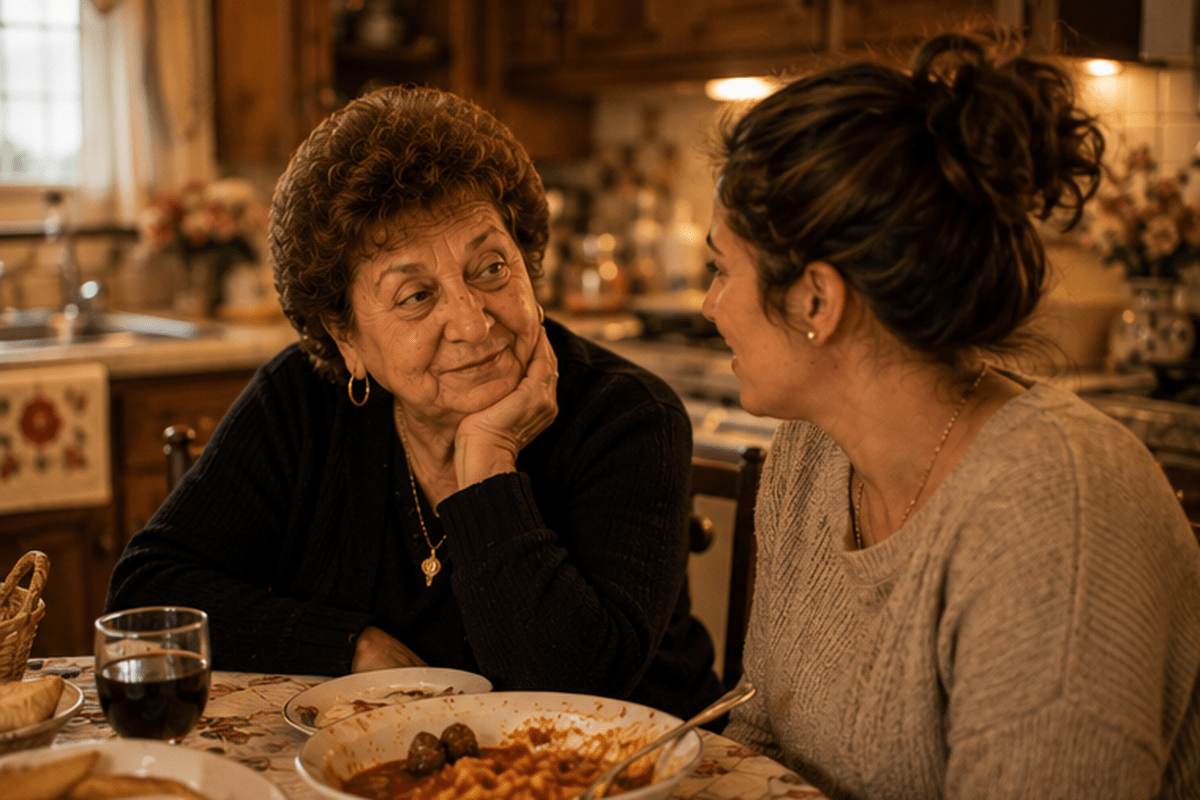
She didn’t need a test or an announcement. She just watched how you ate. A woman who suddenly picked at her food differently, who wanted something she never wanted before, who pushed away something she usually loved — that was enough. My grandmother could read a pregnancy in a plate of pasta the way a meteorologist reads a weather map, and she was almost never wrong.
The moment she knew, the system activated. Not the medical system — the Italian system. The one with its own rules, its own timeline, its own deeply held beliefs about what could help a pregnancy and what could destroy one. The cornicello came out. The warnings started. The silence was enforced. And for the next nine months, the pregnant woman was surrounded by a protective operation so thorough, so detailed, and so completely non-negotiable that modern obstetrics looked casual by comparison.
The Short Version
Italian pregnancy superstitions were a complete protective system — rooted in the same folk beliefs that governed the rest of Italian life. Keep quiet for the first three months. Buy nothing for the baby before it arrives. Satisfy every craving or the baby would bear the mark. Protect the mother from the evil eye. Let the moon decide the rest. These Italian pregnancy superstitions were not old wives’ tales dismissed with a smile. They were rules followed with total conviction, enforced by grandmothers who had seen what happened when they weren’t.
What’s in this guide
- The three-month silence — the first Italian pregnancy superstition
- Don’t buy nothing, eh
- The cravings — le voglie
- Protecting the mother
- Make the husband do everything
- The moon, the gender, and the magic
- When the baby arrives
- Which Italian pregnancy superstitions survive today
- FAQ
The three-month silence — the first Italian pregnancy superstition
The first rule of an Italian pregnancy was absolute: you kept your mouth shut for the first three months, or it would hit the fan.
No announcements. No telling friends. No social media posts, no group texts, no casual mentions at Sunday dinner. For the first trimester, the pregnancy did not exist publicly. It was known only to the couple and — inevitably — to the grandmother who had already figured it out from the way someone was eating, but who understood the rule well enough to keep quiet too.
The reason was simple and deeply rooted in the fear of invidia: you did not announce good fortune. You did not give people a reason to envy you. And a pregnancy — new life, the most precious and most fragile kind of good fortune — was exactly the kind of news that attracted envious attention. Sharing it too early was the same as putting a target on something you could not afford to lose.
There was also the practical fear that something could go wrong in those early months, and having told everyone would turn private grief into public spectacle. The silence was protection on both fronts — against envy and against having to untell something that should never have been told.
Three months of silence. Not because you weren’t excited. Because you were too excited to risk it.
Love these Italian traditions?
Get new stories about Italian customs, folk beliefs, and family traditions — plus our free printable calendar of the Italian year.
Don’t buy nothing, eh
In an Italian family, you did not buy a single thing for the baby before it was born. Not a crib. Not a blanket. Not a onesie. Nothing.
This drove modern expectant parents — and their non-Italian friends — slightly mad. Baby showers, nursery preparation, online registries — all the things the rest of the world does months before the due date were, in an Italian household, forbidden. You did not prepare a room. You did not stock diapers. You did not so much as buy a pair of tiny socks, because doing so was tempting fate in the most dangerous way imaginable.
My family said it plainly: “Don’t buy nothing, eh!” — and they said it to everyone. Not just the parents. The aunts, the cousins, the friends. Everyone was warned. If someone showed up with a baby gift before the birth, the discomfort in the room was real and immediate. You had just done the one thing the family had specifically asked you not to do, and the fear was not abstract.
The logic was the same superstitious logic that ran through everything: you did not act as though a good outcome was guaranteed, because acting certain invited the universe to prove you wrong. Buying for a baby that had not yet arrived safely was presumption — and presumption, in the Italian folk mind, was punished.
“Don’t buy nothing, eh!” It wasn’t a suggestion. It was a command delivered to the entire extended family, and nobody argued.

The cravings — le voglie
In Italian folk belief, a pregnant woman’s cravings were not preferences. They were demands from the baby — and ignoring them had consequences you could see.
Le voglie — literally “the desires” — were taken with complete seriousness. If a pregnant woman craved strawberries, she needed strawberries. If she wanted something at two in the morning, someone was expected to go get it. Because the belief, held firmly and passed down for generations, was that an unsatisfied craving during pregnancy could leave a physical mark on the baby — a birthmark shaped like the thing the mother had wanted and not received.
This was not a metaphor. Italian families genuinely believed that the baby would carry the evidence of the mother’s unmet desire on its skin. A strawberry-shaped birthmark meant someone had wanted strawberries and been denied. A red mark meant something red had been craved. The logic was direct, physical, and completely non-negotiable: you satisfied the craving, or the baby paid for it.
This Italian pregnancy superstition meant that pregnant women were, in this one respect, given absolute authority. Whatever she wanted, she got — because nobody wanted to be the person who said no and then had to explain the birthmark.
A note worth keeping — The voglie belief, however unscientific, had a quietly brilliant effect: it ensured that pregnant women were fed exactly what they wanted, when they wanted it, without argument. In a world where women’s needs were not always centered, this superstition gave the pregnant woman a kind of absolute power at the table that she held at no other time. The fear of the birthmark was the enforcement mechanism, but the result was attentive care.
Protecting the mother
A pregnant woman in an Italian family was treated as someone under threat — and the family’s entire protective system mobilized around her.
The malocchio — the evil eye — was considered especially dangerous during pregnancy. A pregnant woman was carrying the most visible, most enviable kind of good fortune: new life. That made her a target, and the family responded accordingly.
My grandmother brought cornicellos everywhere during a pregnancy — tucked into pockets, pressed into hands, hung near beds. She was on high alert for comments from visitors, for admiring remarks that might carry a trace of envy, for anyone getting too close to the belly with too much interest. Don’t go near the pregnant lady was not paranoia. It was policy.
The protective circle was tight. Visitors were managed. Comments were monitored. And if someone said the wrong thing — something too admiring, too specific, too interested — the grandmother noticed, and the defenses went up. The oil ritual, the prayers, the quiet post-visit conversation: “Did you hear what she said? Be careful.” The same vigilance that guarded the family against invidia in daily life doubled during pregnancy, because the stakes were as high as they could possibly be.
Make the husband do everything
During an Italian pregnancy, the husband’s role was simple and non-negotiable: do whatever she needs, whenever she needs it, without complaint.
This was not modern partnership language. This was the old system — and in the old system, the pregnant woman was carrying the family’s future, and the husband’s job was to make sure nothing interfered with that. Heavy lifting? Him. Errands? Him. Two in the morning craving run? Him. The family made sure of it, and the suocera made especially sure of it, because if the husband was not doing enough, she would tell him so with the subtlety of a fire alarm.
The pregnant woman was not to strain, not to stress, not to do anything that might put the pregnancy at risk. The household rearranged itself around her — not as a courtesy but as a mandate. And if the husband needed reminding, there was always a grandmother nearby to remind him, which she did with the same tone she used for everything else: certain, uncompromising, and correct.
The husband’s job description during an Italian pregnancy was short: everything. His opinion on this was not requested.

The moon, the gender, and the magic
In Italian folk tradition, the moon governed more than the tides — it governed when the baby would come and whether it would be a boy or a girl.
The belief in the moon’s influence on pregnancy ran deep. A full moon meant the baby was coming soon — many Italian families watched the lunar calendar the way modern parents watch the due date, trusting the sky more than the doctor’s estimate. The phase of the moon at conception, or at certain points during the pregnancy, was believed to determine the baby’s gender: one phase for boys, another for girls, passed down as certainty by grandmothers who claimed the system had never failed them.
There were other methods too. How the belly sat — high for a girl, low for a boy (or the reverse, depending on which grandmother you asked). What the mother craved — sweet for a girl, salty for a boy. A ring suspended on a string over the belly, swinging in a circle or a line to reveal the answer. These were not party tricks. They were consulted seriously, discussed at length, and debated between grandmothers with the intensity of rival scholars.
Modern ultrasound has made the question scientifically answerable, but in many Italian families the old methods are still performed — sometimes alongside the scan, sometimes instead of it, and always with the quiet conviction that the moon and the belly know things technology does not.

The same grandmothers who read the moon also prayed to the saints. Our printable Italian saint prayer cards carry eleven of those saints — including Sant’Anna, patron of mothers and grandmothers. Each with a traditional prayer in Italian and English.
$9.49
Instant digital download
When the baby arrives
The moment the baby was born, the family’s protective system shifted from the mother to the child — and the suocera was first through the door.
She arrived with food. She arrived with pharmacy supplies. She arrived with opinions, instructions, and the unshakeable certainty that she had done this before and knew exactly what was needed. The nonna did not wait for an invitation. The baby was here, and that meant she was on duty.
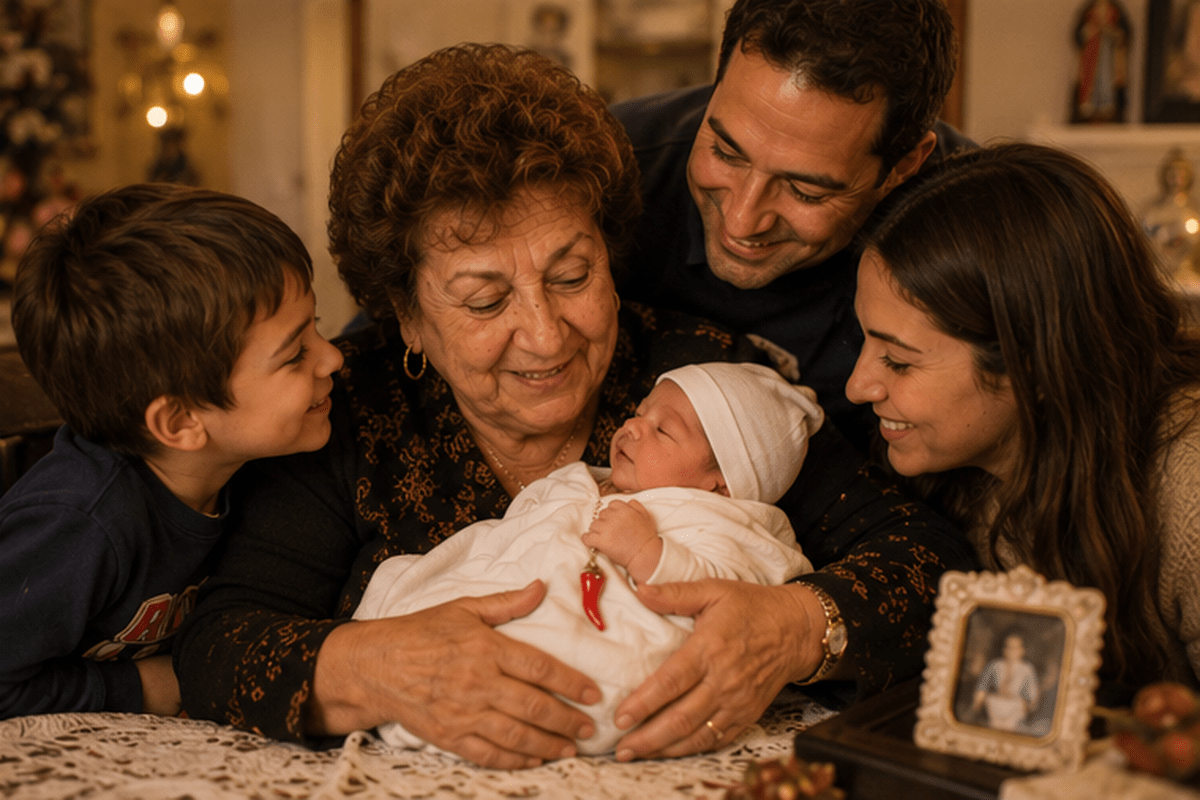
A cornicello was pinned to the baby’s clothing almost immediately — the small red horn that had protected the family for generations, now assigned to protect its newest member. Visitors were watched carefully. Compliments about the baby were deflected, downplayed, or silently noted for later analysis. A beautiful, healthy baby was exactly the kind of thing that attracted the evil eye, and the grandmother who had spent nine months guarding the pregnancy was not about to relax now.
The baptism followed soon — in Italian tradition, sooner rather than later, because an unbaptized baby was considered spiritually vulnerable. The baptism was not just a religious ceremony. It was the final seal of protection — the moment the baby was officially covered, spiritually and socially, by the family and the Church together.
Which Italian pregnancy superstitions survive today
The ultrasound replaced the moon. The registry replaced the post-birth shopping rush. But the instincts underneath — the silence, the protection, the cornicellos — refuse to fully retire.
Modern Italian-Canadian and Italian-American families still negotiate these Italian pregnancy superstitions every generation. The three-month silence is still widely practised, even by couples who consider themselves unsuperstitious — because the logic of it (don’t announce what isn’t certain) makes sense regardless of whether you believe in the evil eye. Many families still avoid buying baby items before the birth, or at least feel uneasy about it. The suocera still shows up first. The cornicello still appears.
What has changed is the packaging, not the instinct. A modern Italian family might laugh about the moon predictions and still feel uncomfortable when someone compliments the baby too enthusiastically. They might buy the crib early and still pin a small red horn to the car seat. They know these Italian pregnancy superstitions are “just superstition” — and they follow them anyway, because the cost of following them is nothing, and the cost of not following them is something they would rather not test.
They know the old beliefs are just superstition. They follow them anyway. Because when it’s your baby, you don’t take chances you don’t have to take.
In Summary
- Keep quiet for three months — announcing too early invited envy and tempted fate
- Buy nothing before the birth — preparing presumed a safe outcome, and presumption was dangerous
- Satisfy every craving (le voglie) — or the baby would carry a birthmark of the unmet desire
- Protect the mother from the evil eye — cornicellos, vigilance, and careful management of visitors
- The husband does everything — no strain, no stress, no argument
- The moon governs gender and timing — consulted alongside (or instead of) the doctor
- When the baby arrives, the suocera is first through the door and the cornicello goes on immediately
- These instincts survive today — softened, sometimes laughed about, but still followed, because when it’s your baby, you don’t take chances
FAQ
What are le voglie in Italian pregnancy tradition?
Le voglie (literally “the desires”) refers to the Italian folk belief that a pregnant woman’s unsatisfied cravings can leave a physical mark — a birthmark — on the baby, shaped like the food she wanted but did not receive. This belief was taken seriously in Italian families and meant that pregnant women’s cravings were fulfilled immediately and without question, to avoid any risk to the child.
Why do Italian families wait three months to announce a pregnancy?
The three-month silence comes from two interconnected beliefs: the fear of invidia (envy attracting misfortune through the evil eye) and the practical caution of not announcing something that is not yet certain. Sharing the news too early was considered both an invitation for envious attention and a tempting of fate. Many Italian and Italian-diaspora families still follow this practice today, even if they no longer consciously connect it to the evil eye.
Why don’t Italian families buy baby items before the birth?
Buying baby items before the birth was considered presumptuous — acting as though a safe outcome was guaranteed when it was not. In the Italian pregnancy superstitious worldview, this kind of presumption invited misfortune. Families waited until after the baby arrived safely before purchasing anything, and guests were explicitly told not to bring gifts before the birth. This tradition persists in many Italian families today.
Did Italians believe the moon determined a baby’s gender?
Yes — in Italian folk tradition, the phase of the moon at conception or during pregnancy was believed to influence the baby’s sex. Other traditional gender-prediction methods included how the belly sat (high or low), the mother’s cravings (sweet for a girl, salty for a boy), and suspending a ring on a string over the belly to read its movement. These methods were consulted seriously by Italian grandmothers, sometimes alongside or even instead of modern ultrasound.
Why do Italian families pin a cornicello on newborns?
The cornicello (little red horn) is the traditional Italian charm against the evil eye. A newborn — beautiful, healthy, and the centre of admiring attention — was considered especially vulnerable to envious looks. Pinning a cornicello to the baby’s clothing was a protective act, shielding the child from the malocchio in the same way the horn protected adults. This practice continues in many Italian families today.
What pregnancy superstitions did your family follow? The three-month silence, the moon predictions, the craving you had to satisfy at midnight — share it in the comments. Every Italian family has a version of this, and every one is worth keeping.

Marco Ricci is an Italian-Canadian writer and the grandson of Calabrian immigrants. He created Italian Family Traditions to document the customs, feast days, and family rituals Italian families carried from Italy to North America — and to understand what they actually meant. He is based in Montreal.