Italian Family Traditions
The Maria Ausiliatrice Feast in Rivière-des-Prairies: Montreal’s Italian Festa Patronale
Every August, the Italian community of Rivière-des-Prairies carries the statue of the Madonna through its streets in one of Montreal’s enduring festa patronale traditions. Here is what the Maria Ausiliatrice feast is, when it happens, its history, and the centuries-old Italian custom behind it — a practical and cultural guide for anyone curious about it or planning to attend.
In the east end of Montreal, in the neighbourhood of Rivière-des-Prairies, one weekend at the start of every August belongs to a tradition that is far older than the city it takes place in. The Italian community there gathers for its festa patronale — its patron feast — in honour of Maria Ausiliatrice, and for three days the neighbourhood fills with Mass, music, food, and, at its heart, a procession that carries the statue of the Madonna through the streets. It is a living example of a custom nearly every Italian town once kept, transplanted across an ocean and still walking down a real Montreal street each summer.
Whether you have roots in the community, live on the procession route, or simply want to understand what the feast is and where it comes from, this guide covers the essentials: the dates and details, what happens across the weekend, the history of the parish, and the deep Italian tradition of the patron-saint feast that gives the whole thing its meaning.
The festa patronale was, for centuries, the single most important day in the Italian calendar of a town — the day the community stepped into the street to honour its protector. In Rivière-des-Prairies, that tradition is still alive.
When is the Maria Ausiliatrice feast? Dates and details
The feast is held annually at the start of August. In 2026, the Festa Patronale runs from Friday, August 7 through Sunday, August 9, hosted by the Missione Maria Ausiliatrice parish. The centrepiece — the Marian procession — takes place on the Saturday evening (August 8), following the 6:30 p.m. Holy Mass, when the statue of Maria Ausiliatrice is carried through the surrounding streets.
| Festa Patronale — the essentials | |
|---|---|
| What | Festa Patronale in honour of Maria Ausiliatrice (Mary Help of Christians) |
| When | Early August each year (in 2026: August 7–9) |
| Procession | Saturday evening, after the 6:30 p.m. Mass |
| Where | Missione Maria Ausiliatrice, 8550 Av. Joliot-Curie, Montreal, QC H1E 4C3 |
| Cost | Free — open to all |
| Includes | Holy Mass, Marian procession, live music, food and gelato, fireworks, family activities |
The parish publishes the full weekend schedule and the procession route each year, so it is worth confirming the current details directly through the Missione Maria Ausiliatrice parish page before attending. The feast is free and everyone is welcome, whether longtime parishioner or first-time visitor.
Free Printable
Every Italian feast day, on one printable calendar.
The Madonna’s feast days, the patron saints, and the whole Italian year — in one free printable calendar. Join the list and we’ll send it to you.
Who is Maria Ausiliatrice?
Maria Ausiliatrice — Mary Help of Christians — is one of the many titles under which the Madonna is venerated. It is worth clarifying, because it confuses many people: the Madonna is a single figure honoured under numerous titles, each with its own history and devotional community. Madonna del Carmine, Madonna della Difesa, Maria Ausiliatrice — all are the same Mary, celebrated under different names, and Italian towns and communities each tended to keep their own particular title, their own statue, and their own feast.
The title Maria Ausiliatrice carries a specific history. While the invocation is ancient, its modern prominence owes much to Saint John Bosco (Don Bosco), the nineteenth-century Turinese priest and founder of the Salesian order, who made Mary Help of Christians the central devotion of his work and built a great basilica in her honour in Turin. Through the Salesians, the devotion spread worldwide, which is part of why parishes and Italian communities across the diaspora — including in Montreal — carry the title. The feast of Maria Ausiliatrice in the universal Church calendar falls on May 24, though local patronal celebrations, as in Rivière-des-Prairies, are often held at the height of summer when the community can gather outdoors.
The history of the parish in Rivière-des-Prairies
Rivière-des-Prairies is one of Montreal’s oldest settled areas — its parish of Saint-Joseph, the fourth parish on the island of Montreal, dates to 1687. But the Italian presence that the Maria Ausiliatrice feast represents is far more recent, part of the great wave of Italian immigration that reshaped Montreal’s east end through the twentieth century.
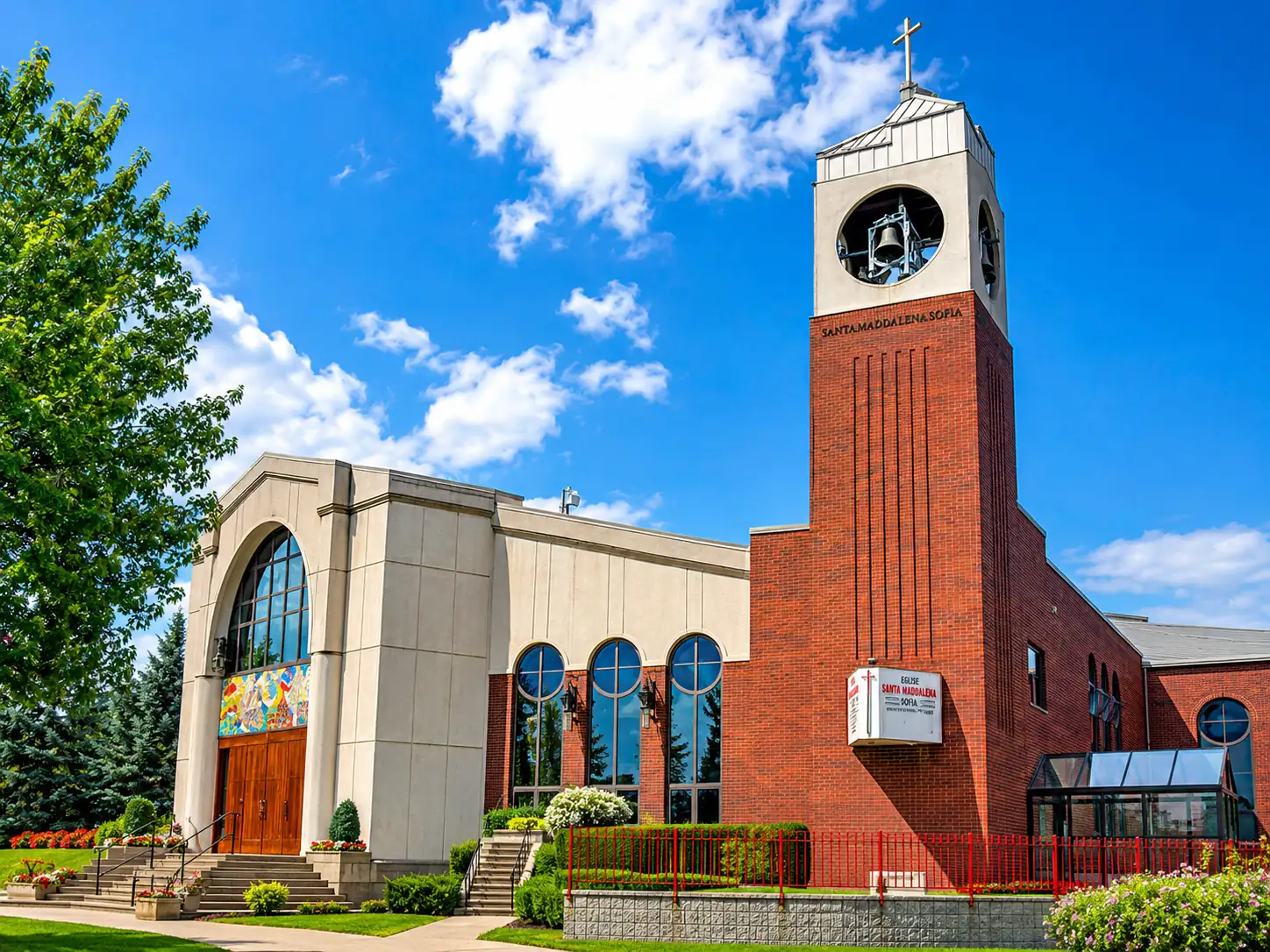
The Italian parish of Maria Ausiliatrice was formally founded on March 19, 1982, established out of the older Saint-Joseph parish to serve the growing Italian community of the neighbourhood, and since 1984 the Maria Ausiliatrice church has been the spiritual home of RDP’s Italian Catholics. In the decades since, as the community grew, the parish and its annual feast became one of the anchors of Italian identity in the east end — a place where a community built by immigration could gather, worship in its own tradition, and keep alive the customs it had carried from Italy. The feast, in other words, is not a quaint revival; it is a continuous tradition maintained by the community that founded the parish.
What happens at the feast
The feast follows the structure of the Italian festa patronale, braiding the religious and the festive together across a full weekend.
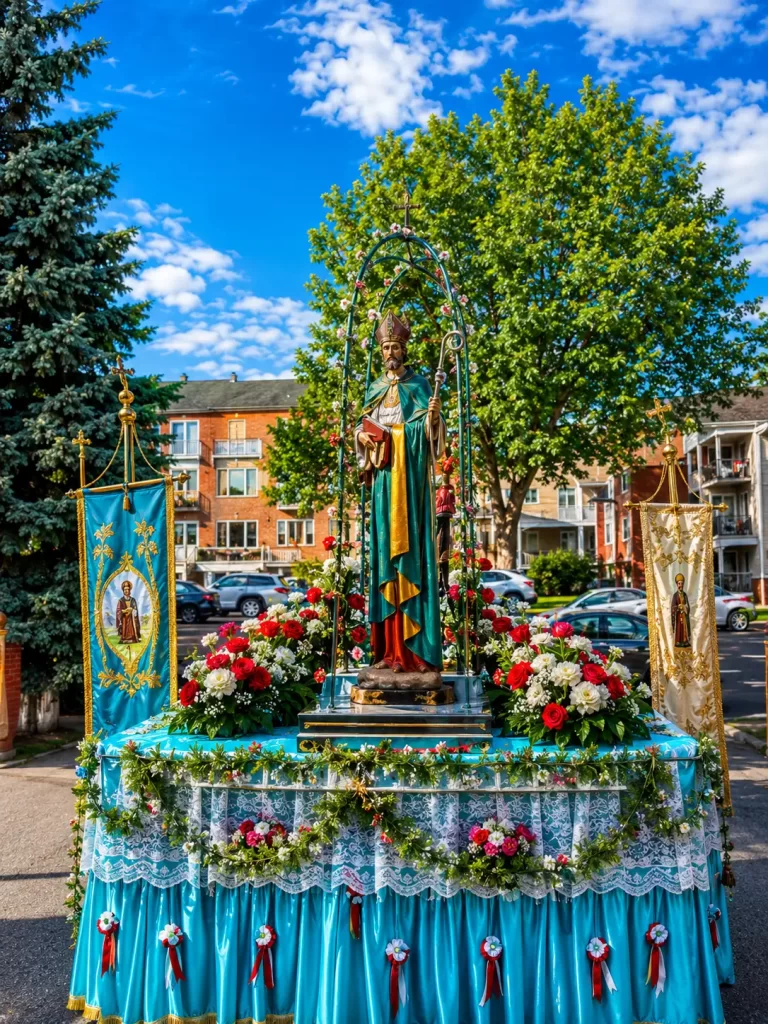
The Holy Mass in honour of the Blessed Mother anchors the weekend spiritually. The Marian procession — the centrepiece — follows the Saturday evening Mass, with the statue of Maria Ausiliatrice carried through the neighbourhood streets, accompanied by the faithful. Around this religious core, the celebration unfolds as a community festival: live music and entertainment, an abundance of food, drinks, and gelato, activities for children and families, and fireworks to close the celebration. It is, in the fullest sense, both a religious observance and a neighbourhood gathering — which is exactly what the festa patronale has always been.
There is one particularly beautiful custom worth knowing, especially for anyone who lives along the route. In the Italian tradition, families whose homes sit on the procession’s path decorate their houses in the Madonna’s honour — hanging lights and flowers, and historically draping their finest linens and bedcovers from balconies and windows as a sign of respect for the saint being celebrated. It is a gesture that turns the whole street into part of the ceremony, and the parish warmly invites residents on the route to take part.
Families on the procession route hang lights and flowers — and, in the old tradition, their finest linens from the balconies — turning the whole street into part of the ceremony.
The festa patronale: the tradition behind the feast
To understand the Rivière-des-Prairies feast, it helps to understand the tradition it belongs to. The festa patronale — the patron feast — was, for centuries, a cornerstone of life in Italy. Nearly every town and village had a patron saint or a particular title of the Madonna as its heavenly protector, and once a year the community held a feast in that protector’s honour: a solemn Mass, a procession carrying the saint’s statue through the streets, and then food, music, and celebration that could last for days.
The most famous example is San Gennaro, the patron saint of Naples, whose feast is celebrated on both sides of the Atlantic — but the same pattern repeated in a thousand smaller towns, each with its own saint and its own day. These feasts were never merely religious observances. They were the moment the community became visible to itself, the high point of the local year, an expression of shared identity as much as shared faith.
When Italians emigrated in the nineteenth and twentieth centuries — to Montreal, New York, Toronto, and beyond — they brought these feasts with them, and parishes abroad became the new home for old devotions. The Maria Ausiliatrice feast in Rivière-des-Prairies is a direct continuation of that transplanted tradition, and it belongs to the broader story of what Italian families kept and carried after immigration. Understanding the feast in RDP means seeing it not as a local curiosity but as one living branch of a very old tree.
What Feast Did Your Family Keep?
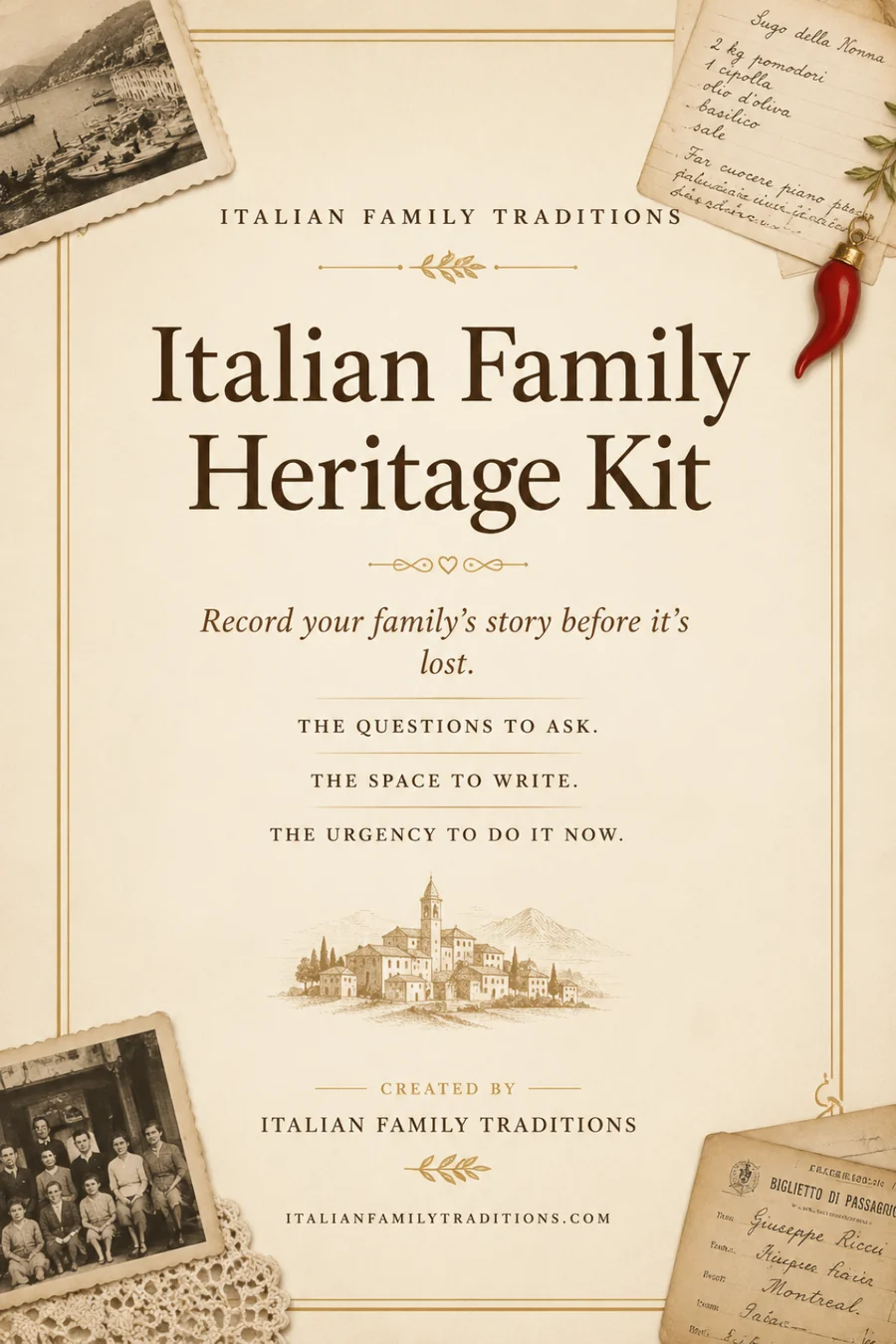
The town’s patron saint or Madonna, the feast day, the procession, the food — these are exactly the details that fade across generations in the diaspora. The Italian Family Heritage Kit gives you the questions and the space to record your family’s feasts, saints, and devotions before they’re lost.
Explore the Italian Family Heritage Kit →Attending the feast: what to know
The feast is a public celebration and visitors are welcome. A few practical notes for anyone planning to go:
- Location: Missione Maria Ausiliatrice, 8550 Avenue Joliot-Curie, Montreal, QC H1E 4C3, in Rivière-des-Prairies.
- The procession is the highlight — held Saturday evening after the 6:30 p.m. Mass. Arrive in time for Mass if you wish to follow the full procession from the church.
- Cost: free. Food, drinks, and gelato are sold on site.
- Families welcome: there are activities for children, and fireworks close the celebration.
- If you live on the route: you’re invited to decorate your home with lights and flowers in the Madonna’s honour, in keeping with the tradition.
- Confirm the schedule: check the parish’s official page or call the parish office for the current year’s exact times and procession route.
Why these feasts still matter
It would be easy to see a neighbourhood feast as simply a pleasant summer evening of food and music. But these celebrations do something quieter and more important. They are one of the last public expressions of a community’s shared heritage — a moment when identity, faith, and belonging become visible in the street. For a community built by immigration, the feast is a link back to the towns its families came from and a way of passing that inheritance to a generation born far from Italy.
These traditions are also more fragile than they appear. They depend on people continuing to show up, on the memory of what the feast means being handed down, and on younger generations choosing to carry the statue their grandparents carried. Documenting them — the saints, the feasts, the customs, and the family stories attached to them — is one of the surest ways to make certain they are not lost, even as the community changes. If your own family kept a feast like this, in Montreal or in the old country, it is worth recording what you remember of it while the people who knew it best are still here.
Each August, the statue of Maria Ausiliatrice is carried through the streets of Rivière-des-Prairies, as it has been since the parish was founded — a festa patronale in the fullest Italian sense, complete with Mass, procession, food, music, and fireworks. It is Montreal’s own version of a tradition that once anchored the year in nearly every Italian town, kept alive by the community that carried it across an ocean. Whether you go to take part or simply to understand, it is a rare and living window into how Italian faith and heritage endure far from home.
Record Your Family’s Feasts & Devotions
Before the feasts and the memories grow quiet.
Which saint or Madonna did your family honour? Which feast, which procession, which town? The Italian Family Heritage Kit includes 133 guided pages and more than 120 prompts to preserve your family’s people, names, saints, traditions, recipes, sayings, photographs, and memories.
Explore the Heritage Kit — $19.99Instant digital download. Print it and complete it with your family.
For the most famous feast of this kind, read about San Gennaro, the patron saint of Naples. For more on the saints Italian families honoured, read the saints every Italian family prayed to and the onomastico, the name day. And to begin preserving your own family’s traditions, start with the questions to ask your Italian grandparents.
FAQ
When is the Maria Ausiliatrice feast in Rivière-des-Prairies?
The Festa Patronale is held at the start of August each year at the Missione Maria Ausiliatrice parish. In 2026 it runs from August 7 to 9, with the Marian procession taking place on Saturday, August 8, following the 6:30 p.m. Holy Mass. Because the exact dates and procession route can vary year to year, it is best to confirm the current schedule through the parish’s official page before attending.
Where is the feast held?
The feast is centred on the Missione Maria Ausiliatrice parish at 8550 Avenue Joliot-Curie, Montreal, Quebec H1E 4C3, in the Rivière-des-Prairies neighbourhood of Montreal’s east end. The procession travels through the surrounding streets. The celebration is free and open to everyone.
Who is Maria Ausiliatrice?
Maria Ausiliatrice means “Mary Help of Christians,” one of the many titles of the Madonna. The devotion was made especially prominent by Saint John Bosco (Don Bosco), the founder of the Salesian order, in nineteenth-century Turin, and spread worldwide through the Salesians. The Madonna is a single figure honoured under many titles — Maria Ausiliatrice, Madonna del Carmine, Madonna della Difesa — each with its own devotional community. In Rivière-des-Prairies, the Italian parish and its patronal feast carry the title Maria Ausiliatrice.
What is a festa patronale?
A festa patronale is the annual feast an Italian town or community holds in honour of its patron saint or its particular title of the Madonna. Traditionally it includes a solemn Mass, a procession carrying the saint’s statue through the streets, and a public celebration with food, music, and, often, fireworks. For centuries it was among the most important days of the local year — as much an expression of community identity as of religious devotion. Italian immigrants carried the tradition abroad, which is why feasts like the one in Rivière-des-Prairies exist today.
Can anyone attend the feast?
Yes. The feast is a free, public celebration and everyone is welcome, whether a longtime parishioner or a first-time visitor. The procession moves through public streets, and the festa’s food, music, and family activities are open to all. Residents whose homes lie on the procession route are traditionally invited to decorate them with lights and flowers in honour of the Madonna.
Why do families decorate their homes along the procession route?
It is a long-standing Italian custom. Families whose homes sit on the procession’s path decorate them as a sign of honour and respect toward the saint or Madonna being celebrated — hanging lights and flowers, and historically draping their finest linens and bedcovers from balconies and windows as the statue passes. The practice turns the whole street into part of the ceremony and is one of the most visible expressions of the community’s devotion during the feast.

Marco Ricci is an Italian-Canadian writer and the grandson of Calabrian immigrants. He created Italian Family Traditions to document the customs, feast days, and family rituals Italian families carried from Italy to North America — and to understand what they actually meant. He is based in Montreal.