Italian Family Traditions
San Gennaro: Naples’ Patron Saint — and the Question He Made Me Ask About My Own Family
To me, San Gennaro was a coffee shop. I’d go on weekends for espresso and pizza and never once wondered who he was. It turns out he’s the most important saint in Naples — his dried blood liquefies three times a year while a whole city holds its breath. And learning that made me realize I couldn’t name my own family’s patron saint at all.
There’s a place in Montreal called San Gennaro. We go on weekends — the espresso is excellent, the pizza better, and for years it was simply the name of the spot where we ended up on a Saturday. I never thought about it. San Gennaro was a sign over a door, the way half the Italian names in this city are just signs over doors now: a bakery, a café, a social club, a saint reduced to a logo.
Then one day it occurred to me to ask who San Gennaro actually was. And the answer stopped me, because it turned out I’d been getting my weekend espresso under the name of one of the most fiercely loved saints in all of Italy — a man whose dried blood, kept in a cathedral in Naples, is said to turn back to liquid three times a year while an entire city waits to see whether it will. I knew none of it. I knew the coffee.
That’s a strange thing to sit with when you’re Calabrian. Because if you’d asked me, in that moment, to name my own family’s patron saint — the saint of the town my grandparents came from in the province of Cosenza — I couldn’t have done it. I was never told. Naples’ saint I could find on a coffee cup. Mine I couldn’t find at all.
So this is two things at once. It’s the story of San Gennaro — who he was, the miracle of the blood, and the enormous feast that still fills the streets of Naples and New York every September. And it’s the tradition behind him: the fact that every Italian town had its own patron saint, its own festa, its own protector carried through the streets once a year. San Gennaro belongs to Naples. This is also about finding the one who belonged to you.
Every Italian town had a saint who belonged to it the way San Gennaro belongs to Naples. Most of us in the diaspora have lost the name of ours — and that loss is quieter, and larger, than it looks.
Who was San Gennaro?
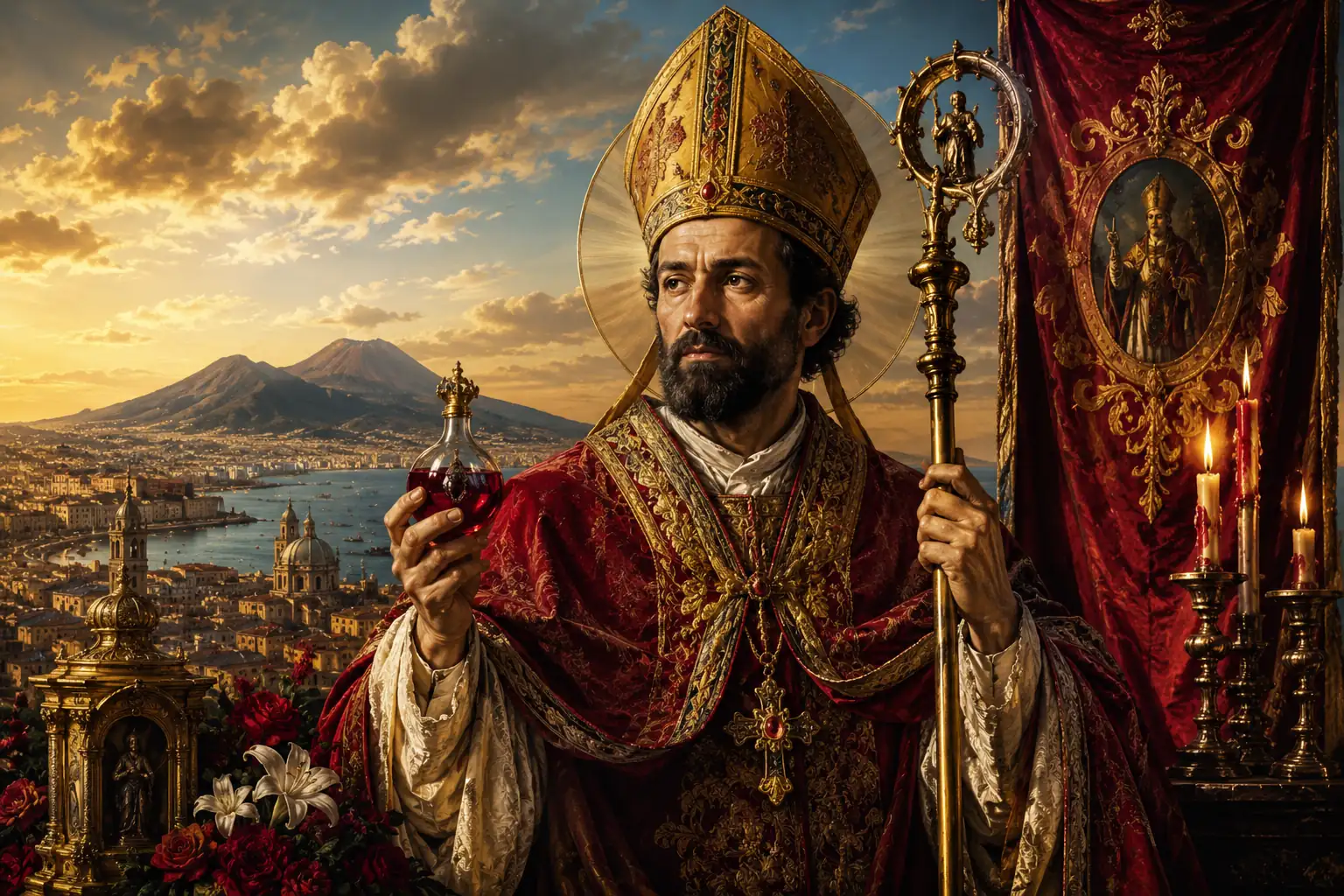
San Gennaro — Saint Januarius in English — was a bishop of Benevento, in the region around Naples, who was martyred during the persecutions of the Roman emperor Diocletian in the early fourth century, around the year 305. The traditional account holds that he was arrested for his faith, survived being thrown to wild beasts, and was finally beheaded near Pozzuoli, outside Naples. Like many saints of that era, the historical record is thin and the devotion around him is vast — but what matters is what he became: the beloved protector of Naples, invoked against the one thing the city feared most.
Because Naples lives in the shadow of Vesuvius, and San Gennaro is the saint Neapolitans have called on for centuries to hold back the volcano, the plague, and every disaster that threatened the city. He is not a distant, abstract figure there. He is o’ santo — the saint, family, a member of the household of the entire city. To understand San Gennaro is to understand that in traditional Italian life, a patron saint was not a decoration. He was a protector you had a real relationship with, the same way Italian families kept the saints they prayed to for the home, the harvest, and the lost.
The miracle of the blood
Here is the thing that makes San Gennaro unlike almost any other saint: the miracle of the blood, and the fact that it is still, to this day, a live public event.
Kept in the Cathedral of Naples are two sealed glass ampoules said to contain the dried blood of San Gennaro, collected at his martyrdom. Three times a year — on his feast day of September 19, on December 16, and on the Saturday before the first Sunday of May — the ampoules are brought out before the faithful, and the solid, dark, dried blood is watched for a sign. The tradition, going back centuries, is that the blood liquefies — turns back from a hardened mass to a flowing liquid — in the hands of the archbishop, before the eyes of a packed cathedral.
When it liquefies, Naples exhales. When it is slow, or fails, the city grows uneasy — because tradition holds that a failure of the miracle is an omen of hard times to come, and Neapolitans point to years when the blood did not liquefy and disaster followed. Whatever one believes about it, the scene itself is extraordinary: a modern city, in a modern century, gathering in a cathedral to watch for a sign in a vial of ancient blood, holding its breath the way its ancestors did five hundred years ago. It is faith and identity and civic emotion all fused into one moment — which is exactly what a patron saint was always meant to be.
A modern city, in a modern century, gathering to watch for a sign in a vial of ancient blood — holding its breath the way its ancestors did five hundred years ago.
Free Printable
Every saint’s day and feast, on one printable calendar.
San Gennaro, the Madonna, your family’s own patron saint — the whole Italian year of feast days in one free printable calendar. Join the list and we’ll send it to you.
The Feast of San Gennaro — Naples and New York
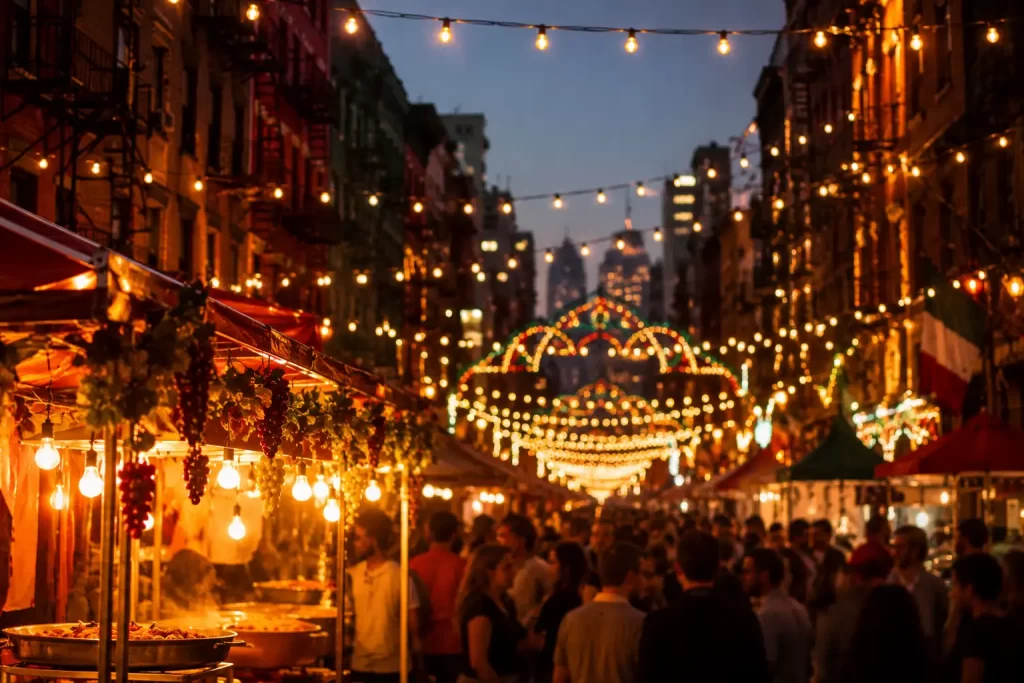
On September 19, Naples throws itself into the feast of its saint. But San Gennaro’s feast crossed the ocean too, and became something iconic on the other side of it. The Feast of San Gennaro in New York’s Little Italy — running for days along Mulberry Street since the 1920s, when Neapolitan immigrants first brought their saint’s celebration to Manhattan — grew into one of the most famous Italian-American street festivals in the world: the lights strung over the street, the processions, the endless stalls of sausage and peppers, zeppole, and cannoli, the whole neighborhood turned into one long table.
That is the pattern of the Italian patron-saint feast wherever it landed. The core is always the same: a statue of the saint carried in procession through the streets, a Mass, and then food and music and community spilling out for hours or days. The saint is honored in church and celebrated in the street, the sacred and the festive braided together — the same instinct that runs through every tradition Italian families carried across the ocean. The feast wasn’t separate from the faith. The feast was the faith, made visible and shared.
| San Gennaro at a glance | |
|---|---|
| Who he was | Saint Januarius, bishop of Benevento, martyred around 305 AD |
| Patron of | Naples — protector against Vesuvius, plague, and disaster |
| Feast day | September 19 |
| The miracle | His dried blood is said to liquefy three times a year in Naples Cathedral |
| The omen | When the blood fails to liquefy, tradition fears hard times ahead |
| The famous feast | The Feast of San Gennaro in New York’s Little Italy, held each September |
| Feast foods | Sausage and peppers, zeppole, struffoli, cannoli |
Every Italian town had its own saint
Here is what San Gennaro taught me, and it’s the part that matters most: he is famous, but he is not unique in kind. What Naples has in San Gennaro, every Italian town had in its own santo patrono — its own patron saint, chosen centuries ago, with its own feast day, its own procession, its own particular relationship to the people who lived under his or her protection.
Your family’s town had one. A specific saint, honored on a specific day, whose statue was carried through specific streets while a specific band played and specific foods were sold and everyone who belonged to that town came out. The feast was the beating heart of the year. It was where the community saw itself whole. And for most of us in the diaspora, the name of that saint is exactly the kind of thing that slipped away — because it lived in the grandparents, and unless someone thought to ask, it left with them.
I am living proof. I can tell you about Naples’ saint from a coffee sign, and I cannot tell you the name of the saint who protected my own family’s town in Cosenza. I was never told, and now the asking is harder than it should have been. That gap — knowing the famous one, not knowing your own — is the small, specific way heritage thins out across an ocean and a generation. It’s the exact thing worth catching before it’s gone, and it’s one of the first questions worth asking your grandparents: which saint’s feast was the biggest in our town, and how did we celebrate it?
Which Saint Belonged to Your Town?
The town’s patron saint, the feast day, the procession, the foods — the details that vanish the moment no one asks. The Italian Family Heritage Kit gives you the questions and the space to record your family’s saints and feast-day memories before they’re lost.
Explore the Italian Family Heritage Kit →My family’s saint was the Madonna
I may not know my town’s patron, but I do know who my family actually prayed to, because it was everywhere in the house: the Madonna.
There was a rosary in my grandparents’ room and a rosary hanging in the car. The Madonna was the one they turned to — not a distant devotion but a daily presence, the beads worn smooth from handling. In countless Italian families she was the true patron of the household, above and beneath every other saint, and mine was no exception. She was who you asked when it mattered.
Here’s something worth knowing, because it confused me for years: the Madonna is one figure with many titles, and Italian communities each tended to keep their particular title of her. Madonna del Carmine, Madonna della Difesa, Maria Ausiliatrice — Mary Help of Christians — these are all the same Mary, honored under different names, each carrying its own feast and its own devotion. So even within the Madonna, there was a specific one that belonged to a specific community. You may not know your town’s patron saint and still have inherited a very particular Madonna without realizing she had a name of her own.
The festa lives on, even here
What’s remarkable is that this tradition didn’t stay in Italy. Wherever Italians settled, the patron feast came with them, and parishes abroad became the new home for old devotions. In Montreal alone, the Italian community of Rivière-des-Prairies still carries the Madonna — under her title of Maria Ausiliatrice — through the neighbourhood streets every August, complete with the procession, the food, the music, and the fireworks that mark a festa patronale anywhere in the Italian world. It is Naples’ San Gennaro and every small town’s saint, transplanted to a Montreal summer: the same procession, the same braid of the sacred and the festive, still walking down a real street.
If you want to see exactly how one of these feasts works today, I wrote a full guide to the Maria Ausiliatrice feast in Rivière-des-Prairies — its history, its schedule, and the traditions behind it. It is a living example of the very thing San Gennaro represents: a community keeping its saint, and itself, alive far from the town it came from.
How to find your family’s patron saint
If, like me, you realized somewhere in reading this that you don’t know your own family’s saint, here’s how to find out — and it’s worth doing before the people who’d know are gone.
Start with your oldest relatives, and ask directly: what town did we come from, and which saint’s feast was the biggest one there? What was the day? Did they carry a statue? What did the family do — the food, the procession, who came? Then go to the town itself: nearly every Italian comune has a well-documented santo patrono and feast day, so once you know the town — which you can trace through finding your Italian town of origin — the patron saint is usually straightforward to identify. Look, too, at the names in your family: with the old naming traditions, children were often named after locally important saints, and the onomastico — the name day — is another thread back to the saints your family honored.
And then write it down. The name of the saint, the day, the way your family kept the feast, the memories of the procession in the old town or the new one — this is exactly the kind of detail that survives only if someone records it. It’s why I keep pushing people to record these things while they still can. I’m doing it myself, working backward, trying to recover the saint I was never told about — and I’d rather you not have to work backward the way I am.
San Gennaro was a coffee shop to me until I asked who he was — and the answer sent me looking for the saint who belonged to my own family, the one I was never told. I still don’t have his name. But I have the Madonna my grandparents prayed to, the rosary in the car, and the statue carried down my street every August with the sausage sandwiches and the old faces. That’s my festa. Somewhere there’s the name of my town’s saint too, waiting to be recovered — and if you don’t know yours either, go ask, while there’s still someone who remembers. The famous saints will always have their coffee signs. It’s the family ones we have to save.
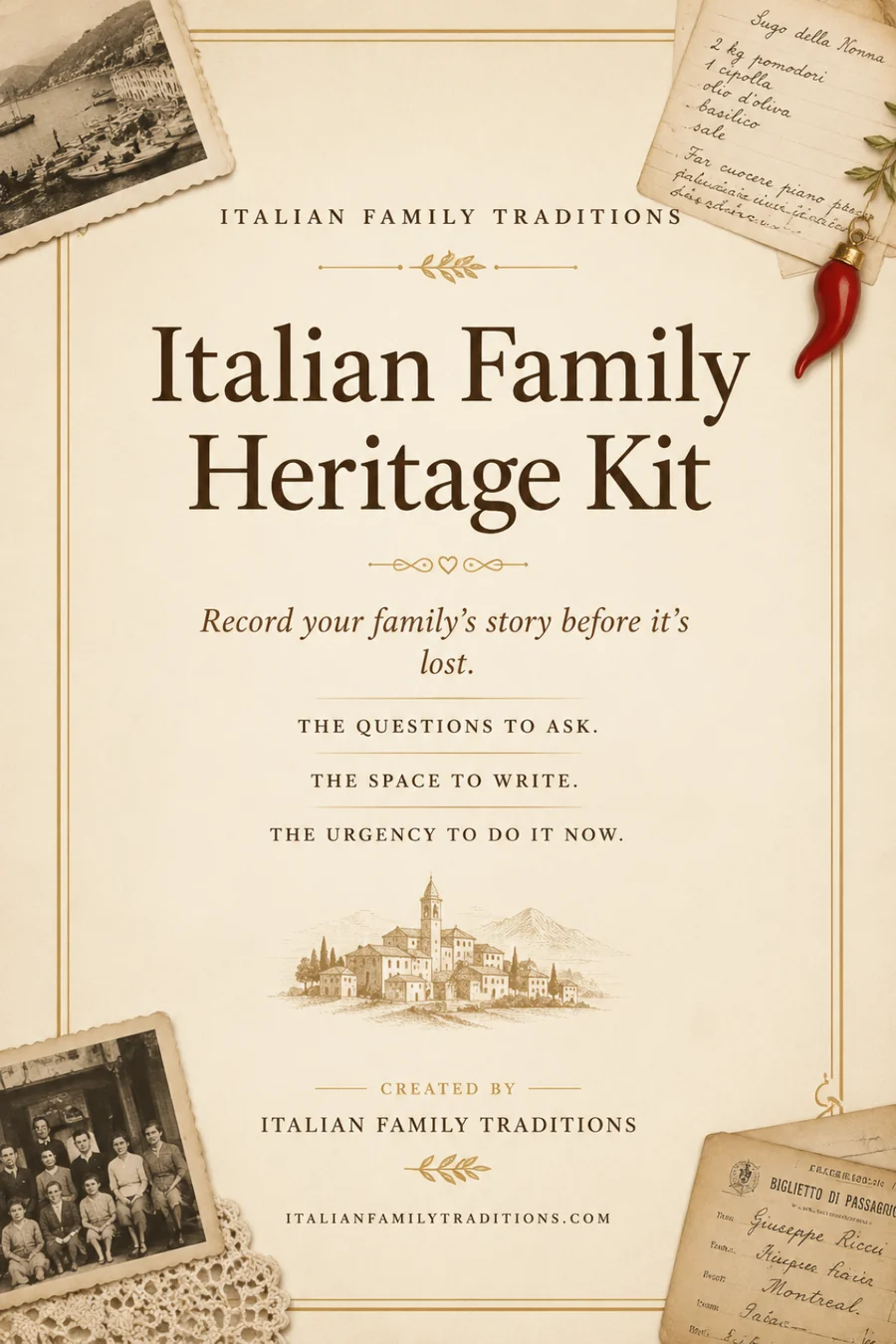
Which Saint Watched Over Your Family?
Record the saints, feast days, and processions before they’re lost.
Which saint’s feast was biggest in your town? What did your family do — the statue, the food, the procession? The Italian Family Heritage Kit includes 133 guided pages and more than 120 prompts to preserve your family’s people, names, saints, traditions, recipes, sayings, photographs, and memories.
Explore the Heritage Kit — $19.99Instant digital download. Print it and complete it with your family.
For more on the saints Italian families lived alongside, read about the saints every Italian family prayed to and the onomastico, the name day every saint’s name carried. For the protective folk side of Italian faith, read about the cornicello and the malocchio, and to begin recovering your own family’s story, start with the questions to ask your Italian grandparents.
San Gennaro is the beloved patron of Naples — find the patron saint for any need in the patron saint finder, and pray a novena in his honor.
FAQ
Who was San Gennaro?
San Gennaro — Saint Januarius in English — was a bishop of Benevento, near Naples, who was martyred during the persecutions of the Roman emperor Diocletian around 305 AD. He became the patron saint of Naples, invoked for centuries to protect the city against the eruptions of Mount Vesuvius, plague, and disaster. He remains one of the most beloved and fiercely honored saints in all of Italy, treated by Neapolitans not as a distant figure but almost as a member of the family of the entire city.
What is the miracle of San Gennaro’s blood?
Two sealed glass ampoules kept in the Cathedral of Naples are said to contain the dried blood of San Gennaro. Three times a year — on his feast day of September 19, on December 16, and on the Saturday before the first Sunday of May — the ampoules are brought out and the dried blood is said to liquefy, turning back into a flowing liquid before the congregation. When the miracle occurs, the city celebrates; when the blood is slow to liquefy or fails to, tradition holds it as an omen of hard times ahead. The event still draws crowds to the cathedral today.
When is the Feast of San Gennaro?
San Gennaro’s feast day is September 19. In Naples it is a major celebration centered on the cathedral and the miracle of the blood. In the United States, the Feast of San Gennaro in New York’s Little Italy — held each September along Mulberry Street since the 1920s, when Neapolitan immigrants brought the celebration with them — has become one of the most famous Italian-American street festivals, with processions, music, and stalls of sausage and peppers, zeppole, and cannoli.
What foods are associated with the Feast of San Gennaro?
The feast is famous for its street food. The classic is sausage and peppers, alongside zeppole (fried dough dusted with sugar), struffoli (honey-coated fried dough balls), cannoli, and other Neapolitan and southern Italian sweets. As with most Italian patron-saint feasts, the food is central rather than incidental — the meal shared in the street is part of how the community honors the saint and celebrates together.
Did every Italian town have its own patron saint?
Yes. Just as San Gennaro is the patron of Naples, nearly every Italian town and village had its own santo patrono — a patron saint chosen long ago, with an annual feast day, a procession carrying the saint’s statue through the streets, and its own traditions of food, music, and celebration. The patron saint’s feast was often the most important day of the local year. For many families in the diaspora, the name of their town’s patron saint is one of the details most easily lost across generations, which is why asking older relatives and tracing the family’s town of origin is the best way to recover it.
How can I find out my own family’s patron saint?
Start by asking your oldest living relatives which saint’s feast was the biggest in the town your family came from, and how it was celebrated. Then identify the town itself — most Italian comuni have a well-documented patron saint and feast day, so once you know the town, the saint is usually easy to confirm. Family first names can be another clue, since children were often named after locally important saints. Finally, write down what you learn — the saint, the day, and the memories of the feast — because this is exactly the kind of detail that survives only when someone records it in time.

Marco Ricci is an Italian-Canadian writer and the grandson of Calabrian immigrants. He created Italian Family Traditions to document the customs, feast days, and family rituals Italian families carried from Italy to North America — and to understand what they actually meant. He is based in Montreal.