Italian Family Traditions
Panettone vs. Pandoro: What’s the Difference?
Italy’s two great Christmas cakes, settled once and for all — where each comes from, how they differ, which one is right for you, and the proper way to serve them.
Every Italian Christmas table has them, and every Italian family has an opinion. The two boxes appear in the shops from late November — the tall domed panettone and the golden star-shaped pandoro — and somewhere in every household, someone insists one is far better than the other. So what actually separates them? They look similar, they arrive at the same time of year, and they’re often mentioned in the same breath. But they come from different cities, different traditions, and genuinely different recipes.
Here is the honest, point-by-point answer — and a few interactive ways to settle the debate at your own table.
Italy’s Two Christmas Cakes
Panettone vs. Pandoro
Side by side
The two great Italian Christmas breads, compared point for point.
Which one is for you?
Three quick taps and we’ll settle the debate at your table.
How to serve it
The classic Italian ways to enjoy each one. Tap to switch.
However you serve them, both are best shared — sliced at the center of the table, the way an Italian Christmas has always ended.
What is panettone?
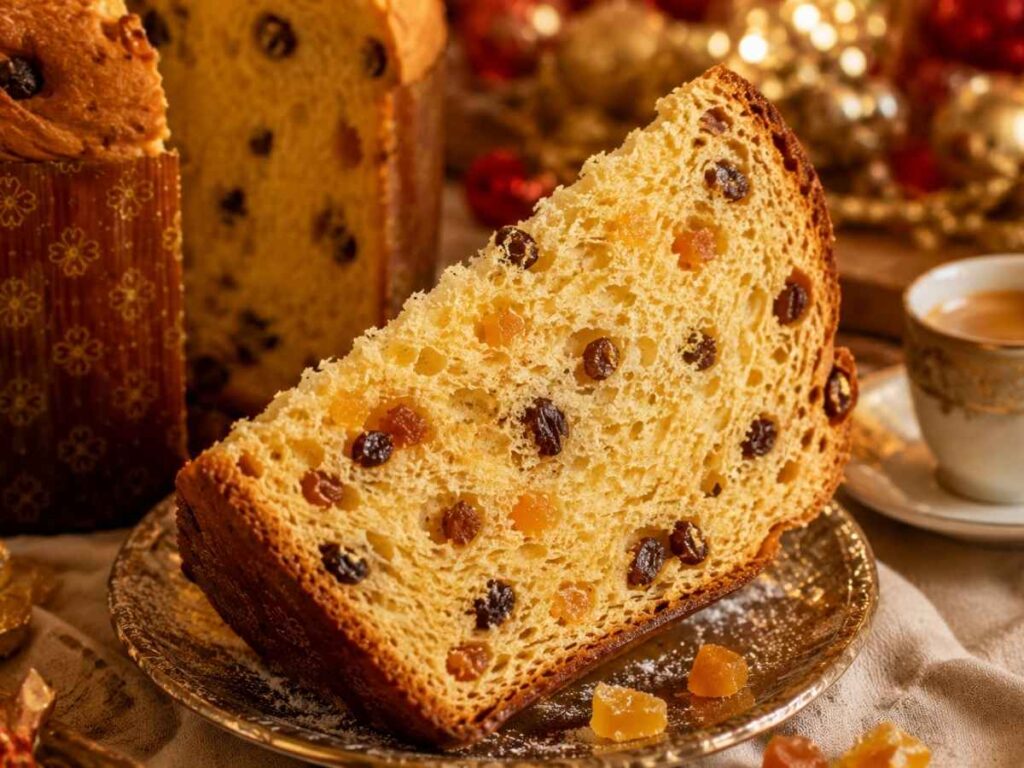
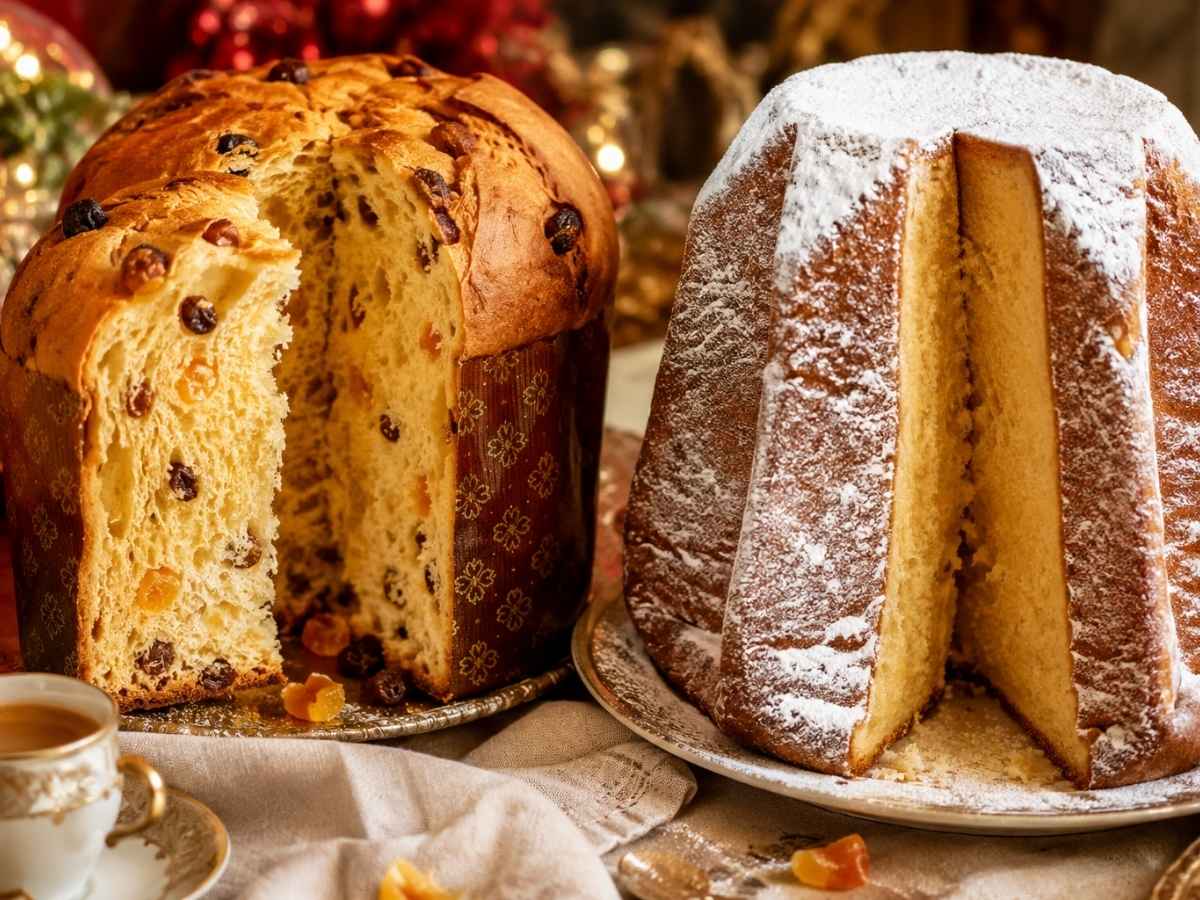
Panettone is the taller of the two — a domed, cupola-shaped sweet bread that originated in Milan. Its defining features are its airy, almost stringy crumb and the candied fruit and raisins studded throughout. Making a true panettone is a slow, difficult process: the dough is leavened with a natural sourdough starter (lievito madre) over many hours, sometimes days, which gives it that characteristic light, pull-apart texture. It is, in a sense, more bread than cake — and a well-made one is a small marvel of baking.
Legends about its origin abound — most tie it to Milan and a tale of a baker named Toni (“pan de Toni,” Toni’s bread) — but what matters is that panettone became the Milanese Christmas bread and spread from there across all of Italy and the world.
What is pandoro?
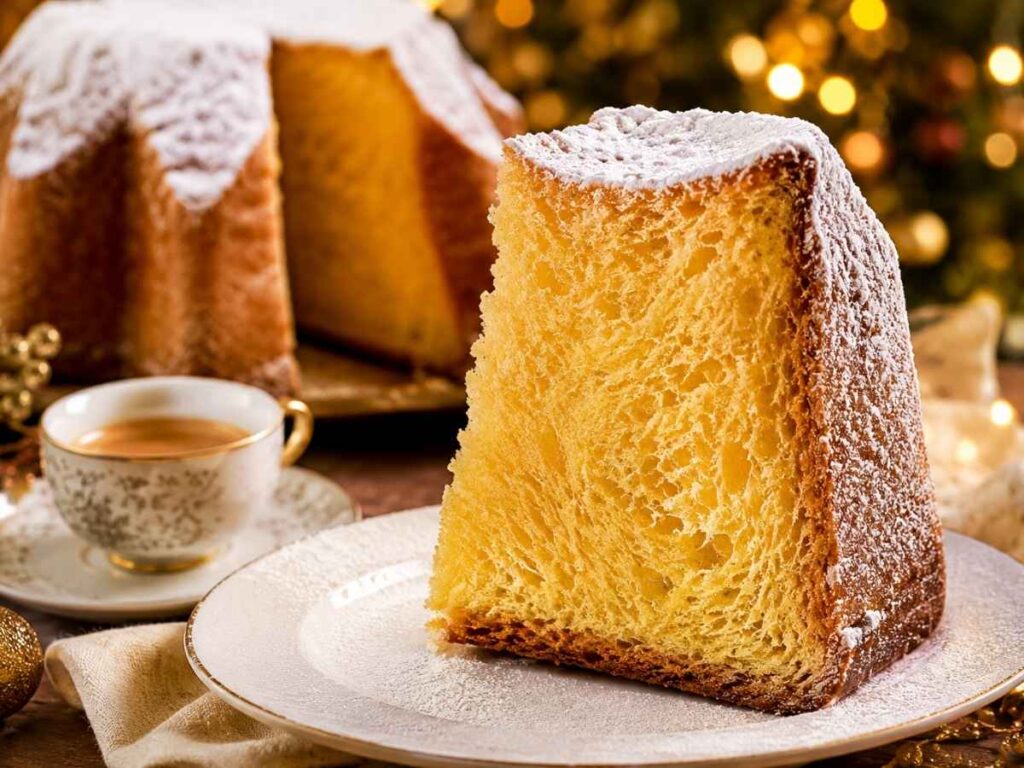
Pandoro — literally “golden bread” — comes from Verona, and it is a different creature entirely. It has no candied fruit, no raisins, nothing studded through it: it is plain, soft, buttery, and rich, closer to a cake than panettone is. Its unmistakable feature is its shape — a tall eight-pointed star, designed so that when sliced horizontally and dusted with powdered sugar, it looks like a snow-covered mountain peak. It is almost always served with a generous shake of powdered sugar, traditionally shaken on inside the bag it comes in.
Where panettone is fruited and bready, pandoro is pure, golden, and tender — the choice for anyone who never liked biting into a piece of candied peel.
Panettone is fruited and bready, from Milan. Pandoro is plain and buttery, from Verona. Same season, same shelf — two entirely different traditions.
The main differences, in short
| Panettone | Pandoro | |
|---|---|---|
| City of origin | Milan (Lombardy) | Verona (Veneto) |
| Shape | Tall, domed cupola | Eight-pointed star |
| Texture | Airy, stringy, bread-like | Soft, buttery, cake-like |
| Add-ins | Candied fruit & raisins | None — plain |
| Finish | Served as is | Dusted with powdered sugar |
| Name means | “Big bread” / Toni’s bread | “Golden bread” |
| Classic pairing | Sweet wine, espresso | Mascarpone cream, cocoa |
Which came first?
Panettone is the older tradition, with roots reaching back centuries in Milan. Pandoro is comparatively modern — it was industrialized and popularized in the late 1800s in Verona (the baker Domenico Melegatti patented a version in 1894), though it draws on older Veronese cakes. So while both feel timeless today, panettone is the ancient one and pandoro the elegant nineteenth-century newcomer that grew up beside it.
Free Printable
The whole Italian Christmas, on one calendar.
From the Feast of the Seven Fishes to La Befana — join the list for a free printable Italian family calendar and never miss a tradition.
How to serve panettone and pandoro
Both are traditionally eaten at the end of the long Christmas meal, sliced at the table and shared. Panettone is classic with a glass of sweet wine (moscato, vin santo, or prosecco), or simply with coffee; some families lightly toast leftover slices, or serve it with warm zabaione (an egg-and-wine custard). Pandoro is almost always dusted with powdered sugar first, then served plain, or dressed up — split into star-shaped layers with mascarpone cream and berries, or dusted with cocoa. Leftovers of either make an extraordinary French toast the next morning.
Both belong to the wider world of the Italian Christmas — the season of feast days, sweets, and family that runs from early December all the way to the Epiphany.
Panettone or pandoro — fruited or plain, Milan or Verona — there’s no wrong answer, only the one your family reaches for first. Both are the taste of an Italian Christmas, sliced at the center of the table and shared. Pick your side, pour something sweet, and pass a slice to the person next to you.
Preserve Your Christmas
The recipes and rituals only your family kept.
Which cake your family bought, the Vigilia menu, nonna’s cookies — the Italian Family Heritage Kit gives you 133 guided pages to record your family’s Christmas before it fades.
Explore the Heritage Kit — $19.99Instant digital download. Print it and complete it with your family.
More of the Italian Christmas table: the complete guide to Italian Christmas traditions, the Feast of the Seven Fishes and La Vigilia on Christmas Eve, the after-dinner game of Tombola, the Feast of Santa Lucia and La Befana that open and close the season, and the Italian Sunday dinner that shaped them all. For the whole season at a glance, see the Italian feast day calendar.
FAQ
What is the difference between panettone and pandoro?
Panettone (from Milan) is a tall, domed sweet bread with an airy texture and candied fruit and raisins. Pandoro (from Verona) is a soft, buttery, star-shaped cake with no fruit, dusted with powdered sugar. Panettone is bread-like and fruited; pandoro is cake-like and plain.
Which is better, panettone or pandoro?
Neither is objectively better — it comes down to taste. Choose panettone if you like candied fruit and an airy, bread-like texture; choose pandoro if you prefer a plain, soft, buttery cake. Many Italian families buy both and settle the debate every year.
Why is pandoro shaped like a star?
Pandoro’s eight-pointed star shape comes from Verona and is designed so that when it’s sliced horizontally and dusted with powdered sugar, it resembles a snow-covered mountain peak — a fitting image for the Christmas season.
Does panettone always have fruit?
Traditional panettone contains candied fruit (often orange and citron) and raisins. However, modern variations exist without fruit, or with chocolate chips instead — but the classic Milanese panettone is defined by its candied fruit and raisins. If you want it plain, pandoro is the traditional fruit-free choice.
How do you serve panettone and pandoro?
Both are sliced and shared at the end of the Christmas meal. Panettone pairs classically with sweet wine (moscato or vin santo) or coffee. Pandoro is dusted with powdered sugar and served plain, or dressed with mascarpone cream, berries, or cocoa. Leftovers of either make excellent French toast.
Marco Ricci is an Italian-Canadian writer and the grandson of Calabrian immigrants. He created Italian Family Traditions to document the customs, feast days, and family rituals Italian families carried from Italy to North America — and to understand what they actually meant. He is based in Montreal.