
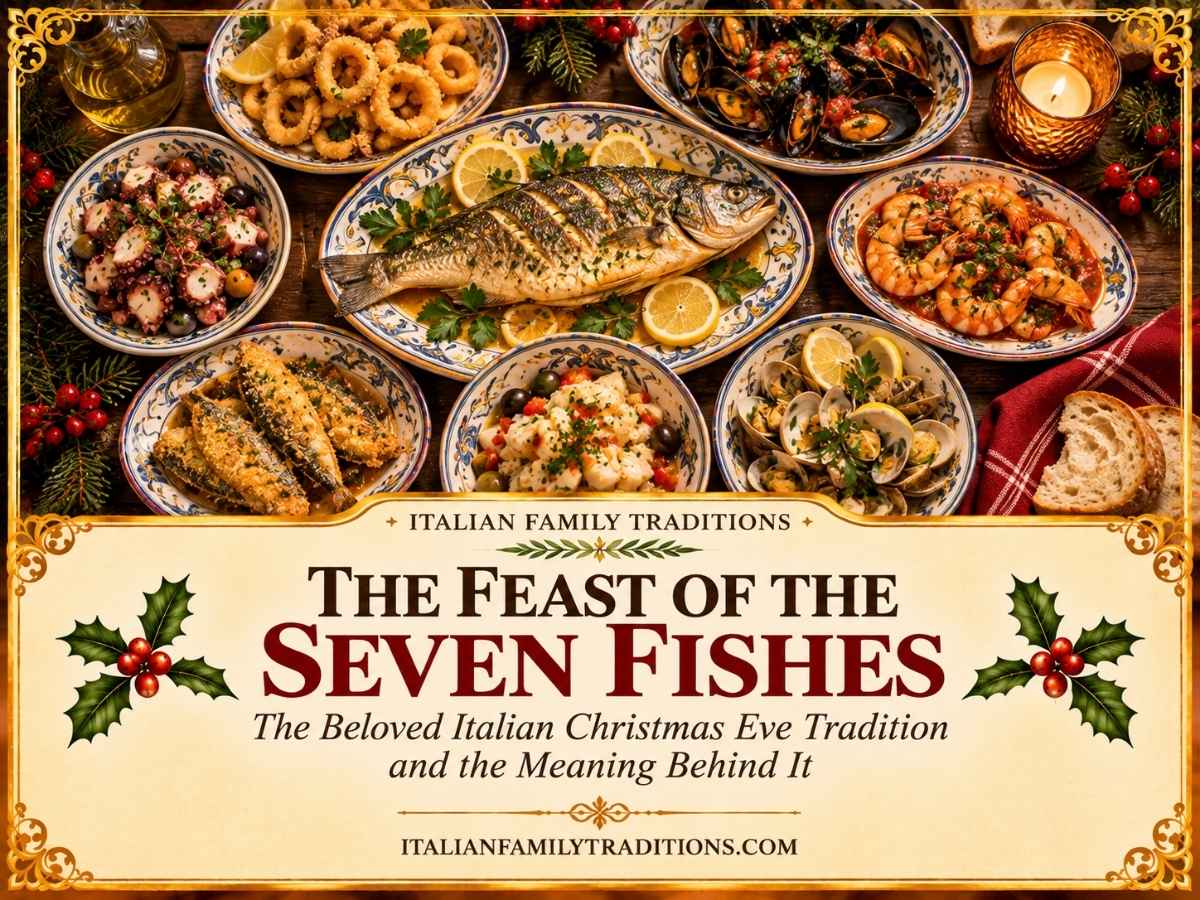
Italian Family Traditions
Feast of the Seven Fishes Menu: Build Your Christmas Eve Menu, With Simple Recipes and a Cooking Plan
Fish, then games. Plain spaghetti with butter for the kids who would not touch the fish. Here is everything you need to cook the Feast of the Seven Fishes at home — a menu builder, a shopping list scaled to your table, a three-day cooking plan, eight simple recipes, and what to do once the plates are cleared.
A classic Feast of the Seven Fishes menu moves from cold to hot: a chilled seafood salad and salt cod salad to start, a fried course of calamari, smelts and baccalà, a pasta with clams or anchovies, and a baked or steamed dish such as shrimp oreganata or mussels. Plan on about half to three quarters of a pound of seafood per adult across all the courses, start soaking the salt cod three days ahead, make the cold dishes on December 23, and fry in small batches on the night. Use the menu builder below to plan yours in a minute, or scroll down for the recipes and the cooking plan.
In our family, Christmas Eve was always fish. Baccalà, calamari, shrimp, clams, smelts — whatever the year allowed, it came out of the kitchen course after course, and nobody asked whether there would be meat, because on the night of the Vigilia there never was. There was one exception, and every Italian family seems to have it: a pot of plain spaghetti with butter for the kids who would not eat the fish. It sat at the end of the table, steaming and innocent, and it was the only dish nobody fought over.
And when the fish was finished, the games began. Nothing elaborate. Someone would take a serving spoon and roll hazelnuts off it, trying to make one touch another on the table. Someone would close a fist around a handful of nuts and make you guess how many were inside. And if we were lucky enough to own a set that year, the tombola came out and the evening ran on numbers and laughter until it was time for Midnight Mass.
Fish, then games. Spaghetti with butter for the kids who would not touch the fish. That was Christmas Eve, and it never needed to be anything more.
That is the whole shape of the Feast of the Seven Fishes, and it is far easier to recreate than its reputation suggests. You do not need a restaurant kitchen or a nonna who has been frying since nine in the morning. You need a plan, a fishmonger, a few simple recipes, and a table full of people. If you want the history first — why fish, why seven, and whether Italians in Italy actually call it that — read our guide to the meaning of the Feast of the Seven Fishes. This page is about getting it on the table.
Free Printable
Plan the whole Italian Christmas, not just the 24th.
The Immacolata, Santa Lucia, the Christmas Novena, La Vigilia, Santo Stefano and La Befana — every feast day of the Italian year on one free printable calendar, with what families did and ate on each one. Join the list and we’ll send it to you.
La Vigilia · December 24
Seven Fishes Menu Builder
Tell us about your table. We’ll build your Christmas Eve menu, a shopping list scaled to your guests, and a three-day cooking timeline.
How many at the table?
What kind of table?
How many fishes does your family serve?
Anything to leave out? (tap all that apply)
Kids or fish-haters at the table?
Quantities assume a long, multi-course dinner and are a starting point — buy a little extra of whatever your family fights over. Recipes for the starred dishes are further down this page.
How to plan a Seven Fishes menu
Every family’s Vigilia is different, but almost all of them follow the same arc, from cold to fried to pasta to baked, and finally to nuts, fruit and sweets. Thinking in courses rather than in a list of seven separate dishes is the single most useful thing you can do, because it tells you what can be made ahead, what has to be cooked at the last minute, and when the stove will be busiest.
The Shape of the Night
1
Cold antipasti
Seafood salad, baccalà salad, scungilli — ready before anyone arrives
2
The fried course
Calamari, smelts, baccalà, fried in batches and sent straight to the table
3
The pasta
Clams, anchovies or crab — and spaghetti with butter for the kids
4
Baked & steamed
Shrimp oreganata, mussels, a whole roasted fish
5
Nuts & fruit
Hazelnuts, walnuts, clementines, dried figs, the cookie tray
6
The games
Nut games, then tombola until Midnight Mass
The cold course is your best friend. A seafood salad, a salt cod salad or an octopus salad can all be made on December 23 and actually improve overnight. Put them out as people arrive and the evening has started before you have lit a burner. The fried course is the heart of most Italian-American tables and the most work on the night: calamari, smelts and baccalà all need to be fried in small batches and eaten hot, so plan to spend half an hour at the stove while everyone else eats. The pasta comes next, and it is the course to choose carefully: clams make it festive, anchovies and breadcrumbs make it cheap and quick, and a crab sauce makes it a project. The baked or steamed course closes the fish, and the best choices are dishes that sit in the oven or a covered pot without attention, like shrimp oreganata or a whole roasted fish.
How many dishes is up to you. Seven is the famous number, but many families serve nine, twelve or thirteen, and plenty of homes now serve three or five excellent dishes instead of seven rushed ones. The menu builder lets you choose any of these. If you are cooking it for the first time, five fishes done well will be remembered far longer than seven done in a panic.
| Dish | Course | Make ahead? | Effort |
|---|---|---|---|
| Insalata di mare (seafood salad) | Cold | Yes, the day before | Easy |
| Insalata di baccalà (salt cod salad) | Cold | Yes, the day before | Easy, once soaked |
| Calamari fritti | Fried | Clean the day before | Medium |
| Fried smelts | Fried | No | Easy |
| Baccalà fritto | Fried | Soak 3 days ahead | Medium |
| Spaghetti alle vongole | Pasta | Purge clams that morning | Medium |
| Pasta ca’ muddica (anchovies & breadcrumbs) | Pasta | Toast crumbs ahead | Easy |
| Shrimp oreganata | Baked | Assemble in the afternoon | Easy |
| Impepata di cozze (peppered mussels) | Steamed | Clean that morning | Easy |
| Branzino al forno (whole roast fish) | Baked | No | Easy |
How much fish to buy
The most common question about the Seven Fishes is also the hardest to answer from a recipe, because recipes are written as if each dish were the whole meal. On Christmas Eve, it is not. When there are seven fish courses, each one is a few bites, and the total is what matters.
½–¾ lb
of seafood per adult in total, across all the fish courses (225–340 g)
2–3 oz
of each individual fish per person when you serve seven (60–90 g)
1 lb
of clams or mussels in the shell for every two people in a pasta or steamed course
The builder above does this arithmetic for you and scales the list to your guests: a smaller menu gets larger portions of each dish, a twelve-course feast gets smaller ones. It counts two children as one adult, which is generous for small children and about right for teenagers. And it adds the spaghetti for the kids, because someone at your table will need it.
Buying fish for Christmas Eve
If you live near an Italian neighbourhood, you already know what December 23 and 24 look like at the fish counter: a line out the door, numbers called over the noise, and the last of the good baccalà disappearing by noon. A little planning makes the whole week calmer.
Order ahead. Call your fishmonger in the week before Christmas and ask to pick up on the 23rd. Buy baccalà early, because it needs three days of soaking; look for thick, white pieces from the centre of the fish rather than thin tail ends. Frozen is fine for shrimp and calamari, which are usually frozen at sea anyway; thaw them overnight in the fridge. Clams and mussels must be alive: buy them on the 23rd or the morning of the 24th, keep them in a bowl in the fridge covered with a damp towel (never in a sealed bag or in water), and throw away any that are cracked or stay open when tapped, as the FDA’s seafood safety guide advises. Smelts and fresh anchovies are often sold frozen in North America and are perfectly good that way. And eel, the Neapolitan capitone, usually has to be ordered specially; if your family insists on it, call early.
The recipes
These are the eight starred dishes from the menu builder, written for a home kitchen and for a table of about eight as part of a multi-course feast. They are deliberately simple — the way most families actually cooked them — and none of them needs anything you cannot find at a good supermarket and an Italian grocery. Start with how to soak the salt cod, because it has to begin three days before everything else.
How to soak baccalà
Salt cod is cod that has been salted and dried until it is as stiff as a board, and it must be soaked before it can be eaten. Rinse off the surface salt, cut it into large pieces, and put it in a big bowl of cold water in the fridge. Change the water two or three times a day for about three days, until a small flake tastes pleasantly salty rather than harsh. Thick pieces take longer than thin ones. Once soaked, remove any skin and bones, pat it dry, and it is ready for frying, salads or stewing. Soaked baccalà keeps for a day in the fridge.
Baccalà fritto (fried salt cod)
Fried course · serves 8 as one of several fishes · soak 3 days ahead
The dish that, for many families, simply is Christmas Eve: chunks of salt cod in a light, crisp batter, eaten hot with a squeeze of lemon.
Ingredients
- 1 lb (450 g) salt cod, dried weight, soaked as above
- 1 cup (130 g) all-purpose flour
- About 1 cup (240 ml) very cold sparkling water
- A pinch of salt (the cod is already salty)
- Oil for frying
- Lemon wedges
Method
- Cut the soaked baccalà into pieces about 2 inches (5 cm) across and pat them very dry with paper towels.
- Whisk the flour and salt with enough cold sparkling water to make a batter like thick cream. Use it straight away.
- Heat 2 inches (5 cm) of oil in a deep, heavy pan to 350–360°F (175–180°C).
- Dip each piece in the batter, let the excess drip off, and fry a few pieces at a time for 3 to 4 minutes, turning once, until deep golden.
- Drain on a rack or paper towels and serve immediately with lemon.
Some families add an egg to the batter or use only flour; others dip the cod in flour alone. All are traditional. The secret is dry fish and hot oil.
Calamari fritti (fried calamari)
Fried course · serves 8 as one of several fishes
Tender rings and tentacles, fried for barely a minute. The only way to ruin calamari is to cook it too long.
Ingredients
- 2 lb (900 g) cleaned calamari, tubes and tentacles
- 1 cup (130 g) all-purpose flour
- ½ cup (80 g) fine semolina or more flour
- 1 teaspoon salt
- Oil for frying
- Lemon wedges and coarse salt to serve
Method
- Cut the tubes into rings about ½ inch (1 cm) wide and leave the tentacles whole. Pat everything very dry.
- Mix the flour, semolina and salt in a large bowl or a paper bag.
- Heat the oil to 375°F (190°C).
- Toss a handful of calamari in the flour, shake off the excess in a sieve, and fry for 60 to 90 seconds, just until pale gold.
- Drain, sprinkle with coarse salt and serve at once with lemon. Fry the rest in small batches.
Soaking the calamari in milk for half an hour before drying it is an old trick for extra tenderness. Never crowd the pan: the oil cools and the calamari steams instead of frying.
Fried smelts
Fried course · serves 8 as one of several fishes
Little whole fish, dredged and fried until crisp enough to eat bones and all. Cheap, quick and addictive.
Ingredients
- 1½ lb (680 g) smelts, cleaned, heads on or off
- 1 cup (130 g) all-purpose flour
- 1 teaspoon salt and some black pepper
- Oil for frying
- Lemon wedges
Method
- Rinse the smelts and dry them thoroughly.
- Toss them in the seasoned flour and shake off the excess.
- Fry in oil at 360°F (180°C) for 2 to 3 minutes, until crisp and golden.
- Drain, salt lightly and serve hot with lemon.
Fresh anchovies (alici) are cooked exactly the same way, and are the classic southern Italian version of this dish.
Insalata di mare (seafood salad)
Cold course · serves 8 as one of several fishes · make the day before
The cold, bright dish that opens the meal and can be made a day ahead. Every family’s version is slightly different; this one is the simple core.
Ingredients
- 1 lb (450 g) raw shrimp, peeled and deveined
- 1 lb (450 g) cleaned calamari, cut in rings
- 2 celery stalks, thinly sliced, plus a few leaves
- ½ cup (120 ml) extra-virgin olive oil
- Juice of 2 lemons
- 2 garlic cloves, minced
- A handful of flat-leaf parsley, chopped
- A pinch of chili flakes, salt and pepper
Method
- Bring a large pot of salted water to a boil with a squeeze of lemon. Cook the shrimp for about 2 minutes until just pink, and lift them out.
- In the same water, cook the calamari for 45 to 60 seconds only, then drain.
- Whisk the olive oil, lemon juice, garlic, chili, salt and pepper.
- Toss the warm seafood with the dressing, celery and parsley.
- Cover and chill for at least 2 hours, or overnight. Taste and add lemon and salt before serving.
Many families add mussels, octopus, olives or roasted peppers. Add them freely — this is a salad that rewards whatever you love.
Spaghetti alle vongole (spaghetti with clams)
Pasta course · serves 8 as one of several courses
The most elegant pasta of the night, and quicker than it looks: the clams make their own sauce.
Ingredients
- 1 lb (450 g) spaghetti or linguine
- 3 lb (1.4 kg) small clams such as littlenecks or Manila clams, purged
- ⅓ cup (80 ml) extra-virgin olive oil, plus more to finish
- 4 garlic cloves, sliced
- A pinch of chili flakes
- ½ cup (120 ml) dry white wine
- A large handful of flat-leaf parsley, chopped
Method
- Purge the clams: soak them in cold salted water for an hour, then lift them out and rinse.
- Start the spaghetti in well-salted boiling water.
- Meanwhile, warm the oil, garlic and chili in a wide pan until the garlic is fragrant but not brown. Add the clams and wine, cover, and cook for 4 to 6 minutes until they open. Discard any that stay shut.
- Drain the pasta two minutes before it is done and add it to the pan with a splash of pasta water. Toss over the heat for a minute or two until the sauce clings.
- Finish with parsley and a drizzle of raw olive oil.
No cheese. Italians do not put grated cheese on seafood pasta, and our article on why Italians never put cheese on seafood explains why.
Pasta ca’ muddica (pasta with anchovies and toasted breadcrumbs)
Pasta course · serves 8 as one of several courses · Calabria & Sicily
The poor man’s Christmas pasta of Calabria and Sicily, where toasted breadcrumbs took the place of cheese no one could afford. Salty, crunchy and deeply savoury, and ready in the time it takes the pasta to boil.
Ingredients
- 1 lb (450 g) linguine or spaghetti
- 10 to 12 anchovy fillets in oil
- ½ cup (120 ml) extra-virgin olive oil, divided
- 3 garlic cloves, sliced
- A pinch of chili flakes
- 1 cup (60 g) plain breadcrumbs, preferably from stale bread
- A handful of flat-leaf parsley, chopped
Method
- Toast the breadcrumbs in 2 tablespoons of the oil in a dry pan over medium heat, stirring, until golden and crisp. Set aside.
- Cook the pasta in well-salted water.
- In a wide pan, warm the rest of the oil with the garlic, chili and anchovies over low heat, stirring until the anchovies melt into the oil.
- Drain the pasta, keeping a cup of the water, and toss it in the anchovy oil with a splash of pasta water.
- Serve with a generous spoonful of toasted breadcrumbs and parsley on every plate.
Muddica is the southern dialect word for breadcrumbs, mollica in Italian. Some families add raisins and pine nuts, in the Sicilian style.
Shrimp oreganata (baked shrimp with breadcrumbs)
Baked course · serves 8 as one of several fishes
An Italian-American classic that can be assembled in the afternoon and baked in ten minutes while the pasta is eaten.
Ingredients
- 2 lb (900 g) large shrimp, peeled and deveined, tails on
- 1 cup (60 g) plain breadcrumbs
- 3 garlic cloves, minced
- 2 teaspoons dried oregano
- A handful of flat-leaf parsley, chopped
- Zest and juice of 1 lemon
- ⅓ cup (80 ml) extra-virgin olive oil
- ¼ cup (60 ml) dry white wine
- Salt and pepper
Method
- Heat the oven to 425°F (220°C).
- Arrange the shrimp in a single layer in a baking dish and pour the wine around them.
- Mix the breadcrumbs, garlic, oregano, parsley, lemon zest, salt, pepper and olive oil until the crumbs look like wet sand. Scatter over the shrimp.
- Bake for 8 to 10 minutes, until the shrimp are pink and the crumbs golden. A minute under the broiler crisps the top.
- Squeeze lemon over and serve.
Clams, mussels and scallops can be baked the same way: the topping is the point.
Spaghetti al burro (for the kids)
For the kids · and anyone who will not touch the fish
Every Vigilia table needs it. Plain, buttery spaghetti for the children and the relatives who will not eat the fish — and, if we are honest, for the adults who sneak a forkful.
Ingredients
- 8 oz (225 g) spaghetti for about four children
- 3 to 4 tablespoons butter
- Salt
- Grated Parmigiano, if your family allows cheese on Christmas Eve
Method
- Cook the spaghetti in well-salted water.
- Drain it, keeping a little of the water, and toss it in the pot with the butter and a splash of the water until glossy.
- Add cheese if you like, and serve straight away.
Cook it at the same time as the first pasta so the kids are eating while the adults move on to the fried course.
Write Down the Menu Before It’s Gone
Which fishes, whose recipe, and how she knew the oil was ready.
The Christmas Eve menu is one of the first things a family loses. The Italian Family Heritage Kit has 133 guided pages and more than 120 questions to record your family’s recipes, holidays and stories while the people who cooked them are still at the table.
Explore the Heritage Kit — $19.99Instant digital download · Print it and fill it in over Christmas
Your three-day cooking plan
The menu builder makes a timeline from the exact dishes you choose, but the general rhythm is always the same, and it is worth seeing at a glance.
| When | What to do |
|---|---|
| December 21 | Start soaking the baccalà. Change the water two or three times a day. |
| December 21–22 | Order the fish for pick-up on the 23rd. Buy wine, nuts, clementines and pantry items. |
| December 23 | Pick up the fish. Make the seafood salad and the salt cod salad. Clean the calamari, devein the shrimp, thaw anything frozen in the fridge. |
| December 24, morning | Purge the clams and mussels. Toast the breadcrumbs. Set the table and chill the white wine. |
| December 24, afternoon | Assemble the shrimp oreganata. Cut and dry everything for frying. |
| Dinner | Cold course out as guests arrive; fry in batches; pasta; baked dishes; then nuts, fruit and games. |
If you are hosting, give everyone a job. One person on the fryer, one on the pasta, one keeping glasses full and the kids out of the kitchen. The Vigilia was never a dinner one person cooked alone; it was a kitchen full of people getting in each other’s way, and that is part of what made it Christmas.
What to drink with the Seven Fishes
Fish and fried food want wine that is crisp, cold and not too serious. Start with a glass of prosecco or another Italian sparkling wine with the cold antipasti; bubbles and fried food are one of the great pairings. With the fried course and the pasta, a dry southern Italian white is ideal: Greco di Tufo or Fiano from Campania, a Vermentino, a Verdicchio from the Marche, or a Cirò Bianco from Calabria. If anyone at the table insists on red, choose something light and cool, served a little chilled. And in many immigrant families, the wine on the table was the homemade wine from the cellar — our article on wine in the Italian cantina tells that story.
After the fish: nuts, games and tombola
The meal ended, but the table stayed. Bowls of nuts in their shells came out — hazelnuts, walnuts, almonds — with clementines, dried figs, the Christmas cookie tray and slices of panettone or pandoro. And with the nuts came the games, because in Italian homes nuts were never just something to eat at Christmas. They were the oldest toys in the house.
In our family the games were simple. One was played with a serving spoon: you set a hazelnut on the spoon and rolled it off onto the table, trying to make it touch another nut already sitting there. Another was a guessing game: someone closed a fist around a handful of nuts, and you had to guess how many were inside. Neither needed rules written down, and both could keep a table of children and grandparents busy for longer than any toy that came in a box.
Games like these are found all over Italy, with nuts as the stakes and the prizes. In many regions children played castelletto, building little castles of three nuts with a fourth on top and trying to knock them down from a distance with another nut, winning whatever fell. Guessing games with a closed hand, like pari o dispari, odd or even, were played the same way. They cost nothing, and the nuts went into the winners’ pockets and then, inevitably, into everyone’s mouths.
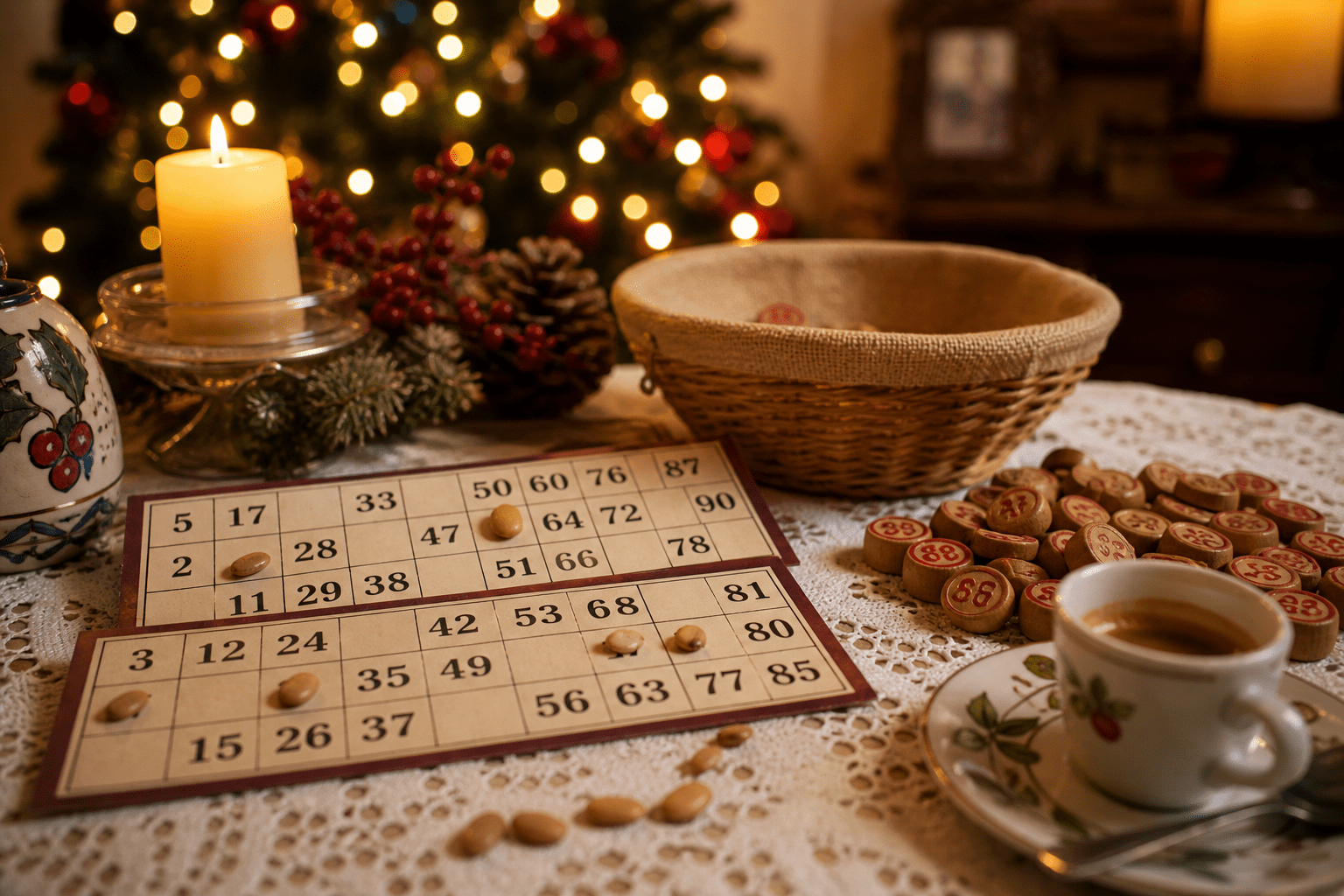
And then, if the family was lucky enough to own a set, came tombola, the Neapolitan Christmas bingo played with ninety numbers, cardboard cards and dried beans or orange peel to mark them. Every number has a meaning in the old Neapolitan tradition — 90 is fear, 47 is the dead man and 48 the dead man who talks — and the caller’s job is to announce each number with its nickname, the more theatrical the better. Tombola sets cost very little today; if your family never had one, this is the year to start.
Nuts were never just something to eat at Christmas. They were the oldest toys in the house.
Keeping the Seven Fishes going in your family
The Feast of the Seven Fishes survives in Italian families not because it is easy — it is a great deal of work — but because it gathers people. The fish brings everyone into the kitchen, the games keep them at the table, and the night ends at La Vigilia’s Midnight Mass or simply in a living room full of people too full to move. It is one of the few nights of the year when three or four generations are in the same room, doing the same thing, for hours.
If you are taking it over from a parent or grandparent, do not try to reproduce every dish at once. Ask them which two or three mattered most, cook those well, and let them sit at the table and direct you, the way so many nonne have done when they could no longer stand at the stove. Write down what they tell you — not just the ingredients, but how they knew the oil was ready and which fishmonger was the only one worth the line. And keep the spaghetti with butter. Some child at your table will remember it for the rest of their life.
Fish, then games. Spaghetti with butter for the kids who would not touch the fish, nuts rolling off a serving spoon, a fist full of hazelnuts and the question of how many, and the tombola if we were lucky. That was Christmas Eve. Build your menu, soak the baccalà on the 21st, and make it yours.
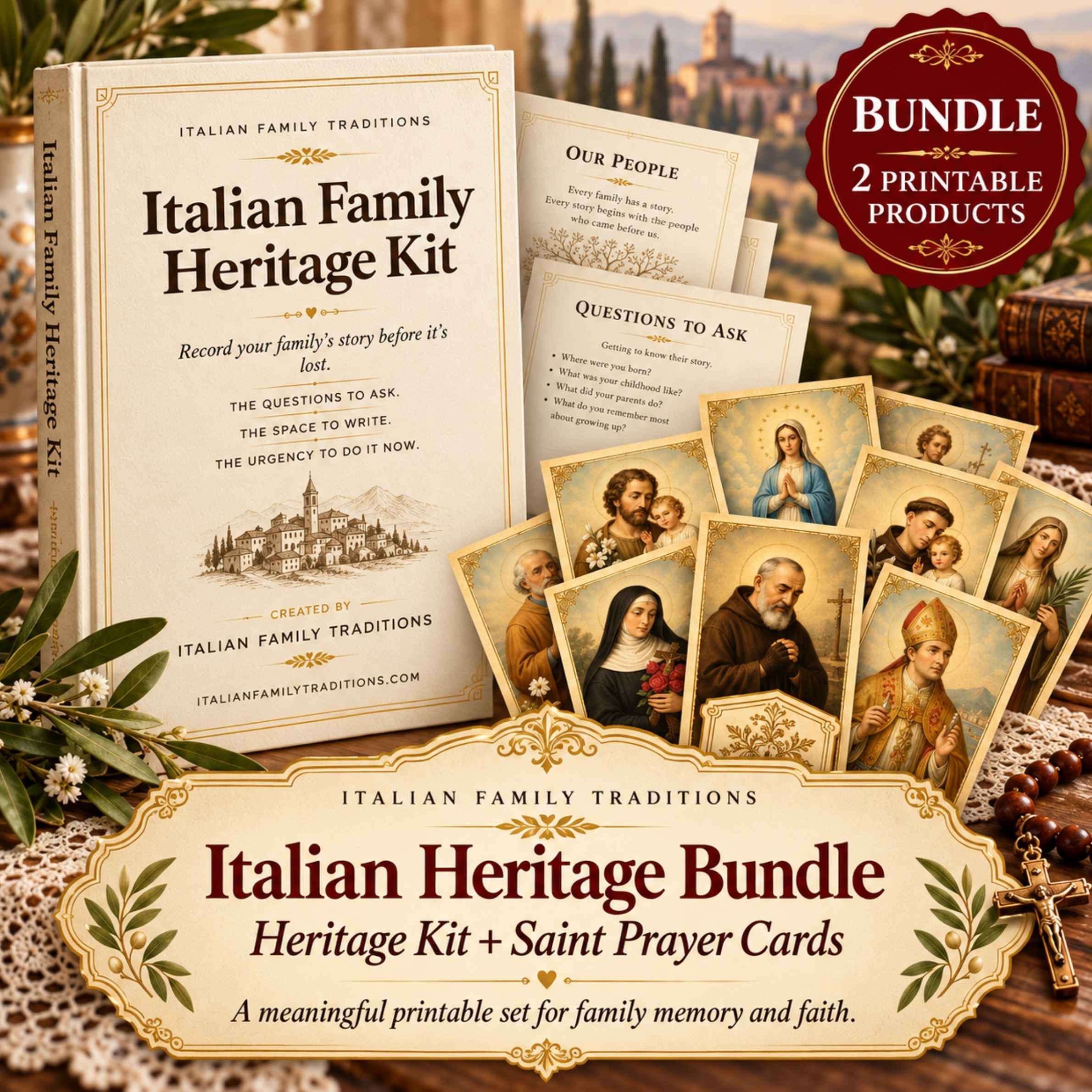
Bring It to the Vigilia
The gift for the one who cooks the fishes.
The Italian Heritage Gift Set brings together the 133-page Italian Family Heritage Kit, to record the family’s recipes and stories, and 11 printable Italian Saint Prayer Cards with prayers in Italian and English. Instant download — print it the morning of the 24th if you have to.
Get the Gift Set — $24.99Instant digital download · $29.48 if bought separately
More of the Italian Christmas: the meaning of the Feast of the Seven Fishes, La Vigilia on Christmas Eve, the complete guide to Italian Christmas traditions, the Christmas Novena from December 16 to 24, the presepe, Italian Christmas cookies, panettone and pandoro, tombola, and La Befana on January 6. And if you are still shopping, see our Italian Christmas gift guide.
FAQ
What are the seven fishes for Christmas Eve?
There is no fixed list. The most common dishes on an Italian-American Christmas Eve table are baccalà (salt cod), fried calamari, fried smelts, shrimp, clams (usually with spaghetti), a seafood salad and mussels. Southern Italian families often add fresh anchovies, octopus and eel. Each family has its own seven, and its own opinions about them.
What is a simple Seven Fishes menu?
A simple, make-ahead menu is a seafood salad and a salt cod salad made the day before, one fried dish such as calamari, spaghetti with clams, shrimp oreganata and steamed mussels — six fishes if the seafood salad has shrimp and calamari, seven if you add a second fried fish. The menu builder on this page will build one for you.
How much fish do I need per person for the Feast of the Seven Fishes?
Plan on about half to three quarters of a pound (225 to 340 grams) of seafood per adult in total across all the courses, or roughly 2 to 3 ounces of each fish when you serve seven. For clams or mussels in the shell, allow about a pound for every two people in a pasta or steamed dish.
How far ahead can I prepare the Seven Fishes?
Start soaking the salt cod three days ahead. Seafood salad, salt cod salad and octopus salad can be made the day before. Calamari can be cleaned and shrimp deveined the day before. Fried dishes, clams and pasta should be cooked on the night.
How long do you soak baccalà?
Soak salt cod in cold water in the fridge for about three days, changing the water two or three times a day, until a small piece tastes pleasantly salty. Thick pieces take longer than thin ones.
What do you serve kids at the Feast of the Seven Fishes?
Plain spaghetti with butter is the classic answer in many Italian families, served alongside the first pasta. Fried calamari and fried shrimp are often the fish that children are most willing to try.
What wine goes with the Feast of the Seven Fishes?
Crisp Italian whites are the best match: Greco di Tufo, Fiano, Vermentino, Verdicchio or Cirò Bianco. Prosecco is excellent with the cold and fried courses.
Do you have to serve exactly seven fishes?
No. Seven is the most common number, but many families serve nine, twelve or thirteen, and many serve three or five. What matters is the meatless Christmas Eve meal and the family around it, not the count.

Marco Ricci is an Italian-Canadian writer and the grandson of Calabrian immigrants. He created Italian Family Traditions to document the customs, feast days, and family rituals Italian families carried from Italy to North America — and to understand what they actually meant. He is based in Montreal.
Pingback: La Vigilia: The Italian Christmas Eve Tradition Explained - Italian Family Traditions