Italian Family Traditions
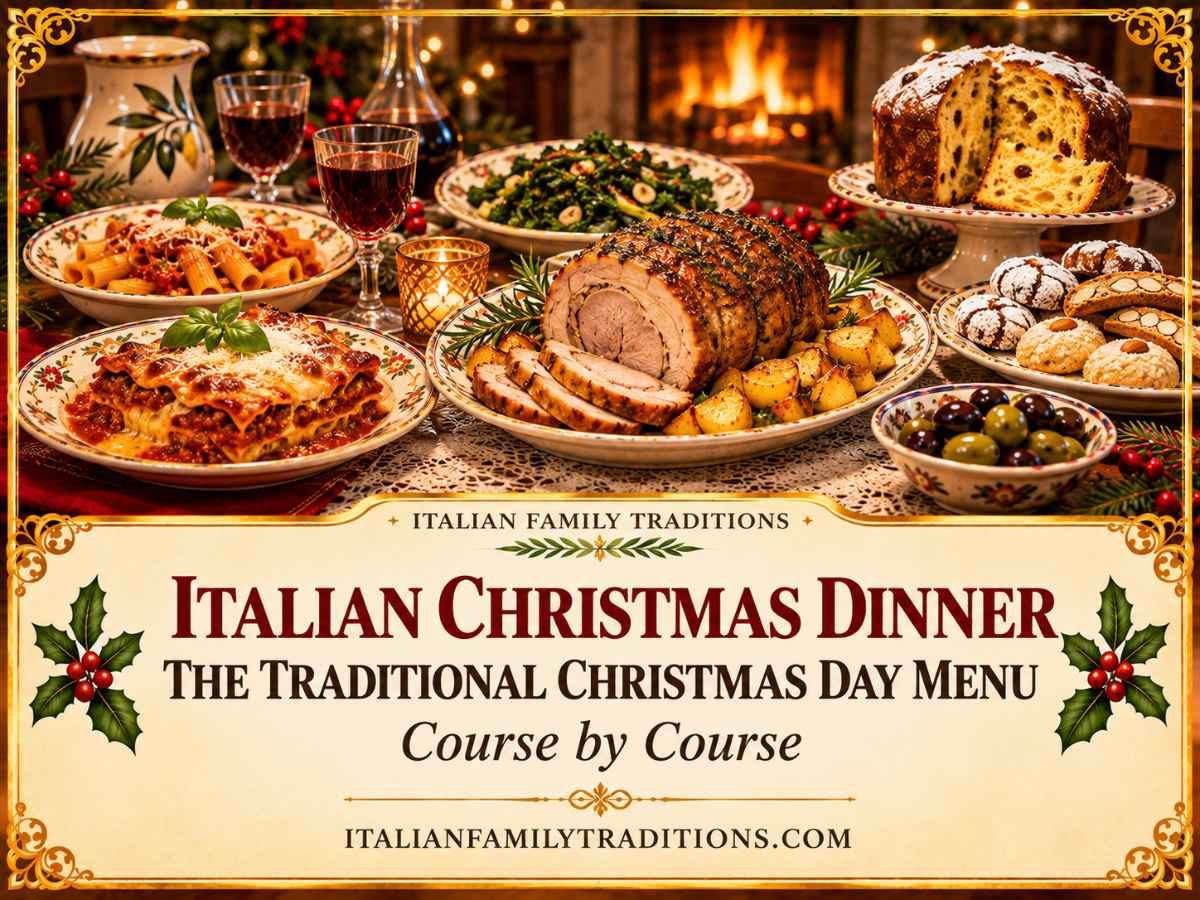
Italian Christmas Dinner: The Traditional Christmas Day Menu, Course by Course
Christmas Eve is the fish. Christmas Day is everything else: the antipasto, the lasagna, the cutlets, the long afternoon at the table. Here is the whole meal, the way Italian families have always served it, and a free planner to put it on your own table.
A traditional Italian Christmas dinner is really a long Christmas Day lunch, il pranzo di Natale, served in courses over the whole afternoon. It opens with an antipasto of cold cuts like mortadella, prosciutto and salami with cheese and olives; then a first course of pasta, usually lasagna or baked pasta in the south and tortellini in broth in the north; then the meats: cutlets, roasts, capon or the meats from the sugo; then salad, fruit and nuts cracked at the table, panettone and Christmas sweets, espresso, and a small glass of something strong. The meatless dinner is the night before, on Christmas Eve.
Use the free planner below to build your own: pick your family’s style of table, enter how many people are coming, and it gives you the menu, a shopping list with quantities, a timeline for the day, and a menu card you can print and put on the table.
Plan your Italian Christmas lunch
Free Christmas lunch planner
Plan your Italian Christmas lunch
Pick your family’s table, tell it how many are coming, and get the menu, a shopping list with quantities, and a timeline that works back from the moment everyone sits down.
Whose table?
Adults
Children
Sitting down at
Family name for the printed menu (optional)
For your Christmas table
Everything else the day needs

After the espresso
Tombola Night Kit
The illustrated Italian Christmas game: 24 cards, the caller’s board and 90 smorfia tokens. Print it before the lasagna is out.
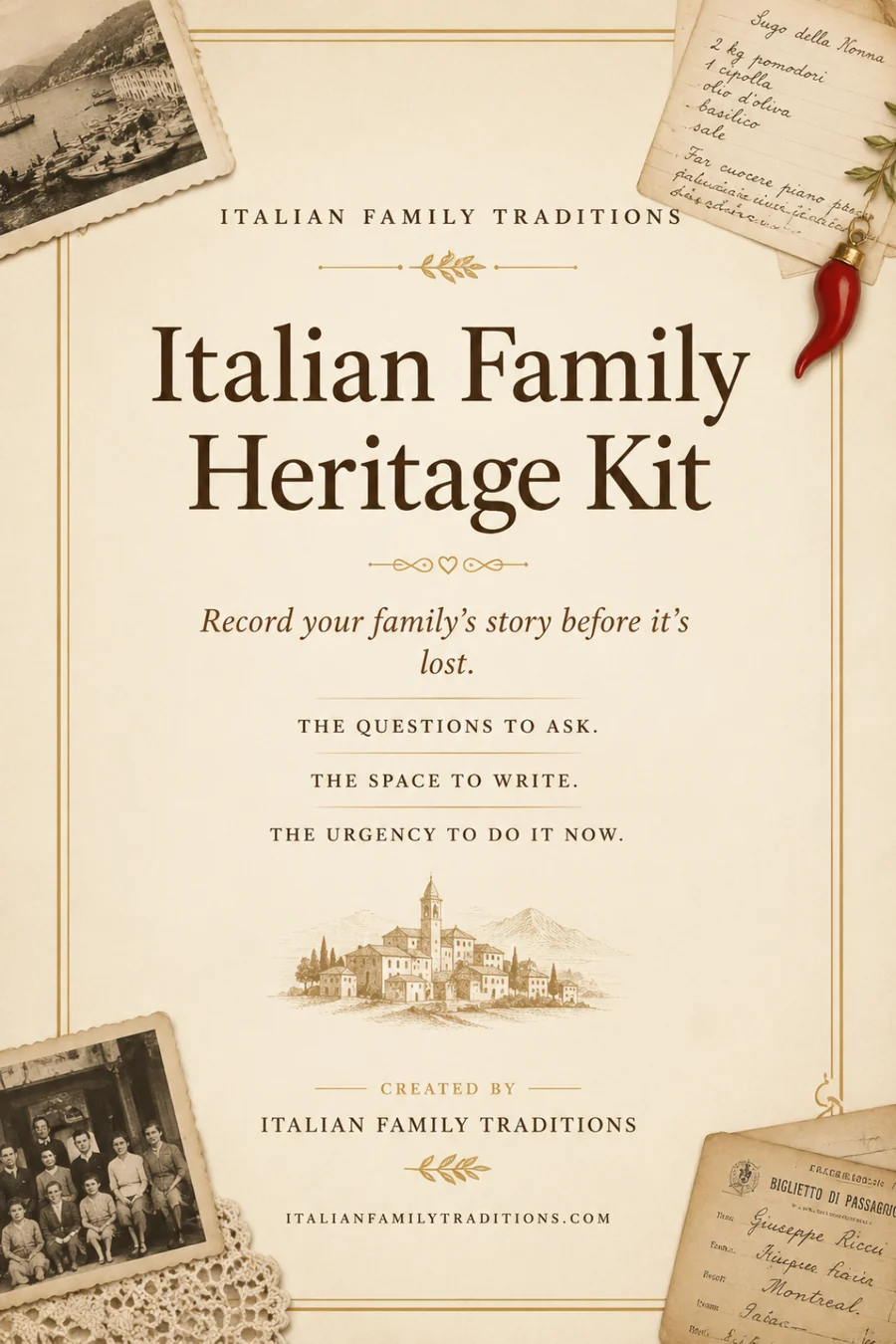
For the nonna at the head of the table
Italian Family Heritage Kit
A beautiful printable workbook to record the family’s stories, recipes and roots, while the people who know them are still at the table.

Free
The 2027 Italian Calendar
Every feast day, name day and Christmas date of the Italian year, the way a nonna would keep them. Yours free by email.
The meal after the fish
In Italian families, Christmas is two meals, and they could not be more different.
The first is the night of the 24th, the Vigilia. It is a night of fasting turned into a feast: no meat, only fish, the baccalà that has been soaking in the sink for days, the fried calamari, the clams, the seven fishes in Italian-American homes. It ends late, often with midnight Mass, and it has a particular feeling to it: a little solemn, a little electric, the whole family waiting for something.
The second is the 25th. And the 25th is the opposite. The waiting is over. The fast is over. Nobody has to go anywhere, nobody has to be anywhere, and the table is going to be covered in meat.
In my family, from the province of Cosenza in Calabria and transplanted to Montreal, our Christmas Day table has always followed the same order. First the antipasto, with mortadella and the cold cuts. Then the lasagna. Then the cutlets and the meats. Then everything that comes after.
Nothing about that order is unusual. That is the point of it. Walk into almost any Italian-Canadian or Italian-American home on December 25 and you will find some version of the same meal, in the same sequence, because it was carried over from the same villages by the same kind of people: families who had very little for most of the year and who, on this one day, put everything they had on the table.
Christmas Eve is about waiting. Christmas Day is about staying.
Lunch, not dinner: il pranzo di Natale
The first thing to understand about Italian Christmas dinner is that it is not dinner. In Italy the big meal of December 25 is il pranzo di Natale, Christmas lunch. It starts somewhere between noon and two o’clock, and it finishes whenever it finishes.
There are good reasons for the hour. The family was up late the night before, at the Vigilia table and often at midnight Mass. Christmas morning is slow. And an Italian meal of seven or eight courses needs daylight and patience: you cannot begin a lasagna at eight in the evening and still have room for panettone before midnight.
So the morning is for cooking, the afternoon is for eating, and the evening, if anyone is still hungry, is for picking at what is left. In some homes the table is never fully cleared on Christmas Day at all. The plates go, the tablecloth stays, and the fruit, the nuts and the bottles stay with it until night.
When Italian-Americans say “Christmas dinner”, and when you search for it, this is the meal they mean: the one on the 25th, whatever time it starts.
A short history of the Italian Christmas table
Every dish on the Italian Christmas table has a story, and some of the stories are even true. Before we go course by course, it is worth knowing how the meal got this way, because almost nothing about it is accidental.
It begins in Rome. The oldest surviving record of a feast of Christ’s birth on December 25 comes from a Roman calendar of the year 354, which lists the celebration as already established in the city by 336. Rome already had a habit of feasting in the dark heart of winter; the Christian calendar simply gave the season a new centre. From the start, the feast came with a fast in front of it: the vigil.
That fast is why Christmas is two meals. For most of Italian history the Church asked the faithful to abstain from meat on the eve of great feasts. The 24th was a giorno di magro, a lean day, so Italians ate fish, vegetables and bread, and turned the restriction into the great fish dinner of the Vigilia. At midnight the fast ended. The 25th was a giorno di grasso, a fat day, and the table made up for every hour of the wait.
The capon is a Roman workaround. The story goes that in 161 BC a Roman sumptuary law, the Lex Fannia, banned the fattening of hens to curb extravagant banquets. Roman farmers, being Roman farmers, castrated young roosters instead, which fattened all by themselves, and the law said nothing about roosters. Whether or not that is exactly how it happened, the cappone became the luxury bird of the Italian winter, and it is still the classic Christmas meat across the north.
The lasagna is older than the tomato. A recipe for lasagne, sheets of dough cooked and layered with cheese and spices, appears in the Liber de Coquina, a cookbook from the Angevin court of Naples written around 1300. There was no tomato in it: tomatoes did not reach Italian kitchens from the Americas until the 1500s, and the tomato sugo that defines the southern Christmas lasagna only became part of everyday cooking in Naples in the late 1700s and 1800s. Your nonna’s lasagna, in other words, is a medieval dish wearing a nineteenth-century coat.
The mortadella had rules. Bologna took its great sausage so seriously that in 1661 Cardinal Girolamo Farnese issued an edict laying down how mortadella had to be made and who could make it, one of the earliest food regulations of its kind. Three and a half centuries later, a few slices of it on a board still announce that this is a feast day.
The cutlet started a war of words. Milan claims the breaded veal cutlet, the cotoletta alla milanese, and points to a twelfth-century menu from the basilica of Sant’Ambrogio that mentions breaded loin. Vienna claims the Wiener schnitzel. Each city has a story about how the other one stole it. The southern Italian families who fried thin cutlets for Christmas in Montreal and New York took no position on the matter; they simply made more of them than anyone could eat.
And then the boats. Between about 1880 and 1920, millions of Italians, most of them from the poor south, left for the Americas. Many came from villages where meat was eaten a few times a year. In the new world, with factory wages, meat was suddenly within reach, and the Christmas table grew accordingly: the antipasto got bigger, the lasagna got meatballs, and the secondo became a parade of cutlets, sausage, braciole and roasts. The Italian-Canadian and Italian-American Christmas lunch is not a copy of the Italian one. It is what that meal looked like when, for the first time, there was enough.
The order of an Italian Christmas meal
An Italian Christmas lunch follows the same structure as an Italian Sunday dinner, only longer and with more of everything. If you grew up with the Sunday table, you already know the shape of it.
| Course | What it is | On many Christmas tables |
|---|---|---|
| Antipasto | The opening board | Mortadella, prosciutto, capicollo, salami, provolone, olives, peppers |
| Il primo | The first course: pasta or soup | Lasagna, pasta al forno, tortellini in brodo |
| Il secondo | The main course: the meat | Cutlets, the meats from the sugo, a roast, capon, bollito misto |
| Il contorno | The vegetable side | Roast potatoes, rapini, spinach |
| L’insalata | The salad, after the meat | Green salad, fennel, oranges |
| Frutta e noci | Fruit and nuts | Clementines, walnuts, hazelnuts, chestnuts, dried figs |
| I dolci | The sweets | Panettone, pandoro, cookies, struffoli, torrone |
| Caffè e digestivo | Coffee and a little glass | Espresso, anisette, sambuca, amaro, grappa |
Nobody follows the table above to the letter. Some families skip the contorno; some put the salad on with the meat; some, especially in the south, add a soup or a second pasta. But the logic underneath never changes: something to pick at, then pasta, then meat, then something green to settle the stomach, then the long, slow descent through fruit, sweets and coffee.
The antipasto: mortadella and the cold cuts
The antipasto is the overture. It is the course that tells everyone the meal has started, and on Christmas Day, in families like mine, it means one thing above all: salumi, the cured meats.
Mortadella first. The great pink sausage of Bologna, studded with cubes of fat and sometimes pistachios, sliced so thin you can see the light through it. Then prosciutto, folded rather than flat. Capicollo, or capocollo, the cured pork neck with its rim of pepper. Salami, and in Calabrian homes, soppressata, sweet or spicy, the kind families once made themselves in the cantina. Beside the meats, cheese: provolone, a wedge of Parmigiano to break with a knife, perhaps caciocavallo or a young pecorino.
Around them, the things in jars. Green and black olives. Roasted red peppers glossy with oil. Marinated eggplant, the melanzane sott’olio that so many families still put up at the end of summer. Giardiniera, the pickled vegetables. And bread, a lot of it, because the bread is how you eat the oil, and later on, how you do the scarpetta through the last of the sugo.
There is a reason the meats come first. For most of history, cured pork was the treasure of the southern Italian household. The pig was killed in winter, every part of it was salted, hung or preserved, and the best of it was saved for the feasts. Putting a board of salumi on the table at Christmas was a declaration that this was a day of abundance. Families who emigrated kept the gesture even when mortadella became something you could buy at any deli on a Tuesday.
How to set out the antipasto
- Fold, don’t stack. Loosely folded slices of mortadella and prosciutto look generous and are easy to pick up. A flat stack welds itself together.
- Buy it sliced the same morning, or the day before. Ask the deli to slice mortadella thin and to lay the prosciutto on paper so it does not stick.
- Take everything out of the fridge 30 minutes before you sit down. Cold cuts and cheese taste of almost nothing straight from the fridge.
- Small bowls for the wet things. Olives, peppers and eggplant go in their own dishes so the oil does not reach the bread before you do.
- Do not overdo it. This is the hardest rule, and almost nobody follows it. There are at least four courses still to come.
Every Italian family has at least one person who ignores that last rule. They arrive hungry, they stand near the board, and by the time the lasagna comes out they have eaten half a mortadella and are already loosening their belt. Every nonna has warned them. None of them has ever listened. It is, in its own way, a tradition.
For quantities, plan on roughly 100 to 120 grams of cold cuts and 50 to 60 grams of cheese for each adult. The planner above works out the exact amounts for your table.
Il primo: the Christmas lasagna
Then the lasagna. In southern Italian families and across Italian Canada and America, there is no Christmas without it. It arrives in the pan it was baked in, too hot to cut, and the whole table watches it rest.
The Christmas lasagna of the south is not quite the lasagna of Bologna. The Emilian original, lasagne alla bolognese, is layered with a slow meat ragù and béchamel. The southern version, the one most Italian immigrants brought with them, is built on a tomato sugo, with ricotta, mozzarella and grated cheese between the layers, and very often tiny meatballs no bigger than a hazelnut scattered through it. It is heavier, louder, and more festive.
In Calabria it can go further. Sagne chine, “filled lasagna”, is the Calabrian feast-day version, made for Christmas and for Carnevale: layers of pasta with tiny meatballs, slices of hard-boiled egg, cheese and sometimes mushrooms or peas, all held together by the sugo. In Naples the famous meatball lasagna belongs to Carnevale, but plenty of Neapolitan families make it for Christmas too. In Sicily the baked pasta is more likely to be anelletti al forno, little rings of pasta baked into a tall, golden timballo.
Then there is the question of the corner. A lasagna has four corner pieces, crisp on two sides, with the edges of the pasta baked hard and the sauce caramelised against the pan, and every family has more than four people who want one. Negotiations begin before the pan reaches the table. Children learn early that the person who serves controls the corners, which is why so many children volunteer to help.
What all of them share is that they are made ahead. The sugo is cooked a day or two before, ideally with the passata the family put up in August. The lasagna is assembled on the morning of the 24th, before the Vigilia cooking takes over the kitchen, and left in the fridge. On Christmas morning it only has to come up to room temperature and go into the oven. That is not a shortcut. It is how the lasagna gets better: the layers settle, the flavours marry, and it cuts into clean squares instead of sliding across the plate.
Lasagna tips for Christmas Day
- Make the sugo two days ahead. It is better the next day, and it frees the 24th for the fish.
- Assemble the lasagna on the morning of the 24th and keep it covered in the fridge.
- Take it out four hours before lunch so it loses its chill, then bake it covered at 190°C / 375°F, uncovering it for the last stretch so the top browns.
- Let it rest 20 minutes before cutting. A lasagna cut straight from the oven collapses.
- Plan one standard pan for about eight people when meat is coming after it. People always want a second piece, and the leftovers are half the point of Santo Stefano.
In the north: tortellini in brodo
Travel north and the lasagna gives way to a bowl of broth. In Emilia-Romagna, and in much of Lombardy, the Christmas primo is tortellini in brodo or cappelletti in brodo: small filled pasta, folded by hand, served in a clear, golden broth made from capon or beef. Families in Bologna and Modena have been arguing about the exact filling for generations. The broth itself is the real labour: simmered for hours on the 23rd or 24th, strained, chilled, and skimmed of its fat before it is brought back to a boil on Christmas morning.
It sounds like the lighter choice. It is not, quite: in the north the broth is followed by the meats that made it.
Free printable
The 2027 Italian Family Traditions calendar
Christmas Eve, Santo Stefano, Capodanno, the Befana, every saint’s day and every feast of 2027, marked out the way a nonna would keep them. Enter your email and it is yours.
Il secondo: the cutlets and the meats
Then the meats. After a plate of lasagna most people would call it a meal. On Christmas Day it is the halfway point.
In Italian-Canadian and Italian-American homes, the centre of the secondo is very often a platter of breaded cutlets: thin slices of veal, or chicken, or both, pounded, dipped in egg, coated in breadcrumbs with grated cheese and parsley, and fried until golden. They are made in quantity, fried in the morning, and kept warm in a low oven. They are also, everyone agrees, best eaten cold the next day in a sandwich.
Which is why every Christmas morning has a cutlet thief. The cutlets come out of the pan, golden and too hot to touch, and are laid on paper on a tray to drain. By the time lunch begins, the tray has fewer cutlets than it should. Nobody saw anything. Somebody has crumbs on their sweater. The cook counts, sighs, and fries another batch, because the cook always made extra knowing exactly this would happen.
Beside the cutlets come the meats from the sugo. In southern Italian cooking, the meat that flavours the sauce is not thrown away; it is served as its own course. Sausage. Meatballs. And braciole: thin slices of beef rolled around garlic, parsley and pecorino, tied with string, and simmered for hours in the tomato. The pasta gets the sauce; the secondo gets what made the sauce taste like that.
Some families add a roast as well: roast pork in the south, roast veal or beef, a leg of lamb, potatoes roasted in the same pan. The quantity is not about hunger. It is about the old idea that on Christmas Day, no one should be able to look at the table and see the bottom of a dish.
Capon, bollito misto and the meats of the north
In northern and central Italy, the most traditional Christmas meat is the cappone, the capon: a castrated rooster, fattened for the winter, tender and rich, once the great luxury bird of the Christmas season. Often it is boiled to make the broth for the tortellini, then served as the secondo. In Piedmont, Lombardy and Emilia, Christmas Day may bring the bollito misto: a parade of boiled meats, beef, tongue, capon, cotechino, carved at the table and served with mostarda, the sweet and fiery mustard fruits of Cremona, and salsa verde, the green sauce of parsley and capers.
Every region does the second course differently, which is why the planner above offers three styles of table. What they agree on is that it is meat, there is a lot of it, and nobody is allowed to say they are full until it has gone around at least twice.
The pasta gets the sauce. The secondo gets what made the sauce taste like that.
The salad, the fruit and the nuts
After the meat comes the salad, and in Italy it comes after, not before. A simple green salad dressed with oil, vinegar and salt, often with raw fennel sliced thin, served once the meat platters have gone. It is one of the quiet rules of the Italian table that surprises guests every year. It is not a starter. It is a reset: something cold, crisp and sharp to tell the stomach that the heavy part of the meal is over.
Fennel deserves its own sentence. Raw fennel, cut into wedges and eaten with the fingers, has been the Italian way of ending a big meal for centuries, believed to settle digestion. In many southern homes it simply sits on the table in a bowl of cold water, and people reach for it between the meat and the sweets.
Then fruit and nuts. Clementines, piled in a bowl, their peel scenting the whole room. Walnuts, hazelnuts and almonds still in their shells, cracked at the table with the old nutcracker that comes out once a year. Dried figs. In some families roasted chestnuts, scored and blackened and passed around hot in a cloth.
This is the part of the meal that cannot be hurried. The nuts are slow to crack, the clementines are slow to peel, and that is deliberate. Nobody is eating out of hunger anymore. They are eating to stay at the table.
The sweets, the coffee and the digestivo
Then the sweets. At the centre of the Italian Christmas table there is almost always a tall cake in a box: the panettone of Milan, studded with candied fruit and raisins, or the golden star-shaped pandoro of Verona, dusted with icing sugar. Which one your family buys is a lifelong allegiance, and we have written a whole guide to the panettone versus pandoro question.
Around the panettone, the homemade sweets, and this is where the regions come out again. Italian Christmas cookies of every shape. Torrone, the hard nougat with almonds. In Naples, struffoli: tiny fried balls of dough piled into a ring and soaked in honey, scattered with coloured sprinkles. In Calabria, turdilli, fried and dipped in honey or fig syrup. In Puglia, cartellate, ribbons of pastry curled into roses and bathed in vincotto. In Naples and across the south, mostaccioli, spiced and glazed in chocolate.
Then the coffee. Espresso, made in the moka pot again and again as the afternoon goes on, never with milk after a meal like this. And with it, the little glass: anisette or sambuca, sometimes with three coffee beans floating in it; an amaro in the south; grappa in the north; the digestivo that every Italian family insists is good for you.
Nobody gets up after the coffee. That is when the cards come out.
After lunch: tombola and the long afternoon
When the plates are cleared and nobody wants to move, Italian families play. Cards, for some: scopa and briscola, with arguments that go back decades. And for many, tombola, the Italian Christmas bingo, with its numbers from 1 to 90 called out by the most theatrical person in the room, each one with its old Neapolitan nickname from la smorfia.
Tombola belongs to the whole Christmas season, from the Vigilia to the Befana, and on Christmas Day it does something important: it keeps the generations at the same table. The children cover numbers with dried beans, the nonna calls the nicknames, the uncles cheat, and nobody notices that four hours have passed.
If you do not have a set, you do not need one. Our free tombola caller draws the numbers and calls them with their smorfia names, and it prints six free cards. For a big table, the illustrated kit below has everything.
For after the espresso
The Italian Tombola Night Kit
The game that keeps everyone at the table once the plates are cleared. A complete, beautifully illustrated printable set: 24 cards in real Italian series, the caller’s board, 90 smorfia number tokens, the caller’s sheet and prize labels. Download it, print it, and it is ready before the lasagna is.
Get the Tombola Night Kit · $9.99
Instant PDF download · print at home, every Christmas
Italian Christmas dinner across Italy
Ask ten Italian families what they eat on Christmas Day and you will get ten menus, because Italy was a country of separate kingdoms, duchies and villages long before it was a nation, and Christmas cooking is the most local cooking there is. Here is how the primo and the secondo change as you travel down the peninsula.
| Region | The Christmas Day primo | The secondo |
|---|---|---|
| Emilia-Romagna | Tortellini or cappelletti in brodo; lasagne alla bolognese | Bollito misto, capon, cotechino |
| Piedmont | Agnolotti, sometimes in broth | Bollito misto with its sauces |
| Lombardy | Tortelli or a rich risotto | Capon, roast meats, bollito |
| Tuscany | Crostini, then tortellini or pappardelle | Capon, roast meats |
| Marche | Vincisgrassi, the Marche baked lasagna | Roast meats |
| Campania (Naples) | Minestra maritata, the “married soup” of greens and meats | Roasts and the meats of the soup |
| Calabria | Sagne chine, lasagna layered with tiny meatballs, eggs and cheese | Meats from the sugo, roast pork |
| Puglia and Basilicata | Orecchiette or baked pasta with ragù | Braciole, lamb or kid |
| Sicily | Anelletti al forno or a baked timballo | Falsomagro, roast meats |
| Sardinia | Culurgiones or malloreddus | Porceddu, spit-roasted suckling pig |
Notice what changes and what does not. The pasta changes: filled and floating in the north, baked and layered in the south. The meat changes: capon and bollito in the north, the meats of the sugo in the south. But the structure, antipasto, primo, secondo, fruit, sweets, coffee, is the same from the Alps to Sicily. And so is the idea behind it: that this is the one meal of the year when nothing is held back.
For Italian families abroad, the regional menu became a family menu. A Calabrian lasagna, a Neapolitan struffoli, a Sicilian cutlet and a Milanese panettone could all end up on the same table in Montreal, Toronto or New Jersey, because the families who shared that table had come from all of those places. That mix is its own tradition now, and it is the one the first style in the planner above is built on.
How to host Italian Christmas lunch
The secret of the Italian Christmas lunch is that almost none of it is cooked on Christmas Day. The families who make it look effortless have done most of the work on the 22nd, 23rd and the morning of the 24th, before the fish of the Vigilia takes over the kitchen.
A make-ahead plan
- December 22 or 23: make the sugo, with the braciole, sausage and meatballs cooked in it, or make the broth if your family’s table is a northern one. Fry and dress any homemade sweets like struffoli; they keep for days.
- December 23: buy the cold cuts and cheese, the panettone, the fruit and the nuts. Ask for the mortadella sliced thin.
- December 24, morning: assemble the lasagna and refrigerate it. Bread the cutlets if you want to, and keep them in layers between paper in the fridge. Then forget about Christmas Day and give yourself to the Vigilia.
- December 25, about four hours before lunch: take the lasagna out of the fridge. Fry the cutlets. Then work backwards from the moment everyone sits down: oven on, lasagna in, meats into the sugo to warm, antipasto on the table, lasagna out to rest.
The planner at the top of this page builds that timeline for you, hour by hour, from whatever time you plan to sit down.
How much food to make
Italian Christmas quantities are not normal quantities. Nobody is trying to make exactly enough. You are trying to make enough for everyone to have seconds and for there to be lasagna, cutlets and panettone left over for Santo Stefano on the 26th. As a guide:
| For each adult | Amount | For 12 adults |
|---|---|---|
| Mixed cold cuts (mortadella, prosciutto, capicollo, salami) | 100 to 120 g | 1.2 to 1.5 kg (about 3 lb) |
| Cheese for the antipasto (provolone, Parmigiano) | 50 to 60 g | 600 to 700 g (about 1.5 lb) |
| Lasagna, as a first course | 1 standard pan (9 x 13 in) feeds about 8 | 2 pans |
| Cutlets | 1 to 2 pieces, about 150 g | 1.8 kg (4 lb) |
| Sausage and meatballs from the sugo | 1 sausage and 2 meatballs | 12 sausages, about 24 meatballs |
| Wine | Half a bottle | 6 bottles |
| Panettone (1 kg) | 1 for every 8 people | 2 |
Children eat about half an adult portion of most things, and twice an adult portion of panettone.
Invited to someone else’s table?
Never arrive with empty hands. A panettone and a bottle of wine is the classic, and for the nonna at the head of the table, our Italian Heritage Bundle (the Heritage Kit and the Saint Prayer Cards, $24.99) is a gift she will keep long after the panettone is gone. It is an instant download, so it is ready even if you are reading this on Christmas Eve. More ideas in our Italian Christmas gifts guide and our gifts for Italian grandparents.
Why the Christmas table matters
It would be easy to read all of this as a list of dishes. It is not really about the dishes.
For the families who left southern Italy in the last century, meat was not an everyday food. In the villages of Calabria, Campania and Sicily, most meals were bread, beans, greens and pasta, with meat on Sundays if you were lucky and on feast days if you were not. A table covered in cold cuts, lasagna, cutlets and roasts was not gluttony. It was proof. Proof that the family had made it through another year, that there was enough, and that on this one day, there was more than enough.
When those families emigrated, the Christmas table became something else as well: the one place where the old country was still completely intact. The language at the table was Calabrese or Neapolitan or Sicilian. The order of the courses was the order of the village. And the children who grew up in Montreal or Brooklyn learned what it meant to be Italian not from a book, but from sitting through four hours of lunch on December 25.
That is what the order protects. Antipasto, lasagna, the cutlets and the meats, the salad, the fruit and nuts, the panettone, the espresso. Every course is a reason to stay a little longer. Every course is another hour together. And every year that a family serves it in the same order, the people who first served it are, in a way, still at the table.
In my family, the antipasto still comes first, with the mortadella and the cold cuts. Then the lasagna. Then the cutlets and the meats. I do not expect that order to change, and I hope my children will one day lay it out for theirs.
Buon Natale.
More of the Italian Christmas
- Italian Christmas traditions: the whole season, from the Immacolata to the Befana
- La Vigilia: the Italian Christmas Eve
- Feast of the Seven Fishes menu builder
- Panettone vs pandoro
- Italian Christmas cookies
- Tombola: how to play, with a free caller and printable cards
- The Immacolata, December 8, when the Italian Christmas begins
- The Christmas Novena, the nine nights before Christmas
- The presepe, the Italian nativity scene
- Capodanno: the Italian New Year
- La Befana
FAQ
What do Italians eat on Christmas Day?
On Christmas Day, Italians eat a long meat-based lunch after the meatless Christmas Eve. The usual order is an antipasto of cold cuts and cheese, a first course of pasta (lasagna, baked pasta, or tortellini in broth in the north), a second course of meats such as cutlets, roasts, capon or bollito misto, then salad, fruit and nuts, panettone and other sweets, espresso and a digestivo.
Is Italian Christmas dinner lunch or dinner?
It is lunch. The big Italian Christmas meal is il pranzo di Natale, served in the early afternoon on December 25 and often lasting until evening. The big dinner is the night before: the Christmas Eve Vigilia, traditionally built around fish.
Why do Italians eat fish on Christmas Eve and meat on Christmas Day?
Christmas Eve was a day of abstinence in the Catholic calendar, so no meat was eaten before the feast. That is the origin of the fish dinner of the Vigilia, and of the Feast of the Seven Fishes in Italian-American homes. On Christmas Day the fast is over, and the table makes up for it with meat.
Do Italians eat lasagna on Christmas?
Many do, especially in the south and in Italian-Canadian and Italian-American families, where lasagna or a baked pasta is the classic Christmas Day primo. In Calabria it may be sagne chine, layered with tiny meatballs. In Emilia-Romagna lasagne alla bolognese competes with tortellini in brodo, and in much of the north the broth wins.
What is the traditional Italian Christmas meat?
It depends on the region. Capon is the classic Christmas bird in the north and centre, bollito misto belongs to Piedmont, Lombardy and Emilia, and the south leans on the meats cooked in the Sunday sugo: braciole, sausage and meatballs. In Italian-Canadian and Italian-American homes, breaded cutlets are almost always on the table.
How many courses is an Italian Christmas lunch?
Usually seven or eight, though nobody counts: antipasto, a first course, a second course with its sides, a salad, fruit and nuts, sweets, then coffee and a digestivo. The meal is measured in hours rather than courses.
How much lasagna do I need for Christmas?
When lasagna is the first course and meat follows, a standard 23 x 33 cm (9 x 13 inch) pan feeds about eight people. For twelve adults, make two. The Christmas lunch planner on this page works out the pans and every other quantity for your headcount.
What do Italians eat on December 26?
December 26 is Santo Stefano, a public holiday in Italy, and in many homes it is a day of leftovers: the lasagna, the meats and the panettone of Christmas Day, eaten again with the same people, at a slower pace.
What is on your family’s Christmas Day table? Lasagna or tortellini, cutlets or capon, panettone or pandoro: tell us in the comments. Every family’s order is a little different, and every one is worth keeping.

Marco Ricci is an Italian-Canadian writer and the grandson of Calabrian immigrants. He created Italian Family Traditions to document the customs, feast days, and family rituals Italian families carried from Italy to North America — and to understand what they actually meant. He is based in Montreal.