Italian Family Traditions
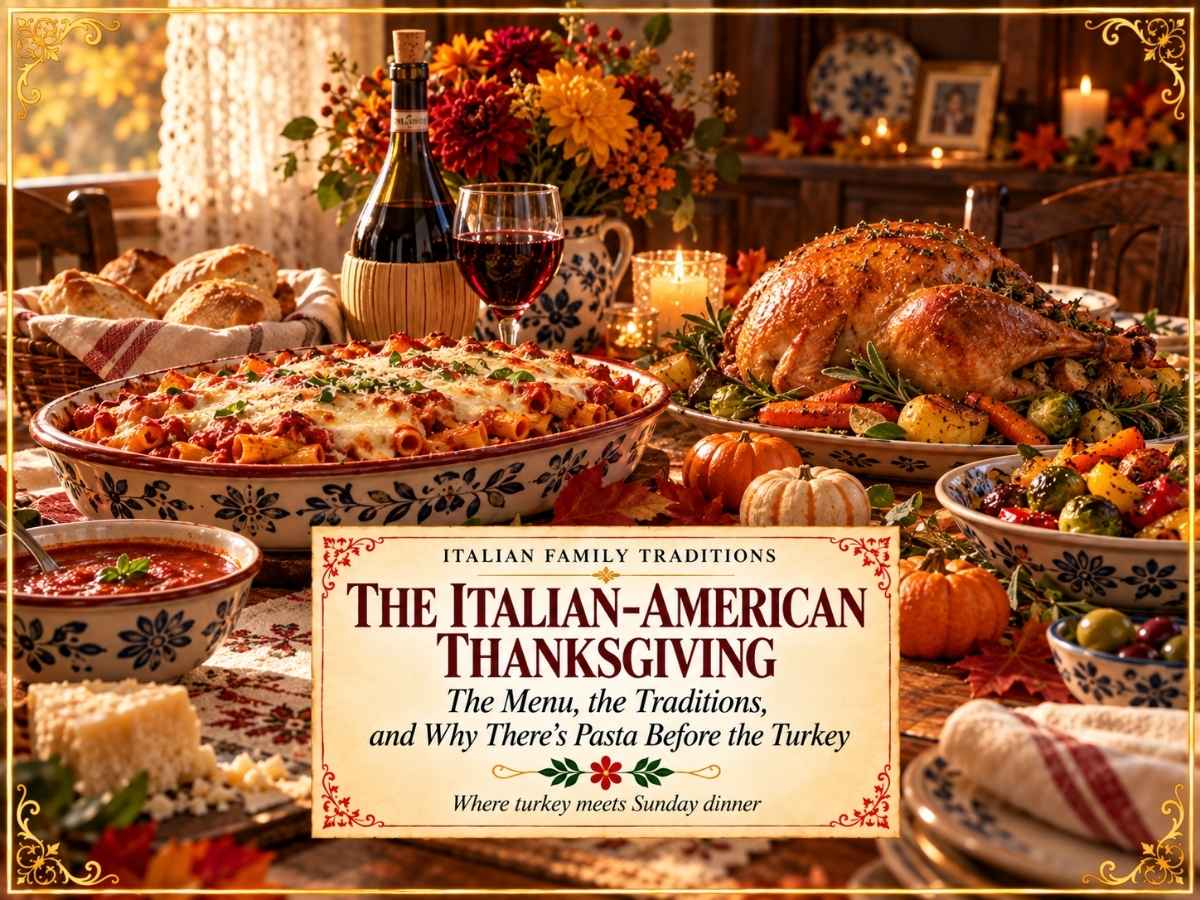
The Italian-American Thanksgiving: The Menu, the Traditions, and Why There’s Pasta Before the Turkey
Yes, there’s a turkey. There’s also lasagna. Here is the full Italian-American Thanksgiving menu, course by course — with a make-ahead timeline, the regional differences, and the story of how an immigrant family turned the most American holiday of the year into something unmistakably their own.
The first time an American friend came to our house for Thanksgiving, he stood in the doorway of the kitchen with a confused look on his face and asked a question that still makes my family laugh twenty years later. He looked at the turkey resting on the counter, and then at the enormous tray of lasagna coming out of the oven beside it, and he said: “Wait — is the pasta instead of the turkey, or before it?”
Before it. Obviously before it. The turkey was not in danger. The turkey was simply going to have to wait its turn, the way the turkey always did, behind the antipasto and the soup and the pasta, because in an Italian-American house the bird is not the star of Thanksgiving. The bird is a guest. A welcome one, a large one, a well-seasoned one — but a guest at a table that was Italian long before it was American, and intended to stay that way.
If you grew up in one of these houses, you know exactly what I mean. You know the smell of roasting turkey and simmering gravy — the Italian gravy, the red one, not the one that goes on the potatoes — filling the same kitchen at the same time. You know the two separate conversations happening over the stove about whether there’s enough food, when there is visibly enough food to feed a small town. You know that somebody’s nonna is going to say the turkey is dry before she has tasted it, as a precaution.
An Italian-American Thanksgiving is two feasts wearing one tablecloth. The American one everybody recognizes — and underneath it, holding it up, the Italian one that was there first and has no intention of leaving.
This is the full guide to that table: the complete menu, course by course, the way Italian-American families actually build it — plus a make-ahead timeline so one kitchen can pull off two feasts in a single day, how the table shifts depending on which region your family came from, and, first, the answer to the question my friend was really asking, which is why. Why is there pasta on Thanksgiving at all?
Why Italians put pasta on the Thanksgiving table
The short answer is that Thanksgiving was not theirs to begin with, and they made it theirs the only way they knew how — by feeding it.
When Italians first arrived in America in the great waves of immigration, Thanksgiving meant nothing to them. It was an American holiday with an American history and no connection to anything they had carried over from Calabria or Sicily or Campania. The first generation largely watched it from the outside. But their children went to American schools, and in those schools they learned the story of the Pilgrims and the harvest and the long table, and they came home wanting to belong to it — wanting to be American, the way immigrant children always do.
So the families said yes. They would celebrate this American day. But they would celebrate it with the only food that meant celebration to them — and that food was not turkey. It was the food of every important Sunday, every wedding, every feast day: the antipasto, the soup, the pasta, the sauce that had been going since dawn. In the earliest Italian-American Thanksgivings, the pasta wasn’t an addition to the turkey. In a lot of houses, the pasta simply was the meal, and the turkey came later, once the family had watched enough of its American neighbors roast one to feel they ought to as well. If you want to understand where the whole structure comes from, it is simply the Italian Sunday dinner in its holiday clothes — the same sequence of courses, scaled up for the biggest table of the year.
My great-grandmother, the story goes, cooked her first Thanksgiving turkey because the children had seen one in a magazine and wanted the family to have what the other families had. She roasted it. She served it. And then, because she did not entirely trust it to be enough, she served it after a full plate of ravioli — just in case the turkey turned out to be, as she suspected, mostly a decoration. That instinct never left the family. The turkey earned its place over the years. It never took the pasta’s.
Over the generations, the American dishes moved in alongside the Italian ones — the mashed potatoes, the cranberry sauce, the sweet potatoes with the marshmallows that every Italian grandmother regarded with deep suspicion. The table became a genuine blend, a two-cuisine negotiation conducted annually and never fully resolved. And that, really, is the whole meaning of it. Thanksgiving is a holiday about being grateful for where you are. An Italian-American Thanksgiving is grateful for where you are and where you came from, on the same plate, at the same time. It is thankfulness for the food that raised you and the people who shaped you — served in that order, pasta first.
And it was not only in America. The same thing happened in the Italian neighbourhoods of Montreal and Toronto, where families kept their Thanksgiving the Canadian way in October and ran it on exactly the same logic: antipasto first, a tray of pasta before the bird, and a nonna who treated the whole affair as a fine excuse to cook for three days. Italian-American or Italian-Canadian, the grammar of the table was identical. The country changed. The order of the courses did not.
Free Printable
The whole Italian family year on one calendar.
Feast days, name days, and the traditions that shaped the Italian table — from the harvest to La Vigilia. Get the free printable calendar of the Italian year. Join the list and we’ll send it to you.
The Italian-American Thanksgiving menu, course by course
Here is how the table is actually built — the full sequence, from the first olive to the last espresso. You do not have to make all of it (nobody makes all of it, though everybody’s nonna claims she could). Think of this as the complete blueprint, from which every family builds its own version.
1. The Antipasto
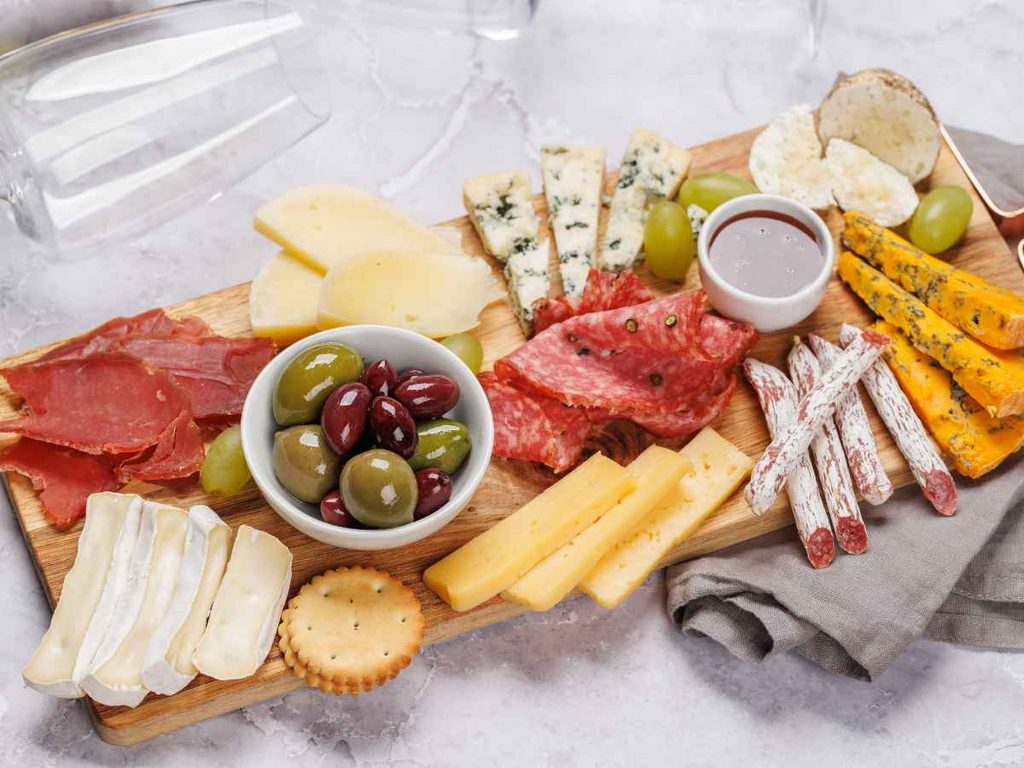
It begins, as every important Italian meal begins, with the antipasto — and on Thanksgiving it is not a modest plate. It is a landscape. A long board or a series of platters covered in cured meats: prosciutto, capocollo, mortadella, soppressata, and whatever dried sausages the family favours. Alongside them, the cheeses: Parmigiano-Reggiano broken into craggy chunks, pecorino, gorgonzola, and fresh mozzarella. Then the supporting cast — olives, roasted red peppers glistening in oil, marinated artichokes and mushrooms, a cold seafood salad in many houses, anchovies for the brave, and baskets of crusty bread to carry it all.
The antipasto is where the grazing starts, hours before the turkey is carved, and it is the course that quietly guarantees nobody at the table was ever actually hungry in the first place. That is not a flaw. That is the design. In an Italian house, you do not arrive at the feast hungry. You arrive at the feast already eating.
2. The First Course: soup, and then pasta
This is the course that confuses the Americans and defines the whole meal.
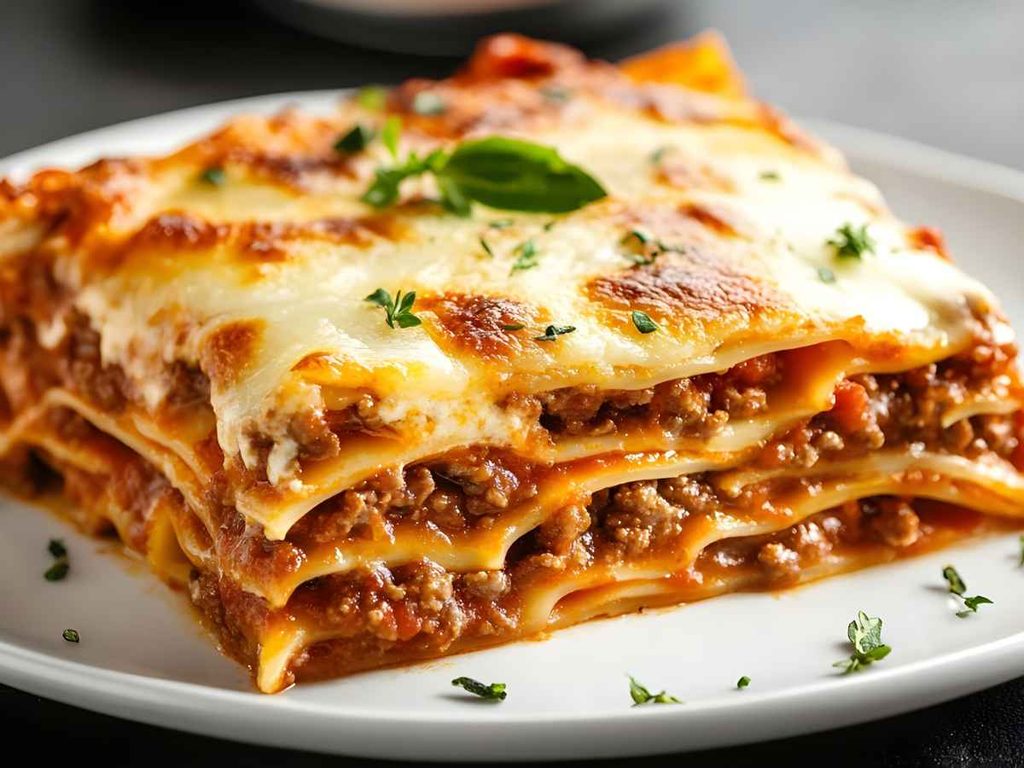
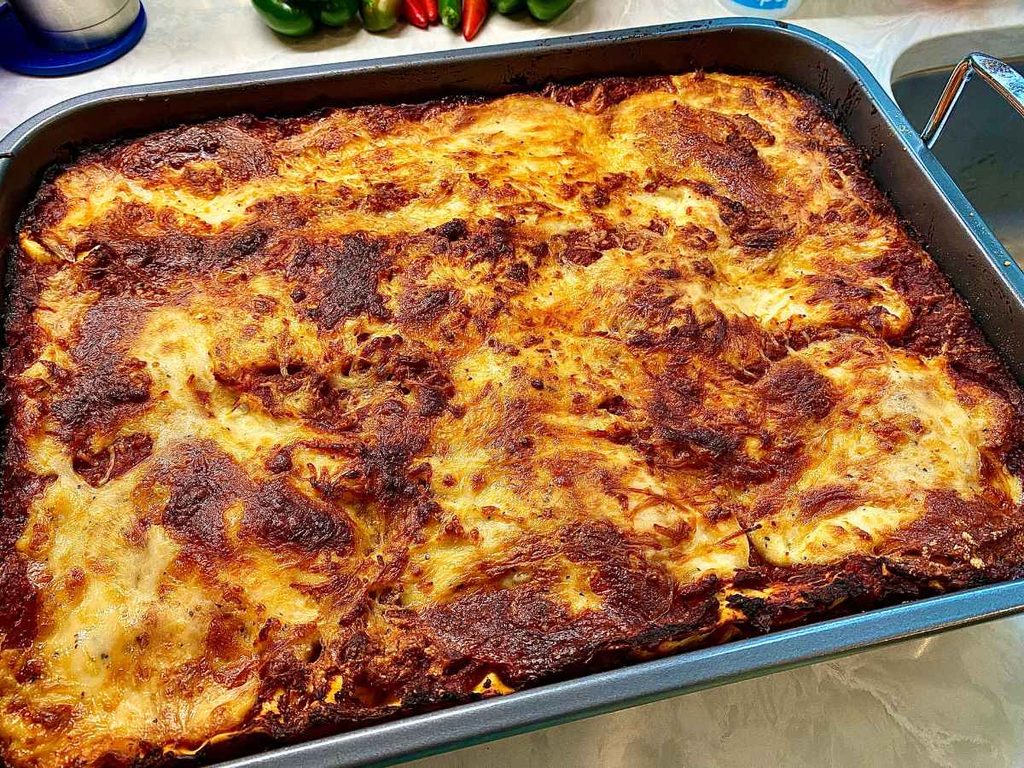
Often it opens with a soup — Italian wedding soup, with its tiny meatballs and greens, or tortellini in brodo, delicate pasta floating in a clear, deep broth. A warm, restrained beginning before the richness arrives. And then the richness arrives: the baked pasta, the true heart of the Italian-American Thanksgiving. Most often it is lasagna — the bubbling, layered, slightly theatrical centerpiece that in many families is more anticipated than the turkey itself. But it might just as easily be baked ziti, or ricotta-stuffed shells, or manicotti, or, in the old-school houses, ravioli made by hand the day before by three generations of women at the same table. Whatever the shape, it is dressed in the family’s own sauce — the slow passata or Sunday gravy that is, in truth, the single most important recipe in the house.
This is the pasta my friend saw. This is the pasta that comes before the turkey, not instead of it — although it is worth saying that in a fair number of Italian-American homes, if the choice ever had to be made, the lasagna would win and the turkey would be the one asked to sit this one out.
In my family there was never a discussion about whether there would be lasagna. There was only a discussion about whose lasagna, which was a far more dangerous conversation. For years it was my grandmother’s. Then, carefully, gradually, it became my aunt’s, in a transition of power that was never formally announced and never fully acknowledged, and that I am fairly sure my grandmother never completely forgave. The turkey, meanwhile, could be bought, dropped, or slightly burned, and nobody would have said a word. The lasagna was sacred. The lasagna had politics.
3. The Turkey — with Italian hands on it
And now, at last, the turkey — which, having waited patiently behind two courses, finally gets its moment. And in an Italian-American kitchen, the turkey does not arrive plain.
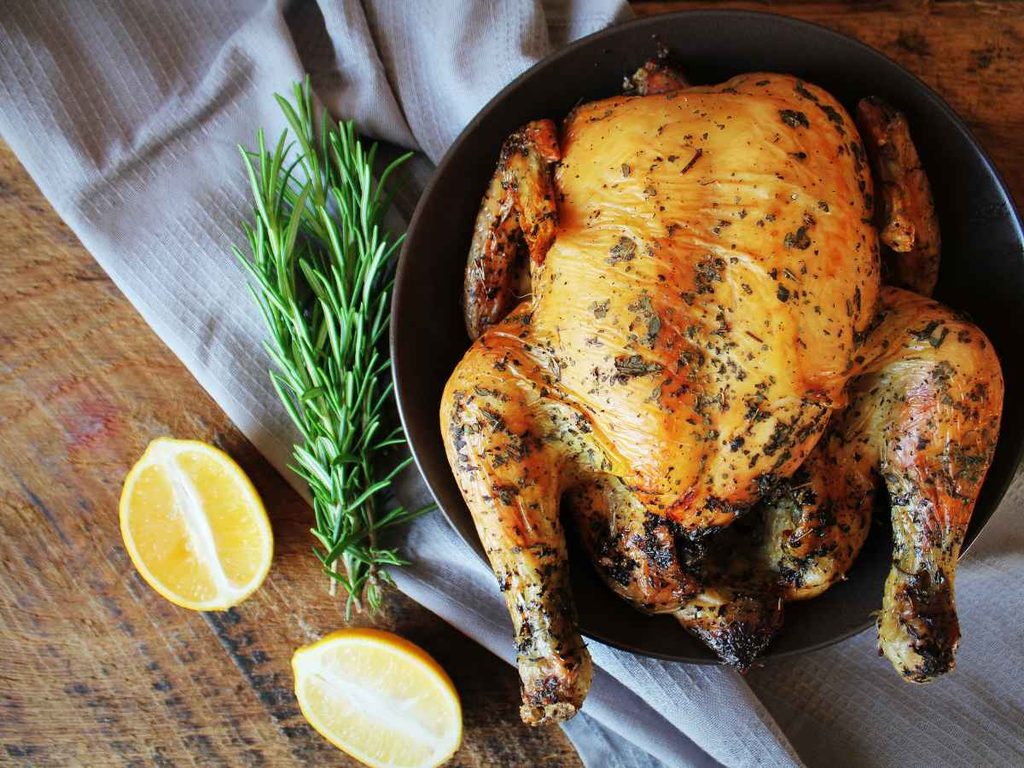
It is large — often twenty pounds or more, because the table is large and the leftovers are part of the plan. It is seasoned the Italian way: garlic worked under the skin, fresh rosemary and sage and thyme, olive oil and butter both, roasted long and basted often until the skin is deep gold. The gravy is made properly, from the drippings and the giblets. And then comes the single most important Italian intervention on the entire bird — the stuffing.
Italian-American stuffing is its own glory, and it is almost never cooked inside the bird. It is made from large cubes of a good round Italian loaf, torn and toasted, mixed with sweet Italian sausage, fennel, onion, herbs, and sometimes chestnuts or pine nuts, moistened with broth and baked in its own pan until the top is crisp and the inside is soft. (If your family used chestnuts, it was almost certainly someone’s job to score and roast them first — here is how to roast chestnuts the Italian way if you want to do it properly.) Baking the stuffing separately is the practical Italian grandmother’s move: the bird cooks more evenly, and the stuffing gets the crust it deserves. Alongside it, in many homes, sit stuffed artichokes — breadcrumbs, garlic, olive oil, and cheese packed between the leaves — a dish that has nothing to do with the Pilgrims and everything to do with the family.
Whose Lasagna Was It, Really?
Every Italian-American Thanksgiving runs on recipes that live in one person’s hands and were never written down. Whose lasagna? Whose stuffing? What was in the sauce? The Italian Family Heritage Kit gives you 133 guided pages and more than 120 prompts to record the recipes, the people, and the traditions behind your family’s table — before the person who holds them is gone.
Explore the Heritage Kit — $19.99Instant digital download. Print it and complete it with your family.
4. The Sides — where two countries share a plate
The side dishes are where the negotiation between America and Italy is most visible, because both show up and neither backs down.
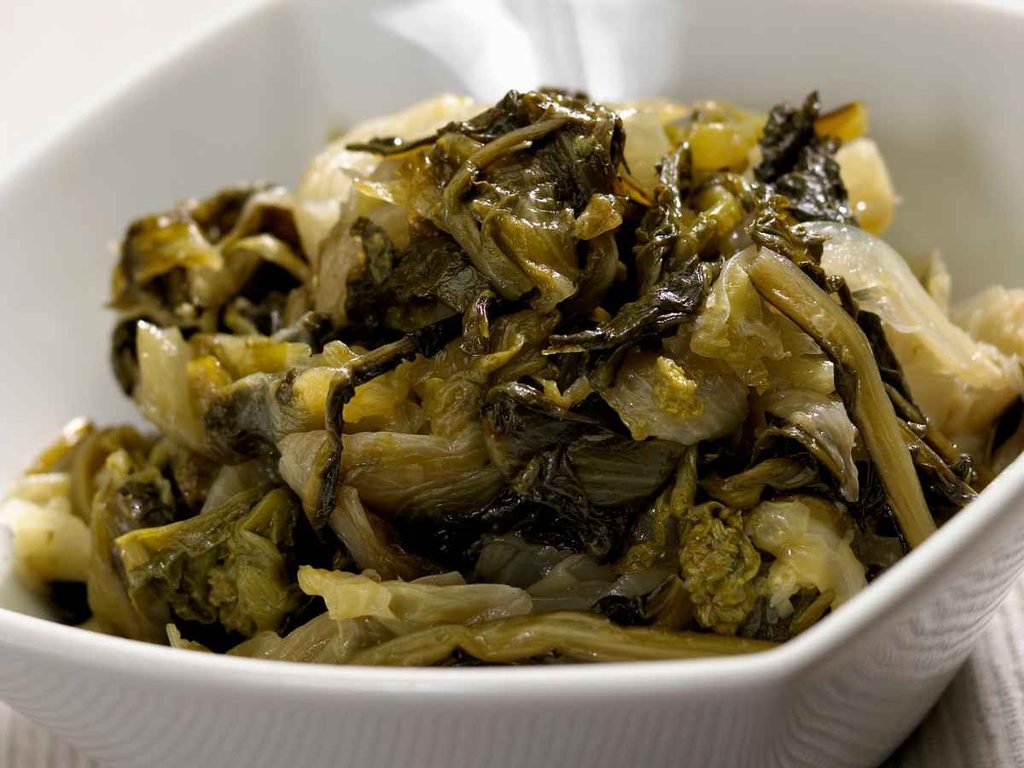
From the American side of the family tree: mashed potatoes, green bean casserole, candied yams or sweet potatoes under their controversial marshmallow crust, and cranberry sauce — frequently the kind from the can, served in its original cylindrical shape, which the children love and the grandmothers tolerate. From the Italian side: sautéed escarole with garlic and oil, broccoli rabe with its pleasant bitterness, roasted peppers, and stuffed mushrooms. The two traditions sit side by side on the same table and are spooned onto the same plate, and somehow it all works, because abundance has a way of making peace.
That word — abbondanza, abundance — is the governing principle of the whole meal. The Italian-American table is not trying to be elegant or restrained. It is trying to be generous, to the point of slight absurdity, because generosity is how the family says the thing it does not always say out loud: there is enough, you are safe here, eat.
5. The Dessert Table — pie meets cannoli
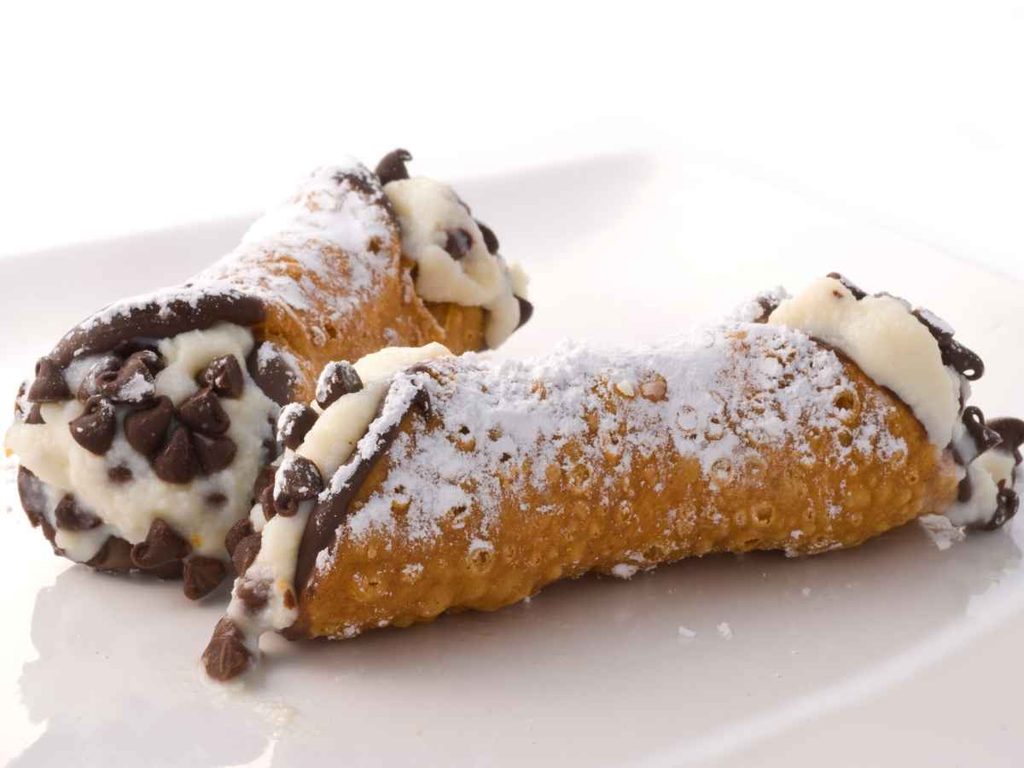
Dessert is not a plate. It is a table of its own, and it is where the two cuisines finally stop pretending to be one meal and simply coexist in happy excess.
The American pies are there — pumpkin, of course, and apple, and often a few more. But they share the table with the Italian sweets, which for many at the table are the real reason to have saved room: cannoli filled that morning so the shells stay crisp, pignoli (pine nut) cookies, rainbow cookies in their layers of almond and jam, flaky sfogliatelle, and pizzelle pressed on the old iron. And then, because the meal cannot simply end, the digestivi: espresso, often with a drop of sambuca, followed by Frangelico or a small glass of vin santo, and the particular sleepy, satisfied, three-generations-around-one-table quiet that is the actual point of the entire day.
There is a moment, every year, somewhere after the espresso and before anyone finds the energy to start wrapping leftovers, when the table goes quiet for a few seconds. The kids have left to collapse somewhere. The plates are a ruin. Somebody’s uncle is asleep in a chair. And the old ones sit there among the wreckage of the meal looking deeply, completely content — because for one afternoon the whole family was in one room, fed past the point of reason, and nobody was missing. That silence is the real dish. Everything else was just how you get there.
Plan your table: build your menu, course by course
Every family’s table is a little different — so build yours. Pick one dish for each course below and watch your own Italian-American Thanksgiving menu come together. There are no wrong answers (except skipping the pasta).
Interactive
Build Your Italian-American Thanksgiving
Tap one for each course. Your menu builds itself below.
The make-ahead timeline: how one kitchen cooks two feasts
Here is the practical problem nobody warns you about: an Italian-American Thanksgiving is two complete meals, and you have one oven. The families who made it look effortless weren’t cooking faster — they were cooking earlier. Almost everything on this table is better made ahead, and the nonne knew it. Here is roughly how the week runs.
- Three to four days ahead — the sauce. The gravy (or sugo) only gets better sitting in the fridge, so it goes first. A big pot, low and slow, then cooled and covered. This is the foundation of the pasta and half the flavour of the day.
- Two days ahead — the baking and the dough. Make the pizzelle and the pignoli cookies (they keep beautifully), roast and peel the chestnuts for the stuffing, and if you’re making ravioli or fresh pasta, this is the day the table gets floured.
- The day before — assemble the lasagna. This is the secret. Build the lasagna (or ziti, or shells) completely the day before and refrigerate it unbaked. It holds its layers better, and a baked pasta that has rested overnight is genuinely better than one assembled the same morning. Toast the bread cubes for the stuffing too.
- Thanksgiving morning — the bird goes in. The turkey is the one thing that must be fresh, so the morning belongs to it. While it roasts, the oven is occupied — which is exactly why everything else was made ahead.
- While the turkey rests — the oven swap. A roasted turkey needs to rest 30–45 minutes before carving, and that resting window is your second oven. The lasagna goes in, the stuffing crisps up, the artichokes warm through. By the time the bird is carved, the pasta is bubbling.
- Last — the cannoli. Fill the cannoli shells only at the very end, just before dessert, so they stay crisp. A cannolo filled too early is a soggy cannolo, and a soggy cannolo is a small family tragedy.
The lesson underneath the timeline is the oldest one in the Italian kitchen: the feast is won in the days before the feast. By Thursday afternoon, the nonna who seems to be doing everything is mostly just reheating things she finished on Tuesday — and accepting compliments.
How the table changes depending on where your family came from
There is no single Italian-American Thanksgiving, because there was never a single Italy. The table you grew up with was shaped by the exact town your family left, and the regional fingerprints are still there if you know where to look.
If your family came from Calabria or the deep South, expect heat and pork. There is chili in things that other families leave plain, likely some ’nduja or soppressata on the antipasto, and a general sense that a dish without a little fire is a dish that hasn’t finished getting dressed. The Calabrian table is generous and unpretentious and slightly suspicious of anything too delicate.
If your family came from Campania — Naples and around it, you are in the heartland of the baked pasta, and the lasagna or the ziti will be the undisputed centre of the meal. The sausage comes with friarielli (broccoli rabe), the sweets lean toward struffoli and sfogliatelle, and the sauce is a matter of deep personal conviction.
If your family came from Sicily, there is more seafood on the antipasto and more sweetness at the end — cannoli, cassata, and marzipan where other families have cookies. The Sicilian table carries a faint memory of Arab and Spanish kitchens, and it shows up in the spice and the sugar.
If your family came from the North — Tuscany, Emilia, the Veneto, the table is quieter and less red. The first course is more likely to be tortellini in brodo than a tray of lasagna, there’s more butter and less tomato, and the ragù, when it appears, is a slow northern one rather than a Sunday gravy. In my own family, with one foot in Calabria and one in Tuscany, Thanksgiving was essentially an annual negotiation between the two: the Calabrian side wanted heat and pork, the Tuscan side wanted the tortellini floating in clear broth. Both got their way, every year, because abbondanza settles every argument by simply making both.
Not sure which traditions were yours? That’s exactly the kind of thing that fades in a generation or two — and exactly the kind of thing worth tracing back. Our guide to finding your Italian town of origin is a good place to start.
What’s poured: the wine from the cantina and the espresso that ends it
You cannot talk about this table without the wine, because in many Italian-American houses the wine was not bought — it was made. The jug on the Thanksgiving table came up from the cantina, pressed by someone’s father or grandfather in the crates-and-barrels ritual of the Italian autumn. (If that smell of fermenting grapes in the basement every October is part of your memory, you’ll recognise the whole world of making wine in the Italian cantina.) It was poured generously, cut with a little soda for the kids at the far end of the table, and nobody measured anything.
And then there was the bread, which never left — because when the sauce is that good, you do not waste it. The quiet art of fare la scarpetta, mopping the last of the sauce off the plate with a torn piece of bread, is practically a Thanksgiving sport. When the eating finally slows, the drinks change character: espresso in the little cups, a bottle of sambuca or amaro produced from somewhere, a splash of Frangelico, a small glass of vin santo for dipping a hard almond cookie. The wine opens the meal and the espresso closes it, and in between is the whole afternoon.
The leftovers are the second holiday
Ask anyone who grew up at this table what their favourite part of Thanksgiving was, and a surprising number will not say Thanksgiving. They’ll say the day after. Because the twenty-pound turkey and the enormous tray of pasta were never really meant to be finished in one sitting — the leftovers were the plan all along, and they are their own small festival.
The first and holiest leftover is the sandwich: cold turkey piled on a good crusty roll with leftover escarole or broccoli rabe and a roasted pepper, pressed down, eaten standing up at the counter, arguably better than anything served the day before. Then there is the frittata di maccheroni — leftover pasta bound with egg and cheese and fried into a golden cake, crisp at the edges, a dish invented specifically so that no strand of pasta is ever thrown away. The turkey carcass goes into a pot for broth, which becomes soup with tiny pasta or escarole floating in it. And the lasagna, somehow, is better on day two than it was on day one, which everyone knows and no one can fully explain.
This, too, is the Italian way of thinking about food: nothing is wasted, everything has a second life, and the generosity of the feast extends for days afterward in smaller, quieter, arguably more delicious forms. The holiday doesn’t end when the plates are cleared. It just changes shape.
What the two-course table really means
If you want to understand the Italian-American experience in a single image, you could do a lot worse than this table: the turkey and the lasagna, side by side, neither one winning.
Because that is exactly what it was to be the child or grandchild of immigrants — to belong to two worlds at once and to refuse to give up either. Thanksgiving is the most American holiday there is, the one about becoming part of the new country. And the Italian-American family answered it not by abandoning the old country but by setting a place for it at the table. The pasta before the turkey is not stubbornness. It is memory. It is a family saying, every single year, on the day designed for becoming American: we are grateful to be here, and we have not forgotten where we came from.
The hard part is that the specifics of this table are fragile. The lasagna recipe lives in one person’s hands. The reason the family makes that soup and not another one is known to one or two people. The story of the first turkey, the transition of the lasagna crown, the exact way your grandmother cut the artichokes — these are not written anywhere. They exist in living memory, and living memory does not last. One generation of not asking, and the two-course table quietly becomes a one-course table, and nobody can say exactly when the other half was lost.
How to build your own Italian-American Thanksgiving
If you want to bring this table to your own home — or bring back the version your family used to make — here is the simple blueprint. You don’t need every dish. You need the shape.
- Start with an antipasto. Even a simple board of cured meats, cheese, olives and bread sets the whole tone. The meal should begin before it begins.
- Serve one pasta before the turkey. If you make one Italian dish, make this one. Lasagna is the classic, but baked ziti or stuffed shells are far easier and nobody will complain.
- Give the turkey Italian hands. Garlic and fresh herbs under the skin, and an Italian-sausage-and-bread stuffing baked in its own pan for the crisp top.
- Add one Italian green. Escarole or broccoli rabe with garlic and oil cuts the richness and earns its place beside the American sides.
- Put cannoli next to the pie. Let both desserts exist. End with espresso. This is non-negotiable.
- Write down whose recipe each dish is — this year, while the person who makes it is still at the table to ask.
That last one matters more than any recipe, because the recipes can be relearned and the stories cannot. The dishes are how the family remembers. The memory of whose dish, and why, is the part that disappears first — and the part worth protecting most.
Two feasts, one tablecloth. The turkey the family learned to make, and the lasagna the family never stopped making. Gratitude for where you landed, served after gratitude for where you began. That is an Italian-American Thanksgiving — and if you were lucky enough to grow up at that table, you already know it was never really about the food. It was about who was in the chairs.
So this year, make the pasta. Season the bird. And write down whose recipe each one was, while they’re still here to tell you.
This Year, Ask at the Table
Record the recipes and the stories while everyone’s together.
Thanksgiving is the one day the whole family is in one room. It’s the perfect time to finally write down whose lasagna it is, what’s really in the stuffing, and the stories behind the table. The Italian Family Heritage Kit gives you 133 guided pages and 120+ prompts to preserve your family’s recipes, names, sayings, photographs and traditions — before they fade.
Explore the Heritage Kit — $19.99Instant digital download. Print it and complete it with your family.
Keep reading
If this is your kind of table, you’ll feel at home in the rest of the family meal: the Italian Sunday dinner this whole tradition grows out of, the Feast of the Seven Fishes that follows a month later on Christmas Eve, and the unwritten rules of the Italian table every one of these meals runs by. For the woman who held it all together, read what an Italian nonna really was, and for the bigger story of what these families carried across the ocean and kept, read Italian-American traditions: what changed and what stayed the same. Looking for a gift for the cook who holds it all together? See meaningful Italian heritage gifts.
Frequently asked questions
Do Italians eat pasta on Thanksgiving?
Many Italian-American families do. Pasta — usually a baked pasta like lasagna, baked ziti, stuffed shells or manicotti, sometimes preceded by Italian wedding soup or tortellini in brodo — is traditionally served as a first course before the turkey, not instead of it. The custom dates back to early Italian immigrants who celebrated the American holiday with the celebratory food of their own culture. In many families the pasta is anticipated even more than the turkey.
What is on a traditional Italian-American Thanksgiving menu?
A full Italian-American Thanksgiving usually runs: an antipasto (cured meats, cheeses, olives, roasted peppers, bread); a first course of soup and/or baked pasta like lasagna; the turkey with Italian herbs and a sausage-and-bread stuffing baked separately, often with stuffed artichokes; sides that mix American staples (mashed potatoes, sweet potatoes, cranberry sauce) with Italian greens like escarole and broccoli rabe; and a dessert table of American pies alongside cannoli, pignoli cookies, rainbow cookies and sfogliatelle, finished with espresso.
Why do Italian-American families serve pasta before turkey?
Because Thanksgiving was an adopted holiday, and Italian families made it their own by celebrating it with their own festive food. To an Italian family, a major celebration means pasta and a long sequence of courses. When they embraced Thanksgiving, they simply slotted the turkey into their existing feast structure — antipasto, soup, pasta, then the main — rather than rebuilding the meal around the bird. It’s a way of honouring both their new country and their heritage on the same day.
Is an Italian Thanksgiving different from a regular American Thanksgiving?
It’s the same holiday on the same day, with the same turkey — but wrapped around an Italian feast structure. The main difference is that the meal opens with an antipasto and a first course of soup and baked pasta before the turkey, the bird gets Italian herbs and a sausage stuffing, Italian greens join the American sides, and the dessert table carries cannoli and Italian cookies alongside the pies. It’s Thanksgiving built on the bones of the Italian Sunday dinner.
What kind of stuffing do Italians make for Thanksgiving?
Italian-American stuffing is typically made from cubes of a round Italian loaf mixed with sweet Italian sausage, fennel, onion and herbs, sometimes with chestnuts or pine nuts, moistened with broth and baked in a separate pan rather than inside the bird — which gives it a crisp top and lets the turkey cook more evenly. It’s richer and more savoury than typical American bread stuffing.
How far ahead can I make the lasagna for Thanksgiving?
You can fully assemble the lasagna the day before and keep it refrigerated, unbaked, until you bake it on Thanksgiving. Many families find it actually holds its layers better after resting overnight. The sauce can be made three to four days ahead — it only improves in the fridge. Bake the assembled lasagna while the roasted turkey rests, so your single oven handles both.
What desserts are served at an Italian Thanksgiving?
Both American and Italian sweets share the table. The American pies (pumpkin, apple) sit alongside Italian classics like cannoli, pignoli (pine nut) cookies, rainbow cookies, sfogliatelle and pizzelle. The meal traditionally ends with espresso — often with a splash of sambuca — and a digestivo such as Frangelico or vin santo.
Do Italian-Canadian families celebrate Thanksgiving the same way?
Yes — in the Italian communities of cities like Montreal and Toronto, families celebrate Canadian Thanksgiving (the second Monday of October) with the same structure: antipasto, a baked-pasta first course, and the turkey treated as one part of a larger Italian feast rather than the sole centrepiece. The holiday’s date and country differ; the order of the courses is identical.
How do I start an Italian-American Thanksgiving tradition in my family?
Start simple: add an antipasto board to begin the meal, serve one baked pasta (lasagna or baked ziti) as a first course before the turkey, give the bird Italian herbs and a sausage stuffing, add one Italian green like escarole, and put cannoli next to the pie. Most importantly, write down whose recipe each dish is while that person is still at the table — the recipes can be relearned, but the stories behind them disappear if no one records them.
Marco Ricci is an Italian-Canadian writer and the grandson of Calabrian immigrants. He created Italian Family Traditions to document the customs, feast days, and family rituals Italian families carried from Italy to North America — and to understand what they actually meant. He is based in Montreal.