
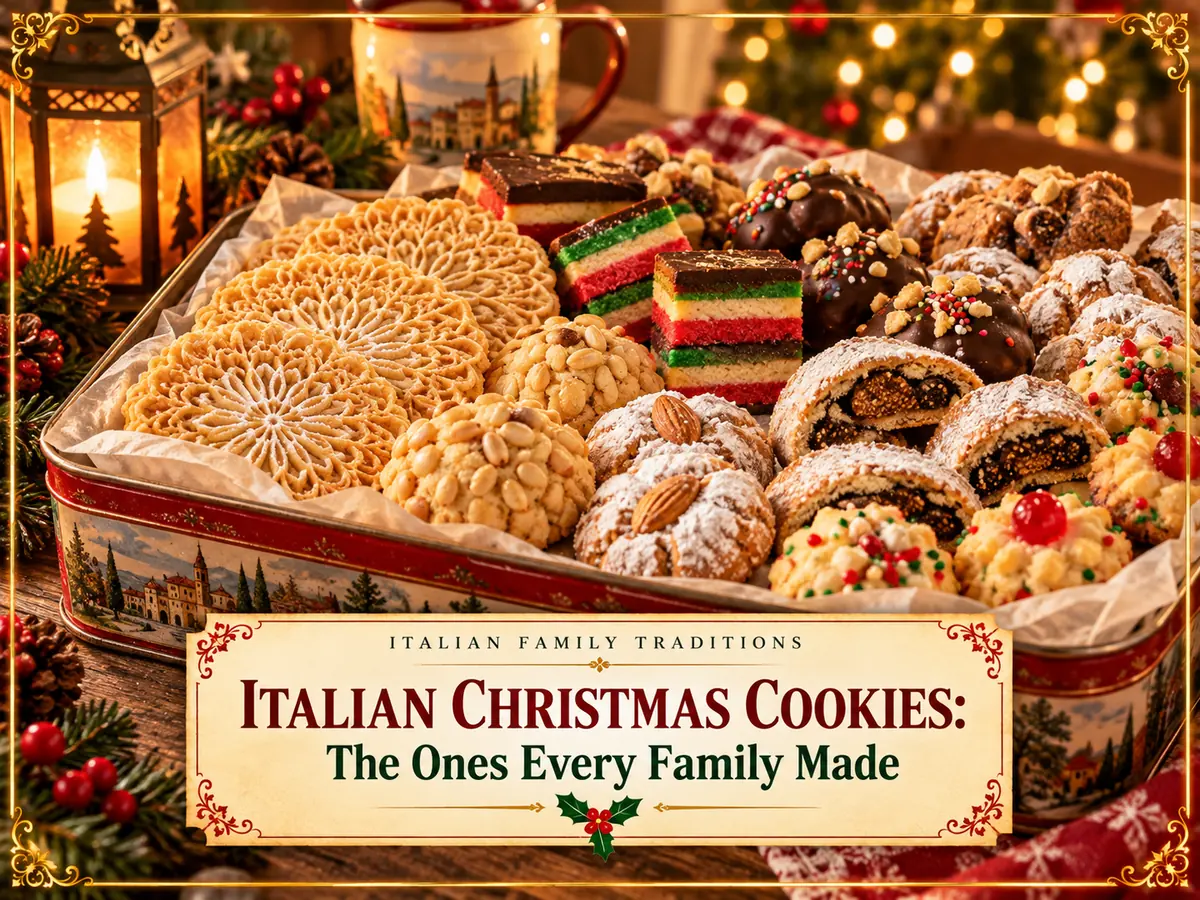
Italian Family Traditions
Italian Christmas Cookies: The Ones Every Family Made
Pizzelle, pignoli, cucidati, struffoli, the rainbow cookies, the fried bowties dusted in powdered sugar — the great tin of Italian Christmas cookies is a family archive you can eat. Here’s the full tour, the stories behind each one, and a tool to build your own tray.
There is a particular tin that lives in the memory of everyone who grew up in an Italian family. It’s round, usually, and it almost certainly once held something else — Danish butter cookies, or panettone, or nothing anyone can remember — and every December it reappears, lined with wax paper, packed in careful layers with a sheet of paper between each one, holding a dozen different kinds of cookie that took three women four days to make. You were allowed one. You took three. Everyone pretended not to notice.
Italian Christmas is not really a cookie. It’s a cookie tray — the vassoio — a groaning, over-full platter of a dozen kinds at once, because one kind would be an insult and because every cookie on it means something. This one was Nonna’s mother’s. That one only Zia Carmela can make. The fig ones take all day and nobody under sixty fully trusts themselves to do them right. The tray is a map of the family, baked, and every Christmas it gets passed around the table and down the generations at the same time.
An Italian Christmas cookie tray isn’t dessert. It’s the family history, written in almond paste and powdered sugar, and reissued once a year in a tin that used to hold something else.
This is the complete guide to those cookies — why Italians bake by the hundred at Christmas, a full tour of the classics (with the stories behind each), the regional differences, how the old bakers made cookies that last for weeks, and a tool to build your own tray. Save room. There’s a lot on the tin.
In this guide
- Why Italian Christmas runs on cookies
- The tour of the tin: 13 classic Italian Christmas cookies
- Same holiday, different tin: cookies by region
- A December baking game-plan
- The bakery box: when you didn’t bake them
- The nonna’s secret: cookies built to last
- Start with these three (full recipes)
- The recipe that lives in one person’s hands
- Frequently asked questions
Before the stories, the useful part. Plan your tray in ten seconds: filter if you like, tap the cookies you want, and get a tray with a made-for-you baking schedule. Then read on for what each one is.
Interactive · plan & bake your tray
Build Your Italian Christmas Cookie Tray
Tap the cookies you want. You’ll get your tray, a made-for-you baking schedule, and a quick recipe for each — printable. New to these? Each chip shows its flavour and difficulty.
Show me
Prefer it on paper? Get the free printable recipe cards: the 3 full recipes, quick cards for the other 10, the baking plan, and blank cards for your own family’s recipes.
Why Italian Christmas runs on cookies
Every culture has its Christmas sweets. What makes the Italian version distinct is the sheer industrial scale of it, and the reason behind it: the cookies were never only for your own family. They were currency.
In an Italian household, you did not bake a batch of cookies at Christmas. You baked a production run — hundreds of cookies, a dozen varieties, over several days — because a huge share of them were going straight back out the door. You made trays for the neighbours, for the priest, for the relatives who’d host, for the teacher, for the family friend who’d had a hard year. Giving a tray of homemade cookies was how the family said we’re thinking of you without ever having to say it out loud. To receive one and send nothing back was unthinkable. The whole neighbourhood ran, every December, on a quiet economy of exchanged cookie trays.
That’s why the baking was a group effort and a multi-day event. It’s why the recipes doubled and tripled and quadrupled without anyone writing the new amounts down. And it’s why the cookies themselves evolved to be sturdy, keepable things — many are built around almonds, honey, and dried fruit precisely because those cookies survive a week in a tin and a journey across town. The Italian Christmas cookie is, by design, a cookie made to travel and to last, because its whole purpose was to be given away. It belongs to the same spirit of abundance as the whole Italian Christmas season, which stretches from the Immaculate Conception on December 8 all the way to the Epiphany.
My grandmother measured Christmas not in days but in pounds of flour. By mid-December the kitchen table disappeared under a dusting of it, the good tins came down from the top of the cupboard, and the house smelled of anise and toasting almonds for two straight weeks. She made cookies for people I’m not sure she even liked, because that was simply what you did. The tray went out; the dignity stayed in.
The kitchen at full tilt
To understand these cookies you have to picture the room they were made in. For a week or two in December the kitchen stopped being a kitchen and became a small factory. Every flat surface was floured and pressed into service. There were bowls everywhere — one of almond paste, one of fig filling going dark and sticky, one of egg whites being beaten by hand until someone’s arm gave out and the job was passed along. The oven never fully cooled. The radio or the record player was on. And there was almost always more than one generation of women in the room at once, working an informal assembly line that nobody had ever written down but everyone understood.
The children had jobs, and the jobs were a kind of apprenticeship nobody called an apprenticeship. You cracked the nuts. You pressed the pizzelle iron and learned, by burning the first three, exactly how long to count. You rolled the little balls for the struffoli and were trusted, eventually, with the sprinkles. You licked the bowls as payment. And without realising it, you were learning the recipes the only way they were ever really taught — by standing at the elbow of the person who knew them, watching their hands, year after year, until one Christmas the hands were yours. That is how a cookie survives a hundred years. It is also, precisely, how one gets lost.
The tour of the tin: 13 classic Italian Christmas cookies
No two family tins are identical, but these are the cookies you’re most likely to find on them — the canon of the Italian Christmas tray. Here’s what each one is, and why it earned its place.
1. Pizzelle
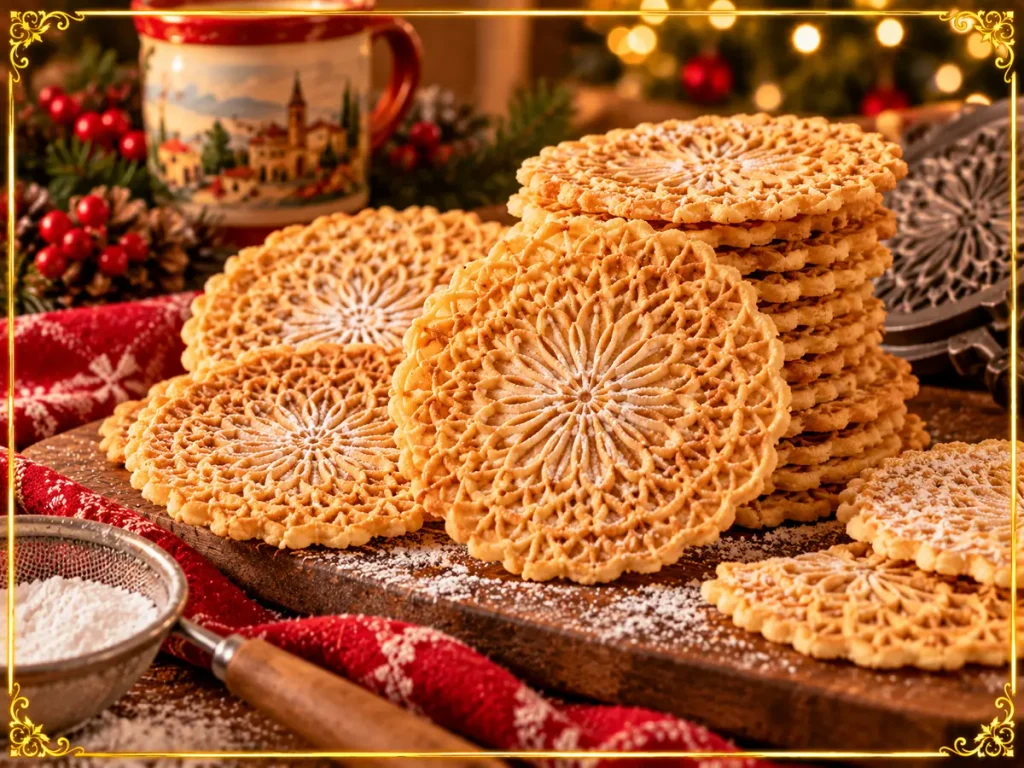
The thin, crisp, snowflake-patterned wafer pressed on a special iron, flavoured with anise or vanilla — pizzelle may be the most iconic Italian cookie of all, and one of the oldest, with roots tracing back centuries to the Abruzzo region, where they’re considered among the earliest cookies in the world. The pizzelle iron itself is often a family heirloom, handed down and guarded, each one stamping its own particular pattern — and the rhythm of it (spoon the batter, press, count, lift, trim the lacy overflow, repeat a hundred times) is one of the defining sounds and smells of the season. The telltale licorice note comes from anise, and specifically from a compound called anethole — the same aromatic molecule that flavours sambuca and the Italian pastry world’s whole family of anise sweets. Crisp, pale, and stackable, pizzelle are the workhorse of the tray; some families even sandwich them with cream or shape them warm into cannoli shells.
2. Pignoli
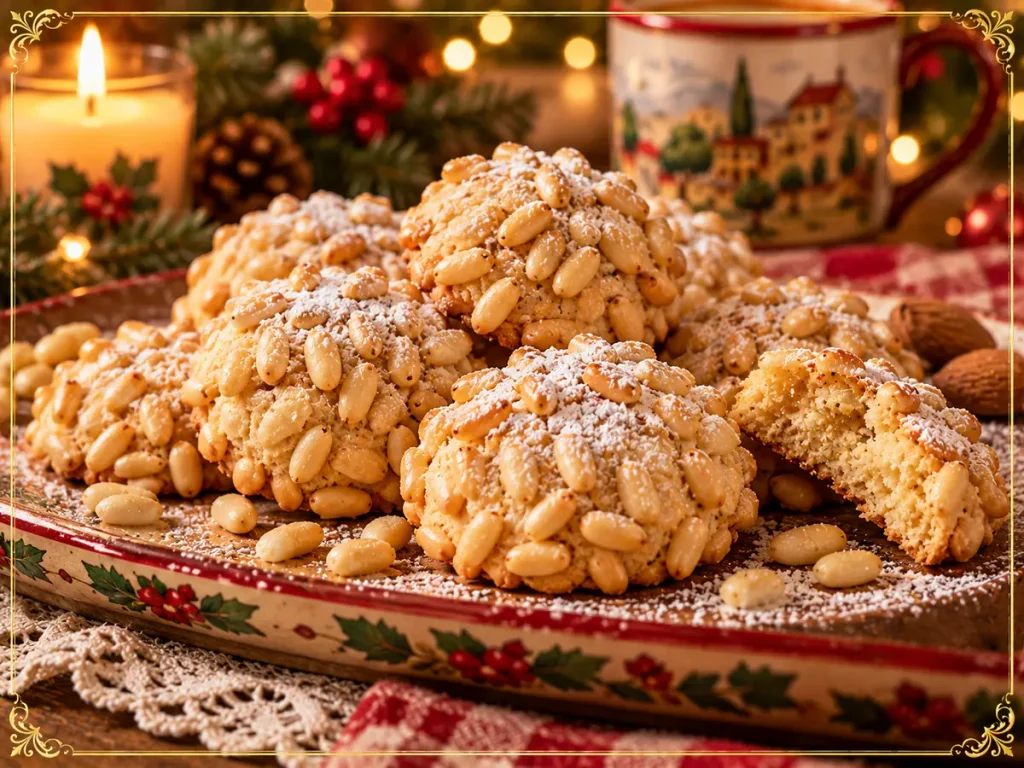
Soft, chewy almond-paste cookies rolled in pine nuts — pignoli — are the aristocrats of the tin, and everyone knows it, because pine nuts are heartbreakingly expensive. There’s a reason: true Mediterranean pine nuts are prised by hand from the cones of the stone pine, a slow, labour-heavy harvest, which is why a small bag costs what it does. That expense is the whole message — pignoli on the tray signal that the family went all out. Made from almond paste, sugar and egg whites, with no flour at all, they’re naturally gluten-free, intensely almond-scented, soft inside with a toasty crust of pine nuts, and gone first from every tray. If a tin has pignoli on it, someone spent real money to say Merry Christmas.
3. Cucidati (Sicilian fig cookies)
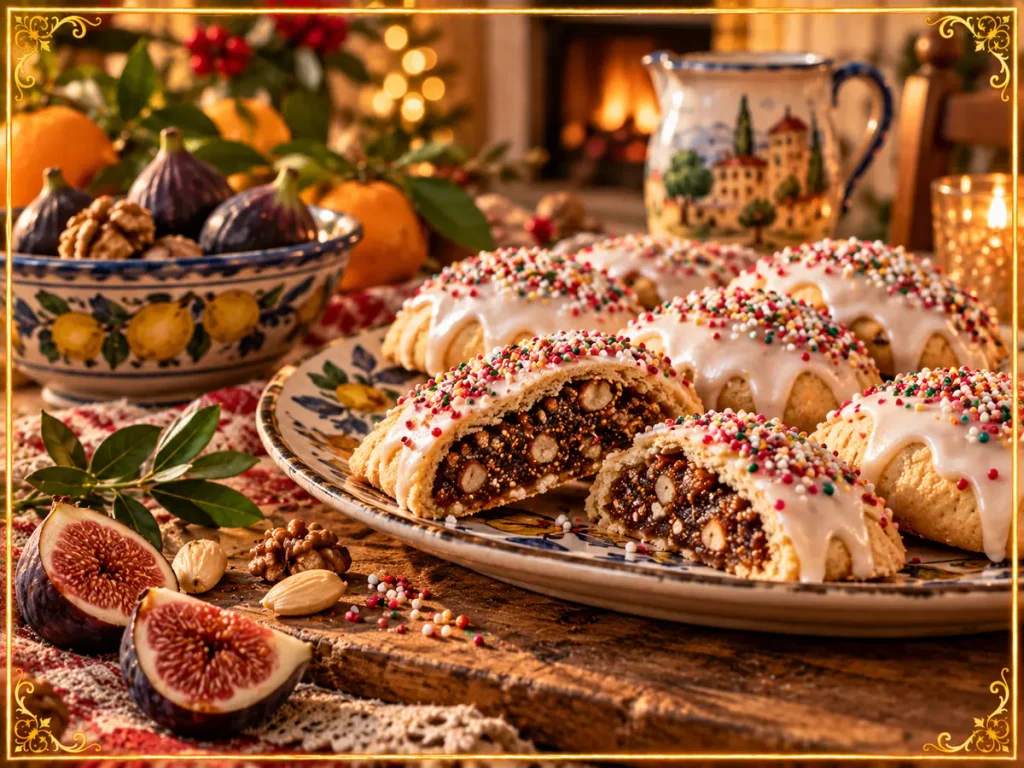
If one cookie strikes fear into the hearts of the under-sixty, it’s the cucidatu — the Sicilian fig cookie, also called buccellato. A tender pastry is wrapped around a dense, dark filling of dried figs, dates, nuts, citrus, and often a little wine and spice, then baked and iced and finished with sprinkles. Some families roll them into long logs and slice them into pinwheels; others shape them into individual crescents or elaborate wreaths, scored and pricked into patterns — the fancier the shaping, the more the maker is showing off, and rightly so. They are a genuine project, taking the better part of a day, which is why they’re the cookie most likely to be entrusted to exactly one person in the family, whose cucidati recipe is spoken of with real reverence. Lose that person, and the family often loses the cookie. They are the clearest proof that the Christmas tray is a repository of knowledge, not just sugar.
4. Struffoli
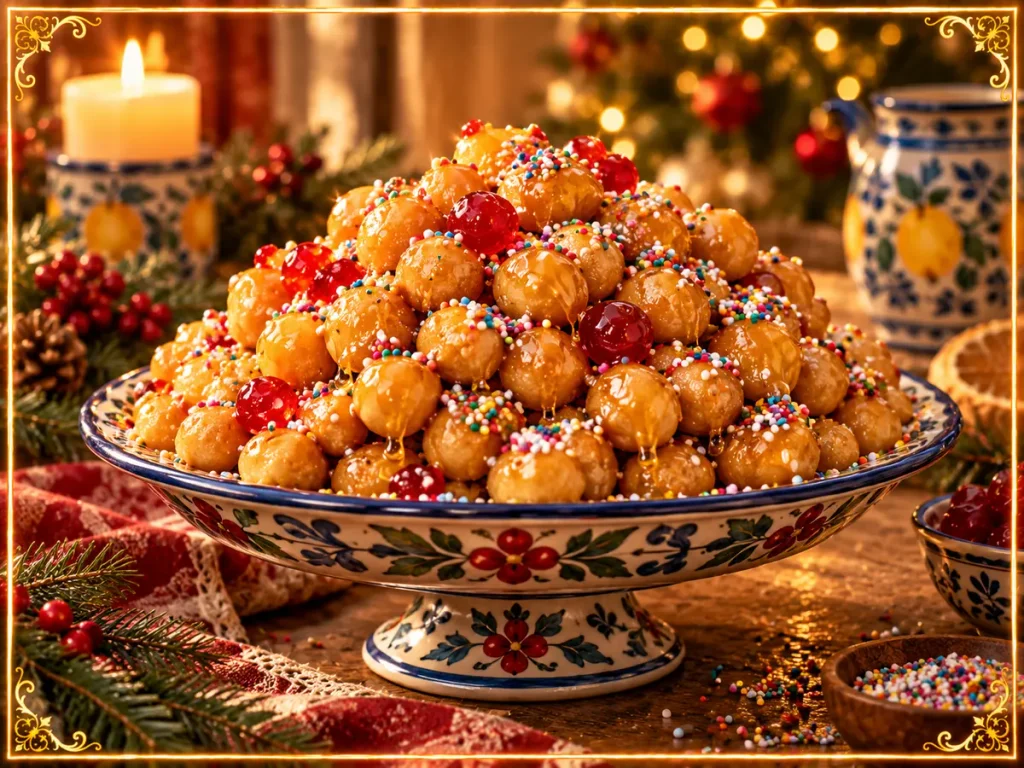
More a centerpiece than a cookie, but it lives on the tray and no Neapolitan Christmas is complete without it: struffoli, a glistening mound of tiny fried dough balls bound together with warm honey and scattered with coloured sprinkles and candied peel, built into a wreath or a pyramid. Making them is a whole-family affair — one person rolls and cuts the endless little balls, another fries them in batches, a third handles the honey and the final architecture. The honey is the whole point — and here’s a small piece of magic worth knowing. Honey is one of the only foods on earth that never spoils: archaeologists have found 3,000-year-old honey in sealed Egyptian tombs still perfectly edible, because honey’s very low water content, acidic pH, and the trace hydrogen peroxide the bees add make it almost impossible for bacteria to survive in it (as Smithsonian explains). The honey that holds your struffoli together is, chemically, nearly immortal. The struffoli themselves rarely last the night.
5. Anginetti (Italian lemon knot cookies)
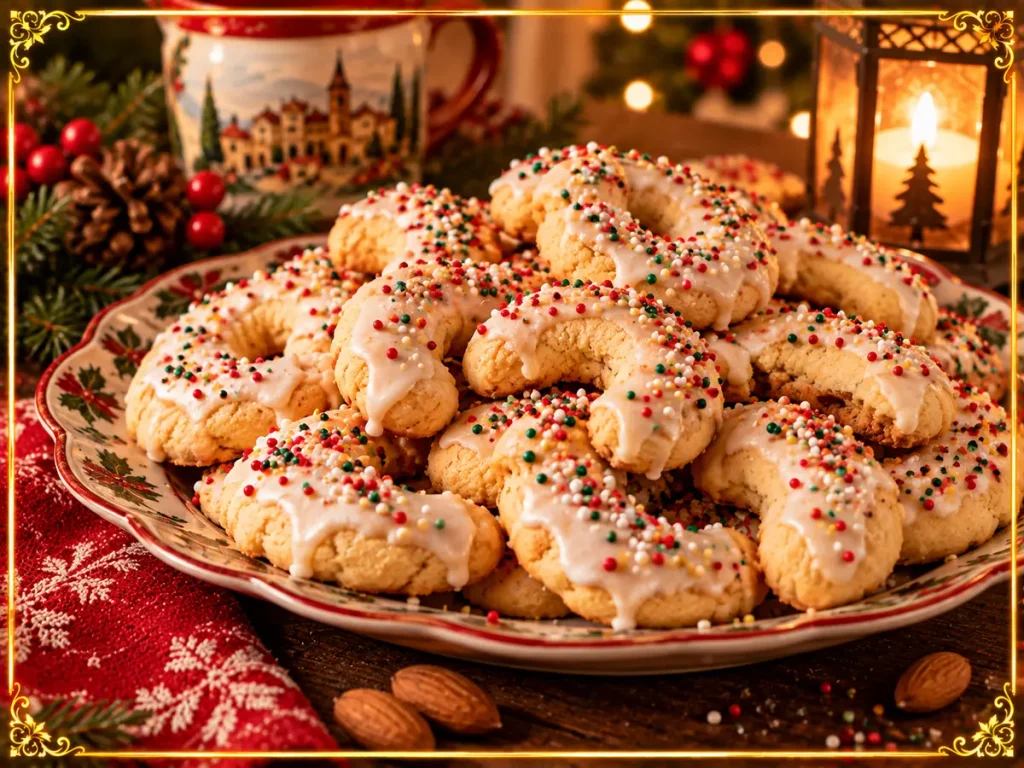
The soft, cakey little knots or domes under a sheen of white icing and a scatter of nonpareils — anginetti, also called Italian wedding cookies or simply “the lemon ones.” Gently lemon- or anise-scented, more tender than sweet, they’re the cookie the kids go for because of the icing and the sprinkles. They turn up at weddings, Easter and baptisms too, but at Christmas they’re a tray staple, bringing colour and softness to a tin otherwise full of crunch.
Whose Recipe Was It?
The recipe lives in one person’s hands.
The cucidati that only one aunt can make. The pizzelle iron handed down three generations. The exact amount of anise Nonna never wrote down. These recipes live in one person’s hands — and vanish with them. The Italian Family Heritage Kit gives you 133 guided pages to record the recipes, the bakers and the stories behind your family’s tray, before they’re gone.
Explore the Heritage Kit — $19.99Instant digital download. Print it and complete it with your family.
6. Amaretti
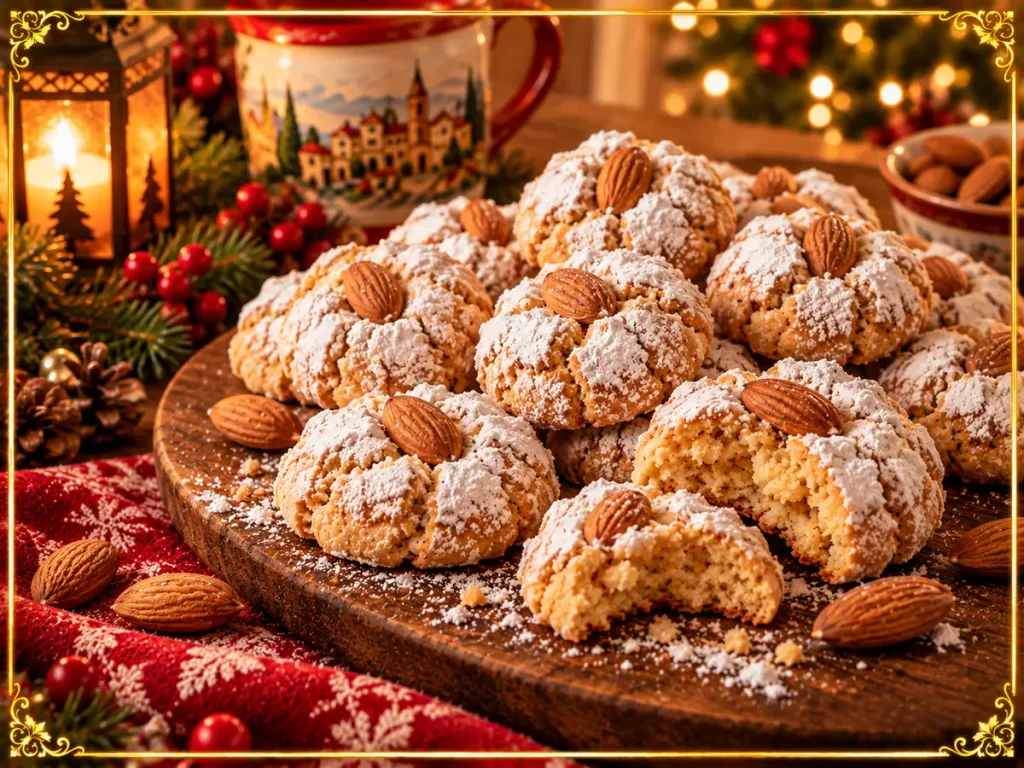
The classic almond macaroon — crisp and crackled on the outside, chewy within, or in the Sardinian style soft all the way through — amaretti carry a gentle bitter-almond note from apricot kernels or bitter almond. Legend ties the famous crisp amaretti of Saronno to a young couple who baked them for a visiting cardinal in the 1700s, wrapping each pair in tissue twisted at both ends — the way the boxed ones are still wrapped today. They’re ancient, elegant, and endlessly useful: eaten straight, crushed over desserts, or dunked in vin santo or coffee. Naturally gluten-free like pignoli, they’re the quietly sophisticated member of the tin.
7. Chiacchiere & wandi (fried bowties)
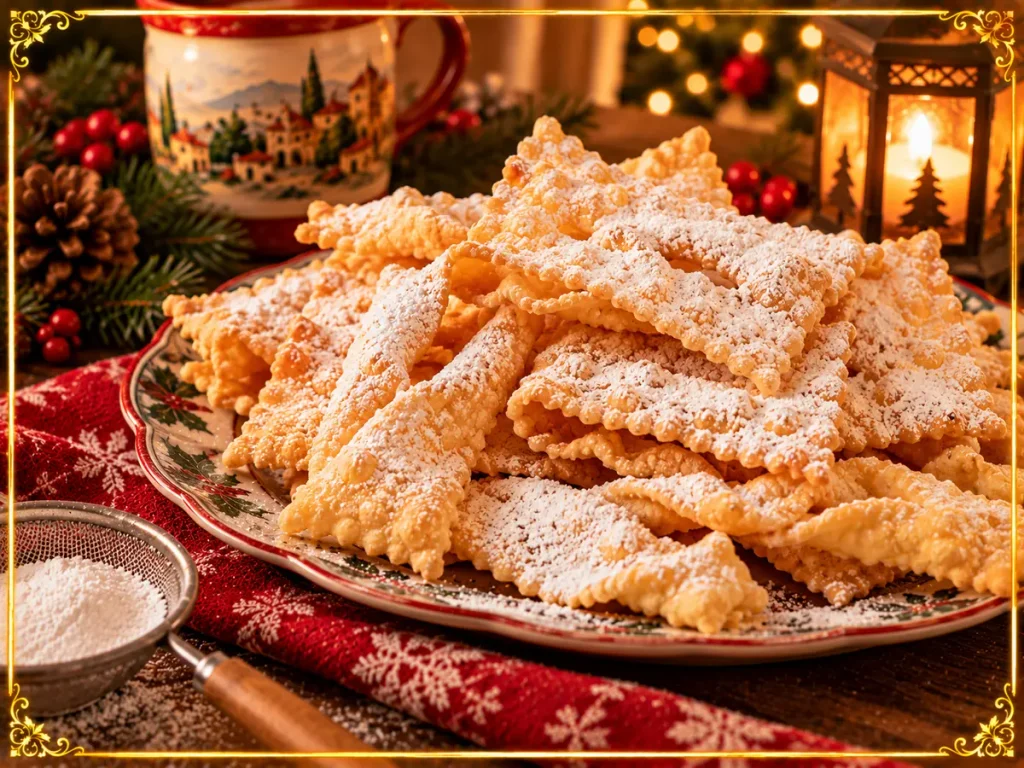
Thin ribbons of dough, fried until blistered and crisp, then buried in powdered sugar — known by a dozen regional names (chiacchiere, crostoli, frappe, cenci, bugie, and the Italian-American wandi or bowties). The most common name, chiacchiere, literally means “chatter” or “gossip” — fittingly, for a cookie as light and endless as conversation. They’re more associated with Carnevale in Italy, but in many immigrant families they migrated firmly onto the Christmas tray, because they’re festive, dramatic, and the whole kitchen gets to help cut and fry them. Messy, powdery, and impossible to eat with dignity — which is the fun, and which is why the powdered sugar ends up on everyone’s sweater.
8. Mostaccioli
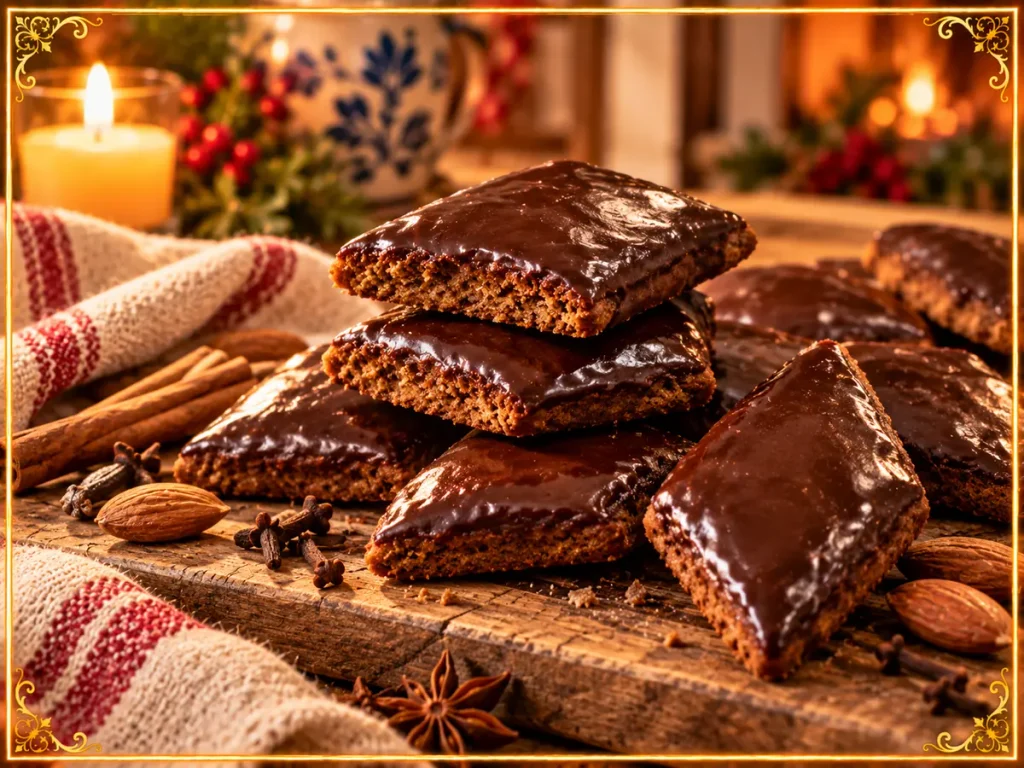
The dark, spiced, diamond-shaped cookies of the South — mostaccioli (or mustaccioli) — dense with cocoa, cinnamon, cloves and often a hint of coffee or citrus, glazed in a hard chocolate shell. Their ancestor was sweetened with mosto, grape must, which gave them their name, and their lineage runs back to Roman times, when spiced honey cakes were offered at feasts and funerals alike. Chewy, grown-up and deeply spiced, they’re a staple of the Calabrian and Neapolitan Christmas and a favourite of anyone who finds the iced cookies too sweet. They’re also one of the great keepers — a batch made in early December is at its best by the 25th.
9. Ricciarelli
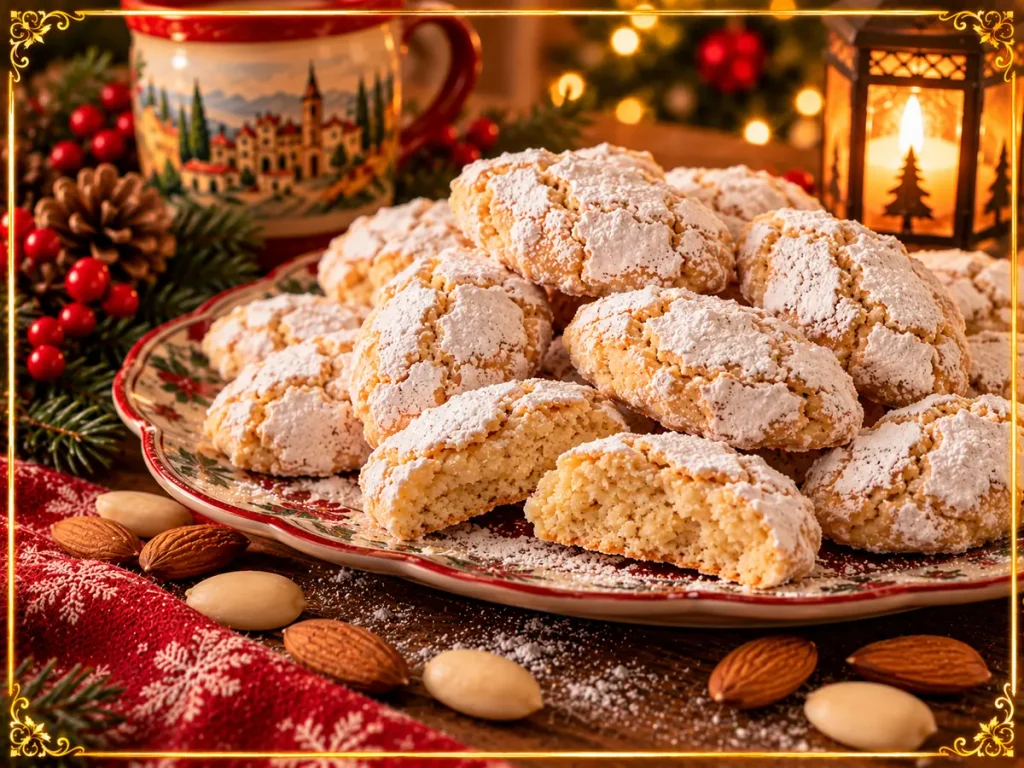
From Siena, in Tuscany, come ricciarelli — soft, diamond-shaped almond cookies with a delicately cracked, powder-sugared top and a tender, marzipan-like centre. Legend has it a Sienese knight brought the recipe back from the Crusades, and the cookies have been a point of civic pride ever since — today they even carry a protected IGP designation. More refined and less sweet than their Southern cousins, they’re the Tuscan contribution to the tin and a reminder that the Italian cookie tradition stretches the whole length of the country, not just the South.
10. Baci di dama
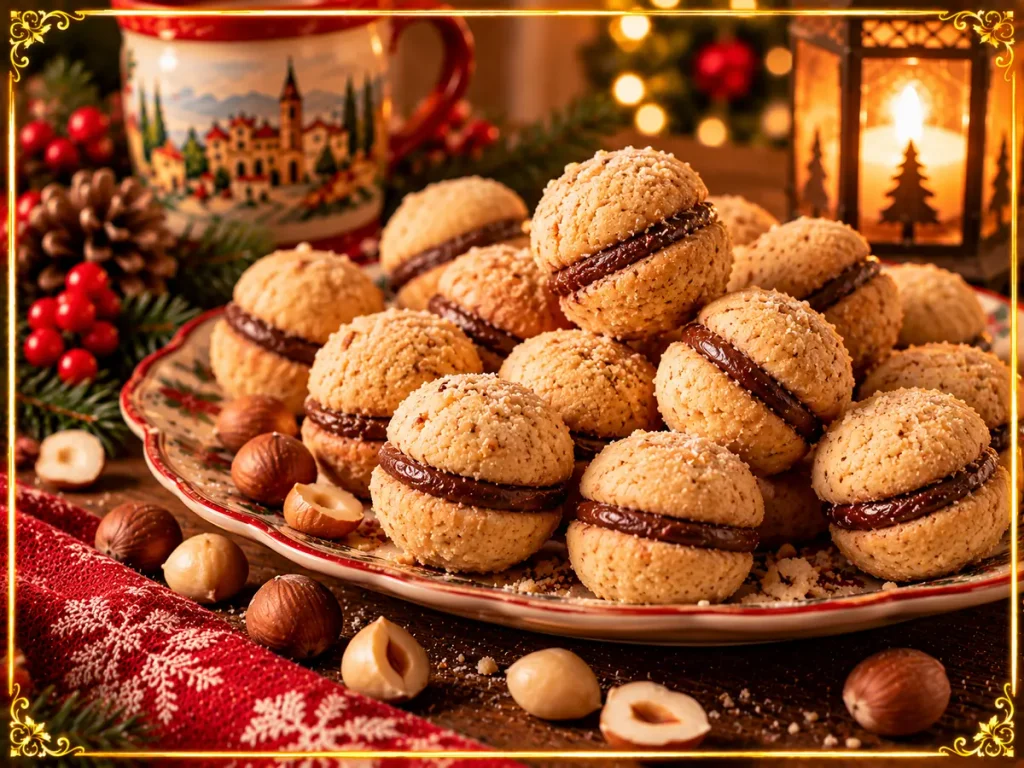
“Lady’s kisses” — two little domed hazelnut cookies sandwiched together with a dab of dark chocolate, from Piedmont. Said to have been invented in the 1850s for the royal House of Savoy, they take their name from the way the two halves meet like a pair of lips. Small, buttery and elegant, baci di dama are the delicate northern counterpoint to the robust southern sweets, lean on the region’s prized hazelnuts, and vanish from a tray almost as fast as the pignoli.
11. Rainbow cookies (seven-layer / Italian flag cookies)
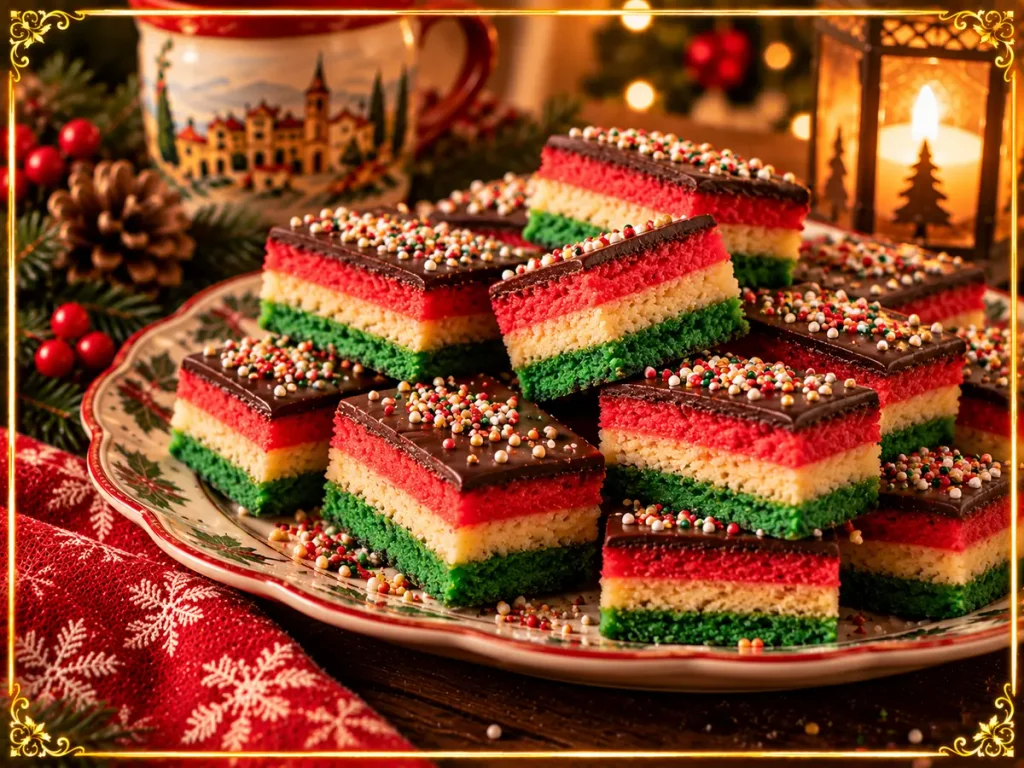
The one that’s purely Italian-American: dense almond sponge baked in three layers tinted red, white and green like the flag, held together with jam and coated in chocolate, then sliced into little stacked rectangles. Also called seven-layer cookies, tricolore, or “Venetians,” they were born in the Italian bakeries of New York and New Jersey and became an immovable fixture of the Italian-American Christmas tray. The almond-paste batter and the layer-by-layer assembly make them a genuine undertaking, which is why they’re the cookie most often bought from the bakery rather than made at home — and they’re best after a day or two, once the jam and chocolate have settled into the sponge. A lot of work, a bakery-case classic, and for many families the single most anticipated cookie in the tin.
12. Roccocò
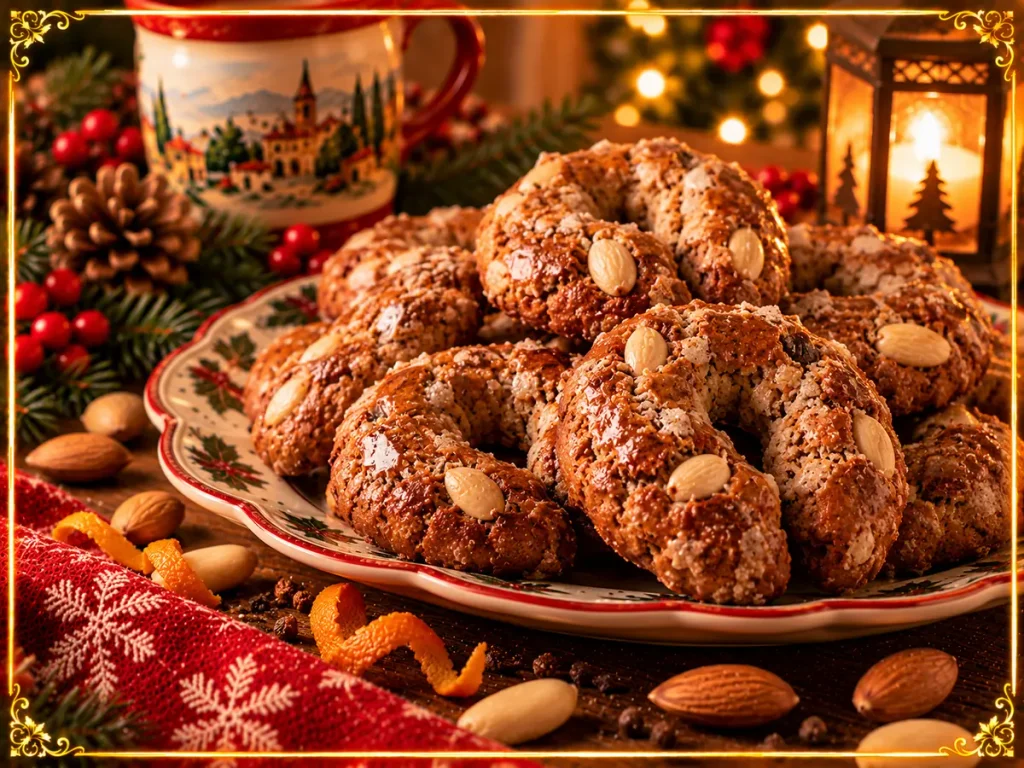
The hard, ring-shaped Neapolitan cookie scented with pisto — a Christmas spice blend of cinnamon, cloves, nutmeg and coriander — and studded with toasted almonds, glazed with egg and baked until they’re genuinely, deliberately tough. Roccocò are not a cookie you bite so much as a cookie you soak: traditionally dunked in spumante, vermouth or coffee to soften. They date to a Neapolitan convent in the 1300s, and their very hardness is the point — it’s what lets them keep for weeks and travel across the city in a tin without a crumb out of place. A true Southern Christmas tray almost always has a few.
13. Italian “S” cookies (taralli dolci)
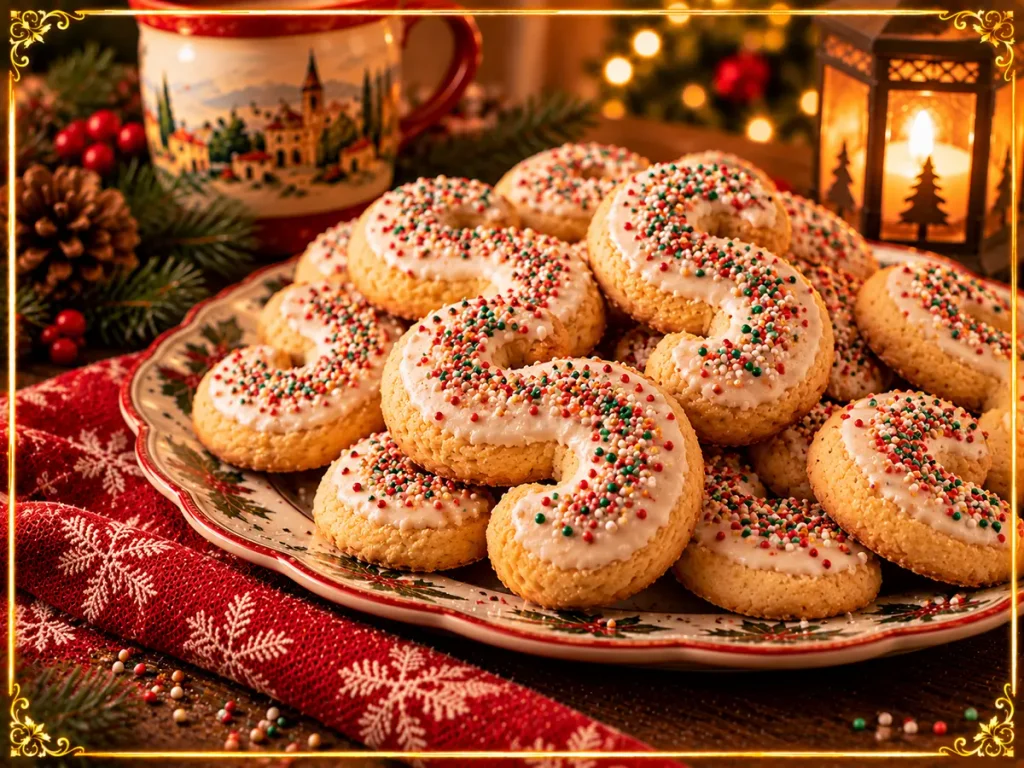
Humble and beloved: the soft, cakey, faintly lemon-scented cookie twisted into an “S” shape and brushed with a thin sugar glaze. Not fancy, not expensive, not hard to make — which is exactly why they’re on every tray and why there are always a hundred of them. These are the everyday cookie of the Italian-American table, the one that’s equally at home dunked in morning coffee as it is on the Christmas vassoio. Every family has a tin of them, and no one can ever stop at one.
Same holiday, different tin: cookies by region
Just like the sweets made for the Day of the Dead, the Christmas tin shifts depending on which corner of Italy your family left. The cookies carry their hometown with them.
Sicily brings the cucidati fig cookies, plenty of almond and marzipan, and often a sweeter, more ornate tray — the island’s long history of Arab and Spanish influence shows up in the spice, the candied fruit and the sheer decorative ambition of the sweets.
Campania (Naples) is struffoli country, the honeyed mound at the centre of the table, alongside roccocò and mostaccioli — hard, spiced, dunk-in-your-wine cookies built for keeping.
Calabria and the deep South lean dark and spiced: chocolate-glazed mostaccioli, honey and dried-fig sweets, cookies with a little heat or a lot of clove. These are robust, rustic, unfussy sweets from a place that never had sugar to waste.
The North — Tuscany, Piedmont, the Veneto — is quieter and more refined: the Sienese ricciarelli, Piedmont’s hazelnut baci di dama, hard almond cantucci for dipping in vin santo, less tomato-red icing and more restraint. In a family like mine, with roots in both Calabria and Tuscany, the Christmas tin was a friendly argument between the two — the dark, spiced southern cookies on one side, the pale, almond-scented northern ones on the other, and everybody reaching across the divide.
Not sure which were your family’s? That’s worth tracing, and our guide to finding your Italian town of origin is a good place to start — the town usually tells you the tin.
A December baking game-plan
Making a dozen kinds of cookie sounds impossible until you see how the old bakers actually did it: not in one heroic marathon, but spread across the whole month, in a sequence dictated by which cookies keep longest. Here’s the game-plan hiding behind every well-stocked tin.
- Early December — the keepers. Start with the cookies that only get better with time: mostaccioli, roccocò, cucidati and the other spiced, honeyed, dried-fruit sweets. Made now, they’ll have mellowed to perfection by Christmas, and they free up the busy final week.
- Mid-December — the freezer batch. Bake the almond cookies (pignoli, amaretti, ricciarelli) and the sturdy ones, and freeze what you won’t give away immediately. Un-iced cookies freeze best — you add the icing and sprinkles after they thaw.
- The week before — the soft ones. Anginetti, S cookies and other soft, iced cookies are best fresh, so they belong to the final stretch. This is also when the whole family gets drafted in to ice and sprinkle.
- Christmas Eve — the fresh-only. Struffoli and the fried bowties are made last, as close to serving as possible, because they’re at their glorious best the day they’re made and nobody wants a soft chiacchiera.
- Then — assemble the trays. With everything baked and the freezer full, the final act is building the vassoi: layering the tins with wax paper, keeping crisp apart from soft, and sending them out across the neighbourhood.
If you’re starting your own tradition and it all feels like a lot, start with three: one keeper (mostaccioli), one almond cookie (pignoli or amaretti), and one easy crowd-pleaser (S cookies or pizzelle). Three kinds is already a real Italian tray. You can add one new cookie a year — which, conveniently, is also how the family repertoire grew in the first place.
The bakery box: when you didn’t bake them yourself
Not every family baked. Plenty didn’t — and that gave rise to its own beloved ritual: the trip to the Italian bakery.
If you grew up in an Italian-American neighbourhood, you know the scene. The week before Christmas, the pasticceria is mobbed, the glass cases are a wall of cookies, and you point — a pound of this, a half-pound of that, the pignoli, the rainbows, a few of the fig ones — while someone behind the counter builds a white cardboard box, fills it in careful layers, folds the lid, and ties it with that red-and-white string pulled from a spool bolted to the ceiling. You carried that box flat on two hands like it was made of glass. It came to the table still tied, and untying it was its own small ceremony.
There is no shame in the bakery box. For a lot of families it was the tradition — the particular bakery, the particular counter lady, the particular cookies you always got, the box on the table Christmas morning. The point was never who baked them. The point was the tray, and the giving, and the family gathered around it. Whether your cookies came from Nonna’s oven or a white box tied with string, they did the same job: they made it Christmas.
Giving a Tin This Year?
Tuck in something they’ll keep after the cookies are gone
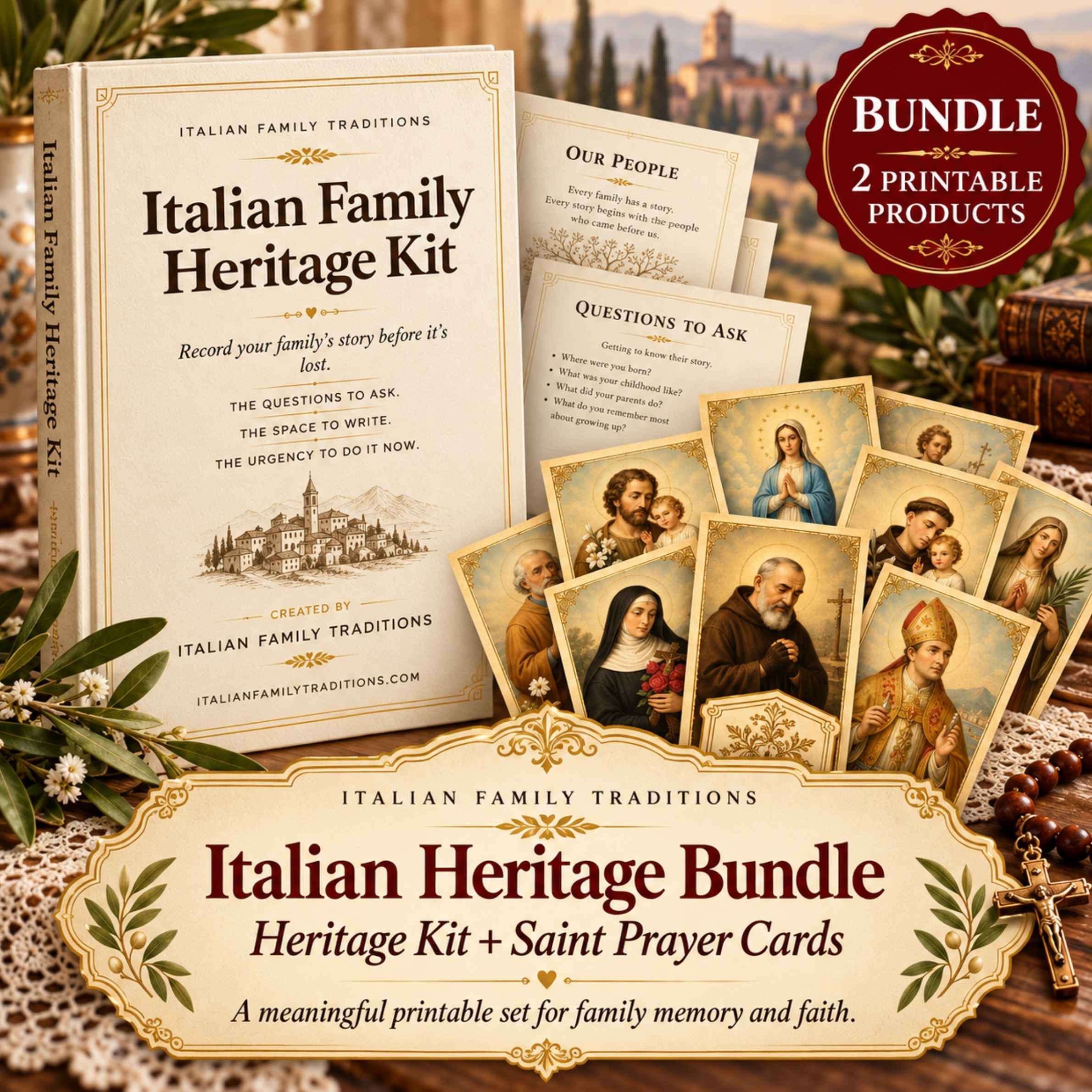
The cookies disappear by New Year’s. Pair the tin with the Italian Heritage Bundle: the Heritage Kit to write down whose recipe each cookie really is, and the Saint Prayer Cards, eleven printable santini with prayers in Italian and English. Instant download, so it’s ready the same day.
$24.99 $29.48
Both downloads together · save $4.49
Get the Heritage Bundle →The nonna’s secret: cookies built to last
Here’s the practical genius hiding inside the tradition. Because the cookies were meant to be made days ahead and given away across town, the Italian Christmas canon is full of sweets that are better after a rest — and that’s not nostalgia, it’s chemistry.
- Spiced and honeyed cookies improve with age. Mostaccioli, cucidati and other honey-and-spice cookies actually taste better a few days to a week after baking, as the moisture equalises and the spices mellow and marry. These are the ones to make first.
- Almond cookies keep beautifully. Pignoli, amaretti and ricciarelli stay good for a week or more in an airtight tin, because almond paste holds moisture and resists going stale.
- Crisp cookies need to stay dry and separate. Pizzelle and the fried bowties keep for weeks if they’re kept airtight and away from the soft, moist cookies — which is exactly why Nonna layered the tin with wax paper and never mixed the crisp with the chewy.
- Almost all of them freeze. Most of these cookies (iced ones un-iced) freeze for a month or more, which is how a working baker produced a dozen kinds without losing her mind: a little every weekend through December, into the freezer, assembled into trays at the end.
And then there’s the honey, which as we saw with the struffoli is in a category of its own — it simply does not go bad. The old bakers didn’t know the chemistry, but they knew the result: a honey-bound sweet was a safe sweet, and that reliability is baked right into the tradition. The Italian Christmas cookie was engineered, over centuries, to be made ahead, to travel, and to last — the perfect gift, by design.
Start with these three (full recipes)
You don’t have to make all thirteen. If you’re building your first Italian Christmas tray, start here: a keeper (mostaccioli), the family showpiece (cucidati), and the iconic one (pizzelle). Full recipes below — the quick versions are in the planner at the top.
Recipe
Mostaccioli (Chocolate-Spiced Christmas Cookies)
Makes ~30 · Prep 25 min · Bake 15 min · A keeper — better after a few days
Ingredients
- 2 1/2 cups all-purpose flour
- 1/2 cup unsweetened cocoa powder
- 1 cup sugar
- 1 tsp baking powder
- 1 tsp cinnamon, 1/2 tsp ground cloves
- 1/2 cup honey
- 1/4 cup brewed coffee (or water)
- 1/4 cup olive or vegetable oil
- 1 egg
- Zest of 1 orange
- 8 oz dark chocolate, melted (to glaze)
Method
- Whisk the flour, cocoa, sugar, baking powder, cinnamon and cloves in a large bowl.
- Stir in the honey, coffee, oil, egg and orange zest to form a stiff dough. Knead briefly until smooth.
- Roll out to about 1/2 inch thick and cut into diamonds about 2 inches long.
- Bake at 350°F (175°C) for 12–15 minutes, until set. Cool completely — they firm up as they cool.
- Dip the tops (or whole cookies) in melted dark chocolate and set on parchment until the chocolate hardens.
- Store airtight; the flavour deepens over several days, so these are the ones to make first.
Recipe
Cucidati (Sicilian Fig Christmas Cookies)
Makes ~40 · Prep 45 min · Bake 18 min · The family showpiece
Ingredients — filling
- 1 lb (about 2 cups) dried figs, stems removed
- 1/2 cup raisins
- 1/2 cup toasted almonds or walnuts
- 1/4 cup orange marmalade or honey
- Zest of 1 orange
- 2 tbsp Marsala or other wine
- 1/2 tsp cinnamon, pinch of cloves
Ingredients — dough & icing
- 3 cups all-purpose flour
- 1/2 cup sugar
- 1 tbsp baking powder
- 3/4 cup cold butter, cubed
- 2 eggs, 1/4 cup milk, 1 tsp vanilla
- 1 cup powdered sugar + a little milk (icing) + sprinkles
Method
- Grind all the filling ingredients together into a thick, spreadable paste. Set aside.
- For the dough, work the butter into the flour, sugar and baking powder until crumbly, then mix in the eggs, milk and vanilla to a soft dough. Chill 30 minutes.
- Roll the dough into strips about 3 inches wide. Pipe a line of filling down each, fold the dough over to enclose, and seal.
- Slice on the diagonal into 2-inch cookies (or shape into crescents). Place seam-down on lined trays.
- Bake at 350°F (175°C) for 15–18 minutes, until just golden. Cool.
- Drizzle with the powdered-sugar icing and finish with sprinkles.
Recipe
Pizzelle (Italian Anise Waffle Cookies)
Makes ~30 · Prep 10 min · About 1 min each · The iconic one
Ingredients
- 3 eggs
- 3/4 cup sugar
- 1/2 cup butter, melted and cooled
- 1 tbsp anise extract (or 2 tsp vanilla)
- 1 3/4 cups all-purpose flour
- 2 tsp baking powder
Method
- Beat the eggs and sugar until pale and thick.
- Mix in the melted butter and anise extract.
- Fold in the flour and baking powder to a thick, smooth batter.
- Heat a pizzelle iron. Drop about 1 tablespoon of batter onto the centre and press closed for 30–45 seconds, until pale gold.
- Lift out and cool flat on a rack to stay crisp (or drape warm over a form to shape). Dust with powdered sugar to serve.
The recipe that lives in one person’s hands
Every family that still makes these cookies is one person away from not making them anymore.
The cucidati recipe that lives only in one aunt’s memory. The precise feel of the pizzelle batter that Nonna judged by eye and never by cup. The reason your family makes that cookie and not the one from the next town over. None of it is written down, because it never needed to be — it was simply known, passed hand to hand at the floured table every December. But that kind of knowledge is exactly the kind that disappears in a single generation of not asking. One Christmas the person who holds the recipe isn’t at the table, and the cookie quietly leaves the tin for good.
So this is the one thing worth doing before the baking even starts: sit down with whoever still holds the recipes and write them down — not just the ingredients, but whose recipe it was, what town it came from, and the little tricks that never made it onto any card. It’s the same work as the rest of preserving a family’s story, and it’s worth as much as any of the things a nonna carried. The cookies are how the family tastes its own history. Make sure the recipe outlives the baker.
And here is the quiet gift in it: the act of asking is itself the tradition. When you pull up a chair beside the person who makes the cucidati and ask them to walk you through it — slowly, this time, writing it all down — you’re not just saving a recipe. You’re giving them the thing everyone wants most and rarely gets: the sense that what they know matters, that it will be carried on, that their hands made something the family will keep. The cookie is the excuse. The afternoon at the table together is the real present. That is the one gift on the whole list that doesn’t come in a tin, and the only one that lasts longer than the cookies.
This Christmas, Ask at the Table
Write down the recipes while the baker is still here.
The cookies, the sauce, the names, the sayings, the stories behind the tray — the Italian Family Heritage Kit gives you 133 guided pages and 120+ prompts to capture your family’s traditions before they fade. The best gift this Christmas might be the one you fill in together.
Explore the Heritage Kit — $19.99Instant digital download. Print it and complete it with your family.
Keep reading
The cookie tray is one sweet corner of a long season. Read about the full Italian Christmas, from December 8 to the Epiphany; the Feast of the Seven Fishes on Christmas Eve; the great panettone vs pandoro debate; and Santa Lucia on December 13, when the season’s baking really begins. The cookies hang on right to the end — some families leave a few out for La Befana on the Epiphany. And if you’re hunting for a present for the baker in your life, see meaningful Italian Christmas gifts.
Frequently asked questions
What are the most traditional Italian Christmas cookies?
The classic Italian Christmas cookie tray usually includes pizzelle (anise wafers), pignoli (pine-nut almond cookies), cucidati (Sicilian fig cookies), struffoli (honey balls), anginetti (iced lemon knots), amaretti (almond macaroons), chiacchiere (fried bowties), mostaccioli (spiced chocolate cookies), ricciarelli (Sienese almond cookies), baci di dama (hazelnut sandwiches), and, in Italian-American families, rainbow/seven-layer cookies.
What are the Italian fig Christmas cookies called?
They’re called cucidati (singular cucidatu), also known as buccellati. They’re a Sicilian specialty: tender pastry wrapped around a dense filling of dried figs, dates, nuts, citrus and spice, baked, iced and topped with sprinkles. They’re labour-intensive, which is why the family cucidati recipe is often guarded by one person.
Why do Italians give cookie trays at Christmas?
Giving a homemade cookie tray (vassoio) was a way of showing care and maintaining relationships — with neighbours, relatives, the priest, friends. Families baked hundreds of cookies specifically to give away, and receiving a tray without sending one back was considered a social misstep. Many of the cookies are built to keep and travel for exactly this reason.
What are Italian rainbow cookies?
Rainbow cookies (also called seven-layer cookies, tricolore or Venetians) are an Italian-American creation: three thin layers of almond sponge tinted red, white and green like the Italian flag, layered with jam and coated in chocolate, then cut into small stacked rectangles. They were born in Italian-American bakeries and are a Christmas-tray icon in the US.
How far ahead can you make Italian Christmas cookies?
Many improve with age. Spiced and honeyed cookies like mostaccioli and cucidati are often better three days to a week after baking. Almond cookies (pignoli, amaretti, ricciarelli) keep a week or more in an airtight tin. Most Italian Christmas cookies also freeze for a month or more, so families bake in stages through December. Keep crisp cookies airtight and separate from soft ones so they stay crisp.
What are the anise Italian Christmas cookies?
The classic anise-flavoured cookies are pizzelle (the thin patterned wafers) and anisette/anginetti (the iced knot cookies, which can be anise- or lemon-scented). The licorice-like flavour comes from anise, which contains the aromatic compound anethole — the same flavour found in sambuca and many Italian sweets.
Which Italian Christmas cookies are gluten-free?
Several are naturally flourless: pignoli, amaretti and ricciarelli are all built on almond paste or ground almonds with no wheat flour, making them naturally gluten-free. Always check a specific recipe, but these almond-based cookies are the traditional gluten-free options on the tray.
Do Italians leave cookies out for La Befana?
Yes — on the eve of the Epiphany (January 5), many Italian families leave out a few cookies and sometimes a small glass of wine for La Befana, the kindly old witch who fills children’s stockings on January 6. It’s the Italian echo of leaving cookies for Santa, and it’s the tin’s last job of the long Christmas season.

Marco Ricci is an Italian-Canadian writer and the grandson of Calabrian immigrants. He created Italian Family Traditions to document the customs, feast days, and family rituals Italian families carried from Italy to North America — and to understand what they actually meant. He is based in Montreal.
Pingback: Italian Christmas Traditions: The Complete Guide
Pingback: Best Gifts for Italian Grandparents: Nonna & Nonno Ideas