
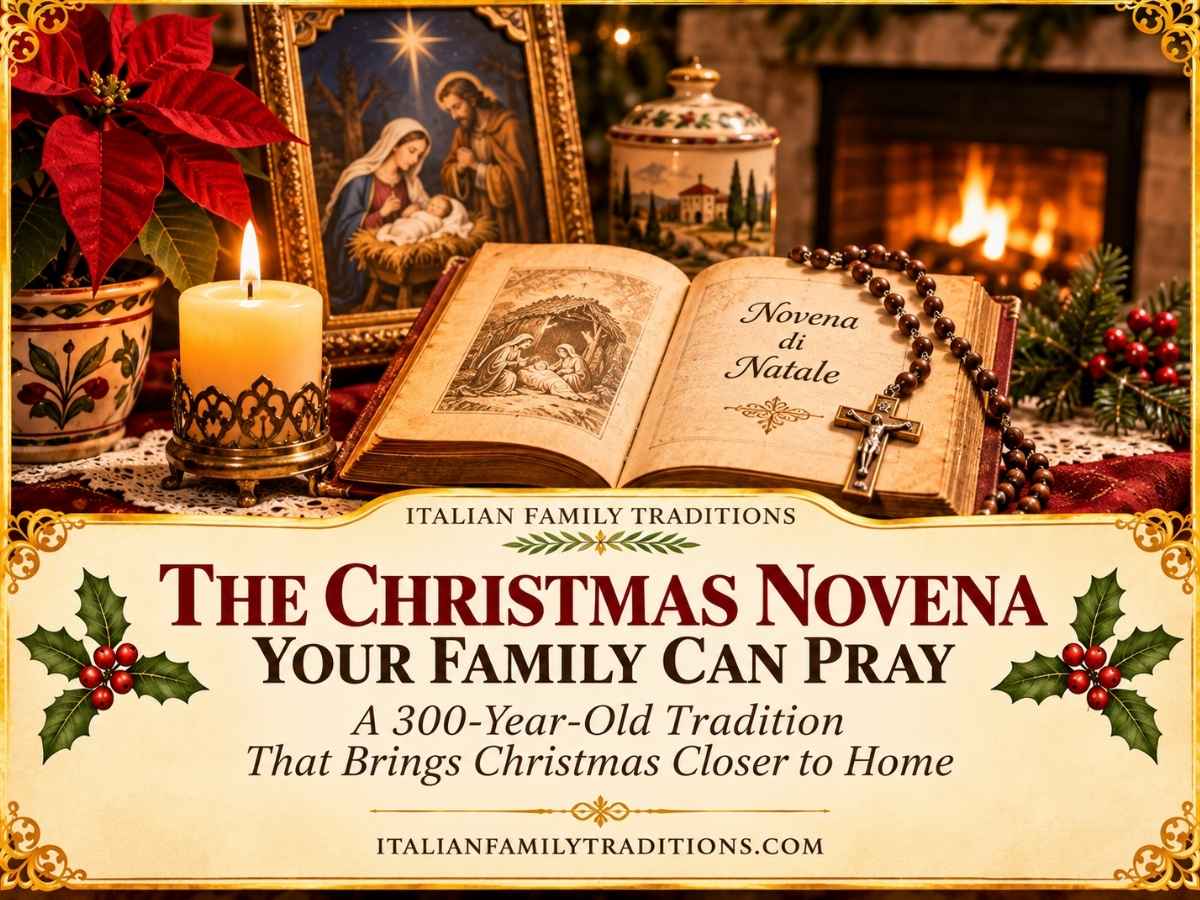
Italian Family Traditions
The Christmas Novena (Novena di Natale): How to Pray the Nine Days Before Christmas
From December 16 to Christmas Eve, Italian families have prayed the same nine evenings for three hundred years. Here is the Christmas Novena day by day — its ancient prayers, its hidden message, the bagpipers who played it in the streets, and how to keep it at home this year.
The Christmas Novena, or Novena di Natale, is nine days of prayer from December 16 to December 24 that prepare for the birth of Christ. Each evening has its own antiphon — on December 17 to 23, the seven ancient “O Antiphons” — together with a Gospel reading, the Magnificat and a closing prayer. The traditional Italian version was written around 1720 in Turin by the Vincentian priest Carlo Vachetta, and it is still prayed in Italian parishes and homes today. Use the companion below to follow it day by day, or read on for its history and the customs around it.
In much of Italy, December 16 is a day that changes the sound of a town. The bells ring for the evening novena, and in the old days the churches filled with women in dark coats, children pulled along by the hand, and men standing at the back near the door. In the south, the shepherd musicians came down from the mountains with their bagpipes and played in front of shrines and houses, and every family knew the melody of Tu scendi dalle stelle before they knew the words. For nine nights the whole town counted down together. The tree, the cookies and the gifts all mattered, but the novena was the clock that Christmas ran on.
That rhythm is the reason the novena survived when so much else was lost on the way across the ocean. It needs nothing but a little time each evening. It can be prayed in a cathedral or at a kitchen table, alone or with a houseful of relatives, in Latin, Italian or English. And once a family has kept it for a few Decembers, the nine evenings become as much a part of Christmas as the presepe on the sideboard and the fish soaking for La Vigilia.
For nine nights the whole town counted down together. The tree, the cookies and the gifts all mattered, but the novena was the clock that Christmas ran on.
Free Printable
Never miss the start of a novena again.
The Immacolata, Santa Lucia, the Novena di Natale, La Vigilia and La Befana — every feast day of the Italian year on one free printable calendar, with what families did on each one. Join the list and we’ll send it to you.
Novena di Natale · December 16–24
Your Christmas Novena Companion
Each of the nine days with its ancient antiphon, its Gospel reading and something to do at home. Tick off each day as you pray it.
From November 30 to Christmas, 15 times a day
The St. Andrew Christmas Prayer
Hail and blessed be the hour and moment in which the Son of God was born of the most pure Virgin Mary, at midnight, in Bethlehem, in piercing cold. In that hour vouchsafe, O my God, to hear my prayer and grant my desires, through the merits of Our Saviour Jesus Christ, and of His Blessed Mother. Amen.
Antiphon translations are our own, from the traditional Latin. Gospel readings follow the Roman Catholic weekday readings for December 17–24; December 16 changes each year, so a traditional Advent reading is suggested. Your ticks are saved only on this device.
What is the Christmas Novena?
A novena — from the Latin novem, nine — is a prayer repeated over nine consecutive days for a particular intention or in preparation for a feast. The custom is as old as the Church: after the Ascension, the apostles and Mary waited and prayed for nine days until Pentecost, and Christians have kept nine-day prayers ever since. If you are new to the practice, our guide on how to pray a novena explains the basics, from choosing an intention to what to do if you miss a day.
The Christmas Novena is the novena that prepares for Christmas itself. It begins on December 16 and ends on December 24, so that the ninth evening falls on Christmas Eve and the prayer flows straight into the Vigilia and Midnight Mass. Many people like to see a quiet symbolism in the nine days, an echo of the nine months Mary carried the child, though that is a pious reading rather than the origin of the custom. Its real purpose is simpler: to give the last, busiest stretch of Advent a shape, so that the waiting means something.
In Italy the Novena di Natale has always been both a church service and a family devotion. Parishes hold it in the evening, often with the Blessed Sacrament exposed, the prophecies sung by the choir and the whole congregation answering. Families who cannot get to church pray a shorter version at home, around the presepe or the kitchen table, with a candle lit and the manger still empty. Both are the same novena; one simply has an organ and the other has the smell of dinner.
Where the Novena di Natale comes from
The novena most Italian parishes still use was composed around 1720 by Father Carlo Vachetta, a priest of the Congregation of the Mission — the Vincentians — at the Church of the Immaculate Conception in Turin. As Catholic World Report recounts, Vachetta wrote it to help his parishioners prepare for Christmas, building it almost entirely out of Scripture: the prophecies of the Messiah from Isaiah, Micah and the Psalms, woven together and answered again and again with the same refrain. He also composed the joyful canticle sung in it, Laetentur caeli, “Let the heavens be glad.”
The refrain is the heart of the whole prayer: Regem venturum Dominum, venite adoremus — “The King who is to come, the Lord: come, let us adore him.” Anyone who has attended an Italian novena will remember it, because it returns after every prophecy, sung back and forth between the choir and the people until it is impossible to forget. On Christmas Eve, the refrain changes from the future to the present, and the waiting is over.
The Vincentians carried Vachetta’s novena wherever their missions went, and it spread from Turin across Italy and then around the world. The Vincentian mission at DePaul University still writes about it as a Vincentian tradition. In Italy it became so universal that most people who pray it have no idea it has an author at all — it is simply la Novena, the one that happens every year in the week before Christmas.
Regem venturum Dominum, venite adoremus. The King who is to come, the Lord: come, let us adore him. Nine nights, and the same answer every time.
The nine days at a glance
Each evening of the novena has its own antiphon and Gospel. From December 17 the Church sings the seven great O Antiphons, the most ancient part of the Advent liturgy, and the weekday Gospels walk through the story of the birth step by step: the genealogy, Joseph’s dream, the angel and Zechariah, the Annunciation, the Visitation, the Magnificat, the birth of John the Baptist and Zechariah’s song.
| Day | Date | Antiphon | Gospel |
|---|---|---|---|
| 1 | December 16 | Regem venturum Dominum — The King who is to come | Advent weekday (varies by year) |
| 2 | December 17 | O Sapientia — O Wisdom | Matthew 1:1–17 |
| 3 | December 18 | O Adonai — O Lord of Israel | Matthew 1:18–25 |
| 4 | December 19 | O Radix Iesse — O Root of Jesse | Luke 1:5–25 |
| 5 | December 20 | O Clavis David — O Key of David | Luke 1:26–38 |
| 6 | December 21 | O Oriens — O Rising Dawn | Luke 1:39–45 |
| 7 | December 22 | O Rex Gentium — O King of the Nations | Luke 1:46–56 |
| 8 | December 23 | O Emmanuel — O God-with-us | Luke 1:57–66 |
| 9 | December 24 | Hodie scietis — Today you will know | Luke 1:67–79 |
The O Antiphons and their hidden message
The seven O Antiphons are short prayers, each a single sentence, that call on the coming Christ by one of the titles the prophets gave him: Wisdom, Lord, Root of Jesse, Key of David, Rising Dawn, King of the Nations and Emmanuel. Each one begins with the same longing “O” and ends with the same plea, veni — come. They have been sung at Vespers in the last week of Advent for well over a thousand years, and they are the source of the best-known Advent hymn in English, O Come, O Come, Emmanuel, whose verses are simply the antiphons set to rhyme.
They also hide a small secret, the kind medieval monks loved. Take the first word after the “O” in each antiphon — Sapientia, Adonai, Radix, Clavis, Oriens, Rex, Emmanuel — and read the first letters backwards, from the last day to the first. They spell ERO CRAS: “Tomorrow, I will be there.” On December 23, after seven nights of asking him to come, the answer arrives on the eve of Christmas Eve. It is a lovely thing to show children on the last night of the antiphons, and they rarely forget it.
The antiphon of December 21 deserves a special mention. O Oriens, “O Rising Dawn, radiance of the eternal light,” falls on or right beside the winter solstice, the longest night of the year in the northern hemisphere. Whether by design or by happy coincidence, the Church prays for the coming of the light on the very night the darkness reaches its deepest point. The companion above suggests marking it by praying by a single candle and switching on the lights of the presepe at the words “come and shine.”
How to pray the Christmas Novena at home
The full parish novena, with its sung prophecies and Benediction, takes the better part of an hour. A family version can take ten minutes and lose nothing essential. What matters is that it happens every evening, at roughly the same time and in the same place, so that it becomes a fixed point in days that are otherwise crowded with shopping, baking and visits. Here is a simple shape that works for most households:
- Gather in one place — in front of the presepe if you have one, or around the kitchen table with a single candle.
- Make the sign of the cross and name the intention, if you have one: a sick relative, a family member far away, someone who has died this year.
- Say or sing the refrain Regem venturum Dominum, venite adoremus, or in English, “The King who is to come, the Lord: come, let us adore him.”
- Read the day’s antiphon from the companion above, in Latin, English or both.
- Read the Gospel for the day, or have an older child read it aloud.
- Pray the Magnificat, Mary’s song from Luke 1:46–55, or a Hail Mary, Our Father and Glory Be if the children are small.
- Close with a short prayer in your own words, and blow out the candle.
Some families add one small action each evening to make the nine days visible: a figure placed in the presepe, an Advent candle lit, a name written on a card for someone to pray for. The companion suggests one for each night, from setting out the empty manger on December 16 to placing the Bambinello on Christmas Eve. If you also pray the rosary, the novena is a natural moment for a single decade together.
If you miss an evening, simply continue. A novena is a discipline, not a contract, and no one who has ever kept one with small children has managed a perfect nine. Pray the missed day together with the next one if you like, and carry on until Christmas Eve.
The Saints of the Italian Advent
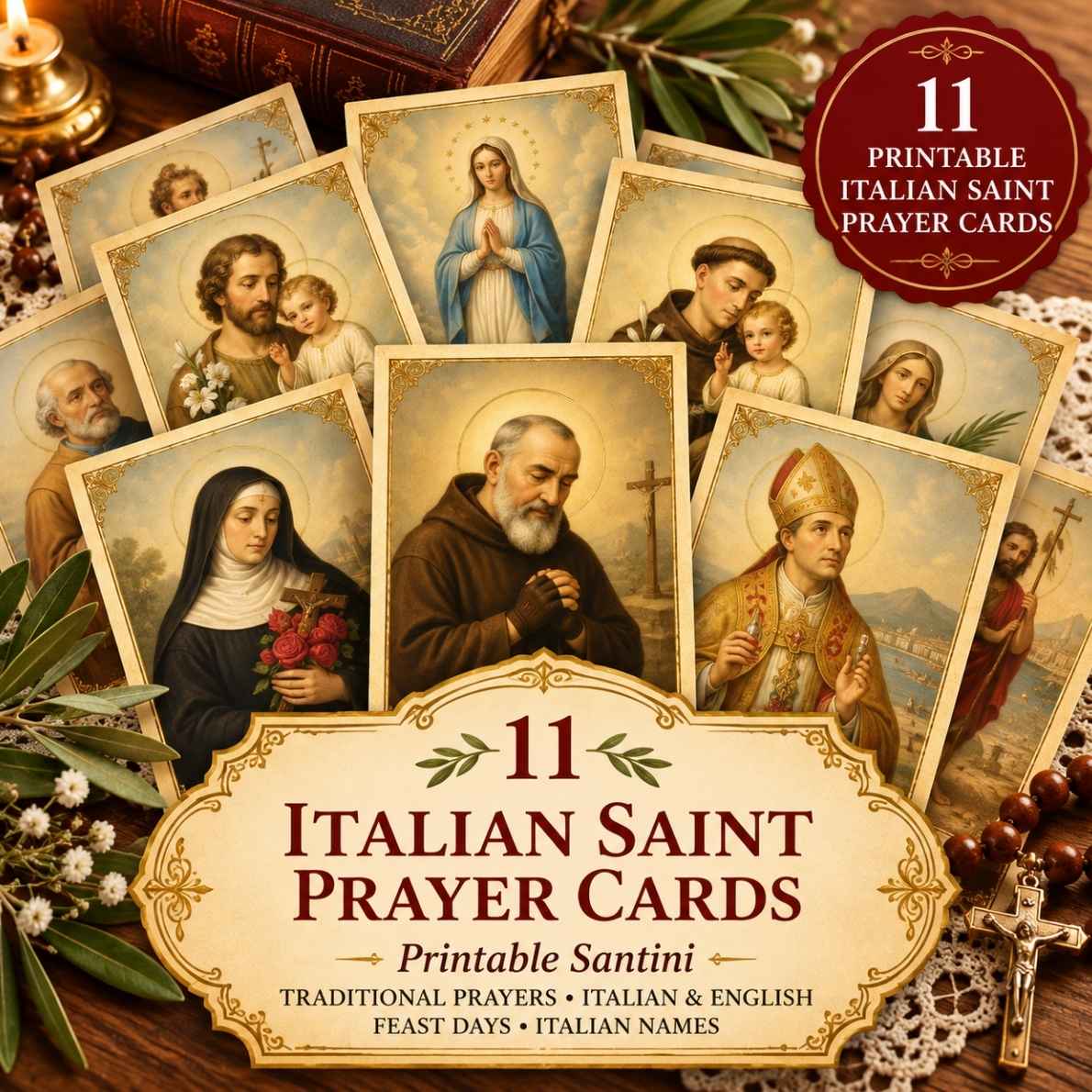
The Immacolata, Santa Lucia and San Giuseppe, ready to print.
The Italian Saint Prayer Cards are 11 printable santini, each with the saint’s prayer in Italian and English and their feast day — including the three saints of the Italian December. Keep them beside the presepe for the novena, tuck one into each Christmas card, or give the set to someone who still prays the way nonna did.
Get the Prayer Cards — $9.49Instant digital download · Print at home as many times as you like
The St. Andrew Christmas Novena
There is a second Christmas prayer that many Catholic families call a novena, even though it lasts much longer than nine days. The St. Andrew Christmas Novena, also called the Christmas Anticipation Prayer, begins on November 30, the feast of Saint Andrew the Apostle, and is prayed fifteen times every day until Christmas. Because the Advent season usually begins on the Sunday nearest Saint Andrew’s feast, the prayer covers the whole of Advent. The text, approved by the Archbishop of New York in 1897 as the Dominican nuns of Summit note, is short enough to learn by heart:
Hail and blessed be the hour and moment in which the Son of God was born of the most pure Virgin Mary, at midnight, in Bethlehem, in piercing cold. In that hour vouchsafe, O my God, to hear my prayer and grant my desires, through the merits of Our Saviour Jesus Christ, and of His Blessed Mother. Amen.
Fifteen times a day sounds like a lot, but the prayer takes about twenty seconds, and most people spread it through the day: five in the morning, five at lunch, five at night. Others pray all fifteen at once, counting on their fingers or on a rosary. The companion above has a tap counter with fifteen beads that resets each day. Strictly speaking, Saint Andrew has nothing to do with the words of the prayer — his feast simply marks the start date — and the prayer is a private devotion rather than an official liturgy. But it has become one of the best-loved Advent customs in English-speaking Catholic homes, and many Italian-American families pray it alongside the Novena di Natale.
The novenas of the Italian December
For devout Italian families, the Christmas Novena was only the last of several. December in Italy is crowded with feasts, and each one traditionally had its own nine days of preparation, so that a grandmother who kept them all could be praying a novena almost continuously from the end of November until Christmas Eve.
| Novena | Prayed | For the feast of |
|---|---|---|
| Novena of the Immacolata | November 29 – December 7 | The Immaculate Conception, December 8 |
| St. Andrew Christmas Novena | November 30 – December 24 | Christmas (15 times a day) |
| Novena to Santa Lucia | December 4 – December 12 | Santa Lucia, December 13 |
| Novena di Natale | December 16 – December 24 | Christmas, December 25 |
The novena of the Immacolata is the great opening of the Italian Christmas season. December 8, the feast of the Immaculate Conception, is a national holiday in Italy, the day many families set up the tree and the presepe, and in Rome the Pope traditionally visits the column of the Immacolata near the Spanish Steps. The novena to Santa Lucia belongs especially to Sicily, where Lucia was born in Syracuse, and to the north of Italy, where Santa Lucia brings the children their gifts on the night of December 12. And the Novena di Natale closes the sequence, carrying everyone to Christmas Eve, the Feast of the Seven Fishes and Midnight Mass.
Each of these saints was part of the family’s life, not just its calendar. The Immacolata watched over the house from a small statue or a santino on the dresser; Santa Lucia protected the eyes; San Giuseppe, the protagonist of the December 18 Gospel, was the patron of fathers, workers and a holy death. Our guide to the Italian saints every family prayed to tells their stories, and the santino — the small holy card with a saint on one side and a prayer on the other — was how most families kept them close.
The zampognari: the novena in the streets
No description of the Italian Christmas novena would be complete without the zampognari. For centuries, in the days before Christmas, shepherd musicians from the mountains of Abruzzo, Molise, Lazio and Campania walked down into the towns and cities dressed in sheepskin vests, wide cloaks and leather sandals laced up the calf. One played the zampogna, a large bagpipe made from a goatskin; the other played the ciaramella, a small, piercing shawm. They went from shrine to shrine and from door to door, stopping in front of the presepi in people’s homes and the images of the Madonna on street corners, and played the novena — nine days of music to match the nine days of prayer. Families paid them in coins, wine and food.
The melody most people associate with them is Tu scendi dalle stelle, “You come down from the stars,” the most beloved Italian Christmas carol. It was written by Saint Alphonsus Liguori, the Neapolitan bishop, lawyer and Doctor of the Church, who, as MercatorNet recounts, composed it in 1754; he also wrote the Neapolitan-dialect carol Quanno nascette Ninno, “When the Child was born.” To this day, when Italians hear a bagpipe drone and the first notes of Tu scendi dalle stelle, they know the novena has begun. In Rome and Naples, zampognari still appear in December, and their image is one of the classic figures of the Neapolitan presepe.
When Italians hear a bagpipe drone and the first notes of Tu scendi dalle stelle, they know the novena has begun.
Nine nights around the Catholic world
The idea of nine nights before Christmas is not only Italian. Wherever the Church took root, it found a local form. In the Philippines, Simbang Gabi is a series of nine dawn Masses from December 16 to 24, and attending all nine is a cherished family promise. In Mexico and much of Latin America, Las Posadas re-enacts Mary and Joseph’s search for shelter on the same nine nights, with processions, candles and songs at a different house each evening. In Colombia and Ecuador, families gather every evening for the Novena de Aguinaldos, with prayers, carols and sweets. Different languages, different foods, the same countdown.
For Italian families in North America, that wider tradition is often visible right in the neighbourhood. An Italian parish in Toronto, Montreal, Philadelphia or New York may share its building with Filipino, Latin American and Portuguese communities, each keeping its own version of the nine days. It is a reminder that the novena was never a museum piece; it is a living devotion, and it travels well.
The Christmas Novena in Italian-American and Italian-Canadian families
When Italians emigrated, the parish novena came with them. The national parishes that Italian communities built in the cities of North America — with their Italian priests, Italian sodalities and Italian feasts — kept the Novena di Natale in the evenings before Christmas, often in Italian, often with the same tunes the older parishioners had sung as children. For a generation of immigrants who had left everything familiar behind, those nine evenings were one of the few times each year when the whole of the old life seemed to be in one room. The same instinct that kept so many Italian traditions alive through emigration kept the novena alive too: it was portable, it needed no special ingredients, and it brought people together.
In many families the parish version gradually faded into a home version, and then, for some, into a memory. The grandmother who never missed it, the aunt who kept a worn booklet with the prayers in Italian, the uncle who could still sing the refrain — these are exactly the kinds of details that disappear first. If someone in your family still remembers how the novena was kept, ask them this Advent, and write it down. Our list of questions to ask your Italian grandparents is a good place to start, and the novena itself makes a natural opening: did you go to the novena when you were young? What did it sound like?
Before the Prayers Are Forgotten
Which saints did your family pray to, and who led the prayers? The Italian Family Heritage Kit gives you 133 guided pages and more than 120 questions to record your family’s faith, holidays, recipes and stories while the people who remember are still here.
Explore the Italian Family Heritage Kit →Keeping the novena with children
Children are the reason many families start the novena again, and they are often its most faithful keepers once it begins. The secret is to make each evening something they can see and do, not only something they sit through. A nine-day novena fits a child’s sense of time perfectly: long enough to feel like a real countdown, short enough that the end is always in sight.
Give each child a job. One lights the candle, one reads the antiphon, one moves the Three Kings a little closer to the stable — a custom many Italian families keep from December until the Epiphany. Let the youngest place a sheep or a shepherd each night, and save the Bambinello for Christmas Eve, when the novena ends and the empty manger is finally filled. Bake one batch of Christmas cookies during the novena and give the first plate to a neighbour. Teach them the first verse of Tu scendi dalle stelle and sing it on the last night. None of it requires much time, and all of it builds the kind of memory that makes an adult, thirty years later, quietly start the novena again with their own children.
For nine nights the whole town counted down together, and the novena was the clock that Christmas ran on. It still can be. Light a candle on December 16, say the old refrain — Regem venturum Dominum, venite adoremus — and keep going until Christmas Eve, when the waiting turns into the feast and the manger is no longer empty.
Their Story and Their Saints
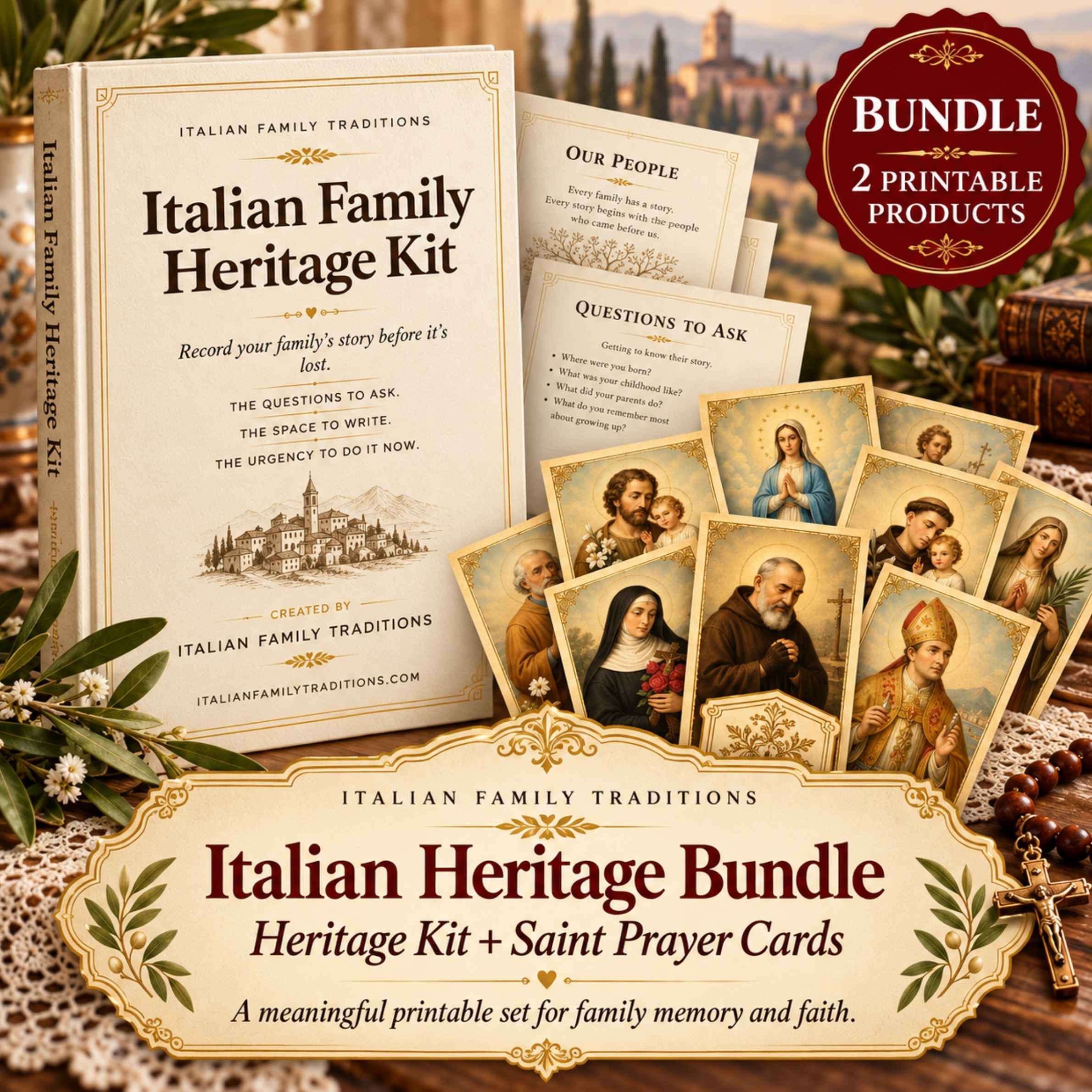
A Christmas gift for the one who still keeps the novena.
The Italian Heritage Gift Set brings together the 133-page Italian Family Heritage Kit, with more than 120 questions to record the family’s story, and the 11 printable Italian Saint Prayer Cards with prayers in Italian and English. Ready to print the same day — no shipping, even on Christmas Eve.
Get the Gift Set — $24.99Instant digital download · $29.48 if bought separately
More of the Italian Christmas: the complete guide to Italian Christmas traditions, the presepe and its figures, La Vigilia and the Feast of the Seven Fishes on Christmas Eve, Santa Lucia on December 13, the after-dinner game of tombola, panettone and pandoro, and La Befana on January 6. For prayers through the whole year, see our collection of Italian prayers, the names of Mary, and the Italian feast day calendar.
FAQ
When does the Christmas Novena start?
The Christmas Novena, or Novena di Natale, starts on December 16 and ends on December 24, Christmas Eve. That gives nine evenings of prayer, with the last one leading straight into the Christmas Vigil and Midnight Mass.
What prayers are said in the Christmas Novena?
The traditional Italian Christmas Novena includes the refrain “Regem venturum Dominum, venite adoremus” (The King who is to come, the Lord: come, let us adore him), prophecies of the Messiah from Scripture, the antiphon of the day — the seven O Antiphons from December 17 to 23 — the Magnificat and a closing prayer. A simple home version can use the antiphon, the day’s Gospel, the Magnificat or a Hail Mary, and a prayer in your own words.
Who wrote the Italian Christmas Novena?
The Novena di Natale used in most Italian parishes was composed around 1720 by Father Carlo Vachetta, a Vincentian priest at the Church of the Immaculate Conception in Turin. The Vincentians spread it through their missions, and it is now prayed around the world.
What are the O Antiphons?
The O Antiphons are seven short prayers sung at Vespers from December 17 to 23. Each calls on Christ by a title from the prophets: O Wisdom, O Lord, O Root of Jesse, O Key of David, O Rising Dawn, O King of the Nations and O Emmanuel. Read backwards, the first letters of their Latin titles spell ERO CRAS, “Tomorrow I will be there.”
What is the St. Andrew Christmas Novena?
It is a short prayer that begins “Hail and blessed be the hour and moment in which the Son of God was born” and is prayed fifteen times a day from November 30, the feast of Saint Andrew, until Christmas. Despite its name it lasts about twenty-five days, not nine.
Can I start the Christmas Novena late?
Yes. If you discover the novena on December 18 or 20, simply begin where you are and continue until Christmas Eve, or pray the missed days together with the current one. A novena is a devotion, not a rule, and starting late is far better than not starting at all.
What is the difference between the Christmas Novena and Advent?
Advent is the four-week liturgical season before Christmas, beginning on the fourth Sunday before December 25. The Christmas Novena is a devotion within Advent, covering only its last nine days, from December 16 to 24, when the Church’s prayers turn directly toward the birth of Christ.
Who were the zampognari?
The zampognari were shepherd musicians from the mountains of central and southern Italy who came down into the towns before Christmas to play the novena on the zampogna, a large bagpipe, and the ciaramella, a small shawm. They played in front of shrines and household presepi, and the tradition survives today in Rome, Naples and many southern towns.
Marco Ricci is an Italian-Canadian writer and the grandson of Calabrian immigrants. He created Italian Family Traditions to document the customs, feast days, and family rituals Italian families carried from Italy to North America — and to understand what they actually meant. He is based in Montreal.
Pingback: Italian Christmas Traditions: The Complete Guide