Italian Family Traditions
Italian Christmas Traditions: The Complete Guide
From the Feast of the Seven Fishes to La Befana — the feast days, foods, and family rituals that make an Italian Christmas, and how families carried them across the ocean.
In Italian families, Italian Christmas traditions were never about a single day. Christmas was a season — a long, deliberate stretch that began weeks before December 25 and did not end until the Befana swept through on the morning of January 6. Every part of it had a meaning: the fish on Christmas Eve, the nativity built piece by piece, the games played at the table, the saints remembered along the way. Nobody explained it. You simply grew up inside it, and it became the shape of the year’s most important weeks.
This is a guide to the whole of it — the feast days, the foods, the folk figures, and the family rituals that make up an Italian Christmas, from the Immaculate Conception that opens the season to the Epiphany that closes it. Wherever a tradition has its own story, you’ll find a link to the full telling. Think of this as the map; the individual posts are the territory.
A Season, Not a Day
The Italian Christmas Season, Day by Day
From the Immaculate Conception to the Epiphany, the Italian Christmas unfolds over nearly a month.
Explore each tradition
Tap any part of the season to read its full story.
In Italian families, Christmas was never a single day. It was a season — and every part of it carried a meaning no one ever had to explain.
When Italian Christmas traditions begin: the start of the season
The Italian Christmas season traditionally opens on December 8, the Feast of the Immaculate Conception (l’Immacolata). This is the day many Italian families put up the tree and, more importantly, begin building the presepe — the nativity scene. In much of Italy, the season runs all the way to January 6, the Epiphany, making it a long arc of nearly a month rather than a single holiday. The rhythm matters: it is a season of preparation, feast days, and anticipation, not a one-day event.
Along the way fall several key feast days, each with its own customs — and each part of the larger Italian religious calendar. For the full year of feasts, see the complete Italian feast day calendar.
December 13: Santa Lucia
Before Christmas itself comes Santa Lucia on December 13 — the feast of the saint of light, celebrated with particular devotion in parts of northern and Sicilian Italy. In some regions it is Santa Lucia, not Babbo Natale, who brings gifts to children, arriving in the night much as Saint Nicholas does elsewhere. Her feast is a bright point in the darkest part of the year, tied to themes of light returning. Read the full story of the Feast of Santa Lucia in Italy.
The presepe: the heart of the Italian Christmas
For many Italian families, the presepe — the nativity scene — matters as much as or more than the tree. Built up over the days of Advent, often with figures collected and passed down across generations, the presepe is a small world assembled by hand: the stable, the shepherds, the animals, the villagers, and finally the Christ child, who is traditionally placed only on Christmas Eve. In Naples, presepe-making is a celebrated art form, centered on the historic workshops of Via San Gregorio Armeno. It is the tradition that most captures the Italian Christmas as something you build, slowly and with care. Read more about the Italian presepe and its meaning.
Christmas Eve: La Vigilia and the Feast of the Seven Fishes
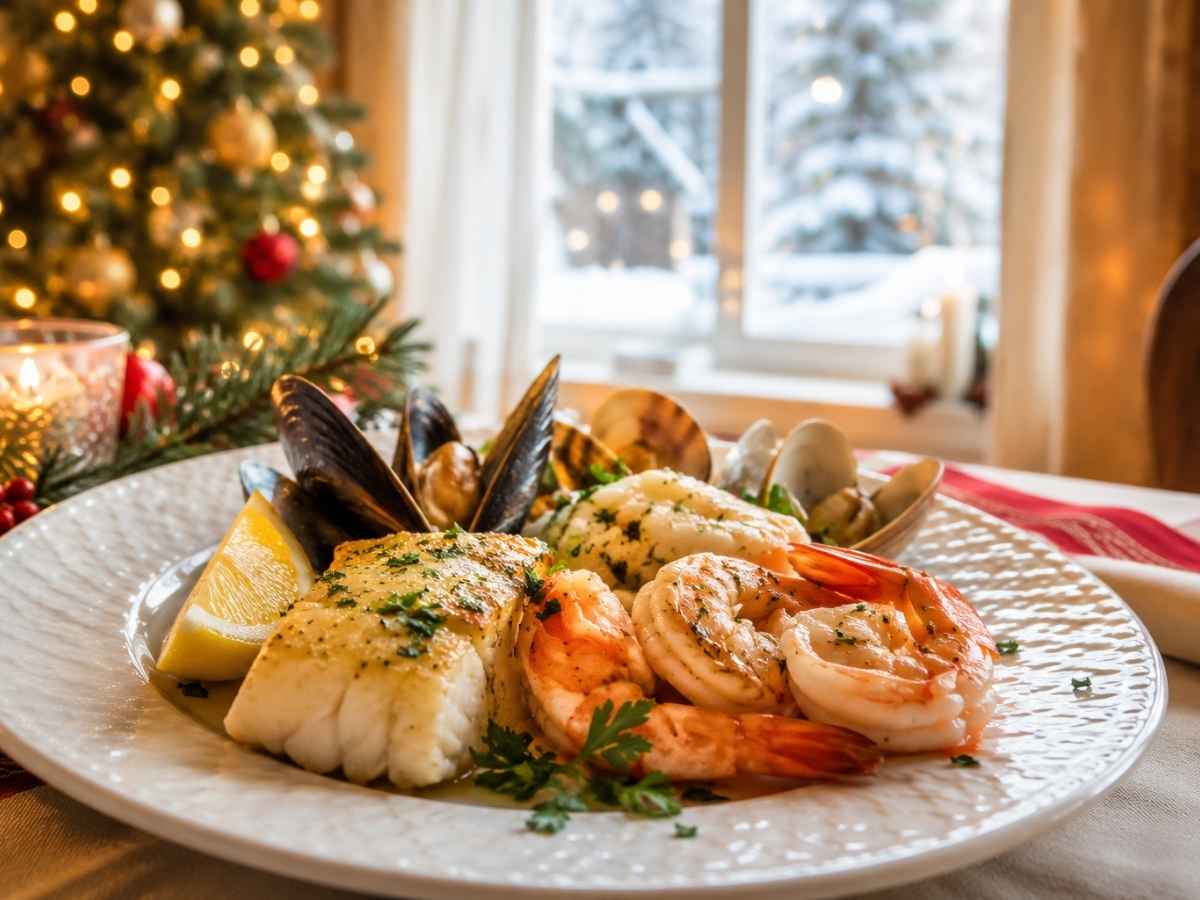
Christmas Eve — La Vigilia — is arguably the most important night of the Italian Christmas, especially in Southern Italian and Italian-American families. Traditionally a day of abstinence from meat, it became instead a celebration of the sea: the famous Feast of the Seven Fishes, a long meal of seven (or more) seafood dishes shared before Midnight Mass. The number carries symbolic weight, and every family has its own lineup — baccalà, calamari, shrimp, clams, eel, and more.
This is the meal that anchors the whole season for many diaspora families. Read the full traditions of La Vigilia, the Italian Christmas Eve, and the meaning behind the Feast of the Seven Fishes.
Christmas Day: the table and the sweets
If Christmas Eve belongs to the sea, Christmas Day belongs to the table. The meal is long and abundant — often built around fresh pasta (in many families, a baked or filled pasta), a roast, and dish after dish brought out over hours, in the same spirit as the Italian Sunday dinner raised to its highest form.
And then there are the sweets. The great Italian Christmas breads — panettone, the tall Milanese sweet bread studded with candied fruit, and pandoro, the golden star-shaped cake from Verona — appear on every table, alongside regional treats: torrone (nougat), struffoli (honey-drenched fried dough) in the south, and countless family-specific cookies. These sweets are so tied to the season that the sight of a panettone box is itself a signal that Christmas has arrived. (The two great cakes have their own rivalry — see our full guide to panettone vs. pandoro.)
After dinner: Tombola and the family table
Once the meal winds down, the Italian Christmas becomes a family affair of a different kind: Tombola, the Neapolitan cousin of bingo, played with the whole family gathered around the table, dried beans marking the cards, and every number carrying its own traditional meaning. It is loud, competitive, and beloved — the game that turns a full stomach into an evening of togetherness. Learn how to play Tombola and what the numbers mean.
New Year and La Befana: how the season ends
The Italian Christmas doesn’t end on December 25. New Year’s Eve — Capodanno — brings its own customs: lentils for prosperity, red for luck, and in some places, old things thrown out to make way for the new. Read about Capodanno, the Italian New Year.
And then, finally, the season closes on January 6, the Epiphany, with La Befana — the kindly old witch who flies from house to house on her broom, filling children’s stockings with sweets if they were good and coal (usually candy “coal”) if they were not. For many Italian children, the Befana rivals Christmas morning itself. She is the last, and most distinctly Italian, figure of the whole season. Read the full story of La Befana and the Italian Epiphany.
What changed across the ocean
When Italian families emigrated to North America, the Christmas season came with them — but it adapted. The Feast of the Seven Fishes, in many ways, became more central in the diaspora than it had been in Italy, a fixed anchor of identity. Some feast days faded; others, like La Befana, survived in families who kept the old calendar. Panettone crossed over intact. The presepe shared space with the tree. What endured was the shape of it: a season, not a day — a long stretch of feast and family that held the year together. Many of these Italian Christmas traditions survived the crossing precisely because families refused to let them go. Understanding what stayed and what changed is part of the larger story of Italian-American traditions.
Free Printable
The whole Italian year, on one calendar.
Every feast day, saint’s day, and seasonal tradition — from the Immacolata to the Befana. Join the list for a free printable Italian family calendar.
An Italian Christmas is a season, not a day — a month-long arc of feast days, fish and sweets, saints and games, built by hand and carried across the ocean by families who refused to let it fade. Keep the parts your family kept, learn the ones you never knew, and pass the whole shape of it on to the next generation before it slips away.
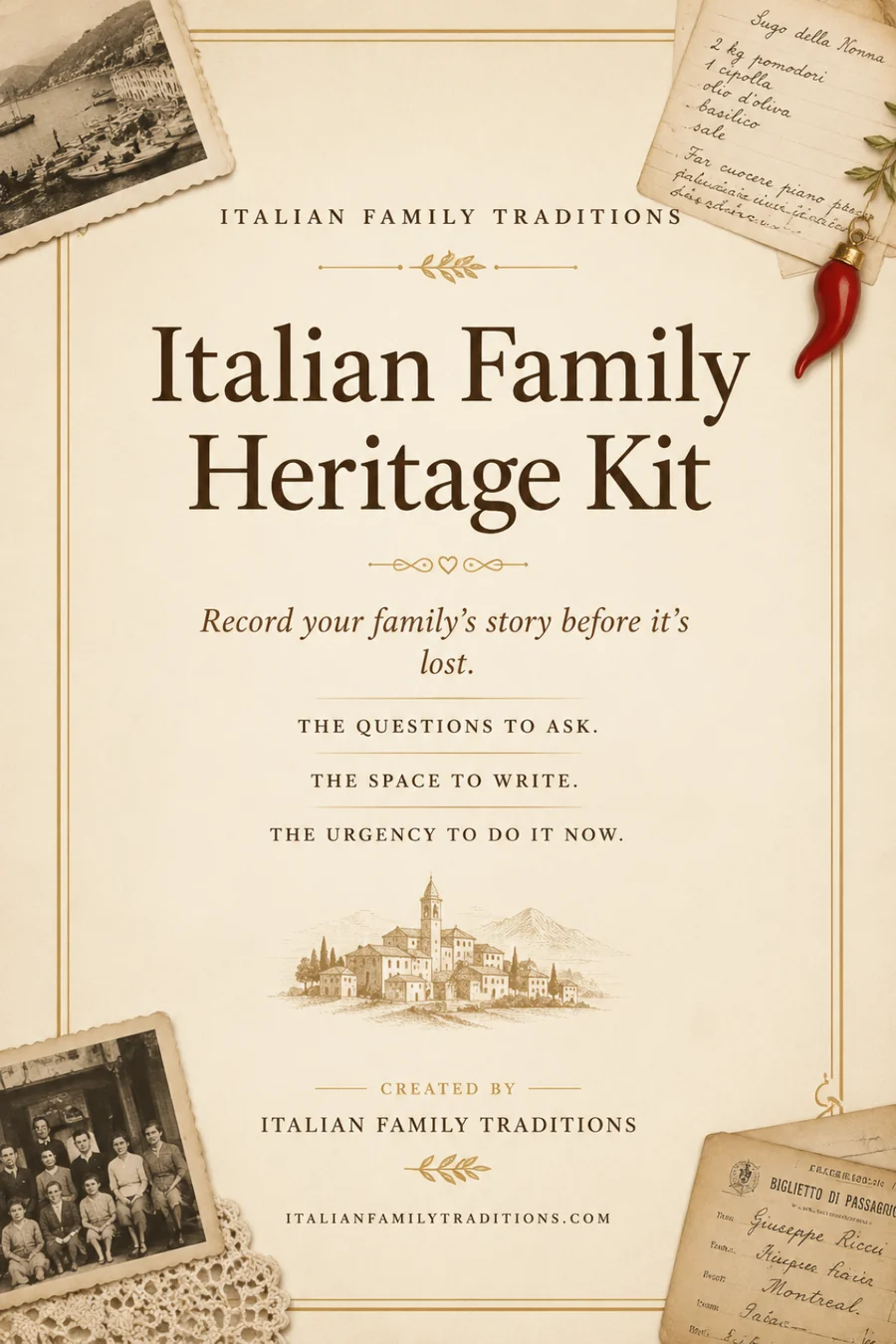
Preserve Your Christmas
Write down your family’s Christmas before it fades.
The recipes, the feast-day customs, the Vigilia menu only your family made. The Italian Family Heritage Kit gives you 133 guided pages to record it all — a keepsake for the next generation.
Explore the Heritage Kit — $19.99Instant digital download. Print it and complete it with your family.
FAQ
When does the Italian Christmas season start and end?
Traditionally it begins on December 8, the Feast of the Immaculate Conception (l’Immacolata), when many families put up the tree and begin the presepe, and it ends on January 6, the Epiphany, with La Befana. That makes the Italian Christmas a season of nearly a month rather than a single day.
What is the Feast of the Seven Fishes?
It’s the traditional Italian (and especially Italian-American) Christmas Eve meal — a long dinner of seven or more seafood dishes eaten on La Vigilia, the day of abstinence from meat before Christmas. Common dishes include baccalà (salt cod), calamari, shrimp, clams, and eel; every family has its own lineup.
What do Italians eat on Christmas Day?
Christmas Day centers on a long, abundant meal — often fresh or baked pasta, a roast, and many courses over several hours. The signature sweets are panettone (a tall Milanese fruit bread) and pandoro (a golden star-shaped cake from Verona), along with regional treats like torrone and struffoli.
Who is La Befana?
La Befana is a kindly old witch who, on the eve of the Epiphany (January 6), flies from house to house on her broom filling children’s stockings with sweets if they were good, or “coal” (usually black candy) if they were not. She closes the Italian Christmas season and is one of its most distinctive figures.
What is the difference between panettone and pandoro?
Both are traditional Italian Christmas sweet breads. Panettone, from Milan, is tall and domed and studded with candied fruit and raisins. Pandoro, from Verona, is star-shaped, golden, and plain (no fruit), usually dusted with powdered sugar. Families and regions tend to have strong preferences between the two.
How did Italian Christmas traditions change in North America?
Many carried over intact — the Feast of the Seven Fishes actually became more central in the diaspora as an anchor of identity, and panettone crossed over unchanged. Some feast days faded while others, like La Befana, survived in families who kept the old calendar. The core shape endured: Christmas as a season of feast and family, not a single day.

Marco Ricci is an Italian-Canadian writer and the grandson of Calabrian immigrants. He created Italian Family Traditions to document the customs, feast days, and family rituals Italian families carried from Italy to North America — and to understand what they actually meant. He is based in Montreal.