
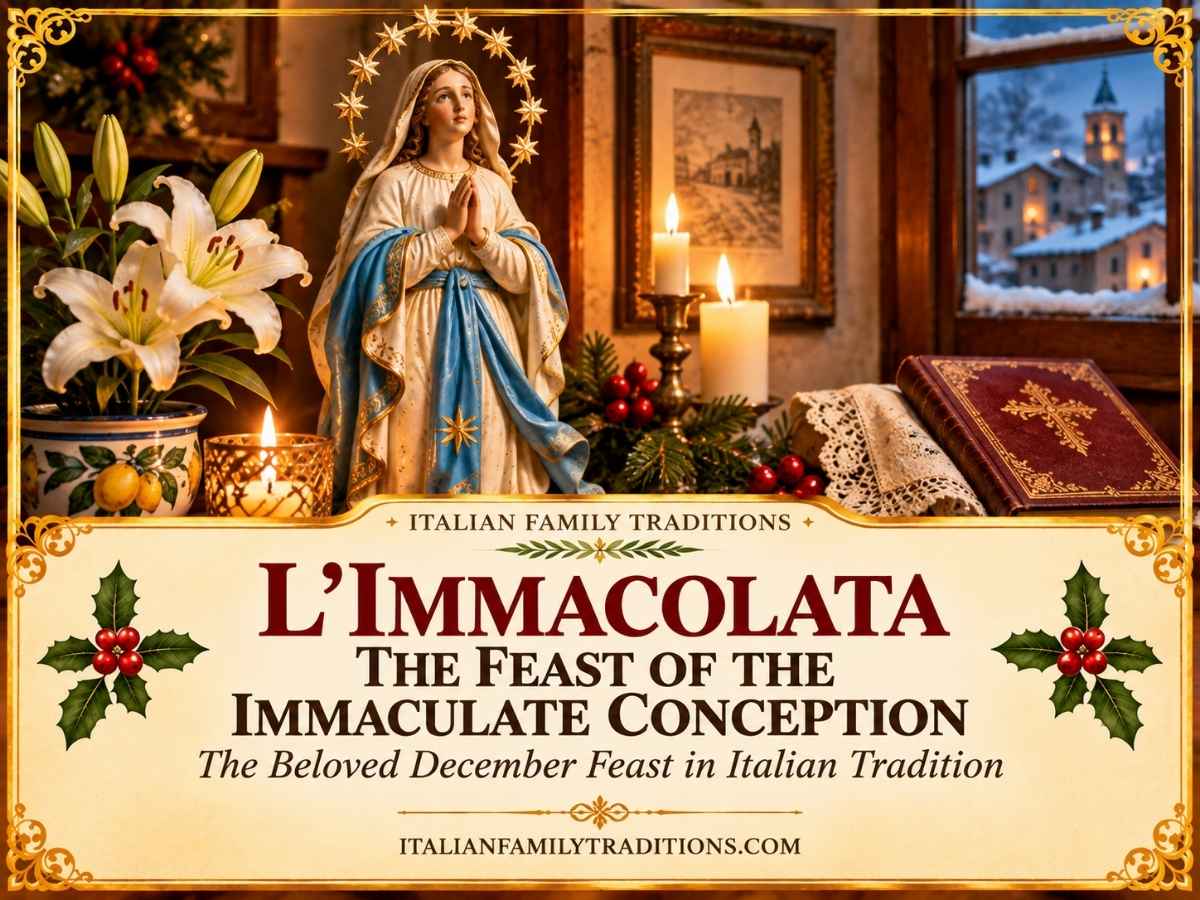
Italian Family Traditions
L’Immacolata: The Feast of the Immaculate Conception and Why December 8 Starts the Italian Christmas
Nobody had to tell us. On December 8 the tree went up, the presepe came out of its box, and the whole family went to evening Mass. Here is what the Feast of the Immaculate Conception means, why it opens the Italian Christmas, and how December 8 is kept from Rome to Palermo — and in Italian families everywhere.
The Feast of the Immaculate Conception, l’Immacolata, falls on December 8. It celebrates the Catholic belief that Mary was conceived without original sin, a doctrine defined by Pope Pius IX on December 8, 1854. In Italy it is a national holiday and the traditional start of the Christmas season: the day families put up the Christmas tree and the presepe, go to Mass, and in Rome watch firefighters lay flowers on the Madonna near the Spanish Steps. It is often confused with the virgin birth of Jesus, but it refers to Mary’s own conception.
In our house, nobody ever announced it. There was no family meeting, no note on the calendar. We just knew. Somewhere in the first week of December a feeling settled over the house that the eighth was coming, and on the eighth the tree had to go up and the presepe had to come out. It was not a rule anyone could quote. It was a gut feeling, the kind you absorb as a child without ever being taught it, and it was so strong that putting the tree up on the sixth, or waiting until the fifteenth, would simply have felt wrong.
Up and down the street, the Madonnas came out too. Some of our neighbours had statues of the Madonna right outside their homes, on display on their front lawns, and they set them up with real pride. And in the evening the whole family went to Mass — a short one, the kind you could fit in on a December weeknight — and came home to a living room that had changed. The tree was lit, the presepe was waiting with its empty manger, and Christmas had officially begun.
Nobody announced it. We just knew. On the eighth, the tree had to go up.
That feeling is not unique to one family. Across Italy, and in Italian families wherever they settled, December 8 is the day the Christmas season starts. This article explains why: what the feast actually celebrates, how a medieval theological debate became a national holiday, what happens in Rome, Naples, Palermo and the mountain towns of Abruzzo, and how to keep the day at home.
Free Printable
December 8 is only the beginning.
Santa Lucia, the Christmas Novena, La Vigilia, Santo Stefano and La Befana — the whole Italian year on one free printable calendar, with what families did on each day. Join the list and we’ll send it to you.
L’Immacolata · December 8
The Immacolata Companion
Pray the nine-day novena before the feast, then see how December 8 is kept from Rome to Palermo.
Choose a place above.
The daily prayer is the traditional invocation of the Immaculate Conception; translations are our own. Customs vary from town to town and family to family. Your ticks are saved only on this device.
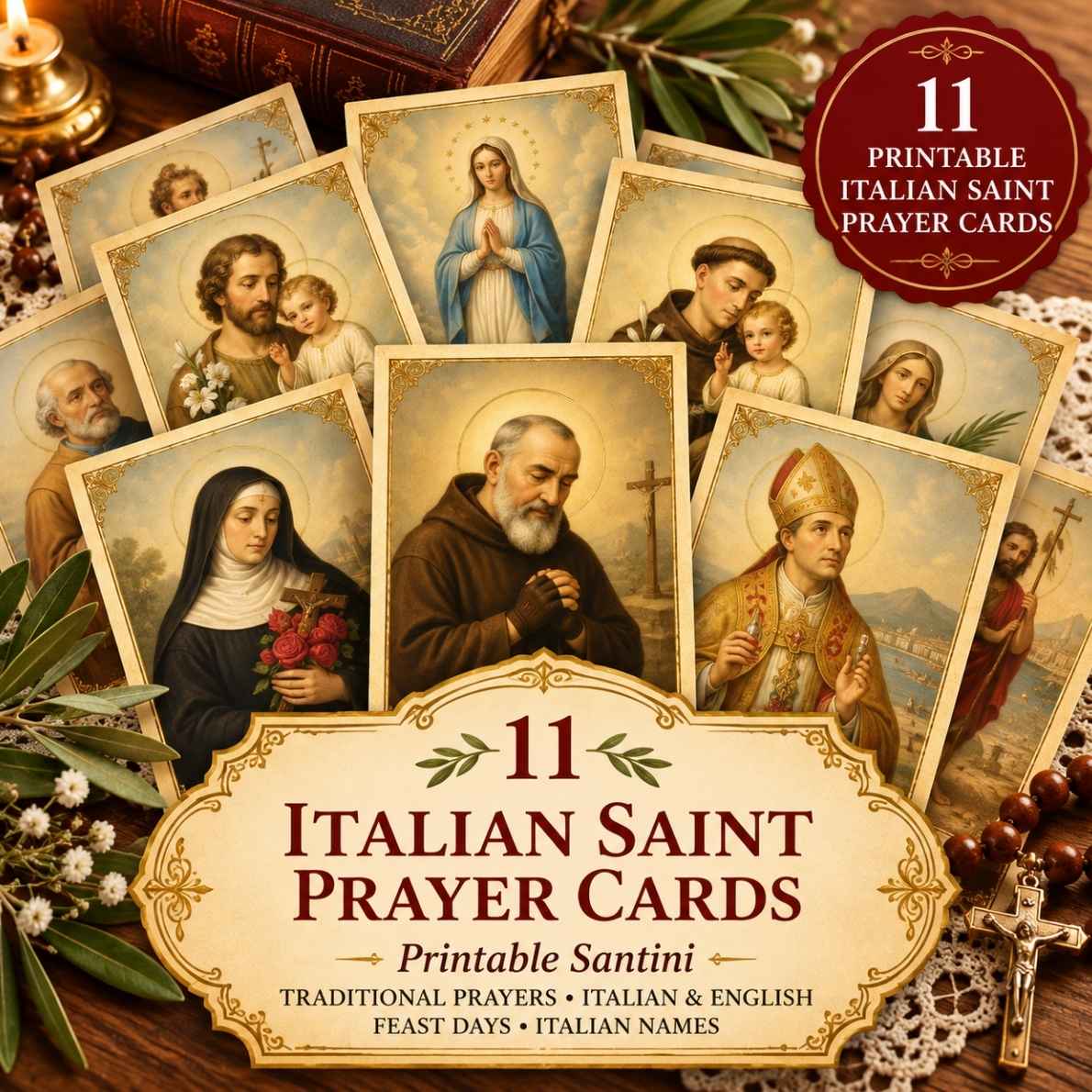
The Immacolata Is in the Set
Keep her prayer where you’ll see it every day of the novena.
The Italian Saint Prayer Cards are 11 printable santini, each with the saint’s prayer in Italian and English and their feast day — including the Immacolata Concezione, Santa Lucia and San Giuseppe, the saints of the Italian December. Print one for the novena, slip one into a Christmas card, or give the set to someone named Concetta on her onomastico.
Get the Prayer Cards — $9.49Instant digital download · Print at home as many times as you like
What the Immaculate Conception actually means
The Immaculate Conception is one of the most misunderstood feasts of the Catholic year, and the confusion is easy to forgive. Because Christmas is coming, many people assume it refers to the conception of Jesus in Mary’s womb. It does not. That event is the Annunciation, celebrated on March 25, exactly nine months before Christmas. The Immaculate Conception refers to Mary’s own conception, in the womb of her mother, Saint Anne.
The belief is that from the very first moment of her existence, Mary was preserved from original sin — the inherited wound that, in Catholic teaching, every other human being is born with — so that she could become the mother of Christ. She was, in the phrase of the angel’s greeting in Luke’s Gospel, “full of grace” before she had done anything to earn it. The date of the feast follows from that: December 8 is exactly nine months before September 8, the feast of the Nativity of Mary, her birthday in the Church’s calendar.
For most of Christian history this was a pious belief rather than a defined doctrine, and it was hotly debated. On December 8, 1854, Pope Pius IX settled the question, solemnly defining the Immaculate Conception as a dogma of the Catholic faith in the apostolic constitution Ineffabilis Deus. Four years later, in 1858, a young girl named Bernadette in the French town of Lourdes reported that the lady who appeared to her in the grotto had named herself in the local dialect: “I am the Immaculate Conception.” For ordinary Catholics, Italians among them, the two events together sealed the feast in the heart as well as the catechism.
A feast Italy embraced long before 1854
Italy did not wait for the dogma. Devotion to Mary’s Immaculate Conception grew through the Middle Ages, and its great champions were the Franciscans, following the Scottish friar John Duns Scotus, whose arguments for the doctrine became the Franciscan position against those of many Dominican theologians. When a Franciscan, Sixtus IV, became pope, he approved the feast with its own Mass and office in 1476. In 1708, Pope Clement XI extended the feast to the whole Church as a holy day of obligation.
By then, Italian cities had already made the Immacolata their own. In 1624 the Senate of Palermo took a public vow to defend the Immaculate Conception — “with arms if necessary,” as the vow put it. Towns across the south chose her as patroness, confraternities were founded in her name, and painters from Naples to Seville gave her the image we still recognise: a young woman in white and blue, standing on the crescent moon, crowned with twelve stars, crushing a serpent underfoot. That image comes straight from Scripture — the “woman clothed with the sun” of the Book of Revelation and the promise in Genesis that the woman’s offspring would crush the serpent’s head — and it is the statue you will find in thousands of Italian churches, and in many Italian homes.
| Year | What happened |
|---|---|
| 1476 | Pope Sixtus IV, a Franciscan, approves the feast of the Immaculate Conception with its own Mass |
| 1624 | The Senate of Palermo vows to defend the doctrine |
| 1708 | Pope Clement XI makes December 8 a feast for the whole Church |
| 1854 | Pope Pius IX defines the dogma in Ineffabilis Deus on December 8 |
| 1857 | The Column of the Immaculate Conception is dedicated in Rome on December 8 |
| 1858 | At Lourdes, Bernadette reports the words “I am the Immaculate Conception” |
| 1953 | Rome’s firefighters begin their annual flower tribute at the column |
| 1958 | Pope John XXIII prays at the column in person, a custom popes have kept since |
How to read a statue of the Immacolata
Once you know what to look for, you will recognise the Immacolata in almost every Italian church, in the niches of old palazzi, on the dresser in a grandmother’s bedroom and in the front gardens of Italian neighbourhoods. The image was fixed by painters and sculptors in the sixteenth and seventeenth centuries — the Spanish painter Bartolomé Esteban Murillo painted it again and again, and the workshops of Naples carved it in wood and marble for churches all over the south — and nearly every detail comes from Scripture.
She is young. The Immacolata is almost always shown as a girl in her teens, not the mature mother of the crucifixion scenes, because the feast is about the very beginning of her life. She stands on the crescent moon, and twelve stars crown her head, from the “woman clothed with the sun, with the moon under her feet, and on her head a crown of twelve stars” in the twelfth chapter of Revelation. She crushes a serpent, from the promise in Genesis that the woman’s offspring would strike the serpent’s head; often the serpent holds an apple in its mouth, the fruit of the first sin from which she was preserved. She wears white and blue: white for purity, and the blue mantle that became Mary’s colour, the colour of heaven.
Look at her hands and eyes as well. In many statues her hands are joined in prayer or crossed on her chest, and her eyes are raised to heaven; in the image of the Miraculous Medal, which so many Italian families wore on a chain, she stands on a globe with her arms lowered and rays of light streaming from her hands. Many of the Madonnas in North American front gardens are versions of exactly these two images. The next time you pass one, look for the moon, the stars and the serpent — and if one stood in front of your family’s house, you may find that someone chose it with all of that in mind.
Look for the moon, the stars and the serpent. The image of the Immacolata is a whole sermon, and every detail comes from Scripture.
Why December 8 is the day the tree and the presepe go up
Ask Italians when the Christmas season starts and most will give you the same answer: l’otto dicembre. December 8 is a national public holiday in Italy, and because it so often falls close to a weekend, it creates the famous ponte dell’Immacolata, the Immaculate Conception “bridge,” a long weekend when families are home together, the cities fill with Christmas markets, and the lights go on in the piazzas. It is the natural moment to bring the decorations down from the attic.
There is also a logic of faith behind the timing. The Immacolata falls in the second week of Advent, the season of waiting, and it celebrates the first step of the Christmas story: before there could be a Bambinello, there had to be a mother prepared for him. Setting up the presepe on Mary’s feast, with the stable built and the manger left empty until Christmas Eve, turns the living room into a picture of that waiting. Many families start the Three Kings far across the room on December 8 and move them a little closer each day until the Epiphany.
But in the end, for most families, the reason is the one we had in our house: everyone just knew. The habit was absorbed long before it was explained, passed down without words from grandparents to parents to children. That is how the most durable traditions work. They do not feel like customs; they feel like the way things are.
The habit was absorbed long before it was explained. That is how the most durable traditions work: they do not feel like customs, they feel like the way things are.
Rome: the firefighters, the Pope and the Madonna by the Spanish Steps
The most famous Immacolata ritual in Italy takes place in Piazza Mignanelli, beside the Spanish Steps, around the tall marble Column of the Immaculate Conception. The column was dedicated on December 8, 1857, to celebrate the new dogma, and it was the city’s firemen who raised it into place. Their successors have never forgotten. Since 1953, early on the morning of December 8, Rome’s firefighters extend a fire-truck ladder up the column and one of them climbs to the top to place a wreath of flowers on the arm of the bronze Madonna, while the crowd below applauds.
In the afternoon, the Pope comes. Pope Pius XII began sending a basket of flowers each year, and in 1958 Pope John XXIII went in person, beginning a custom that every pope since has kept: a short prayer before the statue on behalf of the city, as Romans fill the piazza and lay their own flowers at the foot of the column. By evening the base is buried in white roses and bouquets. Similar ceremonies are held in Naples, where firefighters and city authorities bring flowers to the carved Guglia dell’Immacolata in Piazza del Gesù, and in Palermo, where since 1954 a firefighter has climbed a ladder to place a wreath at the feet of the Immacolata on her column in Piazza San Domenico.
December 8 around Italy
Beyond the big cities, every region keeps the day in its own way, and many of the customs cluster on the night before, the vigil of December 7. In Abruzzo, towns light the fuochi dell’Immacolata, great bonfires in the town squares: in Atri, residents carry bundles of dried cane called faugni to the central fire, and in Pescasseroli a bonfire burns outside the church while neighbours share mulled wine. In Puglia, bonfires called fanove are lit on the same night, and the food of the feast is pettole, puffs of fried dough eaten plain or filled. In Matera, as Visit Italy describes, the vigil was a day of fasting broken in the evening with spaghetti with garlic and chilli and then salt cod, and the feast brings the fennel-scented tarallo dell’Immacolata.
In Naples, the lunch of the Immacolata ends with roccocò, the hard almond-and-spice rings that will stay on the table until Epiphany. In Sicily, the day brings processions, some at night, and sweets such as sfincette, little fritters rolled in cinnamon sugar. In Milan, the feast follows immediately on the city’s own patron’s day, Sant’Ambrogio on December 7, with its Christmas fair called Oh Bej! Oh Bej!, so the Milanese get a double holiday. And in Gubbio, in Umbria, the vast tree of lights on the slope of Monte Ingino is switched on above the town on the eve of the feast. Use the “December 8 around Italy” tab in the companion above to explore each one.
Concetta, Immacolata and the names of the feast
If you have Italian roots, especially from the south, there is a good chance you have a Concetta somewhere in the family tree. The name comes straight from the feast: Concetta is a shortened form of Concezione, conception, so a girl named Concetta was named for the Immaculate Conception itself. Immacolata names the feast even more directly. Both names were especially common in the south of Italy, in Sicily, Calabria, Campania and Puglia — the regions that sent so many emigrants across the ocean.
Like every Italian name, they came with a family of nicknames. A Concetta might be Concettina as a child, Cetta or Cettina to her sisters, and simply Tina once she reached Toronto or New Jersey. An Immacolata was often Imma. There was even a male form, Concetto, still found in Sicily. In immigrant families the names sometimes shifted again with the paperwork, which is why a great-aunt recorded as Concetta in the parish register in Italy can appear as Tina or Connie on a census in North America; our guide to Italian names in English explains how that happened.
What every Concetta and Immacolata shared was a name day. In Italy the onomastico was traditionally celebrated almost as warmly as a birthday, and December 8 meant phone calls, visits and pastries for every woman in the family who carried the feast’s name. In families with several of them, the eighth could turn into a small tour of aunts’ kitchens. You can look up any name in our name day finder, and if there is a Concetta in your life, December 8 is a lovely day to remember her — with a call, a visit, or a holy card of the Immacolata tucked into a Christmas card.
The Immacolata novena: November 29 to December 7
Like the great feasts of the Italian year, the Immacolata is traditionally prepared with a novena, nine days of prayer that begin on November 29 and end on December 7, the vigil. In Italian parishes the novena is often prayed in the evening, with the rosary and Marian hymns, and in some cities it is a public event: in Syracuse, the celebrations begin on November 29 with a band touring the city.
At home, the novena can be very simple. The heart of it is two prayers. The first is the ancient hymn Tota pulchra es, Maria, “You are all beautiful, Mary, and the original stain is not in you,” one of the oldest Marian prayers, sung for centuries on this feast. The second is the short invocation that millions of Catholics learned from the Miraculous Medal, revealed to Saint Catherine Labouré in Paris in 1830: O Maria, concepita senza peccato, prega per noi che ricorriamo a te — “O Mary, conceived without sin, pray for us who have recourse to you.” The companion above gives a short theme, a reading and a small household task for each of the nine days, and lets you tick them off as you go.
For families who keep more than one devotion, the Immacolata novena is the first in a run of December prayers. The St. Andrew Christmas prayer begins the day after it starts, on November 30; the novena to Santa Lucia runs from December 4 to 12; and the Christmas Novena carries everyone from December 16 to Christmas Eve. A devout nonna could be praying a novena almost every evening from the end of November until the night of the Vigilia.
The words of the Tota pulchra es
The Tota pulchra es takes its opening words from the Song of Songs and its closing lines from the praise of Judith, and it has been sung on the feast of the Immaculate Conception for centuries. Italian choirs still sing it at the evening Mass on December 8, often to settings by composers from the Renaissance to the twentieth century. Here is the traditional Latin with our own English translation; at home it can simply be read aloud slowly, by one person or in turns.
Tota pulchra es, Maria,
et macula originalis non est in te.
Vestimentum tuum candidum quasi nix,
et facies tua sicut sol.
Tu gloria Ierusalem,
tu laetitia Israel,
tu honorificentia populi nostri.
Tu advocata peccatorum.
O Maria, Virgo prudentissima,
Mater clementissima,
ora pro nobis,
intercede pro nobis ad Dominum Iesum Christum.

You are all beautiful, Mary,
and the original stain is not in you.
Your clothing is white as snow,
and your face is like the sun.
You are the glory of Jerusalem,
you are the joy of Israel,
you are the honour of our people.
You are the advocate of sinners.
O Mary, most wise Virgin,
most merciful Mother,
pray for us,
intercede for us with the Lord Jesus Christ.
Many Italian grandmothers knew a shorter, homelier version by heart, prayed in Italian before a statue or a santino of the Immacolata at the end of the day: a Hail Mary, the invocation O Maria, concepita senza peccato, and a quiet request for the family. If you have an older relative who prayed to the Immacolata, ask her what she said. Family prayers are rarely written down, and they are among the first things to be lost.
If you would like the prayer in front of you for all nine days, the Immacolata Concezione is one of the eleven saints in our Italian Saint Prayer Cards, with her prayer in Italian and English: print it, prop it beside a candle or the Madonna on the dresser, and pray from it each evening of the novena.
The Immacolata in Italian-American and Italian-Canadian families
When Italians emigrated, the Immacolata came with them, and the feast took on a slightly different shape on each side of the border. In the United States, Mary under the title of the Immaculate Conception is the national patroness, chosen by the American bishops in the 1840s, and December 8 is a holy day of obligation, when Catholics are expected to attend Mass. The great Basilica of the National Shrine of the Immaculate Conception in Washington is dedicated to her. In Canada, December 8 is not a holy day of obligation, so going to Mass was a choice — which, in many Italian-Canadian families, made the evening Mass on the eighth feel all the more like a family tradition rather than a rule.
The Madonnas on the lawns are part of the same story. In Italian neighbourhoods across North America, statues of Mary stood in front gardens and on porches, sometimes in small grottoes or painted shrines, and for many families December was when she was given pride of place, cleaned, surrounded with lights or flowers. Like the presepe inside, the Madonna outside was a way of saying, to the whole street, that this house kept the old faith and the old feasts. If your family had one, it is worth asking who chose it, where it came from and who took care of it — those answers disappear quickly.
The same instinct shaped the great Marian feasts of Italian communities abroad, like the feast of Maria Ausiliatrice in Rivière-des-Prairies in Montreal, where a whole neighbourhood turns out for the Madonna. It is part of the wider story of how Italian traditions survived emigration: the grand public processions sometimes faded, but the household rituals — the statue, the novena, the tree on the eighth — held on.
The Things Nobody Wrote Down
Which day the tree went up, which Madonna stood in the bedroom, which church the family walked to in the evening. The Italian Family Heritage Kit gives you 133 guided pages and more than 120 questions to record your family’s holidays, faith and stories while the people who remember are still here.
Explore the Italian Family Heritage Kit →How to keep the Immacolata at home
You do not need a firefighter’s ladder or a bonfire to make December 8 meaningful. The simplest version of the feast is the one many families already keep without thinking about it, and it only needs a little intention to become something the children will remember.
Put up the tree and the presepe on the eighth, and tell the children why: it is Mary’s feast, and Christmas begins with her. Build the stable and leave the manger empty. Start the Three Kings across the room. Go to Mass, even a short evening one; if you are in the United States it is a holy day of obligation, and if you are in Canada it is a tradition worth choosing. Give the Madonna a place — a statue, a holy card, a print of the Immacolata — with a candle beside it for the season. And if anyone in the family is named Concetta or Immacolata, call her: it is her name day.
If you want to go further, keep the vigil the night before with a simple meatless supper, the way many southern families did, or make the feast the day you bake the first batch of Christmas cookies. Next year, start the novena on November 29. And this year, while the boxes are open and everyone is in the room, ask the oldest person there how December 8 was kept when they were young: which church, which statue, which Madonna, and how they knew, without anyone telling them, that the tree had to go up that day.
Nobody announced it, and nobody needed to. On December 8 the tree went up, the presepe came out, the Madonnas appeared on the lawns and the whole family went to evening Mass. The Immacolata is the feast that opens the Italian Christmas — and the best way to keep it is the way we always did: just know that today is the day.
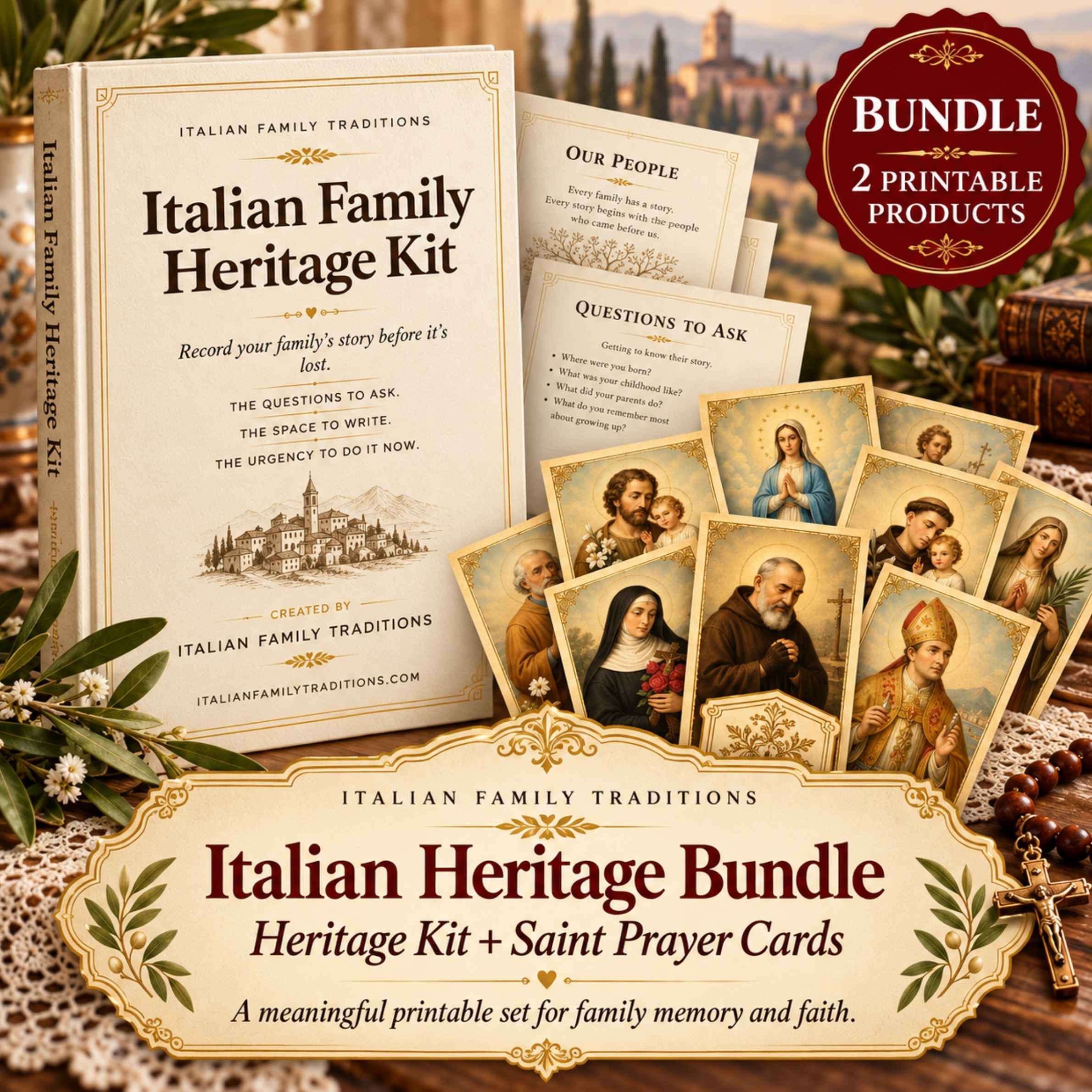
Their Story and Their Saints
A Christmas gift that starts on December 8.
The Italian Heritage Gift Set brings together the 133-page Italian Family Heritage Kit, with more than 120 questions to record the family’s story, and the 11 printable Italian Saint Prayer Cards with prayers in Italian and English. Ready to print the same day.
Get the Gift Set — $24.99Instant digital download · $29.48 if bought separately
More of the Italian Christmas season: the complete guide to Italian Christmas traditions, the presepe and its figures, the Christmas Novena, Santa Lucia on December 13, La Vigilia and the Feast of the Seven Fishes, and La Befana on January 6. For Mary through the whole year, see the Italian names of Mary, how to pray the rosary, our collection of Italian prayers, and the saints every Italian family prayed to. For every date at a glance, see the Italian feast day calendar.
FAQ
What is the Immacolata?
L’Immacolata is the Italian name for the Feast of the Immaculate Conception, celebrated on December 8. It honours the Catholic belief that Mary was conceived without original sin. In Italy it is a national holiday and the traditional start of the Christmas season.
Is the Immaculate Conception the same as the virgin birth?
No. The Immaculate Conception refers to Mary’s own conception in the womb of her mother, Saint Anne, free from original sin. The conception of Jesus is celebrated at the Annunciation on March 25, and his birth to the Virgin Mary at Christmas.
Why is the Immaculate Conception on December 8?
December 8 is nine months before September 8, the feast of the Nativity of Mary. Pope Pius IX also chose December 8, 1854, as the day he defined the Immaculate Conception as dogma.
Why do Italians put up the Christmas tree on December 8?
December 8 is a national holiday that opens the Christmas season, and it often creates a long weekend when families are home together. Putting up the tree and the presepe on Mary’s feast, with the manger left empty until Christmas Eve, also marks the start of the waiting of Advent. For many families it is simply the day everyone knows the decorations go up.
Is December 8 a holiday in Italy?
Yes. The Feast of the Immaculate Conception is a national public holiday in Italy. Schools and most offices close, and many shops open for Christmas shopping.
Is the Immaculate Conception a holy day of obligation?
In the United States, yes: the Immaculate Conception is the patronal feast of the country and a holy day of obligation. In Canada it is not a holy day of obligation, though many families attend Mass anyway. In Italy it is a holy day and a public holiday.
Why do firefighters put flowers on the Madonna in Rome?
Rome’s firemen raised the Column of the Immaculate Conception near the Spanish Steps in 1857. Since 1953, firefighters have honoured the Madonna every December 8 by climbing a fire ladder to place a wreath of flowers on the statue’s arm. The Pope visits the column later the same day.
What does the name Concetta mean?
Concetta is an Italian name taken from Concezione, conception, and refers to the Immaculate Conception of Mary. Women named Concetta, Concettina or Immacolata celebrate their name day on December 8. Common nicknames include Cetta, Cettina and Tina.
When does the Immacolata novena start?
The novena to the Immaculate Conception begins on November 29 and ends on December 7, the vigil of the feast. A simple form is to pray the Tota pulchra es and the invocation “O Mary, conceived without sin, pray for us who have recourse to you” each day.

Marco Ricci is an Italian-Canadian writer and the grandson of Calabrian immigrants. He created Italian Family Traditions to document the customs, feast days, and family rituals Italian families carried from Italy to North America — and to understand what they actually meant. He is based in Montreal.
Pingback: Italian Christmas Traditions: The Complete Guide
Pingback: La Vigilia: The Italian Christmas Eve Tradition Explained
Pingback: The Italian Saints Every Family Prayed To