
Italian Family Traditions
Best Italian Christmas Gifts: Meaningful Ideas for Family, Food & Tradition
The best Italian Christmas gift is not the one with the biggest flag on it. It is the one that belongs naturally at the table, beside the presepe, in the kitchen, in a prayer book, or in the family story long after the wrapping paper is gone.
If you are looking for Italian Christmas gifts that feel meaningful rather than gimmicky, start with the person — not with “Italy.” Is this for the Nonna who still remembers every recipe by feel? The Nonno who can tell you the exact town his father left? The aunt who keeps every saint card? The cousin who has started asking where the family came from? The children who know panettone but do not yet know why Christmas Eve feels different in their family?
That is the difference between an Italian-themed Christmas gift and an Italian family gift. One decorates an identity. The other helps somebody live inside it.
A good Italian Christmas gift should do at least one of four things: get used, get shared, tell a story, or keep a tradition alive.
This guide is built around that rule. There are gifts for grandparents, parents, children, hosts, cooks, people of faith, family historians, and the relative who insists they need absolutely nothing. There are inexpensive gifts, food gifts, Christmas-specific gifts, and a few things that become more valuable with time instead of less.
And because an Italian Christmas is not really a single day, the gifts here fit into the whole season — from the presepe and La Vigilia on Christmas Eve to Capodanno and the Epiphany. If you want the full map of the season first, start with the complete guide to Italian Christmas traditions.
Find the right Italian Christmas gift in 30 seconds
Italian Christmas Gift Finder
What should you actually give them?
Choose the person, what matters most to them, and your budget. The recommendation is based on the role the gift can play — not on how much Italian decoration can be printed on it.
The best answer is usually the one that could only have been chosen for this person.
The short list: best Italian Christmas gifts by person
| Who you’re buying for | Best starting point | Why it works |
|---|---|---|
| Nonna or Nonno | Italian Family Heritage Kit | The gift becomes their stories, not another object |
| The Christmas host | Regional pantry basket + help with the meal | Useful, consumable and generous without creating clutter |
| The devout relative | Italian Saint Prayer Cards | Small, traditional and tied to a real devotional practice |
| The family with children | Tombola set | Turns heritage into something everyone can actually do together |
| The person who loves Christmas tradition | A new presepe figure | Joins a ritual that returns every December |
| The Italian-food person | Regional olive oil + pantry items | Specific, usable and easy to share at Christmas |
| The Italy-nostalgic relative | Map or print of their hometown | Their Italy matters more than generic “Italy” |
| The person who wants nothing | A meal, photographs and recorded stories | No clutter; the time together is the gift |
1. The Italian Family Heritage Kit — the Christmas gift that gets more valuable every year
Christmas is one of the few times when the family is already assembled and the older stories are close enough to touch. Somebody mentions the Christmas Eve apartment where thirty people somehow fit around one table. Someone remembers who used to make the baccalà. A box of photographs comes out because one face looks like one of the grandchildren. The same argument about which town somebody was born in gets restarted. This is family history appearing naturally, without anyone announcing that a family-history session is about to begin.
That makes the Italian Family Heritage Kit especially strong as a Christmas gift. It has 133 guided pages and more than 120 prompts covering origins, names, people, immigration, recipes, traditions, sayings, photographs and the details families usually realize were important only after nobody can answer the question anymore.
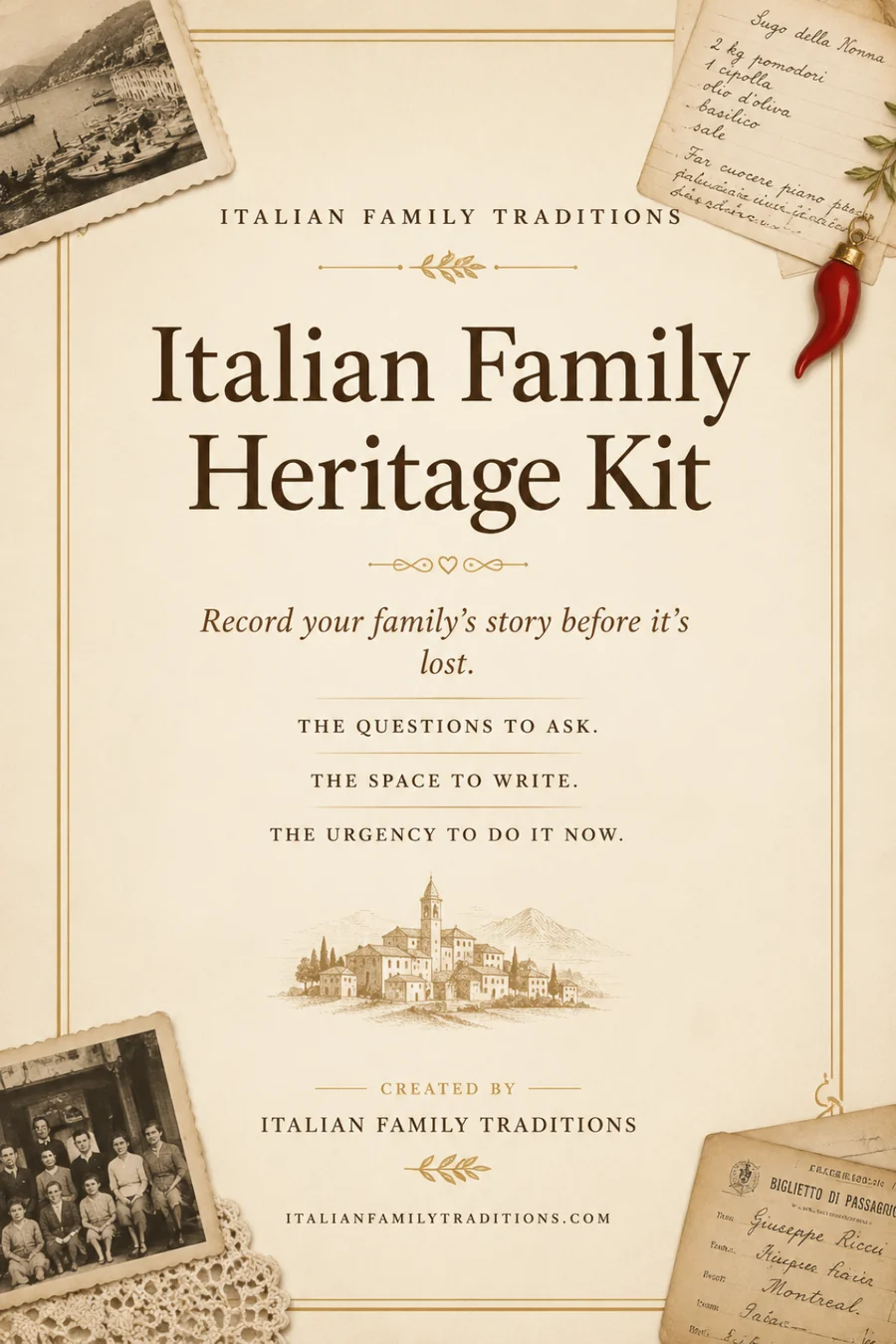
Best Family-Heritage Gift
Put something under the tree that the next generation can inherit.
Print the pages, bring them to Christmas, and begin with one question while the people who know the answers are already in the room. The Kit turns family memory into something you can actually keep.
Explore the Heritage Kit — $19.99Instant digital download · 133 guided pages · Print and complete by hand
The way I would give it is simple: do not wrap the download and make it homework. Print a small section, put it in a nice folder, and include a handwritten note saying that you want to complete it together. Then actually do that. Christmas already gives you the table, the coffee, the relatives and the time. Use the gift to open the conversation while everybody is still there.
If the person is specifically a grandparent, the full guide to meaningful gifts for Nonna and Nonno goes much deeper on family-history gifts, photographs, hometown maps and gifts for grandparents who insist they need nothing.
2. Build a Calabrian Christmas pantry basket that actually feels regional
A food basket is one of the most traditional Christmas gifts for good reason: it gets opened, eaten, passed around and discussed. It does not need shelf space forever, and if you choose well, part of the gift becomes the Christmas table itself.
The mistake is building a basket around “Italian food” so broadly that it could have come from an airport gift shop. The better version is regional. For a Calabrian family, I would make the basket around Calabria. For a Sicilian family, Sicily. For someone from Campania, start in Campania. The point is not geographical perfection; the point is recognition.
A Calabrian Basket I’ve Actually Tasted
Start with the olive oil. Add the passata. Then make it yours.
Sarafino sent me several Calabrian products to try. I was genuinely impressed, and they make far more sense here than a random list of supermarket “Italian” products because each item has a real regional story behind it.
The Centerpiece
Calabrian Extra-Virgin Olive Oil
From the family’s estate in San Giorgio Morgeto. Smooth, rounded and easy to put on a Christmas table immediately — the strongest single-item gift of the group.
See the Calabrian olive oils →For the Sauce Family
Sarafino Passata
This was the surprise. It is sourced from a single seaside farm and has the kind of clean tomato flavor that lets a very simple sauce stay simple.
See the passata →The Distinctive One
Bergamot Marmalade
Bergamot is so closely associated with Calabria that this immediately makes the basket feel specific. It is unusual, bright and far more memorable than adding another generic jar of jam.
See the bergamot marmalade →The Basket Add-On
Arborio Rice from the Sibari Plain
A genuinely useful fourth item if you want the basket to feel complete without stuffing it with filler nobody asked for.
See the Arborio rice →Disclosure: Sarafino provided these products for me to try. I was not paid to include them here, and the opinions are my own. If any links become affiliate links, that is disclosed in our site disclosures.
For Christmas, I would put the oil, passata and marmalade into a simple basket with good pasta, a loaf of bread or taralli, and a handwritten note about why you chose Calabria. That note matters. It tells the person this was not assembled from a search for “Italian gift basket.” It was built around where the family actually comes from.
3. Add one new figure to the family presepe
A presepe is not just Christmas décor that happens to be Italian. In many families it is the visual center of the season — a nativity built slowly, sometimes from figures collected over decades, sometimes from pieces that are chipped, mismatched and emotionally irreplaceable.
That makes a presepe figure one of the rare physical gifts that can become more meaningful by being used every year. You are not replacing the family set. You are adding to it: one shepherd, one animal, one market figure, one small building, one piece that joins the same box that comes down every December.
If the recipient already has an elaborate scene, pay attention to scale before buying. If they have a simple nativity, do not turn it into a miniature city against their will. The gift should belong to the presepe they have, not to the presepe you saw online.
For the meaning behind the empty manger, the moving Magi and the Italian habit of making the nativity into an entire little world, read what the presepe means in Italian family Christmas.
4. A tombola set — the rare gift that becomes the evening
Most gifts have to wait until after they are opened to become useful. Tombola can take over the room immediately.
That is what makes a traditional tombola set such a strong family Christmas gift. The cards come out after dinner. Someone calls the numbers. Someone insists the caller is moving too fast. Someone is perpetually one number away. Children can play with grandparents on equal terms. The prize can be five dollars, a panettone, clementines, chocolates or whatever the family decides is suddenly worth competing over with unreasonable intensity.
The best part is that the gift does not belong to one person. It belongs to the table. If your family has children who are only loosely connected to Italian traditions, this is particularly good because it asks almost nothing of them culturally. They learn by playing. By the second game, they know what ambo and cinquina mean because they desperately want one.
Our full guide to tombola and the Italian Christmas game tradition explains the rules, the pot, the wins and the connection to the Neapolitan smorfia.
5. Panettone or pandoro — but make the choice personal
There is an excellent reason boxes of panettone and pandoro get passed around Italian families in December: they are festive, shareable, useful immediately and almost impossible to separate from the season.
The gift becomes better when you know which side the person is on. Panettone is the tall Milanese loaf with raisins and candied fruit. Pandoro is the soft, golden, star-shaped Veronese cake dusted with powdered sugar. To outsiders, this sounds like a mild preference. Inside some families it is treated more like a constitutional question.
Buy the version the recipient actually likes rather than the version you have been told is more traditional. If you are bringing dessert to a household split down the middle, the correct diplomatic solution is obvious: bring both and refuse to mediate.
If you need to establish where somebody stands before shopping, send them the panettone vs. pandoro guide and quiz and pretend you are asking for no particular reason.
6. Italian Saint Prayer Cards — a small Christmas gift with a long tradition behind it
For the relative whose faith is part of the house — rosary on the dresser, saint card in the wallet, prayer book beside the bed — a devotional gift does not need to be large to feel significant.

Small, Traditional & Easy to Give
Italian Saint Prayer Cards
A printable set of 11 beloved saints, each with a traditional prayer in Italian and English. Give the whole set, place one in a Christmas card, or choose the saint connected to the recipient’s name or devotion.
Get the Prayer Cards — $9.49Instant digital download · Print at home
To make it specific, use the Italian Patron Saint Finder or the onomastico guide to connect the gift to the person’s name. And if you want the story behind why these little cards showed up in wallets, family Bibles and missals, read what a santino is.
7. A rosary or medal chosen for the person — not just because it is Catholic
The same principle applies to rosaries and medals. Do not buy the first generic religious object that appears under “Italian Catholic gift.” Ask which saint matters. Ask which Madonna devotion was in the family. Ask whether there was a medal someone always wore.
A Saint Anthony medal makes sense for the relative who has invoked Sant’Antonio their entire life. A Saint Joseph piece can be especially meaningful for a Giuseppe or a grandfather who identifies strongly with the role of father and worker. A Marian medal can connect to one of the many devotions explored in the family’s own religious history.
The object is not meaningful because it is expensive. It is meaningful because somebody knew which one to choose. If prayer is part of the recipient’s life, the guide to Italian prayers every family knew and how to pray the rosary can help you understand the world the gift belongs to.
8. A map, old postcard or photograph of their actual town in Italy
If you only remember one rule from this entire guide, make it this one: specific beats generic.
A framed map of “Italy” may be attractive. A 1950s postcard of the exact Calabrian town where somebody’s father was born can stop a conversation. A photograph of the church where their parents married can bring out stories no one knew were attached to the building. A map marked with the family surname and immigration year can make geography feel like biography.
This is especially powerful for second- and third-generation families because the place name often survives longer than the details. Everybody knows “we are from there.” Fewer people know the street, the parish, the neighboring town, the port they left from or the reason they moved. A place-based Christmas gift can reopen those questions while the older generation is there to answer them.
9. Restore one Christmas photograph and write down who everybody is
Choose an old Christmas photograph. Not necessarily the best-looking one. Choose the one with people in it.
Scan or restore it, print it properly, frame a copy if you like — but do one more thing before you give it: identify every person you can. Names, approximate year, house, city, occasion. If the recipient knows the missing names, leave space for them to add those details on Christmas Day.
That turns a sentimental gift into preservation. The danger to old family photographs is not only physical decay. It is the moment when everyone in the image becomes “some relatives.” The image survives; the information disappears. A Christmas gift can prevent that.
10. A family recipe book that begins with one Christmas recipe
Do not start by promising to document every recipe the family has ever made. That is how projects become permanent projects.
Start with Christmas. One recipe. The baccalà. The struffoli. The stuffed calamari. The cookies. The sauce. The dish that only appears during the holidays and therefore gets made rarely enough that nobody under forty is completely certain how it works.
Write the ingredients, but also record the parts that never appear in recipes: which pan, what the dough feels like, when to stop adding flour, which brand of tomatoes is acceptable, who is allowed to stir, what gets prepared the night before, and which step everybody argues about because two branches of the family do it differently.
The unwritten rules of an Italian kitchen are exactly why this matters. The recipe is not only the ingredients. The family technique lives in the person doing it.
11. A Christmas ornament tied to a town, saint, family name or year
An ornament is another small gift that gets stronger through repetition. It disappears into a box in January and reappears every December carrying all the Christmases in between.
Personalize it with something real: the hometown in Italy, the family surname, a wedding year, “First Christmas as Nonna,” the year somebody became a citizen, or a small image of a saint or regional symbol that actually belongs to the family’s story.
A generic tricolor ornament can be fun. A little ceramic ornament that says the name of the town your grandfather left seventy years ago is something else entirely.
12. A children’s Italian Christmas book — then attach a real family tradition to it
Children do not inherit traditions because adults gave them a lecture on cultural preservation. They inherit them because the tradition became part of childhood.
A book about the presepe, Santa Lucia, La Befana or an Italian Christmas can be a good entry point — but the book is strongest when it leads into something the child gets to do. Read about the Befana, then leave the stocking out for January 6. Read about the presepe, then let the child place the Christ figure on Christmas Eve. Explain tombola, then put beans on the cards and play.
The guide to keeping Italian family traditions alive with children is built around this exact idea: give children a role, not merely information.
13. A Christmas tradition box for a young family
This is one of my favorite gifts for a couple with young children because it gives them the beginnings of a family Christmas rather than one more toy competing for floor space.
Put together a small box with a tombola set, one presepe figure, a Christmas book, a printed family recipe, a few saint or prayer cards, and a note explaining one or two family customs. You are not trying to recreate every Italian Christmas tradition at once. You are giving them five handles they can grab onto.
Over time, the family will choose what sticks. Maybe tombola becomes permanent and the prayer cards do not. Maybe the presepe becomes the center of December and nobody cares about the book after age eight. That is fine. Traditions survive because families use them, not because they successfully preserve a complete museum collection.
14. A “Christmas Eve helper” gift for the person who does everything
There is usually one person who makes Christmas feel effortless by doing an enormous amount of work nobody sees.
If that person is in your family, the best gift may be taking one entire category of work away. Buy the fish. Pick up the pastries. Set the table. Bring the serving trays. Wash the dishes. Drive the older relatives home. Take the children out for an hour while the kitchen gets organized. Do it without turning your help into another project the host has to manage.
This is especially meaningful around La Vigilia, where the Christmas Eve meal can involve more preparation, more dishes and more inherited expectations than anybody admits until December 23.
15. A family interview at Christmas — for the person who says “please don’t buy me anything”
Believe them.
Bring coffee and pastries. Ask whether you can record the conversation. Choose ten questions. What did Christmas look like when you were a child? Who cooked? What was on the table? Were gifts opened on Christmas Eve or Christmas morning? Did Santa Lucia come? Did the Befana? Who built the presepe? Was there Midnight Mass? What was the first Christmas like after coming to Canada or the United States?
Christmas questions work because the season gives memory structure. People may not know how to answer “tell me about your childhood,” but they can often tell you who sat where on Christmas Eve and which dish they secretly disliked.
If you need prompts, start with what to ask your grandparents about your Italian family history. The recording may be the only Christmas gift in this guide that becomes literally irreplaceable.
16. Give an Italian Christmas experience instead of an object
Tickets to a Christmas concert. A visit to an Italian bakery followed by coffee. A drive to see a presepe display. A day cooking the Christmas sweets together. A church concert. A trip to an Italian neighborhood at Christmas. A family afternoon making fresh pasta before the holiday.
The strongest experience gift has a date attached. “We should do this sometime” is not a gift. “December 20, I pick you up at 10:00, we go for coffee and buy the panettone together” is a gift.
17. Write the letter people usually wait too long to write
This is the cheapest gift in the article and possibly the most difficult.
Write one page. Tell the person one thing they gave the family that you want to keep. Not “thank you for everything.” Be concrete. “You are the reason Christmas Eve still happens.” “You taught me that people come before schedules.” “Every December, when the presepe goes up, I think of you putting the figures in exactly the same places.” “I want my children to know the stories you told me at the table.”
Put the letter inside whatever other gift you buy. The object may wear out. The letter will explain why the object mattered.
Who actually brings Christmas gifts in Italy?
One reason Italian Christmas gift traditions are more interesting than a simple Babbo Natale story is that the answer can depend on region and date.
Babbo Natale is now the familiar Christmas gift-bringer across Italy. But regional traditions remain. In parts of northern Italy, Santa Lucia brings gifts to children around December 13, her feast day. The official Italian tourism site notes that this gift-bringing Santa Lucia tradition is especially associated with places including Verona, Brescia and Bergamo. If your family comes from one of those areas, the December 13 gift may carry more local meaning than a generic Christmas present.
Then there is La Befana, who arrives on the night of January 5 before the Epiphany on January 6, filling stockings with sweets or small gifts. In some Italian families, especially historically, the Befana was every bit as anticipated as Christmas morning. That is why the Italian holiday season feels stretched across weeks instead of compressed into December 25.
If you are buying for children in an Italian-Canadian or Italian-American family, one of the most interesting gifts you can give is not another toy but the recovery of one of these dates. Let Santa Lucia or the Befana have a small role. Children remember the strange, specific things their own family does.
Best Italian Christmas gifts under $25
A meaningful Christmas gift does not need a meaningful price tag. Under $25, the strongest gifts tend to be small, specific, printable, edible or built around a story.
- Italian Family Heritage Kit — $19.99: print a Christmas section or a few pages and begin them together
- Italian Saint Prayer Cards — $9.49: especially good for a devout relative or someone with a strong patron-saint connection
- A panettone or pandoro: useful immediately and unmistakably seasonal
- A single presepe figure: small enough for a stocking, meaningful enough to come back every December
- A framed copy of an old Christmas photograph: add the names and year
- A regional pantry item: olive oil, bergamot preserve, torrone, biscuits or another food tied to the family’s actual region
- A handwritten letter: one page about what this person gave the family
- A printed hometown map or vintage postcard: inexpensive if sourced digitally, deeply personal if chosen correctly
- A Christmas recipe card set: use recipes from your own family rather than generic internet recipes
Best Italian Christmas gifts for Nonna
The lazy version of a Nonna gift guide is kitchen towels, aprons and mugs. Those can be fun, but they assume the only interesting thing about an Italian grandmother is that she fed people.
Start instead with what this particular Nonna holds in the family. If she is the storyteller, give the Heritage Kit or a recorded family interview. If faith structures her day, choose a saint-specific devotional gift. If she is the keeper of photographs, restore one and document the names. If she loves food, build the regional pantry basket or spend an afternoon recording one recipe properly. If she has spent decades hosting Christmas, take work away from her instead of giving her another object for the kitchen.
For a much deeper list, see the full guide to gifts for Italian grandparents and the story of what an Italian Nonna really does in the family.
Best Italian Christmas gifts for Nonno
For Nonno, the same anti-stereotype rule applies. Maybe he gardens. Maybe he fixes things. Maybe he knows the family town better than anyone. Maybe he says almost nothing until an old photograph appears and suddenly knows the names of twelve people nobody else can identify.
A hometown map, family-history project, restored photograph, good olive oil, regional food basket, coffee ritual gift, framed immigration document or a day built around recording his stories can all be better than a generic “Nonno” object. If he likes the generic object, by all means buy it. Just do not confuse the label with knowing the person.
Best Italian Christmas gifts for children
For children, the goal is not to make Christmas more educational. The goal is to make the heritage fun enough that they want it again next year.
- Tombola: easiest win because they can participate immediately
- A presepe figure of their own: let them place it every year
- An Italian Christmas storybook: especially good when paired with a real family ritual afterward
- A Befana stocking for January 6: small sweets and one tiny gift are enough
- A kid-sized Christmas kitchen job: apron, wooden spoon or cookie cutter plus the responsibility of helping with one real recipe
- A family-name ornament: give them something they will eventually take to their own tree
Children remember roles. “You are the one who puts the Christ child in the manger.” “You call the first ten tombola numbers.” “You dust the pandoro with sugar.” That ownership is what makes a tradition feel like theirs rather than something older relatives are forcing them to watch.
Best Italian Christmas gifts for the host
The best host gift is the one that does not create a new problem in the kitchen.
Good options: excellent olive oil, pastries for the next morning, panettone or pandoro, coffee, a small regional pantry item, a serving piece you know they want, flowers already arranged in a container, or a gift that can be put aside until after the holiday.
Even better: ask what you can bring and then bring exactly that. Italian Christmas tables already contain enough improvisation. Generosity does not require surprise.
What not to buy just because the recipient is Italian
There is nothing inherently wrong with tricolor socks, “Mangia!” signs, novelty pasta ornaments or an Italian-flag apron. Some people love them. The problem begins when the entire logic of the gift is “you are Italian, therefore here is an object with Italy printed on it.”
Use a simple test:
- Does this connect to something the person actually does, believes, remembers or enjoys?
- Is it specific to their family, town, region, saint, recipe or Christmas role?
- Will it get used, eaten, displayed with meaning, played with, or talked about?
- Could you explain why you chose it without using the sentence “because you’re Italian”?
If yes, you are probably in good shape. If not, keep going. The internet contains enough Italian-flag merchandise already.
The Italian Christmas gift basket formula
If you want one gift that works for parents, grandparents, hosts or an entire family, build a small regional basket. The trick is restraint.
The 4-Part Formula
1 excellent staple — olive oil, coffee, pasta or rice
1 Christmas item — panettone, pandoro, torrone or regional sweet
1 regional wildcard — bergamot, pistachio, preserves, taralli or another place-specific item
1 family note — explain why you chose that region or tradition
Do not add eleven filler products to make the basket look larger. Three excellent things and a note feel more intentional than twelve mediocre things arranged under cellophane.
If the basket is going to somebody who cooks, add one ingredient they can use on Christmas or New Year’s Day. If it is going to somebody who mostly wants snacks and sweets, stop pretending they need artisanal pasta and give them the panettone they actually want.
Why Christmas is the right time for a heritage gift
There is a practical reason family-history gifts work especially well at Christmas: the evidence is already in the room.
The food brings out recipes. The presepe brings out memories of who built the old one. The saints bring out names. The photographs come out. The older relatives are present. The younger relatives are briefly paying attention because something is happening that does not happen on an ordinary Tuesday.
That is why a family archive, Heritage Kit, recorded interview or restored photograph does not feel like a school assignment at Christmas. It belongs to what the gathering is already doing. The family is repeating itself, which is another way of saying the family is remembering itself.
Italian-Canadian and Italian-American families have always adapted their Christmases. The language at the table changes. The houses get larger or smaller. Some feast days disappear and others return when grandchildren rediscover them online. The Italian-American and Italian-Canadian traditions that survived immigration did not survive because they were preserved perfectly. They survived because somebody kept doing them.
A good Christmas gift can help somebody keep doing one.
The best Italian Christmas gift is the one that earns a place in next Christmas. The tombola set that comes back to the table. The presepe figure that goes into the same box every January. The recipe that finally gets written down. The saint card kept in a wallet. The olive oil opened at dinner. The family story recorded while the person who knows it is sitting three feet away.
Do not worry about making the gift look more Italian. Make it more theirs.
A Gift for This Christmas — and the Ones After
The people are already around the table. Ask while you can.
The Italian Family Heritage Kit gives you the prompts and pages to preserve the names, hometowns, Christmas rituals, recipes, sayings, photographs and stories that make one family’s version of “Italian” unlike anybody else’s.
Give the Heritage Kit — $19.99For the full season behind these gifts, read Italian Christmas Traditions: The Complete Guide. Then go deeper into La Vigilia, the presepe, tombola, panettone vs. pandoro, and Capodanno. Those are the traditions that make the gifts make sense.
FAQ
What are good Italian Christmas gifts?
Good Italian Christmas gifts are specific to the recipient rather than generically Italian. Strong options include a family-history workbook, a regional Italian food basket, a presepe figure, a tombola set, panettone or pandoro, saint prayer cards, a rosary or saint medal, a hometown map, a restored family photograph, a family recipe project, regional cookbooks, olive-wood serving pieces and experience gifts built around cooking or family time.
What is a traditional Christmas gift in Italy?
Food is a classic Christmas gift in Italy, particularly high-quality sweets and pantry products such as panettone, pandoro, torrone, olive oil, coffee and regional specialties. Gift baskets are common because they can be shared by the household. Religious or Christmas-season gifts can also be meaningful in families where the presepe, saints and church traditions remain important.
What do you give an Italian family for Christmas?
For an entire Italian family, choose something shareable or participatory: a regional food basket, panettone and pandoro, a tombola set, a family-history workbook, a framed family photograph, a presepe piece, a recipe collection or an experience such as a family meal or cooking day. Gifts that can become part of the family’s Christmas are usually stronger than objects aimed at only one person.
What are good Italian Christmas gifts for Nonna and Nonno?
For Nonna and Nonno, focus on the part of the family they hold: stories, photographs, recipes, faith, hometown memories or the Christmas table itself. The Italian Family Heritage Kit, a restored photograph, a hometown map, a saint-specific devotional gift, a regional pantry basket or a recorded family interview can all be more meaningful than generic Nonna or Nonno merchandise.
What are inexpensive Italian Christmas gifts under $25?
Under $25, good options include the $19.99 Italian Family Heritage Kit, $9.49 Italian Saint Prayer Cards, panettone or pandoro, torrone, a small regional pantry item, a single presepe figure, a family-name ornament, a framed copy of an old photograph, a printed hometown map, handwritten family recipe cards or a personal letter.
What are good Italian Christmas food gifts?
The best Italian Christmas food gifts are regional and usable: high-quality extra-virgin olive oil, panettone, pandoro, torrone, regional cookies or preserves, coffee, pasta, rice and a good passata. Instead of a huge generic basket, choose three or four high-quality items from one region and explain the connection in a note.
Who brings Christmas presents in Italy?
Babbo Natale is the familiar modern gift-bringer across Italy, but regional and older traditions remain important. In parts of northern Italy, Santa Lucia brings gifts around her December 13 feast day. La Befana brings sweets and small gifts on the night before the Epiphany, January 6. Which figure matters most can depend on region, generation and family tradition.
What is the most meaningful Italian Christmas gift?
The most meaningful gift is one that could only have been chosen for that person: a record of their stories, a map of their hometown, a recipe preserved in their handwriting, a saint connected to their name, a food from their region, or an object that joins a family Christmas ritual. The common thread is specificity. The gift recognizes the person’s actual family life rather than simply their Italian identity.

Marco Ricci is an Italian-Canadian writer and the grandson of Calabrian immigrants. He created Italian Family Traditions to document the customs, feast days, and family rituals Italian families carried from Italy to North America — and to understand what they actually meant. He is based in Montreal.