Italian Family Traditions
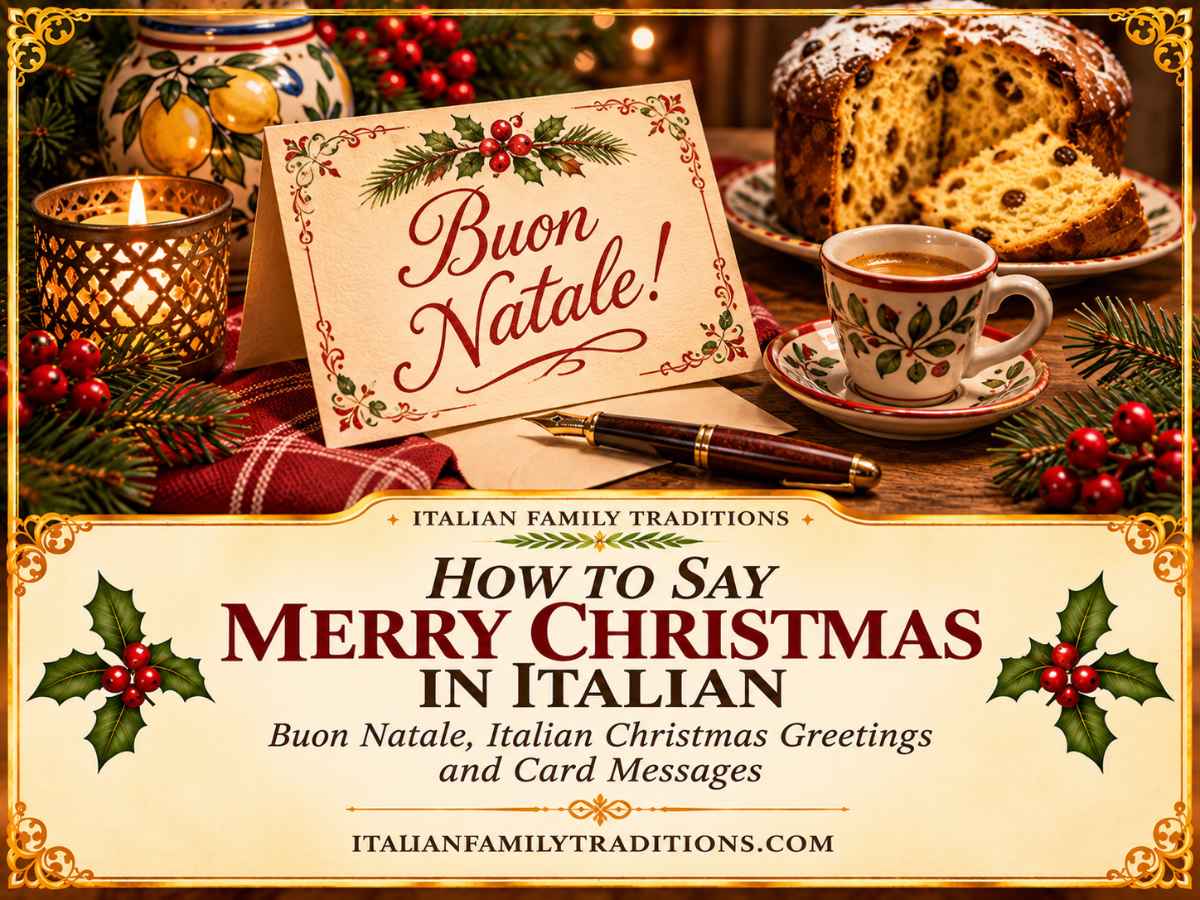
How to Say Merry Christmas in Italian: Buon Natale, Italian Christmas Greetings and Card Messages
Buon Natale, auguri, buone feste: the words an Italian family says every December, how to pronounce them, how to answer them, and exactly what to write in a Christmas card to your nonna, your comare or your boss.
Merry Christmas in Italian is Buon Natale, pronounced bwon nah-TAH-leh. “Merry Christmas and happy new year” is Buon Natale e felice anno nuovo. “Happy holidays” is Buone feste. And the word you will hear most at an Italian Christmas is simply Auguri!, best wishes, answered with Grazie, altrettanto!, thank you, the same to you.
Buon Natale
bwon nah-TAH-leh
Merry Christmas
If you are writing a card, the free message maker below will write it for you: pick who it is for and the feeling you want, and it gives you a real Italian Christmas message with the English translation, ready to copy, hear aloud, or print.
Write your Italian Christmas card
Free Italian Christmas message maker
Write your Buon Natale card in Italian
Choose who it is for and the feeling you want. You get a real Italian Christmas message with its English translation, ready to copy into a card or a text, hear out loud, or print as a little card.
Who is it for?
The feeling
Their name (optional)
Signed by (optional)
Slipping it into a Christmas card for someone devout? Add a printable santino with a prayer in Italian and English. It is the kind of thing that gets kept.
For the people on your list
Something to go with the card
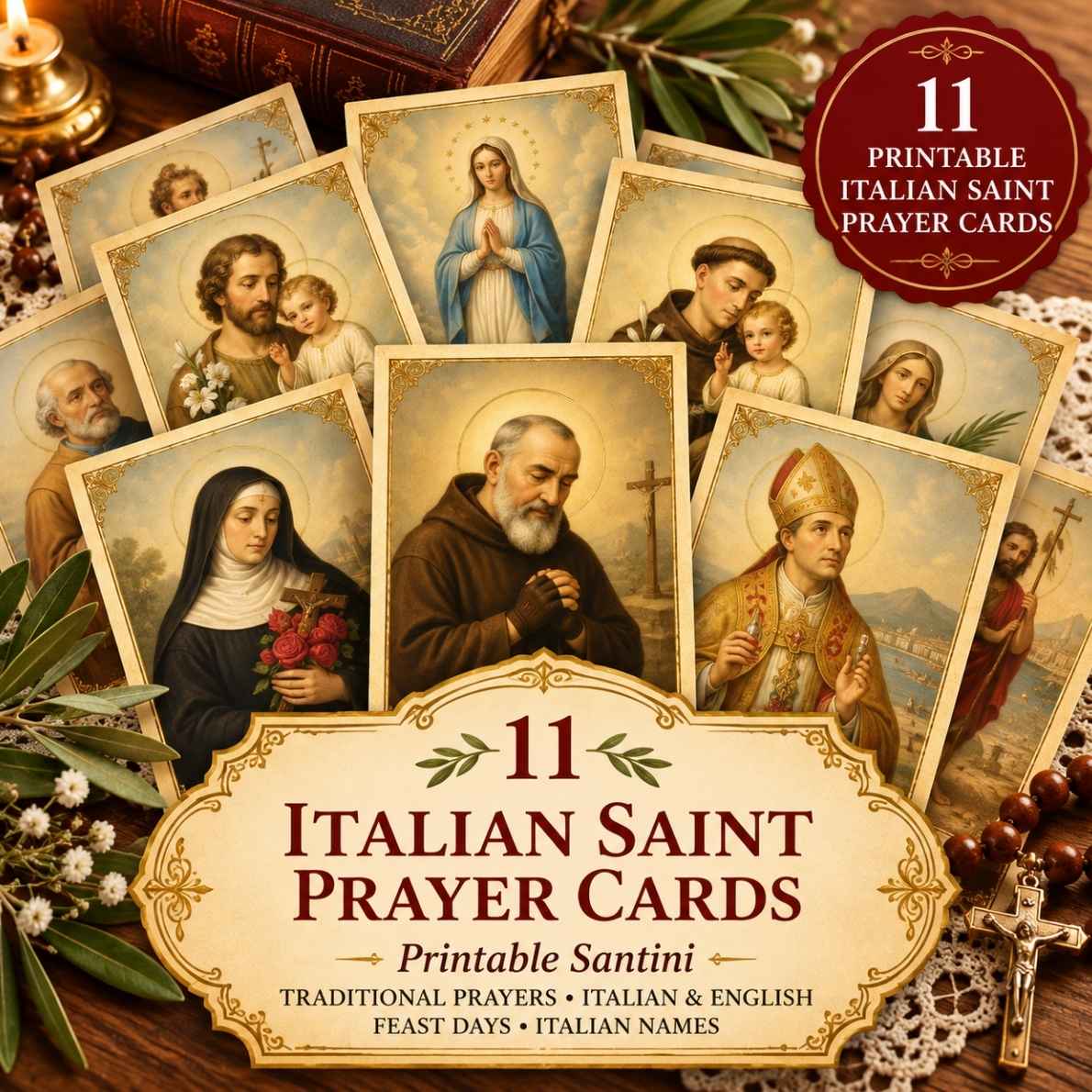
Tuck one inside
Saint Prayer Cards
Eleven beautiful printable santini, each with a prayer in Italian and English. The most Italian thing you can slip into a Christmas card.
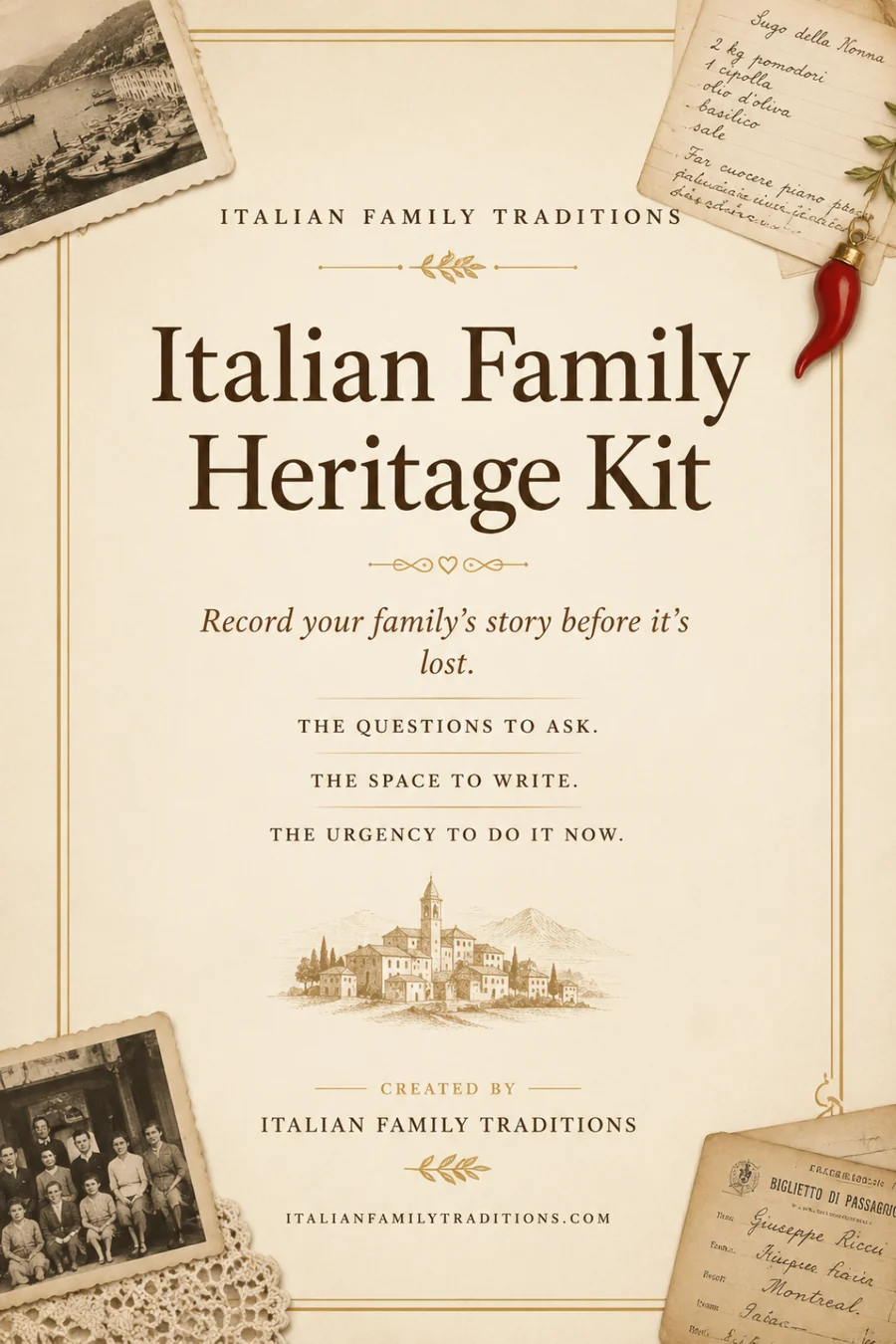
For the nonna and nonno
Italian Family Heritage Kit
A beautiful printable workbook for the family’s stories, recipes and roots. The gift that goes inside the envelope.

Free
The 2027 Italian Calendar
Every feast day, name day and Christmas date of the Italian year, so you never miss an auguri. Yours free by email.
The two words every Italian family says
There is a moment at every Italian Christmas that anyone who grew up with one will recognise. The door opens, the cold comes in, the coats are still on, and before anyone has said hello, someone says it: Auguri! Then the kisses, one on each cheek, then the next person, auguri, auguri, all the way down the hall, until the whole family has been wished well and the coats can finally come off.
Then, later, at the table or on the phone to the relatives who could not come, the other phrase: Buon Natale. Two words, said so often in December that they stop sounding like words and start sounding like the season itself.
For a lot of Italian-Canadian and Italian-American families, these are among the last Italian words left in the house. The grandparents spoke the language. The parents understood it. The grandchildren know the food, the songs, the swear words, and these: Buon Natale, auguri, buone feste. Which is exactly why they are worth getting right, and worth handing on.
Here is everything you need: what the words mean, how to say them, how to answer them, what Italians actually say in their dialects, and what to write in a Christmas card to everyone on your list.
What Buon Natale means
Buon means good, and Natale means Christmas. Word for word, Buon Natale is “good Christmas”, which in English becomes Merry Christmas.
Natale is a beautiful word once you know where it comes from. It descends from the Latin dies natalis, “day of birth”. The Romans used natalis for birthdays, and Christians took it for the most important birthday of all. So when an Italian wishes you Buon Natale, the word underneath is not “holiday” or “season”. It is birth. The same root gives Italian nascere, to be born, and the name Natalia.
Buon is a shortened form of buono, good. In Italian, buono loses its final -o in front of most masculine nouns, which is why you say buon Natale, buon anno and buongiorno, never “buono Natale”. In front of feminine words it becomes buona (buona Vigilia, buona Befana), and in the plural, buone (buone feste).
How to pronounce Buon Natale
- Buon: one quick syllable, bwon. Start with the lips rounded as if for a “w”, and do not stretch it into two syllables (“boo-on”).
- Na: nah, an open “a” as in father.
- TA: the stressed syllable: TAH. Italians lean on it.
- le: leh. The final e is always pronounced in Italian. “Natal” with a silent e is the most common mistake English speakers make.
Put together: bwon nah-TAH-leh. If you want to hear it, the message maker above has a “Hear it in Italian” button that reads your message aloud with an Italian voice.
Italian Christmas greetings: the full list
Italian has a greeting for almost every day of the season, from the Immacolata on December 8 to the Befana on January 6. Here are the ones you will actually hear, with pronunciation and when to use them.
| Italian | Say it | In English | When to use it |
|---|---|---|---|
| Buon Natale | bwon nah-TAH-leh | Merry Christmas | The classic, to anyone, from December to the 25th |
| Auguri! | ow-GOO-ree | Best wishes! | The word you will hear most, all season |
| Tanti auguri | TAHN-tee ow-GOO-ree | Many good wishes | Warmer than auguri alone |
| Buone feste | BWOH-neh FEHS-teh | Happy holidays | Covers Christmas, New Year and the Epiphany |
| Buon Natale e felice anno nuovo | bwon nah-TAH-leh eh feh-LEE-cheh AHN-noh NWOH-voh | Merry Christmas and happy new year | The classic card greeting |
| Sereno Natale | seh-REH-noh nah-TAH-leh | A peaceful Christmas | Gentle; good for cards and for those who are grieving |
| Buon Santo Natale | bwon SAHN-toh nah-TAH-leh | A blessed (holy) Christmas | For religious friends and family |
| Auguri di buon Natale | ow-GOO-ree dee bwon nah-TAH-leh | Wishes for a Merry Christmas | Cards, messages, emails |
| Buona Vigilia | BWOH-nah vee-JEE-lyah | Happy Christmas Eve | On December 24 |
| Buon Santo Stefano | bwon SAHN-toh STEH-fah-noh | Happy St. Stephen’s Day | On December 26 |
| Buon anno | bwon AHN-noh | Happy new year | From the 31st into January |
| Buona fine e buon principio | BWOH-nah FEE-neh eh bwon preen-CHEE-pyoh | A good end and a good beginning | In the last days of December |
| Buona Befana | BWOH-nah beh-FAH-nah | Happy Befana | On January 5 and 6 |
A few notes on using them like an Italian:
- Auguri is the safest word in the language. It works for Christmas, New Year, birthdays and name days, with anyone, in any register. When in doubt, say auguri.
- Buon Natale is for before and on the day. After December 25, Italians switch to buone feste or buon anno.
- Felice Natale exists but is rare. It is grammatically perfect and sounds like a translation. Italians say Buon Natale.
- Buona fine e buon principio, a good end and a good beginning, is one of the loveliest Italian phrases of the season. You say it in the last days of the year, when Christmas is over but the new year has not yet come.
- On the Vigilia, the night of the 24th, you can wish someone buona Vigilia as they head off to the fish. Our guide to La Vigilia explains the night itself.
Auguri: the word you will hear most
If you learn only one Italian word for Christmas, learn auguri. Pronounced ow-GOO-ree, it means “best wishes” or “good wishes”, and it is the sound of an Italian December.
Auguri comes from the Latin augurium, the omen that Roman augurs read in the flight of birds. To give someone your auguri was, originally, to wish them a good sign for what was coming. It is the same root as the English word “augur” and “inauguration”. Two thousand years later, the meaning is unchanged: I wish you good things ahead.
Italians say auguri for every celebration of a life: birthdays (tanti auguri is also the Italian Happy Birthday song), name days, weddings, babies, graduations, new jobs. At Christmas it becomes the default greeting. You say it at the door, on the phone, in the street to the neighbour, to the man at the bakery handing over the panettone. You write it at the top of the card. You shout it across the room.
Auguri: I wish you a good sign for what is coming.
How to answer Buon Natale and auguri
Being wished Buon Natale and answering “you too” in English is a small missed chance. Here is what Italians say back:
| If someone says… | You answer… | Meaning |
|---|---|---|
| Buon Natale! | Grazie, altrettanto! (GRAHT-tsee-eh, ahl-treht-TAHN-toh) | Thank you, same to you! |
| Auguri! | Grazie, anche a te! (AHN-keh ah teh) | Thanks, to you too! |
| Auguri a tutta la famiglia! | Grazie, anche alla tua! | Thanks, and to yours! |
| Buone feste! (formal) | Grazie, altrettanto a Lei! | Thank you, the same to you (polite) |
| Buon anno! | Buon anno anche a te! | Happy new year to you too! |
Altrettanto, “the same”, is the most useful reply in the Italian language: it answers Buon Natale, buon anno, buon appetito and almost any other good wish. And at an Italian door, the words come with a kiss on both cheeks, and the family will make sure you do not skip anyone.
Where the words come from: a short history of auguri
The Italian Christmas greeting is older than Christmas. In ancient Rome, the augurs were priests who watched the flight of birds to read whether the gods approved of what was about to happen. Their sign was the augurium. To wish someone a good augurium was to wish that the omens were with them, and two thousand years later, every Italian who says auguri at the door is still, without knowing it, wishing you good birds.
The Romans also gave Italy its Christmas gift. At the January new year they exchanged small presents called strenae, branches, sweets and coins for luck. The word survives as strenna, still the Italian word for a holiday gift or a Christmas bonus at work. When the Church set the feast of Christ’s birth on December 25, it named it for the dies natalis, the day of birth, and the Latin became Natale.
The song came from Naples. In 1754 Sant’Alfonso Maria de’ Liguori wrote Tu scendi dalle stelle, and the Italian Christmas had its anthem. The card came from London: the first printed Christmas card was commissioned there in 1843. Italians were slower to take to cards, preferring to say their auguri face to face, until emigration made that impossible. In the early twentieth century, with families split across an ocean, the illustrated postcard became the way a mother in Calabria and a son in Montreal or New York wished each other Buon Natale, and many families still have a shoebox of them.
Even Santa is new. For most of Italian history, presents came from Gesù Bambino, from Santa Lucia, from San Nicola in Bari, or from the Befana in January. Babbo Natale, Father Christmas, only became the main gift-bringer across Italy in the twentieth century. The greetings, though, never changed. Auguri at the door. Buon Natale at the table. And now, every December, a few hundred of them in the family group chat.
Merry Christmas in Italian dialects
The Italian your grandparents spoke at home may not have been standard Italian at all. Most Italian emigrants left before the national language had reached every village, and they carried their regional languages, Neapolitan, Sicilian, Calabrese, Venetian, Friulian, to Montreal, Toronto, New York and Buenos Aires. Christmas greetings were among the things those languages kept longest.
Here is how Merry Christmas sounds in some of Italy’s regional languages:
| Language or dialect | Merry Christmas | Where |
|---|---|---|
| Sardinian | Bonu Nadale | Sardinia |
| Friulian | Bon Nadâl | Friuli |
| Venetian | Bon Nadal | Veneto |
| Piedmontese | Bon Natal | Piedmont |
| Ligurian (Genoese) | Bon Dênâ | Genoa and Liguria |
| Sicilian | Bon Natali | Sicily |
In the south, the greeting shifts from province to province and sometimes from one village to the next. In Calabria, where my own family is from, you will hear it in more versions than anyone could list, and in many southern homes the honest answer to “how do you say Merry Christmas” is: the way Nonna says it. If your family has its own version, write it down, and tell us in the comments. These are exactly the words that disappear when nobody records them.
What to write in an Italian Christmas card
Italians do not, as a rule, send stacks of Christmas cards the way North Americans do. In Italy, Christmas greetings are mostly said in person, on the phone, and now in long chains of WhatsApp messages. But a written biglietto di auguri, a greeting card, still matters for the people who matter most: the grandparents, the godparents, the older relatives who keep every card in a drawer.
Here are messages for everyone on the list, in Italian with English translations. The message maker at the top of this page will build a complete card from them, with the right greeting and signature.
For your nonna or nonno
- Cara Nonna, Buon Natale! Ti voglio un mondo di bene.
Dear Nonna, Merry Christmas! I love you more than the world. - Caro Nonno, grazie per le tue storie, i tuoi consigli e la tua pazienza di sempre. Buon Natale.
Dear Nonno, thank you for your stories, your advice and your endless patience. Merry Christmas. - Senza di te non sarebbe Natale.
Without you it would not be Christmas. - Il Natale ha il sapore della tua cucina.
Christmas tastes like your cooking.
Grandparents keep cards. If you want yours to last, add something they can hold on to; our guide to gifts for Italian grandparents has ideas, and a saint card slipped inside is the oldest Italian tradition of all.
For your parents
- Cari Mamma e Papà, Buon Natale a voi due, che ci avete dato tutto.
Dear Mom and Dad, Merry Christmas to you both, who gave us everything. - Grazie per ogni Vigilia, ogni pranzo di Natale e ogni sacrificio. Vi voglio bene.
Thank you for every Christmas Eve, every Christmas lunch and every sacrifice. I love you. - La casa più bella a Natale è sempre la vostra.
The most beautiful house at Christmas is always yours.
For the whole family
- Buon Natale a tutta la famiglia!
Merry Christmas to the whole family! - Che la vostra tavola sia piena, la casa calda e il cuore leggero.
May your table be full, your home warm and your heart light. - Vi auguriamo un sereno Natale e un felice anno nuovo.
We wish you a peaceful Christmas and a happy new year.
For your comare or compare
Godparents hold a special place at the Italian Christmas table, and often in the family itself: the comare and compare are family by choice. A card for them should say so.
- Cara Comare, grazie di essere parte della nostra famiglia, non solo nei giorni di festa.
Dear Comare, thank you for being part of our family, and not only on feast days. - Caro Compare, Buon Natale! Un abbraccio grande.
Dear Compare, Merry Christmas! A big hug.
For friends
- Buon Natale! Ti auguro giorni sereni, buon cibo e belle risate.
Merry Christmas! I wish you peaceful days, good food and good laughs. - Auguri di cuore per queste feste!
Heartfelt wishes for the holidays! - Buone feste e buon anno!
Happy holidays and happy new year!
For colleagues and clients
With anyone you would address formally, Italian uses Lei, the polite “you”, written with a capital L in letters and cards.
- Le auguro un sereno Natale e un felice anno nuovo.
I wish you a peaceful Christmas and a happy new year. - Buone feste a Lei e alla Sua famiglia.
Happy holidays to you and your family. - I migliori auguri di buon Natale e di un sereno anno nuovo.
Best wishes for a Merry Christmas and a peaceful new year.
Short messages for texts and WhatsApp
- Auguri a tutti!
Best wishes, everyone! - Buon Natale e buon anno!
Merry Christmas and happy new year! - Tanti auguri di buone feste!
Many wishes for happy holidays! - Buona fine e buon principio!
A good end (of the year) and a good beginning!
A card, and something to go with it
For the nonna, the nonno or the parents who taught you all of this, the Italian Heritage Bundle is the gift that goes inside the envelope: the Heritage Kit for recording the family’s stories, recipes and roots, plus the Saint Prayer Cards. $24.99, an instant download, ready to print tonight.
Hosting this year? The illustrated Tombola Night Kit ($9.99) puts the Italian Christmas game on your table after lunch.
Free printable
The 2027 Italian Family Traditions calendar
Christmas Eve, Santo Stefano, Capodanno, the Befana, every saint’s day and every feast of 2027, marked out the way a nonna would keep them. Enter your email and it is yours.
Religious Christmas wishes in Italian
For many Italian families, Christmas is first of all a holy day, and the greetings reflect it. Buon Santo Natale, a holy Christmas, is the most common religious wish, and older relatives often appreciate it more than any other.
- Buon Santo Natale.
A holy (blessed) Christmas. - Che Gesù Bambino ti porti salute, pace e serenità.
May the Baby Jesus bring you health, peace and serenity. - Che la luce del Santo Natale illumini la vostra casa.
May the light of holy Christmas shine on your home. - Che la Madonna ti protegga sempre.
May the Madonna always protect you. - Ti auguro un Natale pieno della luce di Dio.
I wish you a Christmas full of God’s light.
Notice the figure at the centre of these wishes: Gesù Bambino, the Baby Jesus. In Italian homes, Christmas has always belonged to him first. In many families it is a child who places the Bambino in the presepe at midnight on Christmas Eve, and in parts of Italy it was Gesù Bambino, not Babbo Natale, who was said to bring the presents.
The old tradition of tucking a santino, a small holy card, inside a Christmas card goes back generations, and it is one of the most Italian gestures there is. If your card is going to someone devout, or someone who is having a difficult Christmas, a saint and a prayer inside it say more than any message.
Tuck a saint into the card
Italian Saint Prayer Cards
Italian families have always slipped a santino, a small holy card, into a Christmas greeting. Our beautiful printable set has eleven beloved saints, from Sant’Antonio to Santa Lucia and Padre Pio, each with a traditional prayer in Italian and English. Print one for every card on your list, today.
$9.49
Instant digital download · print as many as you like
Get the Saint Prayer Cards →Sing it: Tu scendi dalle stelle
The Christmas greeting Italians sing is Tu scendi dalle stelle, “You come down from the stars”, the best-loved Italian carol. It was written in 1754 by Sant’Alfonso Maria de’ Liguori, a Neapolitan priest who later became a saint, set to a tune in the style of the shepherds’ bagpipe music. Every Italian child learns it, and in December it is played everywhere: in churches, in shops, and in the streets of the south by the zampognari, shepherd-musicians with bagpipes and reed pipes who come down from the mountains for the novena before Christmas.
Here is the first verse, with a translation:
Tu scendi dalle stelle, o Re del Cielo,
e vieni in una grotta al freddo e al gelo.
O Bambino mio divino, io ti vedo qui a tremar;
o Dio beato! Ah, quanto ti costò l’avermi amato!
You come down from the stars, O King of Heaven,
and come into a cave, in the cold and the frost.
O my divine Child, I see you trembling here;
O blessed God! Ah, how much it cost you to love me!
The last line is the heart of the Italian Christmas: not a cheerful wish, but wonder at a God who chose to be born poor and cold. It is why so many Italian Christmas greetings ask for serenità and pace, serenity and peace, rather than fun. If you want to give an older relative something they will remember, learn the first verse and sing it to them on the phone on Christmas Eve.
Teaching the words to children
The easiest Italian a child will ever learn is the Italian of Christmas. It comes with presents, sweets and grandparents, which is a very good teaching method. Start with three words:
- Auguri! (ow-GOO-ree): said at the door, with a kiss for every cheek in the room.
- Buon Natale! (bwon nah-TAH-leh): said to the nonni, and written on the card they draw for them.
- Grazie! (GRAHT-tsee-eh): said for every present, especially the socks.
Then add one word a year: Babbo Natale for Santa, Gesù Bambino when the baby goes into the presepe, la Befana in January, tombola! when they win at the table. A child who has a card to make for the nonna has a reason to ask how to spell ti voglio bene, and that is how a language is passed on: one feast at a time. Our guide to raising kids with their Italian heritage has more ideas.
Auguri by phone and WhatsApp
In Italy today, most Christmas greetings travel by phone. The family group chat fills up from the morning of the 24th: photos of the fish, the presepe, the children in pyjamas, and an avalanche of auguri a tutti, each one answered by a dozen more. Voice messages from the zie. Videos of the tombola. It is chaotic, and it is exactly the Italian Christmas, translated into a phone.
Some things have not changed. The older relatives still expect a call, not a message, and they keep count of who rang and who did not. The traditional moments are the evening of the 24th, before or after the Vigilia, and the morning of the 25th, before lunch. A call to the nonna that opens with Auguri, Nonna! Buon Natale! takes two minutes and will be talked about at the table for the rest of the day.
New Year and Epiphany wishes
The Italian Christmas season does not end on December 25. It runs through Santo Stefano on the 26th, Capodanno on the 1st, and all the way to the Epiphany on January 6, when La Befana flies in with sweets for the good children and coal for the rest. Each day has its own wish.
- Buon Santo Stefano!
Happy St. Stephen’s Day! (December 26) - Buona fine e buon principio!
A good end and a good beginning! (the last days of December) - Buon anno! / Felice anno nuovo!
Happy new year! - Che il nuovo anno ti porti salute, amore e serenità.
May the new year bring you health, love and serenity. - Buona Befana!
Happy Befana! (January 5 and 6) - Buona Epifania!
Happy Epiphany!
Italians say: l’Epifania tutte le feste porta via, the Epiphany carries all the holidays away. After January 6, the auguri stop, the presepe goes back in its box, and the year starts for real.
How to sign an Italian Christmas card
The sign-off matters as much as the message. Italian has a whole ladder of closings, from the formal to the intimate.
| Italian | English | Use it for |
|---|---|---|
| Con affetto | With affection | Family, friends, almost anyone |
| Con tanto affetto | With much affection | Grandparents, aunts, godparents |
| Con tutto il mio amore | With all my love | Parents, a partner, your children |
| Un abbraccio | A hug | Friends and family |
| Un abbraccio forte | A big hug | Close friends, cousins |
| Baci | Kisses | Close family, children |
| Un caro saluto | Warm regards | Neighbours, acquaintances |
| Con i migliori auguri | With best wishes | Colleagues, clients |
| Cordiali saluti | Kind regards | Formal letters only |
If you are signing for the whole household, write la famiglia Ricci, or simply i Ricci, “the Riccis”. Italian surnames do not change in the plural: it is i Rossi, never “i Rossis”. And a card to a grandparent is often signed with the family’s nicknames rather than real names, which is a tradition of its own; our guide to Italian family nicknames has the whole cast.
Italian Christmas words to know
A short glossary of the words you will hear around an Italian Christmas table, with links if you want the story behind them:
| Italian | English |
|---|---|
| Natale | Christmas |
| la Vigilia | Christmas Eve |
| Santo Stefano | December 26, St. Stephen’s Day |
| Capodanno | New Year’s Day |
| l’Epifania | The Epiphany, January 6 |
| Babbo Natale | Father Christmas, Santa Claus |
| Gesù Bambino | The Baby Jesus |
| il presepe | The nativity scene |
| l’albero di Natale | The Christmas tree |
| i regali | Presents |
| il biglietto di auguri | Greeting card |
| il cenone | The big Christmas Eve or New Year’s Eve dinner |
| il pranzo di Natale | Christmas lunch |
| la tombola | The Italian Christmas bingo game |
| gli zampognari | Bagpipers who play at Christmas |
Each of these is a door into the season. The tombola that comes out after lunch, with its numbers called by their Neapolitan nicknames. The pranzo di Natale that lasts all afternoon. The whole Italian Christmas, from the Immacolata to the Befana.
Why the words matter
It would be easy to treat all of this as phrasebook material: a few words to get right at the door. For Italian families abroad it is more than that.
Language is the first thing an immigrant family loses. It usually takes three generations. The first speaks only Italian or dialect; the second understands it and answers in English; the third knows a handful of words, mostly about food and mostly said with love. What survives longest are the words tied to the moments that matter: the prayers, the sayings of the grandparents, the names of the dishes, and the greetings of the feast days.
Buon Natale and auguri are often the very last to go. They are said once a year, at the door, to the people you love most, which is exactly why they last. And they are a place to start. A card to your nonna written in her own language is a small thing that will mean more than anything else she receives this year. A child taught to say auguri at the door is a child who will say it to their own children.
So write the card in Italian. Say it at the door with the kiss on both cheeks. Answer altrettanto. And if there is a version of Buon Natale that only your family says, in the dialect of a village most of your cousins have never seen, write it down while there is still someone who can tell you how it goes.
Buon Natale, e tanti auguri a voi e famiglia.
More of the Italian Christmas
- Italian Christmas traditions, from the Immacolata to the Befana
- Italian Christmas dinner: the traditional Christmas Day menu
- La Vigilia: the Italian Christmas Eve
- Feast of the Seven Fishes menu builder
- Tombola: how to play, with a free caller
- Italian Christmas gifts
- Santa Lucia, December 13
- The Christmas Novena
FAQ
How do you say Merry Christmas in Italian?
Merry Christmas in Italian is Buon Natale, pronounced bwon nah-TAH-leh. To wish someone a Merry Christmas and a happy new year, say Buon Natale e felice anno nuovo. The all-purpose seasonal greeting is Auguri!, meaning best wishes.
How do you pronounce Buon Natale?
Say it bwon nah-TAH-leh. Buon is one quick syllable, like “bwon”. In Natale the stress falls on the middle syllable, and the final e is pronounced “eh”, never silent.
Is it Buon Natale or Buono Natale?
It is always Buon Natale. Buono drops its final o before most masculine nouns, which is why Italians also say buon anno and buon giorno. The full form buono is kept only before words starting with s plus a consonant, z, gn, ps or x.
How do you respond to Buon Natale?
The polite reply is Grazie, altrettanto!, thank you, the same to you. With friends and family you can also say Grazie, anche a te!, thanks, to you too, or simply answer with Buon Natale and a kiss on both cheeks.
What does auguri mean in Italian?
Auguri means best wishes, and it is used for every celebration: Christmas, New Year, birthdays, name days, weddings and graduations. It comes from the Latin augurium, an omen, and at its heart it means wishing someone good things to come.
How do you say Happy Holidays in Italian?
Happy holidays in Italian is Buone feste, pronounced BWOH-neh FEHS-teh. It covers the whole season from Christmas to the Epiphany on January 6, and it is the natural choice for colleagues, clients and anyone whose traditions you do not know.
How do you say Merry Christmas in Sicilian?
In Sicilian, Merry Christmas is usually written Bon Natali. Every Italian region has its own version: Bonu Nadale in Sardinian, Bon Nadal in Venetian, Bon Natal in Piedmontese. In the south it changes from town to town, so the best version is the one your own family uses.
How do you write Merry Christmas to grandparents in Italian?
A simple, loving card for an Italian grandmother reads: Cara Nonna, Buon Natale! Ti voglio bene: Dear Nonna, Merry Christmas! I love you. For a grandfather, use Caro Nonno. The free message maker on this page writes longer versions for grandparents, parents, godparents, friends and colleagues.
How does your family say Merry Christmas? In Italian, in Calabrese, Sicilian, Neapolitan or the dialect of one particular village: write it in the comments, with the town it comes from. Let’s keep every version.

Marco Ricci is an Italian-Canadian writer and the grandson of Calabrian immigrants. He created Italian Family Traditions to document the customs, feast days, and family rituals Italian families carried from Italy to North America — and to understand what they actually meant. He is based in Montreal.